Author Archives: Gary D. Robson
Tea and caffeine part I: What is caffeine?

The most popular drug?
This article is the first of a three-part series.
Part I: What is caffeine?
Part II: Exploding the myths
Part III: Decaf and low-caf alternatives
In his excellent book, A History of the World in 6 Glasses, Tom Standage selected the six beverages that he felt had the greatest influence on the development of human civilization. Three of the six contain alcohol; three contain caffeine. Tea was one of the six.
Is it the caffeine that has made tea one of the most popular beverages in the world? The flavor? Its relaxing effects? I think that without caffeine, Camellia sinensis would be just another of the hundreds of plant species that taste good when you make an infusion or tisane out of it. Perhaps yerba maté would be the drink that challenged coffee for supremacy in the non-alcoholic beverage world.
“Caffeine is the world’s most popular drug”
The above quote opens a paper entitled Caffeine Content of Brewed Teas (PDF version here) by Jenna Chin and four others from the University of Florida College of Medicine. I’ll be citing that paper again in Part II of this series. Richard Lovett, in a 2005 New Scientist article, said that 90% of adults in North America consume caffeine on a daily basis.
But yes, caffeine is a drug. It is known as a stimulant, but its effects are more varied (and sometimes more subtle) than that. It can reduce fatigue, increase focus, speed up though processes, and increase coordination. It can also interact with other xanthines to produce different effects in different drinks, which is one reason coffee, tea, and chocolate all affect us differently.
Tea, for example, contains a compound called L-theanine, which can smooth out the “spike & crash” effect of caffeine in coffee and increase the caffeine’s effect on alertness. In other words, with L-theanine present, less caffeine can have a greater effect. See a great article from RateTea about L-theanine here.
Even though Part II of this series is the one that dispels myths, I really need to address a common misconception right now. First, I’m going to make sure to define my terms: for purposes of this series, “tea” refers to beverages made from the Camellia sinensis plant (the tea bush) only. I’ll refer to all other infused-leaf products as “tisanes.” Okay, now that we have that out of the way:
“All tea contains caffeine”
Yes, I said ALL tea. The study I mentioned a couple of paragraphs ago measured and compared the caffeine content of fifteen regular black, white, and green teas with three “decaffeinated” teas and two herbal teas (tisanes). With a five-minute steep time, the regular teas ranged from 25 to 61 mg of caffeine per six-ounce cups. The decaf teas ranged from 1.8 to 10 mg per six ounce cup.
That’s right. The lowest caffeine “regular” tea they tested (Twinings English Breakfast) had only 2-1/2 times the caffeine of the most potent “decaffeinated” tea (Stash Premium Green Decaf).
There are two popular ways to remove caffeine from tea. In one, the so-called “direct method,” the leaves are steamed and then rinsed in a solvent (either dichloromethane or ethyl acetate). Then they drain off the solvent and re-steam the leaves to make sure to rinse away any leftover solvent. The other process, known as the CO2 method, involves rinsing the leaves with liquid carbon dioxide at very high pressure. Both of these methods leave behind some residual caffeine.
(As a side note: I’m not a fan of either process. When I don’t want caffeine, I’d much rather drink rooibos than a decaf tea. I only have one decaf tea out of over 80 teas and 20 tisanes at my tea bar, and I’m discontinuing that one.)
This is why tea professionals need to make a strong distinction between the terms “decaffeinated” (tea that has had most of its caffeine removed) and “naturally caffeine-free” (tisanes that naturally contain no caffeine such as rooibos, honeybush, and chamomile).
“Coffee has more caffeine than tea”
Almost everyone will agree with the statement. For the most part, it is true, assuming you add some qualifiers: The average cup of fresh-brewed loose-leaf tea contains less than half the caffeine of the average cup of fresh-brewed coffee. In the seminar, Tea, Nutrition, and Health: Myths and Truths for the Layman, at World Tea Expo 2012, the studies Kyle Stewart and Neva Cochran quoted showed the plain cup of fresh-brewed coffee at 17 mg of caffeine per ounce versus the plain cup of fresh-brewed tea at 7 mg per ounce (that’s 42 mg per six-ounce cup, which agrees nicely with the numbers from the caffeine content study I quoted above).
Interestingly, though, a pound of tea leaves contains more caffeine than a pound of coffee beans. How can that be? Because you use more coffee (by weight) than tea to make a single cup, and caffeine is extracted more efficiently from ground-up beans than from chunks of tea leaf. Tea is usually not brewed as strong as coffee, either.
At another 2012 World Tea Expo seminar, A Step Toward Caffeine and Antioxidant Clarity, Kevin Gascoyne presented research he had done comparing caffeine levels in dozens of different teas (plus a tisane or two). The difference between Kevin’s work and every other study I’ve seen is that he prepared each tea as people would actually drink it. For example, the Bai Mu Dan white tea was steeped 6 minutes in 176-degree water, while the Tie Guan Yin (Iron Goddess of Mercy) oolong was steeped 1.5 minutes in 203-degree water. Matcha powder was not steeped per se, but stirred into the water and tested without filtering.
The results? Caffeine content ranged from 12mg to 58mg for the leaf teas, and 126mg for the matcha — which is higher than some coffees.
In our next installment, I’ll look at the myths regarding caffeine in tea, including what kinds of tea have the most caffeine and how you can remove the caffeine at home all by yourself — or can you?
Tea and relaxation

If you’re looking for a whole afternoon of spirited discussion, ask an herbalist, a tea expert, and a doctor about the relaxing properties of tea. Any such discussion is immensely complicated by the dizzying variety of tea available, the thousands of herbal blends (“tisanes”) that herbalists call tea, and the dearth of comparative scientific studies.
My wife and I attended several sessions at World Tea Expo this month that discussed caffeine and health benefits of tea, and (since our tea bar is in our bookstore) I’ve read quite a bit on the subject. I think I know less now than I did when I started, but let me pass on a little of what I’ve learned.
All generalizations are wrong (including this one)
Virtually all of the comforting over-generalizations we pick up from Oprah or Dr. Oz are wrong. Green tea has no caffeine? Yes, it does. In fact, matcha (powdered Japanese green tea) had the highest caffeine content of any tea tested in the study presented at World Tea Expo 2012. White tea has the most antioxidants? Again, not necessarily. Oolong is just black tea that wasn’t allowed to ferment all the way? Wrong on two counts! Black tea isn’t fermented (it’s oxidized — pu-erh tea is fermented), and oolong uses a completely different process from black tea.
I have a different take on the subject, though. When I’m thoroughly stressed out and I fix a cup of tea, I don’t attribute the calming effects of the tea on chemical content, antioxidants, caffeine levels, or mystical magical herbal properties. I believe there are three factors at play: ritual, scent/taste memory, interruption, and expectation.
Ritual
Even before I have my first sip of the completed beverage, I can feel the stress slipping away just by going through the ritual of getting out my favorite cup, heating the water, measuring the leaves, and steeping the tea. Ritual is comforting and familiar; it is the basis of techniques like yoga.
When I got sick as a little boy, the ritual was always the same: my mother would tuck me in to bed and make me a hot cup of tea and a couple of pieces of toast. Then, it was just cheap teabags and white toast. Today, it would be Huang Jin Gui oolong and rye toast. But either way, the ritual has a soothing effect all its own.
This is one of the advantages to brewing a fresh cup of tea instead of pouring some iced tea from a pitcher or popping the top off of a can or bottle.
Scent/Taste Memory
Much has been written about the power of scent memory. A whiff of rose and I’m transported back 25 years, walking through a rose garden in San Jose, California with my wife. One sniff of skunk and I’m in junior high school with my best friend, Brian, rubbing tomato juice into his dog’s fur. A hint of rum and … well, let’s not go there.
If tea is a part of your relaxation ritual and you make a point of relaxing with a cup of tea, then the aroma and taste of tea will have a calming effect, whether your tea of choice is a strong malty Assam, a delicate silver needle, or a rich shu pu-erh. Slurping down a bottle of RTD (ready-to-drink) tea just isn’t the same as savoring the aroma of a fresh-brewed cup of tea and swirling that first taste around your mouth.
Interruption
Never underestimate the power of interruption. My father always told me when I got frustrated or angry I should take a break and do something else. When I hit a roadblock in my writing, I can often get past it by stepping away from the keyboard for a little while. Again, this is why it works to prepare a cup of tea. The whole time you’re putting the water on to steep and browsing the cabinet for the right tea to drink, you are focused on something other than the problems of the day. Take a deep breath, take your time, and you’ll feel the soothing effects of the tea before you even drink the tea.
Expectation
If you think something will calm you down, it will. Doctors call this the placebo effect, and it really does work — it’s the entire basis of homeopathy, for example, where they give you very expensive water and it actually has an effect on some people because they believe it will work. Since the word “placebo” carries negative connotations, I will just refer to the power of expectation.
This works with no appeal to authority at all, but it works better when someone you trust makes the suggestion. If a shady-looking huckster on a street corner sells you some tea that’s “guaranteed to mellow you out,” it probably won’t help you. If a doctor (or herbalist, or your mother) gives you the exact same tea and says it will calm and relax you, it probably will.
If you put all of these elements together, you realize that there’s no magic to the relaxing properties of tea. It works, and it works for a lot of reasons. In fact, it worked very well for me earlier today. So grab a spot of tea, keep calm, and stay relaxed!

The Lady Greystoke logo

Does it seem like I’ve got a theme going on this blog lately? I’ve had quite a few posts about the fun we’ve been having with logos for our house blend teas. Some great artist friends have done logos for us, including Al Jones (Hammer & Cremesickle Red Tea and Robson’s Honey Mint), Brandon Pope (Mr. Excellent’s Post-Apocalyptic Earl Grey), and Suzanna Bailey (MaterniTEA). Now, I’d like to introduce the latest in the series: Doug Bailey (Suzanna’s husband) made us a logo for our Lady Greystoke tea (the story behind the blend is here).
As with the other artists, I didn’t give Doug any direction at all beyond explaining the origin of the name and the ingredients in the blend. He picked up on the “wild yet civilized” aspect of Jane Greystoke, and being Doug (his nickname is “the Beerbarian”), he added a saber-toothed tiger. I don’t remember any saber-toothed tigers in the Tarzan books, but that’s probably just because Edgar Rice Burroughs didn’t think of it.
Doug is a pencil kind of guy, so he gave me the logo as a pencil sketch and I colorized it. I’ve always done my colorizing by scanning the image, loading it into Photoshop, making the background transparent, and then painting behind the image. This has the disadvantage of taking out light shading and fine detail from the original sketch, and Doug did a lot of shading in this one.
This time around, I added the color by creating new layers for each element (16 layers in this case) and setting the layer to a linear burn. That way, I don’t have to modify the original layer at all, and any shading—no matter how subtle—shows through the color.
As an aside, I’ve always preferred to drink my Earl Grey teas hot. I got to thinking about iced Earl Grey today when a customer ordered an iced Lady Greystoke at the Tea Bar, so I had to give it a try. The addition of the lavender, rooibos, and vanilla really seems to make this a smooth iced tea. I may be drinking more of it iced.
Steeping Times

The World Tea Expo in Las Vegas has been a phenomenal (and somewhat overwhelming) experience. It will take quite a while for everything to sink in. There were some fascinating trends discussed at the show, and I also learned a lot about just how differently people enjoy their tea.
As I’ve mentioned in the past, I am not a tea Nazi. It matters not to me whether you make your green tea with boiling water, steep your Darjeeling for ten minutes, or whisk your matcha with an electric frother. However you enjoy your tea is the right way for you. Personally, I like my tea steeped much less than most of my friends. A couple of minutes is plenty for most robust black teas in my humble opinion, and I give many of them less than that.
Opening day at the Expo for me was the World Origins Tea Tour. We had presentations from representatives of eight different countries, and tasted teas from each one. The conference organizers were clever enough to put the seminar rooms directly across the hall from the restrooms and give us a 15-minute break between countries. Speaking on behalf of the entire audience, I’d like to give the World Tea Expo a hearty “thank you” for that move! I’d also like to compliment the staff on providing 140 people with 30 different teas to sample and getting them all out to us promptly, and prepared perfectly. In case you didn’t do the math in your head on that previous sentence, they served 4,200 cups of tea at the right temperature with both dry and wet leaves to pass around the table. That’s pretty darned impressive.
The audience members at the World Origins Tea Tour asked lots of questions, and many of them were about how the presenters preferred to make their tea. The first country presented was China, and the speaker said that he rarely steeped tea for himself more than about 30 seconds. I’ve been known to steep a nice aged pu-erh (or pu’er or puer or puerh or…) for 30 seconds, but have never actually tried such short steep times on other teas. He drove me to experiment. He also drove me to ask more questions around the show floor.
I came across a brochure that said the traditional way to prepare pu-erh tea was a ten-second “wash” (rinse the leaves in hot water and discard the water) followed by a twenty to thirty-second steep. I also came across a company that was handing out samples of some beautifully packaged single-serving pu-erh discs. The samples suggested a four-second steep time. Yes, I said four seconds. I asked the woman running the booth if that was right, and she said it was. She placed some tea leaves in the infuser of a glass teapot and poured boiling water through the infuser into the pot. The total steep time of the tea was the few seconds it took for the water to drain through the slits in the glass. She poured some for us, and it had plenty of flavor: rich and complex without being overwhelming.
A whole new world has opened to me. I’m going to be playing around quite a bit with über-short steeping times to see what I get. I’m anxious to get back to the Tea Bar and experiment with some of my friends.
As a side note, by the way, we were staying in the LVH (formerly known as the Las Vegas Hilton) in the block of rooms reserved for the Tea Expo. As with my previous experience at Bally’s, the front desk refused to provide any means of heating water in the room so that I could make my own tea. I went to the front desk and asked to speak to the manager. I explained that if their hotel was hosting the WorldTea Expo, they really should let us make tea. He explained that we could rent water heaters, but they only had two, and it cost twice as much to rent one as it would cost to run out to the store and buy one.
Unlike Bally’s, however, the LVH manager said that I could call room service and request hot water a few times a day if I wished. They would rush it up to the room at no charge and do their best to keep it hot. That still leaves them a notch below every cheap motel in Montana (which all provide free coffeemakers and wi-fi), but several notches above Bally’s. I know the decision not to offer a microwave in the room was made way above this manager’s pay grade, so I don’t blame him for the situation. In fact, I’d like to offer him a hearty thank-you for his exemplary customer service.

Fun Blends: MaterniTEA for Morning Sickness
I am a tea lover, not an herbalist. Let me repeat that for emphasis: I am not an herbalist. I am not trained in the healing powers of herbs (and I believe that most of the claims about most of the herbs are horse-hockey, but that’s another story), but I know what people ask for at the tea bar. We seem to have a lot of pregnant women in town these days, and most of them come in requesting either ginger or mint for their morning sickness.
I did some reading, and found that most of the published studies agree that those are two herbs that settle the stomach well. I know ginger works for me. Doing a straight ginger-mint blend, however, tasted pretty wretched. I started monkeying around with combinations—carefully avoiding caffeine—and came up with MaterniTEA. It uses green rooibos, Egyptian chamomile, and honeybush as its base, along with the aforementioned organic peppermint and ginger. A touch of orange extract for flavor, and we have something that tastes good as well as helping with the nausea that triggered this whole thing.
The Logo
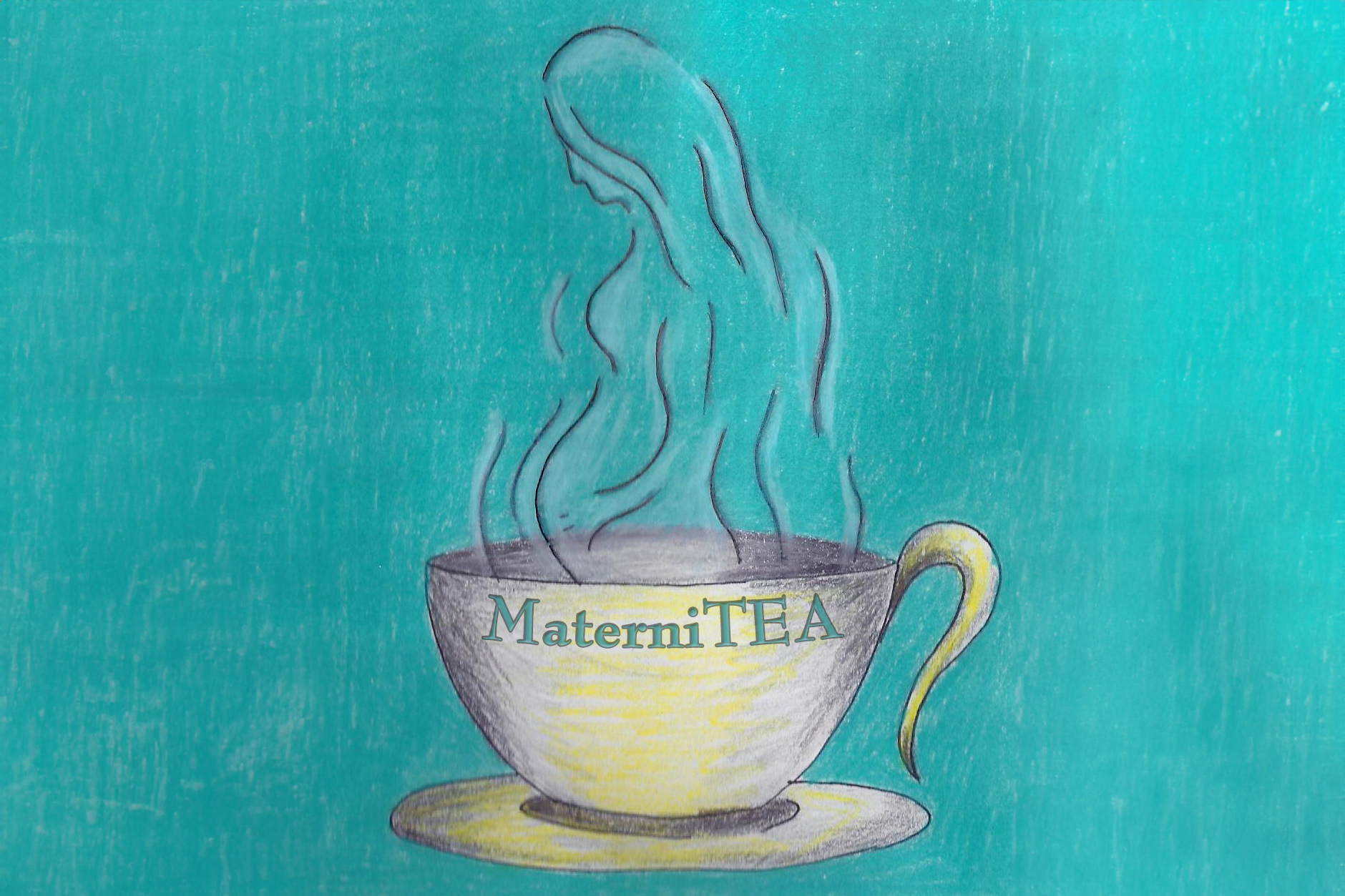
This logo was drawn by the lovely and talented Suzanna Bailey.In keeping with the philosophy I described in the last tea label post, I didn’t give Suzanna any specific instructions. I just described the tea and threw out a few adjectives like “soothing” and “relaxing,” and got out of her way. She came back with several pages of ideas and sketches, and one of them really caught my eye. My wife, Kathy, and I absolutely loved the look of the steam rising from a teacup in the shape of a pregnant woman.
Suzanna has an amazing eye for color, so she did all of the drawing and the coloring for this one—she just asked if I could fill in the lettering. Once again I am thrilled with the results and we’re having posters made of all of our custom tea logos.
Thank you, Suzanna!

Yet another new logo: Mr. Excellent’s Post-Apocalyptic Earl Grey

Such a delay! It was about eight months ago that I came up with the Mr. Excellent’s Post-Apocalyptic Earl Grey Tea blend (see my blog post about it here), and we finally have a logo for it! This one was drawn by my daughter’s friend from college, Brandon Pope.
I’ve found that logo art comes out better if I don’t tell the artist what I want, so I gave Brandon little more information than the name of the tea and what it is (an Earl Grey lapsang souchong). If I could draw, I probably would have done something with a dude sitting in the middle of a burned-out town, his shotgun at his side, drinking a cup of tea as the zombies eye him from a distance. In other words, something way too complex to use as a logo.
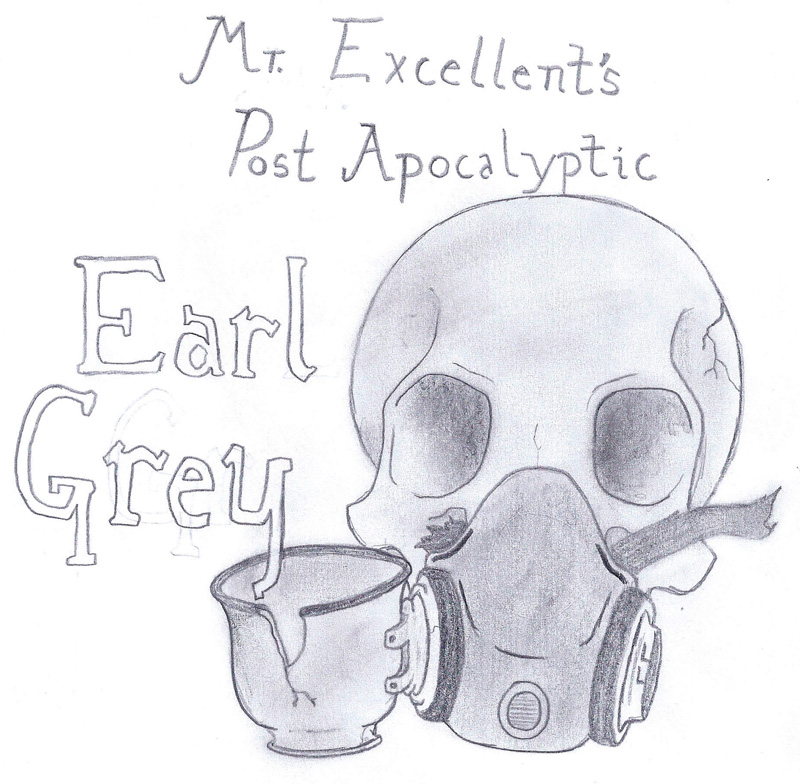
Brandon came up with the skull and gas mask, with one of the air filters replaced by a teacup. Very simple, yet immediately recognizable. His original was a hand-lettered pencil sketch (see below), which I needed to colorize. Brandon’s shading was great, especially where the texture of the paper showed, so I just added solid blocks of color behind the skull, mask, and teacup.
I really, really wanted to put this one on a black background, and I just couldn’t seem to make that work using his text. I re-did the text using a fun font called “Disgusting Behavior,” stretched vertically to achieve the look and aspect ratio that I was after. A blood-red color for the text with a subtle glow and an emboss effect finished it off perfectly.
For comparison, here is Brandon’s original pencil sketch (below) and the final logo (above). You can click on the final logo for a larger image.
This whole program of guest artists for tea logos (kicked off by Al Jones and his Hammer & Cremesickle logo) has been a blast. Thank you very much to Brandon for the artwork, and watch this space for guest logos by husband and wife team Doug and Suzanna Bailey, coming up soon.
Lady Greystoke

Enid Markey, the first actress to bring Jane Porter to life in film. Jane married Tarzan in the book, "The Return of Tarzan," becoming Lady Jane Greystoke.
As I mentioned a couple of days ago, we decided to rename our Lady Grey tea. I put the word out to friends on all of the social media, and a former fellow moderator at the Straight Dope Message Boards who goes by the moniker of “Czarcasm” came up with the winning suggestion: Lady Greystoke.
Since the tea bar is a part of Red Lodge Books, we liked the literary connection behind Lady Greystoke: In Edgar Rice Burroughs’ Tarzan books, Jane Porter was the love interest. Tarzan himself was John Clayton, Earl Greystoke, so when he married Jane in the second book of the series (The Return of Tarzan), she became Lady Greystoke.
We had many other great suggestions — and quite a few silly ones — but none caught our attention quite like this one. We just may use several of those other names for other blends in the future, so we appreciate everyone who took the time to make suggestions.
The most common suggestion, interestingly, was to call the tea Jane Grey. Lady Jane Grey, also known as The Nine Days’ Queen, was the great-granddaughter of Henry VII. She ruled as de facto Queen of England for nine days in 1553, and was later executed for high treason. Since Lady Greystoke was also a Jane, we liked this connection, too.
In celebration, I shall be enjoying a mug of Lady Greystoke tea tomorrow morning at the tea bar. Everyone’s invited to come in and join me!
Lady Grey
 Today was tea blending day at the tea bar, as I mixed up new batches of our house blends. As I was working on our Lady Grey, I got to thinking about how incredibly different Lady Grey teas are from one company to the next, and decided to do a bit of reading on the subject.
It didn’t take long to find a comment that “Lady Grey” is a registered trademark of R. Twining and Company in the U.S. and U.K. (here’s a link to the trademark search on Trademarkia that shows it renewed in March of 2006). This hasn’t stopped quite a few companies from producing their own variations, like Jasmine Pearl (theirs has orange zest and lemon myrtle, but no bergamot!), SereneTeaz (an Earl Grey with lavender), American Tea Room (they don’t have a full ingredient list, but it includes cornflower petals), and Tea Embassy (another Earl Grey with lavender).
Should I follow their lead and continue calling my blend Lady Grey? Nah. I have better things to do with my time and money than fight legal battles. I’ll do the right thing and follow the example of Marks & Spencer (they call theirs Empress Grey) and Trader Joe’s (Duchess Grey).


Twinings originally named their Lady Grey tea for Mary Elizabeth Grey. Their Earl Grey tea (which they changed last year) was named for her husband, Charles, who was the second Earl Grey. Twinings uses less bergamot in their Lady Grey than they do in Earl Grey, but they add other citrus and some cornflower.
I’ve never understood the rationale of “clone blends.” My “Lady Grey” isn’t the same as anyone else’s. If it was, I’d just buy theirs. I want something different. Mine is an organic blend, using Chinese black tea, oil of bergamot, wild Tibetan lavender, a little bit of vanilla, and a touch of rooibos.
What to call it? The one consistent thing about all of our other Earl Grey teas is the word “Earl.” Earl Green (green tea + bergamot), Earl Red (rooibos + bergamot), and all of the blends that use the full “Earl Grey” moniker, like Mr. Excellent’s Post-Apocalyptic Earl Grey and Cream Earl Grey. The name “Lady Grey” keeps the “Grey” instead of the “Earl,” but is still connected.
So I have done what I often do in such situations: turn the question over to my friends, colleagues, and acquaintances. I’ve asked Facebook and the Twitterverse for suggestions, and I’m starting a thread on my favorite message board (the Straight Dope). When we decide on a new name, you’ll read about it here first!
Another new logo: Honey Mint Tea
 Back in October, my friend Al drew a logo for our Hammer & Cremesickle Red Tea blend. Today, he put his artistic talent back to work and came up with another logo for the Tea Bar. This time, it was for my caffeine-free “Honey Mint” blend.
I developed this blend a few months ago when some customers had expressed an interest in a caffeine-free version of our Moroccan Mint tea. Not being a fan of decaffeinated teas, I went for a naturally caffeine-free base instead. I wanted it to be a little bit sweet, so I used honeybush as the base tea, and blended that with organic peppermint from Washington state. A little bit of licorice root for the aftertaste finishes off this sleepytime mint tea blend.
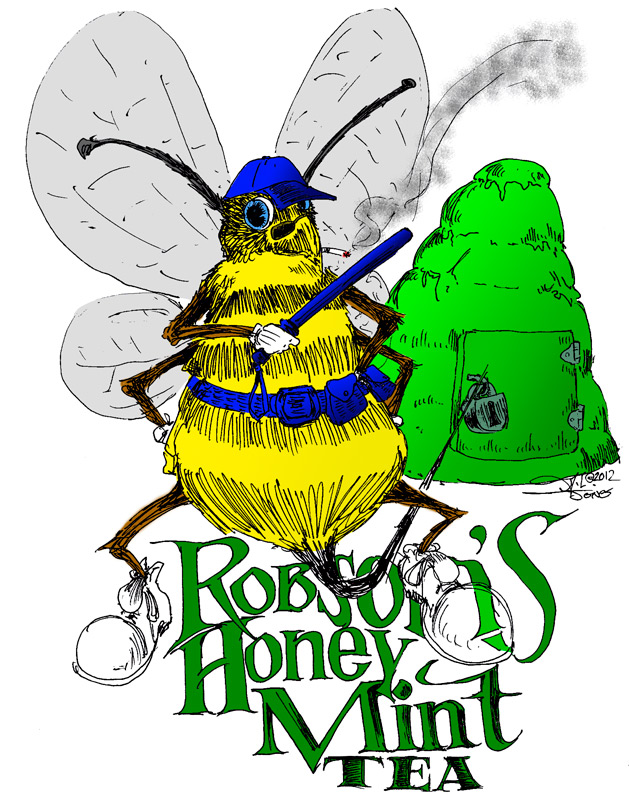
Al has a rather strange sense of humor (that’s why we get along, of course), and I gave him no guidelines at all on the logo. He set to work developing a logo based on a pun.
When I called the blend “Honey Mint,” I was referring to honeybush and peppermint. Al went after another meaning of mint, as in the United States mint. He drew a bee guarding a mint (a locked up hive full of peppermint and honey). Pretty tough-looking bee, too, with his cigarette, truncheon, and shades. The original drawing (see below) was just done with a pen and some printer paper. I scanned it in and colorized it using Photoshop. Hopefully, my colors fit Al’s original concept. I always feel strange about colorizing other people’s artwork — I’m afraid I’ll screw it up.
Another artist friend is currently working on a logo for Mr. Excellent’s Post-Apocalyptic Earl Grey, and we hope to find people to do my other house blends (Lady Grey and MaterniTea). As always, watch here for news.

Al’s original artwork for “Robson’s Honey Mint Tea.”

Free mystery tea (Tieguanyin)!

A friend of mine stopped by the tea bar the other day. Unlike most tea bar visits from friends, Wanda brought tea in with her. It was a bag of tea from China that a friend had given her. She didn’t know what it was, and she’d had it for five years, so she asked if I’d like to have it.

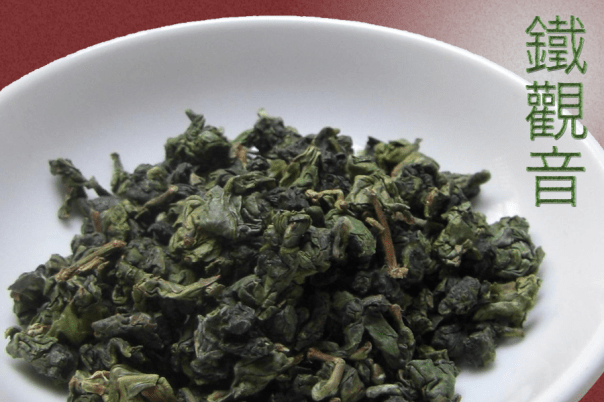
I cut the bag open and poured out a bit of the tea. It was full rolled leaves; not rolled tightly into balls like Dragon Tears or gunpowder tea, but pretty dense nonetheless. The leaves were hard; dropping them into bowl made a pinging sound. The color was a bit darker than a typical green tea, and the smell reminded me of the Huang Jin Gui oolong we carry at the tea bar.
I brewed a cup, using a bit more tea than I usually would because of the age, and decided it was definitely a oolong, but I couldn’t quite identify it. Good packaging, by the way. Five years old, and it still tasted good.
Here’s where Facebook comes in handy. I took a picture of the large print on the top of the bag (the photo that’s now on this page), posted it on Facebook, and asked if anyone could identify it. Within about 20 minutes, I had my answer: Iron Goddess of Mercy, a lightly oxidized oolong with a unique aroma. After enjoying it for a few days, I started hunting for a good one to carry at the tea bar, and I’m excited to have a fresh batch coming in next week. Given how good the five-year-old stuff at home is, I have a feeling I’m really going to love the fresh tea.
Update 2014: Iron Goddess has indeed become one of my favorite teas, and was one of the most popular teas in the tea shop.
Iron Goddess of Mercy (called “tieguanyin” in Chinese) originated in Anxi, in the Fujian province of China. Today, it is produced in quite a few other areas of China and Taiway. The one we sell at our tea bar is a medium-roasted variety from Nantou, Taiwan. I’ve used the leaves for three infusions without loss of flavor, and I’ve been told they’re good for as many as seven.
The processing of tieguanyin is complex. Traditionally, it follows these steps:
- Picking – usually done early in the day when it is sunny
- Sun drying (“withering”) – Done before sunset the same day as the picking
- Cooling (“cool green”) – Done overnight, along with the tossing
- Tossing (“shake green”)
- Withering/partial oxidation – Done the day after picking
- Fixing
- Rolling/kneading
- Drying
- Roasting

There are several conflicting legends regarding the origin of Iron Goddess of Mercy, all recounted on the Chinese Tea Culture site. Personally, I much prefer the Wei Yin legend. I don’t know that it has any more veracity, but it’s a better story. That’s the one I used as the basis for my version of the Iron Goddess story, told in my book, Myths & Legends of Tea, volume 1.
Oolong-related articles on Tea With Gary
-

The Iron Goddess of Mercy – Part 1
The Iron Goddess of Mercy Part 1 — China, 1761 — It was the reign of the Qianlong Emperor, the sixth emperor of the Qing Dynasty in China, but our story concerns no emperors, warlords, or nobles. It is just a tale of a humble farmer by the name of…
-

The Iron Goddess of Mercy – Part 2
The Iron Goddess of Mercy Part 2 — China, 1761 — It was the reign of the Qianlong Emperor, the sixth emperor of the Qing Dynasty in China, but our story concerns no emperors, warlords, or nobles. It is just a tale of a humble farmer by the name of…
-

Canon cameras and oolong tea
Why should you drink oolong tea when you’re taking pictures with a Canon camera? Let me explain…
-
The Oolongs of Taiwan: Stop 6 on the World Tea Tasting Tour
Taiwan may not have originated oolong tea, but it is definitely at the forefront of oolongs today. At this stop on the tea tour, attendees learned about what oolong tea actually is, and tasted a variety of Taiwanese oolongs, including Bao Zhong, White Tip Bai Hao, and of course Tieguanyin,…
-
Free mystery tea (Tieguanyin)!
A friend stopped by the tea bar the other day and brought a bag of tea from China that a friend had given her. She didn’t know what it was, and she’d had it for five years, so she asked if I’d like to have it.
 Tea With Gary