Blog Archives

The Iron Goddess of Mercy – Part 1
This is one of the stories from my book, Myths & Legends of Tea Volume 1. I will post the conclusion tomorrow [Update: here it is]. In the book, each story is followed by notes about the tea and how to prepare it. I hope you enjoy the stories!

To read more about Myths & Legends of Tea, download a sample chapter, or buy a copy (paperback, Kindle, or Apple iBook), please visit the main book page!
The Iron Goddess of Mercy
China, 1761
It was the reign of the Qianlong Emperor, the sixth emperor of the Qing Dynasty in China, but our story concerns no emperors, warlords, or nobles. It is just a tale of a humble farmer by the name of Wei.
Wei lived in Anxi Country in the Chinese province of Fujian. People there were struggling with hard times. Fujian, they say, is eight parts mountain, one part water, and one part farmland. Wei’s tiny village was no exception. He and his neighbors grew what they could. A bit of wheat, a bit of rice, and a few sweet potatoes were enough for most of them to get by.
Their favorite crop was tea. They worked hard to produce good tea, using the complex oolong production style. Their process wasn’t bad but the result was usually mediocre, as it came from poor stock.
“Oh, well,” they used to say. “You can’t get silk from an earthworm.”
Each week, Wei would go to market in the city. Each week, he passed an old temple that had fallen into disrepair. The pathway was overgrown, the gates had fallen, and it appeared that nobody had worshipped there in a very long time. It was such a part of the scenery that Wei walked by it without even seeing it.
Like the rest of his village, Wei was a Buddhist. It’s difficult to describe how Buddhism works to Westerners like us, as the Buddha himself isn’t considered a god but an enlightened being. What we often refer to as gods and goddesses in Buddhism, actual Buddhists would call bodhisattvas. The temple Wei passed each week was built for the Bodhisattva Guanyin, whom you or I might call the Goddess of Mercy.
One particular day – a day that would become a major turning point for Wei, Wei’s village, and lovers of tea everywhere – Wei stopped on the road to rest. Not that stopping on the road was an unusual occurrence. The trip was long and Wei was not as young as he used to be. On this very notable day, however, he stopped right at the pathway to the temple of Guanyin.
After Wei set down his heavy load, he pushed back his hat and wiped the sweat from his forehead. What used to be the temple’s garden was surrounded by a small rock wall, more decorative than functional. It would do no good at keeping out deer or rodents, and in its current tumbledown state, even a rabbit could hop right through in several places.
Once, the flowers and cherry trees of the garden had been carefully-tended, but that was long ago. The undergrowth almost completely obscured the path, bushes had grown tall and scraggly, and the unpruned cherry trees blocked the sun to the flowers. At least, he thought, the wall provides a place to sit and the trees give me shade.
He looked down the pathway, wiped his sleeve across his forehead again, and thought about the temple.
Guanyin is the Goddess of Mercy, he thought. Okay, perhaps he called her a bodhisattva rather than a goddess, but he was, after all, Chinese, and neither goddess nor bodhisattva is a Chinese word, so I shall use the more familiar word in my telling of Wei’s story.
It is not seemly that we should treat Guanyin’s temple with such disrespect, he continued to himself. We should show … well … mercy.
He picked up his wares and continued to market, but his moment of epiphany (or dare I say, enlightenment?) stuck with him throughout the day. The following week, he brought some old gardening tools with him and stashed them beside the pathway on his way to market. He hurried through the selling of what little he had to sell and the buying of what little he could afford to buy, and then he headed home.
When Wei reached the temple, he retrieved his tools and began clearing the path. Carefully, he pruned back the bushes that encroached on the pathway. Thoughtfully, he trimmed the tree branches that overhung the walk. Delicately, he pulled the weeds from the path itself. Soon, the sky began to redden as the sun fell in the west, and he secured his tools behind the rock wall and went home, a bit disappointed that he had cleared only the beginning of the path.
Over the following weeks, Wei repeated the process. Sometimes he would clear the plants. Sometimes he would fix the flat rocks and fill in gaps to smooth the path. Sometimes he would leave the path alone for an evening and work on the wall. He made a special trip with a friend from the village to fix the gate.
This continued until the path was clear all the way to the temple entrance. Pleased with his progress, he lit a candle and stepped into the temple itself.
The sorry state of the exterior was nothing compared to the disrepair of the inside. Webs occupied the corners of the room, and spiders occupied the webs. Dust was everywhere. The offering bowl was reduced to ragged shards, and vines crept in the windows. A mouse skittered across the floor, and a snake watched hungrily from behind the altar. But Wei noticed none of it. All of his attention was drawn to the statue of Guanyin.
There she sat! The center of the temple was dominated by the statue of a beautiful maiden meditating. In her lap she held a fish basket. Although the statue was dirty and old, it was unbroken and the fine details of her necklace and her Tang Dynasty clothing were clear. Wei thought he could see sadness on that lovely face, and it nearly broke his heart.
He stood staring at Guanyin for many minutes, finally breaking his reverie to look about the room. To one side was a painting of Guanyin with a child on each side and a white parrot above. A beetle crawled across the frame. Even the painting looked sad, he thought.
Wei was touched by the experience and vowed that he would get rid of that melancholy look. He continued coming back each week on his way home from market. On one visit, he brought a stick long enough to take down the spider webs. Of course, he carefully took the spiders outside without harming them. Guanyin is, after all, the Goddess of Mercy.
The next week, he brought a broom and swept out the temple. The next, he delicately dusted the statue itself. He found the nest the mice had built and moved it outside. The snake, he scooted out the door with the broom. This had to be repeated several times as snakes can be stubborn once they’ve chosen a home.
The next time he stopped at the temple, he looked at the shattered bowl in front of Guanyin’s statue. He carefully gathered the pieces of the broken offering bowl in the sleeve of his robe and took them home. He set the pieces on his table and studied them. Wei was a simple farmer. He didn’t have the skills to repair the bowl. But perhaps he knew someone who did.
Wei once again gathered up the bowl fragments and carried them to the home of his good friend Wang, the potter. Wang invited Wei into his home and went immediately to the teapot. After all, when a friend visits, it is important to serve them tea.
As the water heated, Wei began to tell Wang about the temple. Wang listened as he carefully measured out the leaves. At first, the tale did not interest him much, for China is filled with old temples and roadside altars. Some are well-kept. Some are not.
As large bubbles began to form and rise through the water (the Chinese people call this stage “fish eyes”), Wang put the tea on to steep. When Wei started to tell him about the offering bowl Wang’s ears perked up.
“I do not know how to fix the bowl,” Wei told him, “and I do not have the money to buy one.”
“Let me look,” Wang said, and Wei spread out the pieces before him. Wang became so engrossed in studying the broken bowl that he almost forgot to pour the tea. He was so distracted that he hardly noticed the muddy flavor and the bitterness of their tea. When you can rarely afford to buy good tea, you soon become accustomed to poor tea.
“Can you repair this,” Wei asked anxiously, “or perhaps make another one like it?”
“Where will you get the money to pay for it?” Wang responded. “I am very busy and must make many bowls to sell so that I can feed my family. And Guanyin’s temple is your project, not mine.”
“You are my friend, Wang. When you were sick last summer, who brought tea and rice for you and your wife? When the monsoon rains came early two seasons ago, who helped you to make a ditch to drain your wheat field and irrigate your rice properly?”
“You are right, Wei. I am sorry. Friends help their friends. I shall make you a proper bowl. I cannot do it today, and maybe not for a couple of weeks, but I will make a bowl that you will be proud to give to Guanyin.”
And so things went. Wei replaced the offering bowl with the one that Wang made him. He pruned the trees. He found an inexpensive incense burner and set it in a nook on the wall. He took a pitcher of water and washed the statue. He kept the pathway clear. He even planted some flowers. And every week he lit incense and meditated before he left.
Tune in tomorrow for the conclusion to Wei’s story!
Oolong-related articles on Tea With Gary
-

The Iron Goddess of Mercy – Part 1
The Iron Goddess of Mercy Part 1 — China, 1761 — It was the reign of the Qianlong Emperor, the sixth emperor of the Qing Dynasty in China, but our story concerns no emperors, warlords, or nobles. It is just a tale of a humble farmer by the name of…
-

The Iron Goddess of Mercy – Part 2
The Iron Goddess of Mercy Part 2 — China, 1761 — It was the reign of the Qianlong Emperor, the sixth emperor of the Qing Dynasty in China, but our story concerns no emperors, warlords, or nobles. It is just a tale of a humble farmer by the name of…
-

Canon cameras and oolong tea
Why should you drink oolong tea when you’re taking pictures with a Canon camera? Let me explain…
-
The Oolongs of Taiwan: Stop 6 on the World Tea Tasting Tour
Taiwan may not have originated oolong tea, but it is definitely at the forefront of oolongs today. At this stop on the tea tour, attendees learned about what oolong tea actually is, and tasted a variety of Taiwanese oolongs, including Bao Zhong, White Tip Bai Hao, and of course Tieguanyin,…
-
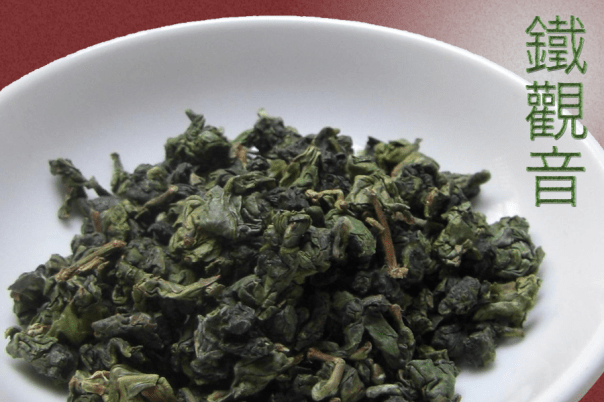
Free mystery tea (Tieguanyin)!
A friend stopped by the tea bar the other day and brought a bag of tea from China that a friend had given her. She didn’t know what it was, and she’d had it for five years, so she asked if I’d like to have it.

The Iron Goddess of Mercy – Part 2
This is the continuation of yesterday’s post, which is one of the stories from my book, Myths & Legends of Tea Volume 1. In the book, each story is followed by notes about the tea and how to prepare it. I hope you enjoy the stories!
In our story so far, a farmer named Wei has discovered an abandoned temple to Guanyin, the Goddess of Mercy, and worked tirelessly to restore it to its former beauty.

To read more about Myths & Legends of Tea, download a sample chapter, or buy a copy (paperback, Kindle, or Apple iBook), please visit the main book page!
The Iron Goddess of Mercy
China, 1761
One day, Wei walked into the temple and realized he had done everything he could do. All of the little things were repaired. Everything was clean. The incense was burning and someone – he did not know who – had placed an offering in the bowl. He looked at the statue of Guanyin and thought he detected a trace of a smile. Just a tiny bit. Just at the corner of her mouth. But he didn’t see the sadness he had seen before.
There may actually have been a hint of smile on the statue’s face, or Wei may have been imagining it. It really didn’t matter, though. It brought a real smile to Wei’s face. There’s a special kind of happiness we get from doing things for others, things that bring us no personal benefit. That is what Wei felt as he walked home that afternoon.
That night, as Wei slept, he had a vivid dream. Not like our normal dreams, where things have soft edges and little detail and we forget them as soon as we wake. This dream was crystal clear, and felt like he was actually experiencing it.
Wei stood on the shore of an ocean where a mighty storm was raging. He was on a rock looking down at the powerful waves crashing against the shore. The wind whipped the spray into his face and threatened to knock him from his precarious perch. Although it was daytime, the dark clouds above hid the sun from him, making everything look like it was drawn in charcoal.
He seemed to actually feel the sea water on his skin, hear the howl of the wind and the roar of the surf, smell the salt in the air. Never had he experienced a dream with such clarity, and it made him nervous.
He fell to one knee and braced himself against the wind so that it wouldn’t sweep him into the surf booming against the sharp outcroppings below him. As he knelt there, the clouds parted far out over the water and he saw a beam of sunshine fight its way through. Where it hit the water, the head of an enormous sea dragon breached the surface of the sea, and the furious storm-whipped waves began to calm around its mighty neck. As more of the dragon crested, Wei saw someone standing on its back, wearing flowing white robes.
As the dragon approached, the calm water and the beam of light came with it. Soon, Wei could make out the woman riding upon the dragon. It was Guanyin, carrying a willow branch in her right hand and a jar of clear water in her left. Although water coursed from the back of the sea dragon, Guanyin’s hair and robes were dry. On her face was an expression so serene, so calm, that Wei did not fear the monstrous beast that towered high over the shore. Guanyin stood effortlessly, her dry feet showing no signs of slipping on the wet scales of the dragon’s back.
When the dragon approached his rock, Wei was encompassed by the beam of light. The crashing of the waves ceased and the world around him suddenly felt like it was painted in delicate watercolor. Tranquility settled over him, and he rose to his feet to find himself looking into the eyes of Guanyin. He fell back to his knees and bowed his head.
“Rise,” she told him. He stood awkwardly, intimidated by her presence and the head of the dragon looming over him, water dripping from the barbels alongside the fearsome mouth.
She studied him for a long moment before she spoke. He kept his head down, but could not stop himself from looking at her.
“You are a good man, Wei,” she said. “You have worked long and hard to restore my temple, and you have shown me great respect. What would you ask from me as a reward?”
He responded without stopping to think. “I did what I did because it needed to be done. I did not fix your temple because I sought reward. I fixed it because it was the right thing to do.”
“I know that,” the goddess responded. For the first time, Wei saw a smile on her face, and it brought such joy to his heart that he almost interrupted her. Luckily, he held back, for it is not wise to interrupt the gods. But what reward could compare with bringing a smile to the face of the Goddess of Mercy? No man could ask for more.
“Had you done this for a reward,” she continued, “I would not be inclined to give you one. But your motives are pure and enlightened. Kindness deserves kindness, and for that reason, I shall reward you.
“You did not select a gift, so I have selected one for you. You shall find it behind the temple, shadowed by the large bear-shaped rock. It holds the key to your future and your village’s future, so treat it with care and respect.”
He bowed his head again as the dragon pulled back from the rock upon which he stood. The clouds dissipated from the sky, and the sea became smooth as glass. A single yellow butterfly danced before him as the dragon swam away, gradually disappearing under the water.
Wei stood on the rock, overcome with joy. Slowly, the vision faded and he settled into a deep dreamless sleep.
When Wei awoke in the morning, he lay quietly in his bed, serene and rested. Then the dream came back to him. He leapt out of bed and rushed through his morning routine. He felt no hunger, and took only a moment to eat a half-bowl of rice, barely tasting it as he ate.
He rushed to the temple. How different it looked! The stone wall looked sturdy and solid. Flowers were beginning to bloom in the rays of sunlight that streamed through the neatly-pruned cherry trees, which were showing signs of blooming themselves. The entrance to the temple was inviting, clean, tidy.
Without even pausing to enter the temple and light incense, Wei stepped from the path and circled around behind. He hadn’t ventured here before. It was still wild. A rivulet of water burbled happily down the steep slope, and only a small area was flat and level. In that small area stood the bear-shaped rock that Guanyin had referred to, taller than Wei himself.
He looked eagerly in the rock’s shadow, not knowing what to expect, and saw nothing but dirt, rocks, and a pathetic little sprig of a plant.
I see nothing, he thought. My treasure must be buried.
But as Wei kneeled to start digging, something about the sapling caught his eye. The deep green of the leaves and their slightly jagged edges looked familiar. It was a tea plant! Small, undernourished, with only a few leaves, but a tea plant nonetheless. He dug it up and carefully transplanted it into his garden at home.
For days and weeks, he watered it, tended it, fertilized it, all the while not quite sure if this tiny plant was really his reward from the goddess. The scraggly plant grew quickly into a thick healthy bush. The trunk grew strong and thick; the leaves glossy and bright. He picked a leaf and crushed it between his fingers. The aroma was strong and sweet. It was time.
Carefully, he selected a handful of delicate new buds and the young leaves next to them. He laid them out in the sun to wither, and went to tell his friend Wang about his prize. Wang came back to see the tea bush, and they took the leaves into the house to cool.
“Should I go to the city and find a tea master to help me prepare this properly?” Wei asked his friend.
“No,” said Wang. “Guanyin gave you this tea plant. Meditate as the leaves cool. Clear your mind, and then follow your instincts.”
And so he did. He followed the same process that he always used with the scruffy tea plants that he and his neighbors grew. Tossing, a bit of oxidizing, fixing; he dedicated the next day to working with his prized leaves.
He rolled the leaves as oolong tea makers did – and still do. Not being very skilled at it, he ended up not with neat little balls, but with little curled-up tadpole shapes, which he roasted very lightly. Over the next two days, they dried hard as he looked on impatiently. At last, the leaves appeared ready.
Excited, Wei fetched one of his most prized possessions: a beautiful black iron teapot. He took a small scoop of the leaves and dropped them into the teapot and they made sharp “ping” sounds, almost like iron pieces tumbling into the iron pot. He rushed to get Wang and some of his neighbors. They looked at him dubiously as he chattered on about the visit from Guanyin in his dream. They passed around one of his dried leaves and looked it over uncertainly.
Then he poured the hot water over the leaves in his teapot, and the aroma of the tea struck them. They rushed in to look, to smell, and – when the tea was finished steeping – to taste.
The tea was magical. It had a rich amber color and a bold taste with overtones of honey and spice. They held the liquid in their mouths and it felt smooth and light. The taste lingered long after the tea was swallowed, and it brought what could only be called an energizing calm to the villagers. All of the tea they had ever produced before suddenly seemed inadequate and drab.
Because of the hard dried leaves and their ringing sound when dropped on iron or steel, Wei called the tea tieguanyin, which we translate today as Iron Goddess of Mercy.
As Wei’s tea bush flourished, he took cuttings for his neighbors, his friends, and his own farm. All of the other tea plants in the village were slowly replaced, and he taught everyone in the village how to produce his special tea. Soon there was enough tieguanyin to take to market, and the reputation of the tea spread like fire.
The poor village prospered and expanded, but Wei was always there to remind them to take time for Guanyin’s temple. Together, they expanded the garden around the temple, lovingly planted with the most beautiful and fragrant flowers, the most luscious fruits, and of course, the goddess’ own tea bushes.
They sculpted a streambed for the water flowing down the slopes behind the temple. They directed the water around the bear-shaped rock and past the temple to the front, where the garden filled with the tinkling sound of water over rocks, and made a pool in front, which they filled with koi and lilies. In that magic way that ponds have, it filled itself with frogs, who added their music to the sound of the stream.
Drinking a cup of tieguanyin there made the garden seem brighter and the tea taste better. Life was not always easy in the village, but it was never as hard as it had been before Wei began his work on Guanyin’s temple.
Does that temple still stand? I don’t know. If so, I think you’ll agree that the statue of Guanyin upon that alter must now be smiling as tea lovers the world over enjoy the rich ambrosia that we call tieguanyin.
Oolong-related articles on Tea With Gary
-
The Iron Goddess of Mercy – Part 1
The Iron Goddess of Mercy Part 1 — China, 1761 — It was the reign of the Qianlong Emperor, the sixth emperor of the Qing Dynasty in China, but our story concerns no emperors, warlords, or nobles. It is just a tale of a humble farmer by the name of…
-
The Iron Goddess of Mercy – Part 2
The Iron Goddess of Mercy Part 2 — China, 1761 — It was the reign of the Qianlong Emperor, the sixth emperor of the Qing Dynasty in China, but our story concerns no emperors, warlords, or nobles. It is just a tale of a humble farmer by the name of…
-
Canon cameras and oolong tea
Why should you drink oolong tea when you’re taking pictures with a Canon camera? Let me explain…
-
The Oolongs of Taiwan: Stop 6 on the World Tea Tasting Tour
Taiwan may not have originated oolong tea, but it is definitely at the forefront of oolongs today. At this stop on the tea tour, attendees learned about what oolong tea actually is, and tasted a variety of Taiwanese oolongs, including Bao Zhong, White Tip Bai Hao, and of course Tieguanyin,…
-
Free mystery tea (Tieguanyin)!
A friend stopped by the tea bar the other day and brought a bag of tea from China that a friend had given her. She didn’t know what it was, and she’d had it for five years, so she asked if I’d like to have it.

Jasmine Tea

Even purists who eschew “flavored” teas will often enjoy a cup of jasmine green tea. Perhaps it is because when you look at the loose tea, all you see is tea leaves; there are no visible indications that your tea leaves have been adulterated in any way. Perhaps it is because the affect of the jasmine in a well-made jasmine tea is delicate and subtle. Perhaps it is the rich history of jasmine teas.
Jasmine first made its way to China from Persia (now known as Iran) over 1,700 years ago, and it took hundreds of years before it was used to scent tea. Even then, it spread quite slowly, and it wasn’t until the Qing Dynasty, which began in 1644, that it became widespread.
The making of jasmine tea is quite different from typical flavored teas. Most flavored teas are either blends, where dry ingredients are mixed together, or tea leaves sprayed with flavor extracts, like Earl Grey with its bergamot oil. Jasmine tea, on the other hand, is scented rather than flavored.
In the traditional process, jasmine flowers are picked early in the morning, when the blossoms are still tightly rolled. Trays of processed and dried tea leaves (usually, but not always, green tea) are stacked in alternation with trays of jasmine. The trays have woven mesh or screens as bottoms, so as the jasmine blossoms open up and release their scent, it travels freely into the tea leaves over the course of about four hours.
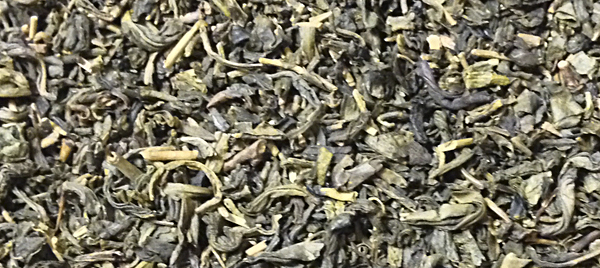
The tea leaves pick up moisture from the flowers along with the jasmine scent, so they have to be re-dried before they can be packaged. In the finest quality jasmine teas, this scenting process may be repeated half a dozen times or more. The finished tea has no jasmine blossoms in it — only the scent that has transferred.
How you prepare a cup of jasmine tea depends on the base tea used. If it is made form a green tea, as most of them are, then you’ll want to use 175-185°F (80-85°C) water, and steep for three minutes or less. Using boiling water is a quick way to ruin a good cup of jasmine tea — or any other green tea, for that matter — by bringing out unwanted bitterness.
Grades of jasmine tea vary with the quality of the tea and the process used. One of the popular higher-end styles involves tea leaves that are tightly rolled, often known as “jasmine pearls.”
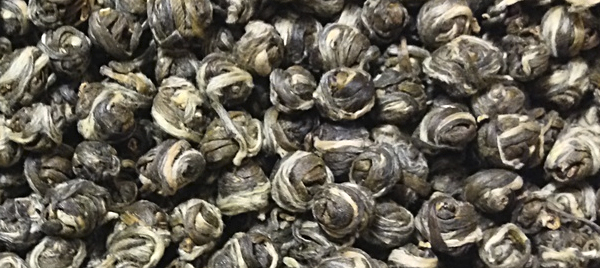
When drinking jasmine pearls, seven balls are placed in a small cup. Seven is considered good luck, so with jasmine pearls you don’t weigh them out or measure them in a tablespoon. Each rolled ball contains two leaves attached to a bud, which will slowly unfurl when the hot water is added.
Unlike most loose tea, jasmine pearls are infused right in the cup with no screens or filters, and you don’t remove them before drinking. The unbroken leaves assure that if you sip carefully, you won’t get a mouthful of leaf. If you’re drinking jasmine pearls with friends, the host should make sure that there’s always more hot water available to keep refilling the cups.
Jasmine blossoms certainly aren’t the only flowers used to scent tea — I’ve written about Vietnamese Lotus Tea, for example — but jasmine is definitely the best-known and most popular.

Tea plants as props? Thanks, #TeaAcrossAmerica!
When we first joined #TeaAcrossAmerica, I had visions of a big bushy tea plant in the front window at the shop. I still think we can build a neat window display around it at some point. When our tea plant, Tea H. White, arrived, the temperature outside was well below zero Fahrenheit. Even the windowsill seemed awfully cold for a little cutting that had just been shipped halfway across the country. So we set him on the tea bar instead.

Tea H. White today, about two months after his arrival in Montana.
Tea H. started out as a decoration and a passive tool for raising awareness of American-grown tea. Every now and then, I’d point at him and say, “that’s a tea plant.” Perhaps I’d explain what the significance is of Camellia sinensis and talk about Tea Across America. Perhaps not. But that slowly began to change.
I found myself saying things like, “we could make black tea, white tea, green tea, oolong, and pu-erh, all from this plant here.” I was pointing at the plant a lot.
Then it got more specific. I’d point at the bud and leaf at the end of a branch and say, “this right here is where the plant concentrates its caffeine.” I’d point at a smaller, brighter-colored leaf and say, “this leaf would find its way into something like this oolong tea we’re drinking, but this big leaf down the stem would probably be broken into dust and stuffed in a Lipton teabag.”
In the last week, I’ve referred to little Tea H. White every day.
I brewed up some taiguanyin, and showed a customer the dried, rolled-up, tadpole-shaped leaves. Then I pulled an unraveled leaf from the infuser and held it next to a similar-sized leaf on the tea plant to show that it really is a whole tea leaf.
I showed someone the soil in the plant’s pot and explained that Camellia sinensis can grow on steep hillsides at high altitudes where other crops can’t thrive, and talked about what that’s done for the economy in places like Kenya’s Rift Valley.
I was talking about the ancient tea forests near Mannong and Manmai in the Yunnan province of China, and I walked over to Tea H. White and said, “little tea plants like this one can grow into 30-foot trees and live for a thousand years or more.”
Just today, someone asked what variety of tea Orange Pekoe is. I started to explain that it’s not a variety, it’s a grade. Then I went over to the tea plant and showed them what a pekoe is.
My tea plant has become an educational tool.
As I’ve said many times before, the primary job of a tea vendor today is education. Learn everything you can about tea, and then pass it on to your customers. It pays back in spades when you can find the perfect tea for somebody and they turn into a tea fan (and a loyal customer)! I live for the aha moment, when somebody really “gets” what tea is all about. Having a real, live tea plant sitting on the tea bar makes for more of those moments.
Someday, that plant will grow into a tea bush, and we’re going to produce a batch of tea from it. Between now and then, however, the plant will help to educate hundreds of people about the world of tea.
Champagne, Tequila, Darjeeling, and Dark Tea
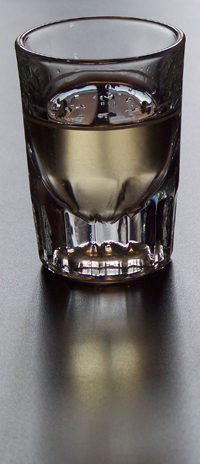
If you make a carbonated white wine, it’s called a “sparkling wine,” unless you are producing it in the Champagne region of France. Then, and only then, should it be called Champagne. I say “should” because there are a number of countries that didn’t sign (or don’t honor) the treaties involved, but that’s a whole different blog post.
The same applies to beverages made from distilling blue agave cactus. If you are in the Mexican state of Jalisco, or designated portions of certain other states, you may call that beverage Tequila. Otherwise, you have made mezcal.
The theory behind these distinctions is not so much the strict corporate trademark enforcement that governs most usage of names in the U.S. It is more a question of terroir. If you were to take two cuttings from the same grape vine and plant one in Napa Valley, California and the other in the Rhine Valley of Germany, you would get different wines from the two vines. Terroir describes the effect that the soil, weather, drainage, and related geographical factors have on the resulting taste of the beverage, whether it be wine or tea.
Darjeeling tea is often called the Champagne of tea (this appellation is usually reserved for first flush Darjeeling tea, but we’ll ignore that distinction for the moment). This little factoid has little to do with the subject of the article, but does make for a marvelous segue from alcoholic beverages to teas, n’est pas?
Like Champagne and Tequila, Darjeeling refers not only to a particular style of tea, but to the origin of that tea: the Darjeeling district of West Bengal, India. Darjeeling tea is unique because of its terroir, but also because of the varietal of the tea plant that they use. Most tea grown in India comes from Camellia sinensis var assamica (the varietal native to India), but Darjeeling tea comes from Camellia sinensis var sinensis (the varietal native to China). Combining the terroir of West Bengal with the flavor of the Chinese tea plant produces the tea we’ve all come to know and love.
And, finally, we get to dark tea
Another geographically-named tea style is pu-erh (also spelled pu’er or puer), named for the town in the Yunnan province of China where the style originated. Only recently has the tea industry really started using the more generic name of “dark tea” to refer to fermented (as opposed to oxidized) teas.
There are two ways to make pu-erh: sheng and shu (also spelled shou).
SHENG (a.k.a. raw or green pu-erh) is the more prized by collectors. The tea is stored in a slightly damp humidity-controlled environment and allowed to slowly ferment. It’s generally not considered ready to drink for years after being picked. Shengs have the same vegetal flavors and aromas as a good Chinese green tea, but with very complex earthy undertones.
SHU (a.k.a. ripe or cooked or black pu-erh) gets a bacterial “kick-start” to the fermentation process, so it’s ready to drink within a matter of months instead of years. Shu pu-erh requires very little steeping time (I’ve spoken to producers that recommend as little as ten seconds), and many pu-erh drinkers start with a “wash,” where you add boiling water, swirl for a few seconds, and pour it off before doing a “real” steeping. Shu pu-er tends to be extremely earthy, with a “composty” undertone. The flavor profile is even richer and deeper than a strong black tea (often reminiscent of a good Keemun), but with very little astringency.
There are several common shapes of pu-erh cakes, including rectangular bricks, bird-nest shapes (“tuo cha”), and flat disks (“beeng cha”).

The standard size for a beeng cha (like the one pictured above, which I wrote more about) is 357 grams, although they can be found in smaller sizes as well. I’ve found several suppliers for 100g beeng chas lately, which is a more affordable alternative for someone new to dark teas or someone sampling a new variety.
Tuo chas, on the other hand, are available in a wide variety of sizes usually centered around 80-120g. Mini tuo chas have become quite common. Each is a single serving of tea, roughly 5g.
Bricks can be found in a variety of sizes as well.
Something new (to me, anyway) is the log-shaped dark tea. My wife, Kathy, and I found these at the World Tea Expo (the big annual industry trade show for tea people) a couple of weeks ago. The ones we purchased for our tea bar are logs about 3.625 kilos (8 pounds), 25 inches long by 5 inches in diameter. We’re selling a single log in its bamboo wrapping with a canvas carry tote for $99.99, but most people will be more interested in slices taken from the log.
In the picture below, Kathy and I are posing with what the tea grower calls the world’s largest log of dark tea. If it puts the size of that tea log in perspective, I am 6’5″ tall (195 cm) not counting the hat and boots. Not having a spare thousand dollars laying around, we didn’t buy that one!

All the Tea in China: Stop 1 on the World Tea Tasting Tour
 Legend says that tea originated in China in 2737 B.C., over 100 years before the first Egyptian pyramid was built. In this first stop on our tasting tour, we explored China’s best-known tea growing areas in Yunnan, Anhui, Zhejiang, and Fujian provinces. We also took a look at traditional Chinese teaware, including gaiwans and guangzhou teapots.
The teas we tasted were:
- Organic Longjing Dragonwell (green)
- Organic Pinhead Gunpowder (green)
- Jasmine Dragon Tears (green)
- Silver Needle (white)
- Organic Shui Xian Wuyi Oolong
- Organic Keemun Mao Feng (black)
- Organic Golden Yunnan (black)
We started out by taking a look at the legend of the history of tea, going back to Emperor Shennong in 2737 B.C., and then talking about the major tea growing provinces of China. Four provinces were represented in our sampling: Yunnan, Anhui, Zhejiang, and Fujian. Obviously, this is just a beginning, but in a single short class, we can’t hit them all.
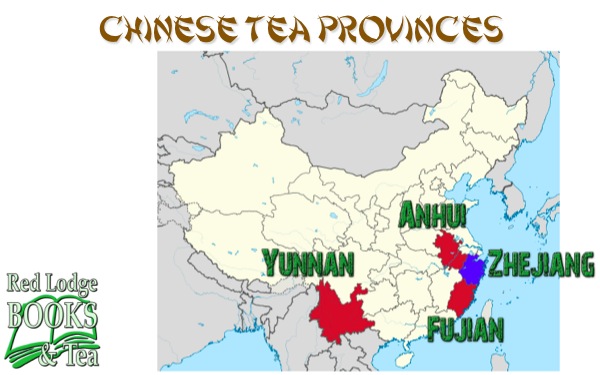
After the background was covered, including varietals of the tea plant, we launched into the individual teas, organized by style.
White Tea
First was white tea, the most lightly processed. I chose a Silver Needle blend from Rishi instead of a single-origin tea for this one mostly because our focus was comparing Chinese white tea with green and oolong teas. At some point down the road, we’ll do a comparative white tea tasting where the focus will be on terroir and origin.

One of the bullet points on the slide is an important one: busting the caffeine myth of white tea. The fact that this tea is made from early-picked buds means that there is a high concentration of caffeine. The preparation style does nothing to change that. The longer steep times we typically use on white tea just accentuates this.
We steeped the tea for five minutes in 165 degree water.
Green Tea
I chose three different green teas for the tasting. Each brought something completely different to the party.

First – a straight green tea very typical of Chinese fare, with a history dating back well over a millennium. The name of the tea comes from the finely-rolled leaves resembling gunpowder.
We steeped the gunpowder tea for three minutes in 175 degree water.

I simply couldn’t resist including the original story (fable?) of Longjing tea here, which I’ll be covering in much more detail in the future. Of all of the green teas I’ve tried, this is the one I keep coming back to as my favorite.
We steeped the dragonwell tea for three minutes — although I only do two minutes when I’m brewing it for myself — in 175 degree water.
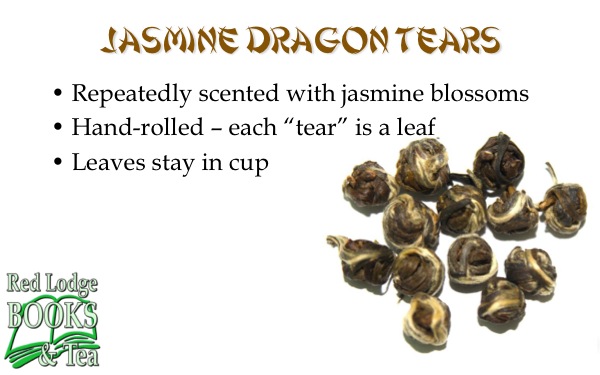
And finally, we come to the only flavored tea of the evening. We followed tradition with this tea, placing seven tears in each cup and sipping the tea as the leaves unfurl. Unlike all of the other teas we tasted, this one didn’t have a fixed steeping time. Everyone began sipping after a minute or two and kept sipping as the character changed over the next few minutes. We used 175 degree water.
Oolong Tea
We could have easily set up an entire evening just tasting Chinese oolongs (we are, in fact, doing this with Taiwanese oolongs on March 29), but for tonight we chose only one: an oolong from the Wuyi mountains.

It was a very difficult choice deciding which oolong to include. My first temptation was Tieguanyin (Iron Goddess of Mercy), but since I had two rolled teas already I decided to go with an open-leaf oolong.
We brewed this for three minutes in 195 degree water.
Black Tea
And finally, we moved on to black tea. Choosing only two black teas to represent China wasn’t easy (although it was a lot easier than choosing a single oolong), so I simply went with my two “leaf and a bud” favorites: one fully oxidized rich black with overtones of red wine (Keemun Mao Feng) and one lightly oxidized golden tea from Yunnan.

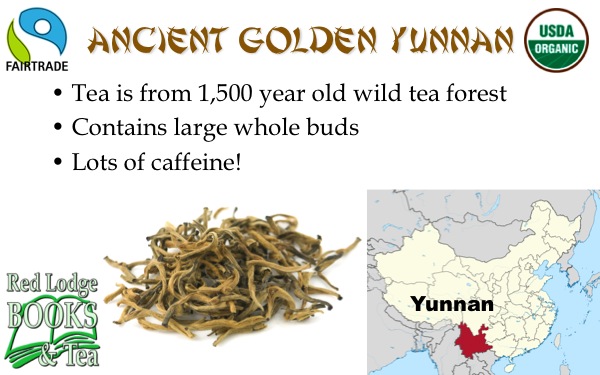
This was another case where I steeped the teas both at three minutes in boiling water for a better comparison, but when I drink them myself I prefer about 2:30 for the Keemun and 4:00 for the Yunnan.
We closed out the evening with a discussion of steeping times, water temperatures, multiple infusions, and other factors involved in preparing a great cup of tea. As always, I ended with the admonition to ignore the Tea Nazis and drink your tea however you like it.

If you live in the area and were unable to attend this session, I sure hope to see you at one of our future stops on our World Tea Tasting Tour. Follow the link for the full schedule, and follow us on Facebook or Twitter for regular updates (the event invitations on Facebook have the most information).

Fun Blends: Terracotta Army Chocolate Pu–erh
My wife, Kathy, is a chocoholic who loves tea. She has tried chocolate tea blends from various companies, and decided that she’s not a fan of chocolate tea blends using mild-flavored tea. She likes to be able to taste the chocolate and the tea.
Gwen and Kathy and I experimented and came up with a blend based on a loose-leaf shu (ripe) pu-erh blended with cocoa nibs and vanilla. It was a struggle getting the balance just right, but the result was so good, we decided to give it a permanent home on the tea bar’s menu. After struggling for a while to come up with a name reflecting its Chinese origins: Terracotta Army Chocolate Pu-erh.
The Logo
I love having fun with tea logos. As I’ve mentioned before (see list below), a series of local artists have been creating logos for our house blends. This one was produced by artist (and art history professor) Kory Rountree:

We love that Kory started with one of the soldiers in the real Terracotta Army, made him chocolate, and gave him a cup of tea. He actually provided two logos for us to choose between. We picked the one above because it is clear, simple, and easy to identify even at small sizes. I actually prefer the alternative (shown below), but it’s just too complex to put on a little tea label.

The details are what really make this one. Note the eyes on the soldier above and left of the chocolate soldier. You can almost hear him thinking “Yummy!” The one above and to the right has a similar, but more subtle expression. It’s not obvious at first glance, but if you look closely, the soldier to the right of the chocolate fellow is holding a piece of the melted/broken chocolate arm in one hand, and a cup of chocolate pu-erh tea in the other.
Thank you, Kory! Another awesome logo for the collection!
This is the latest in a collection of labels I’ve written about here before:
Far Too Good For Ordinary People
 Part of the fun of the tea business is the names. The names of the teas themselves are wonderful — from classics like Iron Goddess of Mercy to house blends like Mr. Excellent’s Post-Apocalyptic Earl Grey — but the industry terminology is fun as well. Let’s take the “orange pekoe” grading system used for black teas from Sri Lanka (Ceylon) and India.
I can’t count the number of times someone has come into the tea bar telling me they like flavored teas. “You know, something like that Orange Pekoe stuff.”
“Actually,” I have to explain, “that’s not a style of tea, but a grade. And it has no flavorings at all. Nope. No orange in it.”
What I generally don’t go on to explain is how that whole pekoe grading system works. Let’s start with the words “orange” and “pekoe.” A pekoe is a tea bud, the unopened leaf at the very tip of a branch. A pekoe tea, then, would contain the buds and smallest leaves adjacent to the buds. To further confuse matters, the word “pekoe” in grading tea doesn’t mean quite the same thing as it means when speaking of tea buds. We’ll get to that in a moment.
“Orange,” as I mentioned above, has nothing to do with fruit. What it does actually mean is open to debate. It could refer to the color of the oxidized leaves. It could refer to the color of the brewed tea. It could refer to the Dutch royal family (the House of Orange). All that really matters is that in tea grading, any whole-leaf black tea qualifies as an Orange Pekoe.
So what about all those other letters? The joke in the tea business is that FTGFOP stands for “Far Too Good For Ordinary People.” In reality, it stands for “Fine (or Finest) Tippy Golden Flowery Orange Pekoe.” Referring to a grade of tea as the “finest” isn’t good enough, of course, so there are actually several grades above that. Here are the basic grades:
- OP (Orange Pekoe): A whole-leaf black tea.
- FOP (Flowery Orange Pekoe): Long leaves with some tips (pekoes).
- GFOP (Golden Flowery Orange Pekoe): An FOP with more tips.
- TGFOP (Tippy Golden Flowery Orange Pekoe): A GFOP with a whole lot of tips.
- FTGFOP (Finest Tippy Golden Flowery Orange Pekoe): Traditionally the highest-quality grade of black tea.
- SFTGFOP (Special Finest Tippy Golden Flowery Orange Pekoe): Sorry, we needed one more grade.
For the true connoisseur, a grading system can never have fine enough gradations, so you can also elevate each of these grades another half-point by adding the number “1” after it. Thus, despite the industry joke, there are three grades of tea better than FTGFOP (FTGFOP-1, SFTGFOP, and SFTGFOP-1).
Let me reinforce an important point here: this grading system is used only for black teas, and only in a few countries. China, for example, rarely grades its teas using this system, although Kenya is doing more of it as their teas increase in quality.
Are there lower grades?
I thought you’d never ask.
The majority of tea consumed in the U.S. and U.K. is in teabags. In a traditional teabag, there’s little room for the hot water to circulate or the leaves to expand as they absorb water. The solution? Break those leaves into smaller pieces. That exposes more of the surface area of the leaf to water and allows more tea (by weight) to fit into a smaller area.
OP-grade teas use whole leaves. There is a series of grades below OP that include the letter B for “Broken.” BOP (Broken Orange Pekoe), FBOP, GBOP, and so on. There are also a couple of broken grades below BOP, including BP (Broken Pekoe) and BT (Broken Tea).
So that’s what’s used in teabags? Nope. Let’s drop another grade.
After the processing facility has sorted out all of the Pekoe and Broken Pekoe grades, what’s left is known as “fannings.” Grades like PF (Pekoe Fannings), FOF (Flowery Orange Fannings), and TGFOF (Tippy Golden Flowery Orange Fannings). These are the grades used in most decent-quality teabags (high-end teabags may use whole-leaf teas, typically in a sachet-style bag).
“Decent-quality teabags?” I hear you cry. “Are you implying there’s another grade below fannings?”
Yes. Yes I am.
The smallest-sized particles of tea — too small to be fannings — are called “dust.” There are different grades of dust, of course, depending on the tea leaves they come from. You may encounter PD (Pekoe Dust), GD (Golden Dust), FD (Fine Dust), and others. Typically, though, grades like that don’t make it onto commercial packaging.
So these lower grades suck?
No, I didn’t say that.
Fannings from an extraordinary tea will produce a much better drink than whole leaves from a mediocre tea. There are a lot of factors to take into consideration, but the number one factor is your own preferences. As I’ve said before on this blog, I’m not a tea Nazi. It won’t hurt my feelings a bit if you prefer the cheapest grade of Lipton teabags to my shop’s whole-leaf FTGFOP-1 First Flush Darjeeling. In fact, it would be quite a waste of money to buy a tea you don’t like.
In a way, buying tea that’s highly-graded on the pekoe system is like buying organic. What it really tells you is that you’re dealing with a legitimate tea producer that cares enough about their product to pick it right and have it graded by experts.
What’s the difference between Japanese and Chinese green tea?
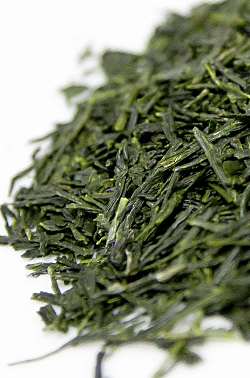
Japanese sencha leaves
As I did last month and the month before, I took a look at some of the search terms that brought people to this blog and found a question that I didn’t really address. This time: “What’s the difference between Japanese and Chinese green tea?” The obvious smart-aleck answer is that one comes from Japan and the other comes from China, but it runs a bit deeper than that.
First off, it’s not the plants themselves. The first varietal discovered of the tea plant is Camellia sinensis var. sinensis: the Chinese tea plant. About 1400 years ago, during the Sui Dynasty, Buddhist monks introduced tea — and the tea plant — to Japan. This means that the same varietal of tea plant is growing in China and Japan.
Terroir, on the other hand, can definitely have an effect. The climate, soil, and other factors can definitely affect the taste of the tea. Also, the Japanese have been crossbreeding and developing their strains of tea plant for over a millennium.
The biggest factor in the taste, though, is a very simple one: the process.
The difference between black tea and green tea is oxidation. Black tea is fully (or near-fully) oxidized, while green tea is not oxidized at all. There is an enzyme in the tea leaf that starts the oxidation process as soon as the leaf has been broken or bruised. Making green tea requires a “kill green” step that destroys the enzyme and stops the tea from oxidizing. That step requires heating the tea leaves quickly to at least 140 degrees.
To make Japanese green teas, such as sencha, bancha, and gyokuro, the leaves are steamed. To make Chinese green teas, such as dragonwell or gunpowder tea, the leaves are pan-fired. Just this simple difference in processing gives Japanese teas a rich grassy flavor and Chinese greens more of a vegetal character.
Granted, I am oversimplifying, but this is the fundamental answer to the question.

A Nice Cup of Tea

On January 12, 1946, the Evening Standard published an essay by George Orwell entitled “A Nice Cup of Tea.” Like almost everyone else in my generation, I had to read his books Nineteen Eighty-Four and Animal Farm in school. They told us a lot about society and a lot about English culture, but not much about tea.
Orwell was British, and born in 1903. These two facts tell you a lot about how he viewed tea. I’ve written before about “Tea Nazis,” who believe that their way of preparing tea is the only way to prepare tea, and this essay is a marvelous example of that philosophy in action.
He opens the essay by saying that if you look up “tea” in a cookbook it’s likely to be unmentioned. That was very true in 1946. It is less true now, but even though there are a lot of wonderful books about tea, mainstream cookbooks generally find it unnecessary to describe how to prepare a pot (or a cup) of tea.
Orwell continues by pointing out that tea is a mainstay of civilization in England, yet the “best manner of making it is a subject of violent disputes.” Judging from conversations I’ve had with British friends, I’d have to agree with that. His next paragraph sets the tone for everything that follows:
“When I look through my own recipe for the perfect cup of tea, I find no fewer than eleven outstanding points. On perhaps two of them there would be pretty general agreement, but at least four others are acutely controversial. Here are my own eleven rules, every one of which I regard as golden:”
Since in my humble opinion just about everything related to preparing tea is subjective, I’d like to present my own take on Orwell’s eleven rules. Lets look at them one at a time.
“First of all, one should use Indian or Ceylonese tea. China tea has virtues which are not to be despised nowadays — it is economical, and one can drink it without milk — but there is not much stimulation in it. One does not feel wiser, braver or more optimistic after drinking it. Anyone who has used that comforting phrase ‘a nice cup of tea’ invariably means Indian tea.”
Here, I must vehemently disagree with Mr. Orwell. Perhaps the fact that he was born in India is showing through here. There is excellent tea from China (and Japan and Kenya and Taiwan…). If you want a beverage that will make you feel “wiser, braver or more optimistic,” I would recommend tequila. If you want tea that tastes good, you can find it all over the world.
Incidentally, when Orwell refers to “Ceylonese” tea, he means tea from the country that was called Ceylon when he wrote this essay, but became Sri Lanka when it achieved independence in 1948. We still typically call tea from Sri Lanka “Ceylon” tea.
“Secondly, tea should be made in small quantities — that is, in a teapot. Tea out of an urn is always tasteless, while army tea, made in a cauldron, tastes of grease and whitewash. The teapot should be made of china or earthenware. Silver or Britannia-ware teapots produce inferior tea and enamel pots are worse; though curiously enough a pewter teapot (a rarity nowadays) is not so bad.”
He has an excellent point about the small quantities. To me, this means preparing it by the cup rather than by the pot, and there is a lot of excellent teaware available for that purpose. Although china, earthenware, and ceramic teapots do add something to the tea, using plastic or glass pots allows you to watch the tea steep. It also adds (and detracts) nothing to the flavor.
“Thirdly, the pot should be warmed beforehand. This is better done by placing it on the hob than by the usual method of swilling it out with hot water.”
I agree that pre-warming the pot helps to keep the water hot as the tea steeps.
“Fourthly, the tea should be strong. For a pot holding a quart, if you are going to fill it nearly to the brim, six heaped teaspoons would be about right. In a time of rationing, this is not an idea that can be realised on every day of the week, but I maintain that one strong cup of tea is better than twenty weak ones. All true tea-lovers not only like their tea strong, but like it a little stronger with each year that passes — a fact which is recognized in the extra ration issued to old-age pensioners.”
My biggest problem with this “rule” is the statement that “all true tea-lovers not only like their tea strong.” In fact, many tea lovers like a shorter steeping time so that the flavor of the tea isn’t overwhelmed by the bitterness and tannins that come out later in the steep.
“Fifthly, the tea should be put straight into the pot. No strainers, muslin bags or other devices to imprison the tea. In some countries teapots are fitted with little dangling baskets under the spout to catch the stray leaves, which are supposed to be harmful. Actually one can swallow tea-leaves in considerable quantities without ill effect, and if the tea is not loose in the pot it never infuses properly.”
Philosophically, he’s right. Allowing the water to circulate freely through the leaves does improve the infusion process. I do prefer not to consume the leaves (unless I’m drinking matcha), but a proper modern infuser will catch pretty much all of them.
“Sixthly, one should take the teapot to the kettle and not the other way about. The water should be actually boiling at the moment of impact, which means that one should keep it on the flame while one pours. Some people add that one should only use water that has been freshly brought to the boil, but I have never noticed that it makes any difference.”
Clearly, Mr. Orwell was aware of only one kind of tea: black. While boiling water is the right way to go for black and pu-erh tea, you get much better results with green and white tea if you use cooler water. I won’t get into the oolong debate at the moment…
The little aside that he snuck in here about freshly-boiled water is perhaps the biggest point of argument I hear from tea lovers. Does your tea really taste different if the water is heated in a microwave instead of being boiled in a teapot? Does the tea taste different if you reboil water that has been boiled before? In a blind taste test, I can’t tell the difference. Perhaps you can.
“Seventhly, after making the tea, one should stir it, or better, give the pot a good shake, afterwards allowing the leaves to settle.”
I confess. I do this.
“Eighthly, one should drink out of a good breakfast cup — that is, the cylindrical type of cup, not the flat, shallow type. The breakfast cup holds more, and with the other kind one’s tea is always half cold — before one has well started on it.”
Your cup is as personal as your clothing or your car. Most of the time, I use a 16-ounce ceramic mug made by a local potter. When I’m trying a new tea, I make the first cup in a glass mug so I can see it better. I typically use a smaller cup for matcha, a bigger one for chai lattes, and a bigger one than that for iced tea.
“Ninthly, one should pour the cream off the milk before using it for tea. Milk that is too creamy always gives tea a sickly taste.”
Unless I’m drinking chai, I do not add milk to my tea. I have made the occasional exception (I actually like milk in purple tea), but I generally prefer to taste the tea, not the milk.
“Tenthly, one should pour tea into the cup first. This is one of the most controversial points of all; indeed in every family in Britain there are probably two schools of thought on the subject.
The milk-first school can bring forward some fairly strong arguments, but I maintain that my own argument is unanswerable. This is that, by putting the tea in first and stirring as one pours, one can exactly regulate the amount of milk whereas one is liable to put in too much milk if one does it the other way round.”
When I make chai, I don’t use either of Orwell’s methods. I find that the spices extract better with the lipids in the milk present than they do in water alone. In other words, I heat the milk and add it to the water while the tea is steeping. It changes the flavor considerably.
When I’m adding milk to any other tea, I typically put it in the cup first and then add tea to it.
“Lastly, tea — unless one is drinking it in the Russian style — should be drunk without sugar. I know very well that I am in a minority here. But still, how can you call yourself a true tea-lover if you destroy the flavour of your tea by putting sugar in it? It would be equally reasonable to put in pepper or salt.”
Good point, Mr. Orwell. Now please substitute the word “milk” for “sugar” in this paragraph. Then go back and read rule nine. I don’t sweeten my tea (chai being the exception again — I like some honey in it), but I see nothing wrong with doing so. Adding a bit of sugar is no different than adding a bit of milk.
Oh, and by the way, tea was traditionally prepared in salt water in ancient China. And one of my favorite chai blends does, indeed, contain pepper.
Orwell continues…
“Tea is meant to be bitter, just as beer is meant to be bitter. If you sweeten it, you are no longer tasting the tea, you are merely tasting the sugar; you could make a very similar drink by dissolving sugar in plain hot water.
Some people would answer that they don’t like tea in itself, that they only drink it in order to be warmed and stimulated, and they need sugar to take the taste away. To those misguided people I would say: Try drinking tea without sugar for, say, a fortnight and it is very unlikely that you will ever want to ruin your tea by sweetening it again.”
Again, Orwell is speaking only of black tea here. I do not expect bitterness in, for example, a Long Jing Dragonwell green tea. And I would argue that there are a lot of fine black teas that have minimal bitterness: Royal Golden Safari from Kenya, to pick a favorite of mine.
If I had to pick one issue to argue in this essay, it would be that George Orwell considers all tea to be the same (after eliminating the majority of the world’s production by limiting himself to India and Sri Lanka). Even within the world of black tea, there is immense diversity. I don’t use the same preparation methods or expect the same results for a malty Assam tea and a delicate first flush Darjeeling — much less a smoky Chinese lapsang souchong.
My recommendation? Experiment. Try new teas, and try them first without adding milk or sweetener. Use your supplier’s recommended water temperature and steeping time. Taste the tea. THEN decide whether you want to steep it for a shorter or longer time; whether it needs a bit of milk; whether you’d prefer to sweeten it.
The best tea is your favorite tea, prepared just the way you like it.
 Tea With Gary