Blog Archives

Jasmine Tea

Even purists who eschew “flavored” teas will often enjoy a cup of jasmine green tea. Perhaps it is because when you look at the loose tea, all you see is tea leaves; there are no visible indications that your tea leaves have been adulterated in any way. Perhaps it is because the affect of the jasmine in a well-made jasmine tea is delicate and subtle. Perhaps it is the rich history of jasmine teas.
Jasmine first made its way to China from Persia (now known as Iran) over 1,700 years ago, and it took hundreds of years before it was used to scent tea. Even then, it spread quite slowly, and it wasn’t until the Qing Dynasty, which began in 1644, that it became widespread.
The making of jasmine tea is quite different from typical flavored teas. Most flavored teas are either blends, where dry ingredients are mixed together, or tea leaves sprayed with flavor extracts, like Earl Grey with its bergamot oil. Jasmine tea, on the other hand, is scented rather than flavored.
In the traditional process, jasmine flowers are picked early in the morning, when the blossoms are still tightly rolled. Trays of processed and dried tea leaves (usually, but not always, green tea) are stacked in alternation with trays of jasmine. The trays have woven mesh or screens as bottoms, so as the jasmine blossoms open up and release their scent, it travels freely into the tea leaves over the course of about four hours.
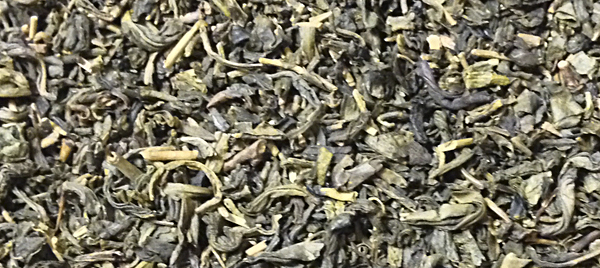
The tea leaves pick up moisture from the flowers along with the jasmine scent, so they have to be re-dried before they can be packaged. In the finest quality jasmine teas, this scenting process may be repeated half a dozen times or more. The finished tea has no jasmine blossoms in it — only the scent that has transferred.
How you prepare a cup of jasmine tea depends on the base tea used. If it is made form a green tea, as most of them are, then you’ll want to use 175-185°F (80-85°C) water, and steep for three minutes or less. Using boiling water is a quick way to ruin a good cup of jasmine tea — or any other green tea, for that matter — by bringing out unwanted bitterness.
Grades of jasmine tea vary with the quality of the tea and the process used. One of the popular higher-end styles involves tea leaves that are tightly rolled, often known as “jasmine pearls.”
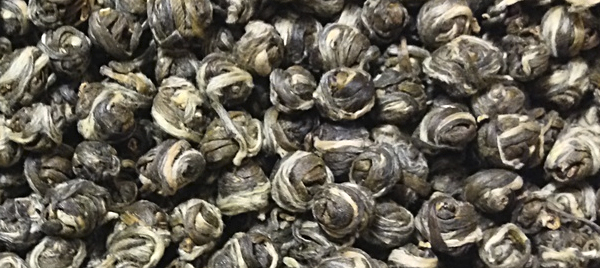
When drinking jasmine pearls, seven balls are placed in a small cup. Seven is considered good luck, so with jasmine pearls you don’t weigh them out or measure them in a tablespoon. Each rolled ball contains two leaves attached to a bud, which will slowly unfurl when the hot water is added.
Unlike most loose tea, jasmine pearls are infused right in the cup with no screens or filters, and you don’t remove them before drinking. The unbroken leaves assure that if you sip carefully, you won’t get a mouthful of leaf. If you’re drinking jasmine pearls with friends, the host should make sure that there’s always more hot water available to keep refilling the cups.
Jasmine blossoms certainly aren’t the only flowers used to scent tea — I’ve written about Vietnamese Lotus Tea, for example — but jasmine is definitely the best-known and most popular.
Tea. Earl Grey. Hot: Stop 2 on the World Tea Tasting Tour

Update: The story of the origin of Earl Grey tea is one of the chapters in my book, Myths & Legends of Tea. Check it out!
England may not grow many tea plants, but the United Kingdom has had a massive impact on the development and popularization of tea since the 1660s. Our second stop on the Red Lodge Books & Tea World Tea Tasting Tour explored the world of Earl Grey tea, from the Right Honourable Charles Grey (for whom Earl Grey tea is named) to Star Trek TNG’s Captain Jean-Luc Picard. Earl Grey isn’t a single tea, but a broad range of styles. We carry nine different Earl Greys, of which over half are our own house blends, made right here in Red Lodge. The teas we tasted were:
- Organic Ancient Tree Earl Grey
- Lady Greystoke
- Jasmine Earl Green
- Coyotes of the Purple Sage
- Fifty Shades of Earl Grey
- Mr. Excellent’s Post-Apocalyptic Earl Grey

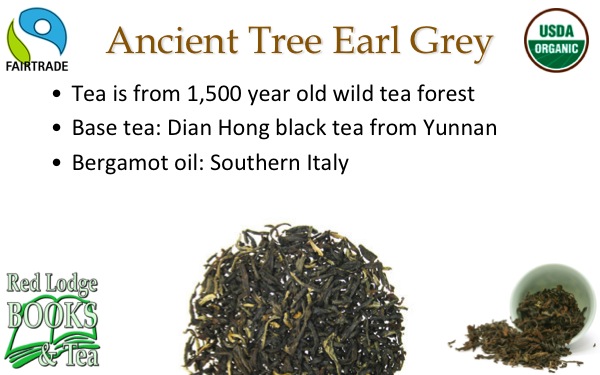


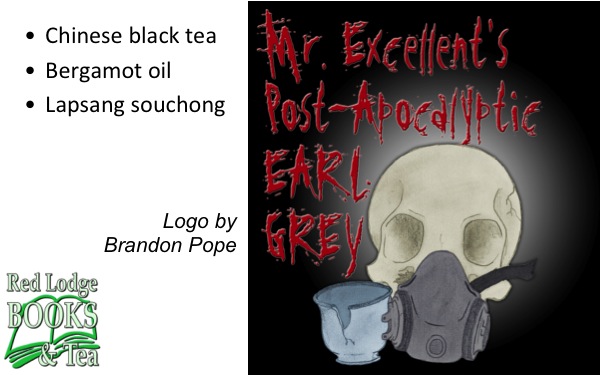
We started out with a discussion of the history of Earl Grey tea. The common myth is that the tea blend was presented to Charles, the 2nd Earl Grey by a Chinese mandarin after Charles (or one of his men) saved the life of the mandarin’s son on a trip to China. In reality, Charles never set foot in China, and the history has a more mundane beginning. The Earl lived at Howick Hall, which had a high lime (calcium) content in its water. This gave his tea an off-flavor and he (or possibly Lady Grey, depending on who’s telling the story) consulted a tea expert for advice. This tea expert — possibly a Chinese mandarin, we don’t know — came up with the idea of adding the oil of the bergamot orange (Citrus bergamia) to the tea. This is what was served in Howick Hall, and the formula was eventually presented to Twinings by the Earl and it became one of their regular offerings. Twinings changed the formula a couple of years ago, but that’s another story. Before we leave the subject of bergamot, by the way, the word is Italian, not French, so the “T” at the end is pronounced. I have heard a lot of tea people talk about “bergamoh,” but it is actually pronounced just the way it is spelled. Tea purists who scoff at Earl Grey often use the word “perfumey” to describe it. There’s a reason for that. By some estimates, as much as half of women’s perfumes contain bergamot oil, and about a third of men’s fragrances. The first Earl Grey that we tasted is Ancient Tree Earl Grey from Rishi — a wonderful blend that does quite well in our tea bar. This amazing tea won “Best Earl Grey Tea” at the 2008 World Tea Championship. Next, we moved on to a house blend called Lady Greystoke. This is my take on lavender/vanilla Earl Grey, a blend which many tea shops would call Lady Grey, despite the trademark violation. Lady Grey tea is named for Mary Elizabeth Grey, the wife of Lord Charles, 2nd Earl Grey. Our Lady Greystoke is named for Jane Porter, who married Tarzan to become Lady Jane Greystoke (the full story is in an earlier blog post). For people that enjoy the bergamot, but want a milder tea, many shops offer an Earl Green or Earl White, and perhaps a caffeine-free Earl Red made from rooibos (yes, we have all three of those). For a different twist, we offered up a Jasmine Earl Green. Lightly perfumed with both with jasmine blossom and bergamot oil, it’s the most delicate of the teas we tasted. Next, we come to a popular blend of ours that really captures the character of the American West: a sage-based Earl Grey we call Coyotes of the Purple Sage. I know, it sounds rather strange, but the flavor mix really works. The literary allusion in this one comes from Zane Grey’s book, Riders of the Purple Sage. Yes, it’s a Zane Grey Earl Grey! For the story of the logo and blend, see my earlier blog post about it. The next tea also has a book theme — you can tell we have a combination tea bar and bookstore — but I’m not going to call this one a “literary” allusion, as nobody would refer to the Fifty Shades of Grey books as “literature.” I came up with the blend just for fun, with lots of punny references to the book, ranging from tea’s color (black and blue) to the rich flavor and overpowering bergamot. It actually ended up being quite tasty, and we’ve been selling quite a bit of it. We wrapped up with a signature house blend that’s completely different — a lapsang souchong-based Earl Grey that we call Mr. Excellent’s Post-Apocalyptic Earl Grey. The full story of that tea has already been told here, so I won’t repeat it. If you live in the area and were unable to attend this session, I sure hope to see you at one of our future stops on our World Tea Tasting Tour. Follow the link for the full schedule, and follow us on Facebook for regular updates (the event invitations on Facebook have the most information). Let us close with a short video explaining the proper way to order a cup of Earl Grey tea:
 Tea With Gary