Category Archives: Styles
Another new logo: Honey Mint Tea
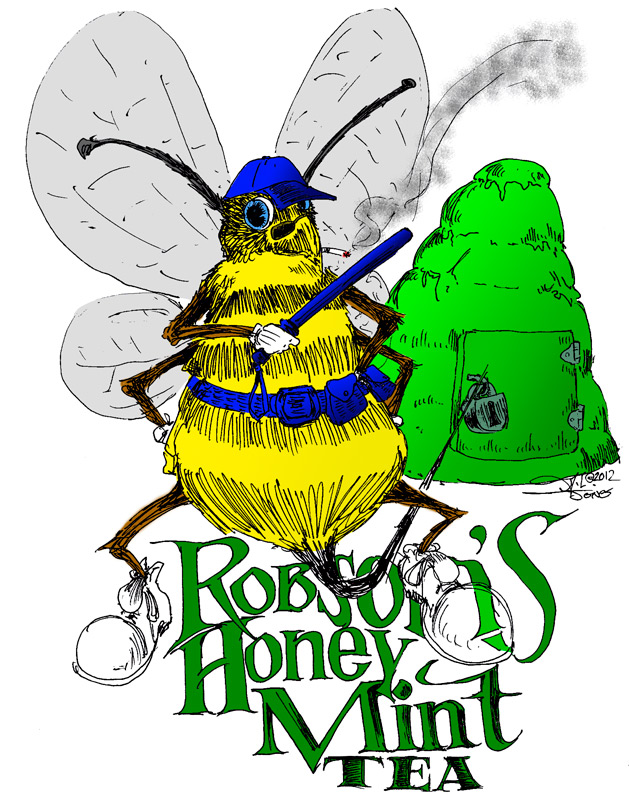 Back in October, my friend Al drew a logo for our Hammer & Cremesickle Red Tea blend. Today, he put his artistic talent back to work and came up with another logo for the Tea Bar. This time, it was for my caffeine-free “Honey Mint” blend.
I developed this blend a few months ago when some customers had expressed an interest in a caffeine-free version of our Moroccan Mint tea. Not being a fan of decaffeinated teas, I went for a naturally caffeine-free base instead. I wanted it to be a little bit sweet, so I used honeybush as the base tea, and blended that with organic peppermint from Washington state. A little bit of licorice root for the aftertaste finishes off this sleepytime mint tea blend.
Al has a rather strange sense of humor (that’s why we get along, of course), and I gave him no guidelines at all on the logo. He set to work developing a logo based on a pun.
When I called the blend “Honey Mint,” I was referring to honeybush and peppermint. Al went after another meaning of mint, as in the United States mint. He drew a bee guarding a mint (a locked up hive full of peppermint and honey). Pretty tough-looking bee, too, with his cigarette, truncheon, and shades. The original drawing (see below) was just done with a pen and some printer paper. I scanned it in and colorized it using Photoshop. Hopefully, my colors fit Al’s original concept. I always feel strange about colorizing other people’s artwork — I’m afraid I’ll screw it up.
Another artist friend is currently working on a logo for Mr. Excellent’s Post-Apocalyptic Earl Grey, and we hope to find people to do my other house blends (Lady Grey and MaterniTea). As always, watch here for news.

Al’s original artwork for “Robson’s Honey Mint Tea.”

Free mystery tea (Tieguanyin)!

A friend of mine stopped by the tea bar the other day. Unlike most tea bar visits from friends, Wanda brought tea in with her. It was a bag of tea from China that a friend had given her. She didn’t know what it was, and she’d had it for five years, so she asked if I’d like to have it.

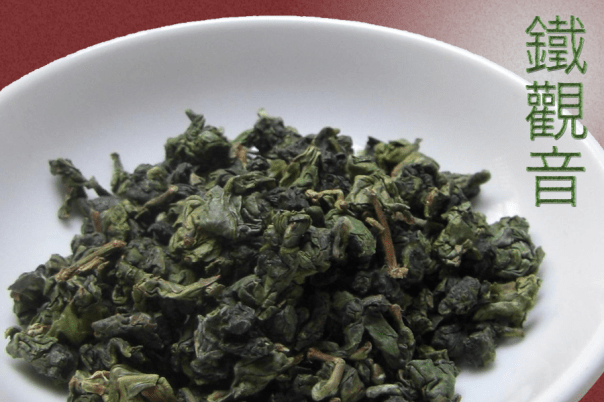
I cut the bag open and poured out a bit of the tea. It was full rolled leaves; not rolled tightly into balls like Dragon Tears or gunpowder tea, but pretty dense nonetheless. The leaves were hard; dropping them into bowl made a pinging sound. The color was a bit darker than a typical green tea, and the smell reminded me of the Huang Jin Gui oolong we carry at the tea bar.
I brewed a cup, using a bit more tea than I usually would because of the age, and decided it was definitely a oolong, but I couldn’t quite identify it. Good packaging, by the way. Five years old, and it still tasted good.
Here’s where Facebook comes in handy. I took a picture of the large print on the top of the bag (the photo that’s now on this page), posted it on Facebook, and asked if anyone could identify it. Within about 20 minutes, I had my answer: Iron Goddess of Mercy, a lightly oxidized oolong with a unique aroma. After enjoying it for a few days, I started hunting for a good one to carry at the tea bar, and I’m excited to have a fresh batch coming in next week. Given how good the five-year-old stuff at home is, I have a feeling I’m really going to love the fresh tea.
Update 2014: Iron Goddess has indeed become one of my favorite teas, and was one of the most popular teas in the tea shop.
Iron Goddess of Mercy (called “tieguanyin” in Chinese) originated in Anxi, in the Fujian province of China. Today, it is produced in quite a few other areas of China and Taiway. The one we sell at our tea bar is a medium-roasted variety from Nantou, Taiwan. I’ve used the leaves for three infusions without loss of flavor, and I’ve been told they’re good for as many as seven.
The processing of tieguanyin is complex. Traditionally, it follows these steps:
- Picking – usually done early in the day when it is sunny
- Sun drying (“withering”) – Done before sunset the same day as the picking
- Cooling (“cool green”) – Done overnight, along with the tossing
- Tossing (“shake green”)
- Withering/partial oxidation – Done the day after picking
- Fixing
- Rolling/kneading
- Drying
- Roasting

There are several conflicting legends regarding the origin of Iron Goddess of Mercy, all recounted on the Chinese Tea Culture site. Personally, I much prefer the Wei Yin legend. I don’t know that it has any more veracity, but it’s a better story. That’s the one I used as the basis for my version of the Iron Goddess story, told in my book, Myths & Legends of Tea, volume 1.
Oolong-related articles on Tea With Gary
-

The Iron Goddess of Mercy – Part 1
The Iron Goddess of Mercy Part 1 — China, 1761 — It was the reign of the Qianlong Emperor, the sixth emperor of the Qing Dynasty in China, but our story concerns no emperors, warlords, or nobles. It is just a tale of a humble farmer by the name of…
-

The Iron Goddess of Mercy – Part 2
The Iron Goddess of Mercy Part 2 — China, 1761 — It was the reign of the Qianlong Emperor, the sixth emperor of the Qing Dynasty in China, but our story concerns no emperors, warlords, or nobles. It is just a tale of a humble farmer by the name of…
-

Canon cameras and oolong tea
Why should you drink oolong tea when you’re taking pictures with a Canon camera? Let me explain…
-
The Oolongs of Taiwan: Stop 6 on the World Tea Tasting Tour
Taiwan may not have originated oolong tea, but it is definitely at the forefront of oolongs today. At this stop on the tea tour, attendees learned about what oolong tea actually is, and tasted a variety of Taiwanese oolongs, including Bao Zhong, White Tip Bai Hao, and of course Tieguanyin,…
-
Free mystery tea (Tieguanyin)!
A friend stopped by the tea bar the other day and brought a bag of tea from China that a friend had given her. She didn’t know what it was, and she’d had it for five years, so she asked if I’d like to have it.
Tea Styles
This article first appeared in the May 2010 issue of the Local Rag newspaper, describing a tea tasting and class I held at our bookstore before we added the tea bar.
When I was a kid, tea was something that came in bags with a little tag that said “Lipton.” Visits to a Chinese or Japanese restaurant introduced me to the “other” kind of tea: green tea. The first time I ordered tea in a nice restaurant, I encountered the fancy presentation box, containing exotic varieties of tea like chamomile, Earl Grey, English breakfast tea, and Constant Comment. In high school, I drove a delivery truck for an office supply store in Boulder, Colorado, and one of my stops was Celestial Seasonings.
By that time, I was probably a typical American tea consumer. I classified teas into herbal, green, medicinal, and “ordinary.” Not until quite some time later did I discover just how much I was missing, and in an April tea tasting at Red Lodge Books, I tried to pass on a bit of what I’ve learned. This article is a distillation of the talk I gave that day.
All “true” tea comes from the same plant: Camellia sinensis. There are three major variants. The China bush (var. sinensis), the Assam bush (var. assamica) from India, and the Java bush (var. cambodi). Within those broad categories are over 1,000 individual subvarieties. Just as red climbing roses and yellow tree roses are both roses, all of these subvarieties are still Camellia sinensis, the tea plant.
There are six generally-accepted ways to process Camellia sinensis leaves, which produce white, yellow, green, oolong, black, and pu-erh. Yellow tea is so rare that I decided not to cover it. All “true” teas have caffeine, including the delicate whites and greens. Red tea (a.k.a. African rooibos), which I’ll discuss next month, is made from a different plant that does not have caffeine.
White Tea
White tea is the least-processed, and generally lightest and sweetest-flavored tea. It is typically more expensive than black or green teas, and is recognized as having significant health benefits. It is brewed at a lower temperature, and steeped for a short time. The leaves can be re-used, to make 2-3 cups of tea from one teabag or container.
The white tea we tasted at the bookstore was Rishi’s organic Silver Needle (Bai Hao Yin Zhen), from the Fujian province of China. This tea was voted the best tea in the world at the 2008 World Tea Championships, and the best white tea in 2009. The taste is very light and subtle, and there is a wonderful jasmine-infused version available as well.
White teas start out as young budsets (an early bud with or two leaves). After picking, they are “wilted” indoors to get some of the moisture out, and then baked or panned. After a light rolling of the leaves, they are dried and packaged for shipment.
Green Tea
Green tea is the traditional tea of China and Japan. It has long been lauded for its healthiness, and intricate ceremonies have been developed around its preparation. People study the Japanese Tea Ceremony for years before performing it publicly. Like white tea, it is brewed at lower temperatures, and can yield 2-3 infusions.
The green tea we tasted was an organic Sencha from the Kagoshima Prefecture of Japan; voted the best green tea in the 2008 championships. It is a very traditional green tea, grown in volcanic soil, yielding a deep almost grassy flavor.
After picking, the leaves are steamed or panned, rolled, and then dried. Sometimes, they’ll be formed into balls or other shapes before drying.
Oolong Tea
Oolong is a very highly-processed tea; one of the most complex to produce. It is generally flavorful and rich without the bitterness often associated with black teas. Unlike green and white teas, the leaves are partially oxidized, which darkens the color and intensifies the flavor.
We tasted an organic Wuyi Oolong. The Wuyi Mountains in Northern Fujian are where oolong tea was first produced, and this variety has a roasted aroma, complex flavor, and sweet finish.
To make oolong tea, the freshly-picked leaves are first wilted (partially dried) in the sun, and then again indoors. They are tossed in a basket to bruise them, and then partially oxidized (typically anywhere from 30-70%). After oxidation, the leaves are baked or panned, and then rolled. The final steps are drying and firing, which produces the smoky aroma.
Black Tea
By far the most common type of tea in Europe and India, black tea is usually brewed hot and strong. Many cultures serve it with milk, sugar, or both to mitigate its inherent bitterness, and it is often flavored with lemon, orange, or other spices (Red Lodge Books has a fascinating vanilla black tea). Black tea flavored with bergamot is known as “Earl Grey.” Black teas are also the basis of English and Irish breakfast tea. Unlike white, green, and oolong teas, black teas are generally only infused once: use the leaves and discard them.
At the tasting, we had Rishi’s organic fair-trade China Breakfast, which won “best breakfast blend” at the 2009 World Tea Championships. It’s rich, malty, and robust; great for the first cup of the morning.
Black teas are usually made with an indoor wilting, followed by a cutting or crushing step. This can range from a light crush to a full “CTC” (crush-tear-curl). This exposes more of the leaf’s insides to assist in oxidation. Black teas are 100% oxidized, yielding higher caffeine content and stronger flavor. Following oxidation, leaves are rolled and dried.
Pu-Erh
This is probably the least familiar process to Americans, but it has been around in China for centuries. What differentiates it from black or oolong tea is a fermentation step at the end of processing. Although the term “fermented” is often incorrectly used instead of “oxidizing” for black teas, pu-erh is the only variety that is actually fermented.

If you’ve ever had a mulch pile, you’re familiar with the process: plant matter is piled up wet, and left alone. The inside of the pile grows hotter as it ferments. Unlike most teas, which are served as fresh as possible, pu-erh is often compressed into cakes (sometimes immense bricks) that can be stored for years. Century-old pu-erh cakes are sold at auctions for thousands of dollars.
Pu-erh is brewed in boiling hot water, and can be re-infused at least 6-8 times. I’ve used leaves ten times and still gotten good flavor from the tenth infusion.
At the tasting, we had a classic loose-leaf organic fair-trade pu-erh from Yunnan, China. The flavor was earthy and rich. The description may seem off-putting to some, but it’s definitely worth trying a good pu-erh.
Tasting purple tea

Today, I received my first shipment of the purple tea that I blogged about back in August. I opened the bag with no preconceptions, as I haven’t read anyone else’s tasting notes.
The leaves look like pretty much any black tea. Not surprising, as the purple tea plant (TRFK306/1) can be prepared using any tea process, and this was oxidized like a traditional (orthodox) black tea. This is a very dense tea. The kilogram bag I purchased was the same size as the half-kilo (500g) bag of Golden Safari (a Kenya black I’ll be writing about soon).
I took a deep whiff, and picked up a slight earthiness to it that isn’t present in the other Kenya black teas I’ve tried. Not as extreme as a shu pu-erh, of course, as there was no fermentation in the process, but enough to distinguish the aroma from a traditional black tea.
Actually, despite my previous comment, I did come in to this with one preconception. Since this is a high-tannin tea, I expected a fair amount of astringency (“briskness,” as Lipton calls it), so I decided to take it easy on the first cup and make it like I make my 2nd-flush Darjeelings: 5 grams of leaves, 16 ounces of water at full boil, and a scant two-minute steep time.
“I did not expect purple, as the anthocyanin that gives purple tea its name doesn’t affect the color of black tea.”
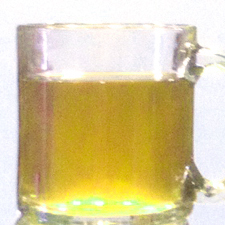
The leaves settled immediately to the bottom of the pot, and I was taken by surprise by the color. I did not expect purple, as the anthocyanin that gives purple tea its name doesn’t affect the color of black tea. But I also didn’t expect the pale greenish tan color that immediately appeared (it later mellowed to a deep black with — you guessed it, a purplish tinge). We don’t have any analyses yet of total antioxidant content, but we know that the anthocyanin does contribute quite a bit.
My first taste of the purple tea was impressive. Rich, complex, and a bit more astringent than you’d expect with only a two-minute brewing time. The earthiness in the aroma comes through subtly in the taste, and there’s a silky mouthfeel that lingers on the back of the tongue.
I figured that there was enough going on in that tea that it could hold up to a second infusion, so I brewed a second cup off of the same leaves. This time I gave it a three-minute steep, and it came out tasting very similar to the first brew, although a bit more pale in color.
“Purple tea is certainly not cheap.”
All in all, I’m pleased and excited to have this new varietal available at the tea bar. Purple tea is certainly not cheap. At $16.00 per ounce, it’s one of the priciest teas on our menu, but I expect it to build a fan base quickly. Our new tea website isn’t quite ready to launch yet (I’ll make a big announcement here when it is), but if you’d like to order some Royal Purple tea, just call the store (406-446-2742) or send an email to gary (at) redlodgebooks (dot) com. We’re ready to ship right away.
UPDATE MAY 2012: Our tea website is up and running, and Royal Purple tea is now available for purchase.
More more information about purple tea, please see my earlier blog post announcing and describing the varietal.
Hammer & Cremesickle Red
 Isn’t it fun how names develop for tea blends? The naming process is almost as much fun as the blending process itself.
For weeks, I had been trying to come up with a tea that invoked the taste of the creamsicles I used to enjoy so much as a kid (Who am I kidding? I still enjoy them!). Frozen orange over a vanilla bar. Yum! My initial attempts were based on black teas, and the flavor of the tea kept overwhelming the flavor of the orange and vanilla.
Finally, I hit on something that seemed to work. A blend of rooibos and honeybush as a base, which adds a rich, creamy texture. Orange and natural vanilla for the cremesicle flavor, and just a touch of carob to round everything out. I tried it both hot and iced and decided I liked it.
Some friends, Al and Ranetta, popped by the tea bar, and I asked if they’d like to sample my newest concoction. Being willing guinea pigs, they acquiesced. They tasted, we talked, and they liked it. Ranetta asked if she could buy a few ounces. As I started to write out the label, my hand stopped, poised to write, as I realized I hadn’t named the new blend yet.
I decided to write “orange creamsicle,” but Al was talking and distracting me (It’s all Al’s fault. Really it is). I misspelled the word. Unbelievable, isn’t it? But I threw an extra K in there. I noticed the error and commented on it.
“How did you spell it?” Al asked.
“Sickle with a K,” I replied. “As in ‘hammer and sickle’.”
It struck us both at about the same time that this is a red tea (the rooibos plant is also called the African redbush), so that could end up as a very fitting name. Al asked for a sheet of paper and set to work sketching a logo. I scanned, tweaked, and colorized his masterpiece (sorry, Al) and included it at the top of this blog post.
(Please imagine, in the following paragraph, that I’m speaking with the same accent as Mickey Rourke used when playing Whiplash in the second Iron Man movie. If you can’t do that, I’ll settle for Boris Badenov from the Rocky & Bullwinkle show.)
You must buy Hammer & Creamsickle Red now, comrade. Will take you back to childhood summers at family dacha on Volga river. Decadent treat from American capitalists. We have our own capitalism now; our own pravda. We have no money, but tea is cheap. Try now.
[UPDATE Feb 2012: We used this tea in the frosting for our Orange Spice Carrot Cake Muffins. It worked beautifully!]
[UPDATE Apr 2012: Al has drawn us another logo, this time for Robson’s Honey Mint Tea. He does great work.]
[UPDATE May 2012: Hammer & Cremesickle Red Tea is now available on our new Tea Bar website. I’ve updated the links in this article accordingly.]
Mr. Excellent’s Post-Apocalyptic Earl Grey Tea
After my blog post a couple of weeks ago about Twinings changing their Earl Grey formulation, I went to my favorite online forum (the Straight Dope Message Boards) and started a poll to see what people thought about it. I never thought at the time that it would lead to a whole new spin on Earl Grey tea.

During the discussion, a fellow who uses the online moniker “Mr. Excellent” commented that:
“But yah, Twinings is acceptable, but I prefer to get my tea from a local tea shop. And lapsang souchong is more my thing, anyway. (Though adding bergamot could be neat …) “
The idea of a smoky lapsang souchong with bergamot just seemed wonderful to me, and I commented that I was going to give a shot at creating one. Mr. Excellent responded with:
“I’m looking forward to hearing how the Post-Apocalyptic Earl Gray works out! (Named thus because, with the smokiness of the lapsang, it should be like Earl Gray that survived some firey holocaust and came out awesome.) “
Over the course of the day, I played with recipes, and drank a lot of tea. By mid-afternoon, I was getting fairly close to what I wanted, and described it thus:
“The various strong flavors in this tea hit you at different times. As you bring the cup up to your mouth, the bergamot is the first thing to hit the nose, cutting through the smokiness of the lapsang souchong. When you take the first sip, the bergamot all but disappears, leaving the pine smoke flavor, which fades into the base tea (an organic black Yunnan) as it swirls through your mouth. After you swallow, the bergamot returns, blending with the smoke to create a lingering aftertaste.”
My goal was to create a blend that would make you feel like you were sitting among the smoldering remains of civilization, enjoying a nice cup of tea before hefting your shotgun and going back to fighting off the zombies. After another week or so of experimentation, I think I hit it. “Mr. Excellent’s Post-Apocalyptic Earl Grey” has officially gone on the menu at our tea bar, and as soon as I have the new tea website finished you will be able to buy it online.
Thank you, Mr. Excellent, for the idea and the name. I hope you enjoy the tea!

[UPDATE May 2015: My book, “Myths & Legends of Tea, volume 1” is out, and there’s a chapter devoted to the (fictional) backstory of Mr. Excellent’s Post-Apocalyptic Earl Grey. It’s set in Australia, 20 years from now…
Twinings changes their Earl Grey. Stop the presses. Or don’t.
 The tea world is all a-twitter because British tea giant Twinings has changed the formulation of their Earl Grey tea after over a century and a half. This is being likened to the “New Coke” fiasco. It’s difficult to address a subject like this without puns, so let me get this out of the way and call it a tempest in a teapot.
When it comes to Earl Grey tea, we are swimming in a sea of alternatives. Every tea company has their own twist on the blend, and the only things they have in common are black tea and bergamot. In fact, even the black tea part is optional these days. You can get Earl Grey made from Chinese tea, Indian tea, Ceylon tea, or Kenya tea. You can even get white Earl Grey, green Earl Grey, red Earl Grey (which is made with rooibos rather than tea), or Mr. Excellent’s Post-Apocalyptic Earl Grey. The amount of bergamot can vary from just a hint to enough to knock your socks off. You can get your Earl Grey with lavender or dozens of other additives.
I am most amused by the Earl Grey variants that they call “citrus” Earl Grey. Hey, guys, all Earl Grey is citrus. That’s what bergamot is. It’s a variety of orange.

The bergamot orange.
We’ve done some experimentation in our tea bar. Since Earl Grey tea is hugely popular — one of my personal favorites, in fact — we started out with four Earl Greys: an Ancient Tree Earl Grey, Empire’s Earl Grey Supreme, a rooibos Earl Grey for the caffeine-free crowd, and our own lavender Earl Grey blend we call The Countess (here’s why we don’t call it Lady Grey). Yes, we know that’s not what’s in Twinings’ Lady Grey. We don’t care.
We knew those last two were going to be specialty drinks. The purists wouldn’t be interested in either one. The first two would be a horse race for popularity.
Rishi’s offering is my personal favorite. It’s a very straightforward Earl Grey made from organic fair-trade Yunnan Dian Hong. The Earl Grey Supreme from Empire Tea includes quite a bit more bergamot and some other citrus as well. The horse race became a runaway. Rishi’s Ancient Tree Earl Grey is the most popular tea at the tea bar (judging by ounces sold), outselling the high-bergamot Supreme by a four-to-one margin. If I were the type to draw conclusions based on a single data point, I’d say that adding more bergamot to Earl Grey isn’t a good thing.
That, however, is exactly what Twinings just did (and a touch of lemon, too).
This isn’t really going to affect me. They may have been first out of the gate with Earl Grey, but theirs has never been my favorite formulation. I think it will be a good thing for the tea business, though, as it will drive the old-line Twinings Earl Grey purists to get out and experiment a bit. We’ll see where it goes.
Update: 7 September 2011
That didn’t take long. Andrew Brown at the Telegraph blogged (actually before my post came out, so I suppose my research was inadequate) that Twinings has released “Earl Grey: The Classic Edition” to satisfy discontented fans. It’s an interesting post. The thing I find most interesting is the biography line at the top, which says, “Andrew M Brown is a writer with an interest in mental health and the influence of addiction on culture.” Good qualifications for someone writing about tea, eh?
How important is the word “organic”?

About 40% of the teas we offer at our tea bar are certified organic. Generally speaking, those teas run about 50% higher in price than the non-organic alternatives. In most cases, however, they outsell their non-organic counterparts by a fairly healthy margin. In tough economic times, that says something. But what does it say?
UPDATE 2017: The price difference between organic and non-organic teas is a lot smaller now. There are also a lot of alternatives to USDA organic programs, like the ones I wrote about in 2015.
Let’s say you were to prepare two cups of tea, processed identically, with tea grown in neighboring plantations. Identical weather and soil, but one organic and the other not. Would you be able to tell those two cups of tea apart? I doubt that I would. Yet as I write this I’m drinking a cup of USDA Organic Earl Grey tea, for which I paid quite a bit more than the “brand X” earl grey that I could have prepared instead. Why? Because I like it better. But the real question is why I started drinking that particular earl grey in the first place.
To me, the “organic” label doesn’t necessarily mean you have a better product. Conversely, lack of organic certification doesn’t mean there’s anything wrong with it. But when I’m looking at new tea for home or the tea bar, I look for the “USDA Organic” logo because it means somebody went to a lot of effort to get that certification. They cared enough to wade through the mounds of required paperwork and certify the origins of every ingredient. That’s a lot of work, and it means they take pride in their product.
On the front page of the current issue of our local paper, The Carbon County News, there’s an extensive interview with Bonnie Martinell, one of the owners of the On-Thyme Gourmet, the farm that grows the sage and apple mint tea we sell. They quoted her as saying:
“We were certified organic but the process became so burdensome. We tried to keep up with the forms but they are about five inches deep to start with and they keep coming back for changes with another five inches. You can’t function with all the paperwork.”
I’ve heard the same thing from other farmers and ranchers in this area. When I had my ranch, I couldn’t certify my cattle as organic because they had grazed for six months on BLM land, where I had no control over what they might have eaten.
If there’s an organic tea that I like, which sells well in my tea bar, I’m not going to stop selling it if it suddenly becomes non-certified. To me, it’s still the same product. I consider the “Certified Organic” label to be a shopping aid, not a label requirement. It guides me to producers who care enough to put extra effort into their product. I think it helps me to find good tea.
What about the price issue? Well, most tea is pretty inexpensive. The majority of our organic loose-leaf teas sell for $3.00/ounce or less. Even a big 16-ounce mug like the one I use at home only needs 7 grams of tea, which means about four cups per ounce. I generally use my leaves twice, which doubles the yield to eight cups per ounce. That’s 38 cents per cup for the organic tea, versus about 25 cents for a non-organic equivalent. About a dime a cup difference. I’d have to drink a lot of tea before a dime a cup would break my budget!
And in the tea bar, I charge the same price for a cup of just about every tea in the store (we do charge more for some specialties, like boba and chai), so as a consumer, you’d pay the same for the organic as you would for the non-organic.
My conclusion: argue all day long about what “organic” really means, but I don’t think it matters. When I’m buying unfamiliar tea, I’m going to look for that label!
Kenya will be growing Purple Tea

According to Business Daily in Africa, farmers in Kenya have been given permission to start growing purple tea, a varietal they’ve been developing for the last 25 years. The new varietal, called TRFK306/1, was developed by the Tea Research Foundation of Kenya (TRFK), and is expected to provide dramatically higher profits for farmers than existing tea plants.
Unlike white, green, and black tea — which all refer to different ways of processing tea leaves — purple tea is actually a variant of the plant. It can be processed in different ways to yield “black purple tea” or “green purple tea,” as confusing as that terminology might be (kind of like the “green red rooibos” I wrote about recently.

All “true” tea is produced from the same plant: Camellia sinensis. There are two main variants of the plant, known as var. sinensis (Chinese) and var. assamica (Assam), and hundreds of sub-varieties. The new purple tea cultivar is what’s known as a “clonal” cultivar, meaning it is propagated by cutting and grafting rather than seed.
It is called “purple” because of high amounts of anthocyanin. The anthocyanin gives the leaves a purplish color in the fall, and contributes more astringency (what Lipton calls “briskness”) to the taste than standard varieties. People who drink tea for its healthy properties will be more interested, however, in the powerful antioxidant properties of anthocyanin.
According to New Agriculturalist, the strain is also higher yielding than existing Kenya teas, and is drought-resistant and frost-resistant. (Hmmm. Drought and frost resistant tea plants. I wonder how they would do here in Montana?) The TRFK told Reuters that the seeds “produce oil suitable for cooking, cosmetics and the pharmaceutical industries.” Kenya is the world’s third-largest producer of tea, after China and India, but it is the largest exporter of tea, according to FAO statistics.
How will this affect us in the U.S.?
Fans of black teas typically prize astringency (the “puckeriness” provided by the tannins in the tea, also found in wines like merlot), which purple tea processed like oolong will provide more of. People looking for a healthier beverage often seek out the teas with the highest antioxidant content, which lead them to white and green teas. Green purple tea should provide more of the antioxidants (although the jury is still out on the affect of anthocyanin on free radicals) while filling a new taste niche. I’ve only found one review of the flavor (apparently it’s “earthy and rustic”), so I’m holding off on expressing an opinion there until I get some myself.
It will probably be next year or the following before any significant quantity of purple tea shows up in the United States. I’m not going to jump on the health bandwagon, but I’ll certainly be one of the first to give it a taste and bring some in for the tea bar when the price becomes a bit more reasonable.
I’ll have a green red tea, please
I’ve been drinking rooibos (a.k.a. “African redbush,” a.k.a. “red tea”) for years, and stocked our tea bar liberally with varieties of it. All of them use the same base plant — Aspalathus linearis — prepared with an oxidation process similar to what’s used for black tea. The plant is naturally caffeine-free, which is a great boon for those of us who aren’t fans of chemical or pressure decaffeination techniques.
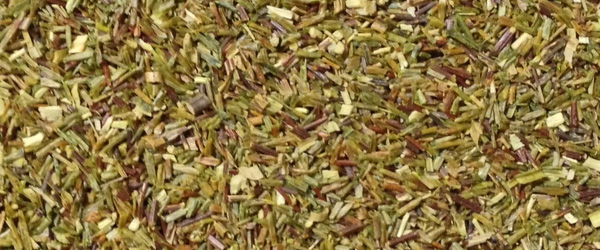
In green rooibos, the leaves (shaped like needles) are heated after picking to stop the oxidation process and keep the green color and mild flavor.
Rooibos has developed quite a following, especially with all of the press it’s been getting for being high in antioxidants. Only recently, however, have requests started coming in at the tea bar for “green” rooibos.
I am in the tea business because I love the flavors of tea. I’m not an herbalist, so everything I do with tea starts with the taste. I ordered in some green rooibos for the tea bar, and gave it a try. Green rooibos has minimal tannin content, so bitterness isn’t a danger. For my first try, I made a cup using 195-degree water (I’m at 5,500 feet altitude, so that’s about 7 degrees below boiling), and steeped it for 5 minutes. I used one tablespoon for a 13-ounce cup, and did not add anything (no lemon, sugar, milk…).
The first thing I noticed was the color. The liquid is a beautiful golden honey color, quite different both from most green teas and from the traditional red rooibos. The tea is smooth and woody, with just a hint of grassiness and nut flavor. True to promise, there’s no bitterness at all, and no need for additives. Just to push the limits, I re-used the leaves, steeping them for 10 minutes this time. The flavor and aroma were almost identical to the first cup.
There are a lot of claims out there about green rooibos being significantly higher in antioxidants than traditional red rooibos. A quick perusal of the research still shows mixed results on that, so I’m not going to take a position on the health effects. As I’ve mentioned before, I’m in it for the taste!
While writing this, I realized that I had tried it hot, but not iced. The folks over at Suffuse Rooibos say green rooibos makes a fantastic iced tea, so I took a break to make a cup of iced green rooibos (the research is the best part of this job!). I brewed it the same way (5-minute steep time), and poured it directly over a cup of ice cubes — again, I didn’t add anything to it. I found it refreshing and tasty; excellent for a hot day when I don’t want to overload with caffeine. I will definitely be drinking more of this!
 Tea With Gary