Category Archives: Blends

Earl Grey vs Black Tea

Man, I see these questions all the time on places like Quora. I used to get them in the tea shop all the time, too: What’s the difference between Earl Grey and black tea? How much caffeine is there in Earl Grey? What are the health benefits of Earl Grey compared to black tea?
Well, strap in and let’s see if I can cover it all in one article!
First, let’s get the basic facts on Earl Grey out of the way:
The original Earl Grey tea was black tea

Specifically, it was Earl Grey tea with bergamot oil added to it. (I know, that raises a new question. More on bergamot oil shortly…) Most, but not all, of the tea currently marketed as Earl Grey is still basically black tea with bergamot oil. That means the caffeine content is the same as black tea, the steep times are the same as black tea, and the color is the same as black tea. The aroma, however, is decidedly not black tea.
The origin story—who was this Earl Grey dude and why did he create this tea?—is one of the chapters in my book, Myths & Legends of Tea, volume 1. In short, Charles Grey II, Lord of Howick Hall, First Lord of the Admiralty, and soon to become the second Earl Grey, had really crappy water at Howick Hall. All of the limestone (just called “lime” by most at the time) in the water made the tea taste foul. Bergamot oil was the solution, as its strong aroma masked the bad stuff in the water.
Many people say Earl Grey smells “perfumey” because, well…
People have been using bergamot oil as an ingredient in perfumes and colognes for over 300 years now. Brands like Giorgio Armani, Christian Dior, Yves St. Laurent, Elizabeth Arden, Lancome, Calvin Klein, Oscar de la Renta, Donna Karan, Jimmy Choo, and many others put bergamot oil in various of their scents.
But what the heck is bergamot oil? Ready for the most unhelpful answer ever? It’s oil from a bergamot.
Okay, okay, I’ll explain. The bergamot, Citrus bergamia, is a citrus fruit native to southern Italy. It’s sometimes called a “bitter orange,” and to make your life just a little more complicated, it isn’t related at all to the bergamot herb, Thai bergamot, wild bergamot, or bergamot mint.

The bergamot oil is extracted from the rind of the fruit, and a little bit goes a long way! Typically, to make Earl Grey tea, the tea leaves are sprayed with a fine mist of bergamot oil and then packaged.
I keep referring to “most” Earl Grey teas
The Grey family never copyrighted the name Earl Grey for the tea, nor did they protect the formula legally. Although the original recipe was passed on to Twinings, anyone is free to make any variant they want and proudly brand it as Earl Grey.

There are Earl Grey teas out there using all manner of black teas as the base, not to mention all of the variants using green tea, white tea, herbal teas (“tisanes“), and other tea styles. I produced a number of these when I had my tea shop, including the oddly popular Mr. Excellent’s Post-Apocalyptic Earl Grey, which was made with lapsang souchong, a smoked black tea from China.
Most, if not all, tea companies that make Earl Grey teas do try to use different names if they don’t use the classic black tea base. You’ll see names like Earl Green, Duke Grey, Creme Earl Grey, Earl Greyer (one of my favorite names), and many more.
And then there’s Lady Grey

Neither the Grey family nor Twinings has any protection on Earl Grey. Twinings does, however, have a trademark on “Lady Grey.” Unless you have bigger badder lawyers than Twinings (and the budget to pay them), I strongly recommend coming up with a different name for your take on Lady Grey. My version, which was black tea, bergamot oil, and lavender flowers, was called Lady Greystoke, named for Tarzan’s wife, Jane, after they got married and she took his family name and the title that came with it.
The dreaded topic of health benefits
My regular readers know that I rarely discuss health benefits of tea unless there’s some really solid science behind it. There are so many claims with zero data to back them up, so many flawed studies, so many misinterpreted studies. It’s really difficult to sort things out.
I really really wanted to say up at the very top that the health benefits of Earl Grey are exactly the same as the health benefits of plain black tea. But I just can’t.
On one hand, we have the aromatherapy and essential oil folks, who claim that bergamot oil helps to heal wounds, reduce inflammation, cure acne, promote hair growth, reduce stress, fight food poisoning, lower cholesterol, fight liver disease, reduce pain, and more.
On the other hand, we have medical evidence that bergamot oil can be a skin irritant for some people, causing blisters, pain, difficulty breathing, nausea, and vomiting. Also, it is a known phototoxin. Exposure to UV light (such as sunlight or tanning beds) after an aromatherapy session with bergamot oil can cause severe burn-like reactions, and the International Fragrance Association restricts the amount of bergamot oil that can be used in leave-on skin care products. Healthline even states that bergamot oil can be poisonous and should never be swallowed, although they are talking about the pure oil, not the small concentrations found in Earl Grey tea.
And so in conclusion
What most people call Earl Grey tea is just black tea with bergamot oil, which doesn’t change the looks (reddish-black), caffeine (probably 40mg per cup or so), or calories (about 2 per cup). It does, however, affect the smell and flavor. The health benefits may be different, but the amount of bergamot oil in a cup of Earl Grey tea is so tiny (less than .25 grams in my recipes) that it’s probably insignificant.
So enjoy your Earl Grey, treat it as nutritionally equivalent to black tea, and if you want to read the whole story, please buy a copy of my Myths & Legends of Tea book. I’d sure appreciate it!

Making traditional masala chai at home
Before we address the topic at hand, may I take a moment to get something off of my chest?

Today we are discussing a tea called masala chai. The word “masala” refers to a yummy blend of spices, often containing cardamom, ginger, and pepper. The word “chai” means “tea” in Hindi (and Urdu, and Russian, and Bulgarian, and Aramaic, and Swahili, and a variety of other languages). Therefore, when you refer to “chai tea,” you’re talking about “tea tea.” Although most Americans call masala chai just “chai,” they really should be calling it “masala” or “masala tea” if they don’t want to say “masala chai.”
We can thank the coffee industry for confusing our terminology a couple of decades ago, as they coined the phrase “chai latte” to differentiate masala chai (traditionally made with milk) from coffee lattes. Your other word of the week is “latte,” which just means “with milk” and has nothing whatsoever to do with coffee. Tea made with heated and frothed milk is a latte, too!
Thank you. I feel better now. On to the aforementioned topic at hand:

I would never presume to tell you the right way to make a cup of tea. As I’ve mentioned so many times before, there is no single right way to do it. In this post, however, I will talk about one of the traditional ways to make masala chai. In India, where this concoction (or decoction, if you prefer) originated, it is almost always made with milk and sugar.
In a coffee shop, masala chai (which they usually call a chai latte) is almost always made from a pre-sweetened concentrate. It’s quick and easy to make, and it tastes pretty good. But it doesn’t taste like authentic masala chai.
In a tea shop, masala chai is usually brewed fresh from a blend of black tea leaves and masala spices. If they add milk, it is usually poured in after the tea is brewed, unless the tea shop is specifically set up for lattes. You get that fresh-brewed taste, but somehow the spices don’t seem quite right to me (my tea bar does it differently, but that’s a topic for another post).
At home, you can make it the way they do in India.
The masala spices
First of all, the masala spice mix and the tea (chai) are usually purchased and stored separately. Just as many Americans have a family chili or soup or cookie recipe, many Indian families have their own masala recipe handed down through the generations. You can research and experiment to come up with your own, or go to your favorite tea shop and see if they have a blend for sale. Many tea shops (including mine) will sell you the masala spice mix they use in-house without the tea.
If you’re really serious about it, you’ll make each batch up fresh, grinding cardamom, cloves, cinnamon, pepper, ginger, and whatever other spices you use as needed. I know a few folks that do it that way, but not many. I’d recommend starting with a mix that you like.
The tea
In India, the tea leaf of choice is usually a rich black Indian tea like Assam. It’s brewed pretty strong so that you can taste the tea through all of the spice and milk and sweetener. That doesn’t mean you need to use an Assam, but it’s a good place to start.
The milk
Milk serves a definite purpose in masala chai. You can extract flavor from many spices much better in fats or oils than you can in water, as any chef will tell you. Steeping the spice blend in milk will result in a richer, more nuanced flavor than steeping it in water. In India, the milk of choice is typically water buffalo milk, which can be difficult to get hold of here in North America. The usual substitute is whole milk, although 1% or 2% is common with the more health-conscious crowd. Nonfat milk is rather pointless, as the fat is the main reason for using it.
The sweetener
Sugar. Some drink their masala chai unsweetened, but if there is sweetener, it will typically be sugar.
That said, when I’m making masala chai at home, I usually use honey or agave nectar.
The process
You’ll need a pan, a stove, and a strainer to do this. This is my recipe for making enough for you and a few friends. Adjust accordingly if you’re drinking it by yourself.
- Heat up a pint (16 oz) of milk in the pan, but do not bring to a boil!
- Add 1-1/2 tablespoons of masala spice mix and simmer for five minutes, stirring gently
- Bring a pint (16 oz) of water to a boil in a kettle or microwave
- Add the water to the pan along with 1-1/2 tablespoons of tea leaves
- Stir in 1 teaspoon of sugar or honey
- Allow to simmer for another five minutes, stirring occasionally
- Pour through strainer to remove leaves and spices, and serve immediately
Put out more sugar or other sweetener for your guests. That single teaspoon is a lot less than a traditionalist would use, but I prefer to let everyone choose their own level of sweetness.
For best results, enjoy with your favorite Indian foods. Masala chai does a wonderful job of cutting the spiciness of curries. You can also use your masala chai tea in your Indian cooking: see my post on Chai Rice.
NOTE: The resulting masala chai will not look like the latte in the picture above. To get that look, I frothed up some milk and placed the foam on the top of the cup, and then added a dash of cinnamon powder.

Tea blends you can’t put in a bag
Before I get to the subject of today’s blog post, I’d just like to get a little announcement out of the way. My last post was the 100th post to Tea With Gary. Yay! Celebration! Fireworks!

Okay, now on to tea blends.
Professionals developing tea blends have several goals in mind beyond just making something yummy. One absolute requirement is that it has to be simple for the consumer to make at home. And by simple, I mean the instructions have to read like this: “Put ____ teaspoons of leaves in ____ ounces of water at ____ degrees, and steep for ____ minutes.” If at all possible, “water at ____ degrees” should be replaced with “boiling water,” but sometimes that’s not practical.
When I’m having fun with tea blends at home (or in my case, at the tea bar), I’m often faced with a conundrum. I want to combine significantly different teas, but they require different steep times or water temperatures — or sometimes both. A perfect example of this is the oolong/pu-erh blend that I made the other day.
I like the particular oolong that I used (Iron Goddess of Mercy) steeped for about three minutes. I wanted to try blending it with a loose-leaf ripe pu-erh, but I really didn’t like the results. Even if I backed off on the amount of pu-erh, that three minutes is just too long for me. If I steeped the blend as long as I’d steep the pu-erh by itself (about a minute and a half), then the oolong flavor didn’t come through properly.
For such an obvious solution, it took me the better part of a day to come up with it. Here are my instructions for this lovely blend:
- Place 1-1/2 teaspoons of Iron Goddess in 16-ounce infuser (or teapot) filled with 200 degree water
- Steep for 1:30
- Add 2 teaspoons of shu pu-erh to infuser
- Continue steeping for another 1:30
- Pour tea into mug, filtering out leaves
- Enjoy
The alternative would be to brew the two teas separately and then combine them in the cup, but that ends up being much more complicated and messy, and dirties two infusers. On the other hand, that method allows you to use the leaves more than once — and both of these teas lend themselves to multiple infusions. It also takes some experimentation to make that system work.
A direct translation of that infusion method to multiple infusers would look like this:
- Place 1-1/2 teaspoons of Iron Goddess in infuser (or teapot) with 8 ounces of 200 degree water
- Steep for 3:00 and pour tea into 16-ounce mug, filtering out leaves
- Place 2 teaspoons of shu pu-erh in a second infuser (or teapot) with 8 ounces of 200 degree water
- Steep for 1:30 and add tea to mug from step 2, filtering out leaves
- Once both teas have been blended in the mug, stir briskly
- Enjoy
If you just do the math here, it would seem to be a completely equivalent brewing process, but it’s not. The results are quite different when you steep 1-1/2 teaspoons of oolong in 8 ounces of water or when you steep 1-1/2 teaspoons of oolong in 16 ounces of water. Making that second method produce the same results would require a good bit of finagling.
For me, though, this game isn’t about producing the perfect cup for resale. It’s about experimenting with flavors, doing things that Lipton can’t put in a bag, and coming up with something I like. There are some blends that have worked very well for me this way. There are others that have pretty much bombed every time.
Among the experiments I’ve considered successful are adding fresh raspberries to pouchong oolong, adding a dash of zinfandel (wine) to an aged wild shu pu-erh, and mixing a short-steeped green tea with a long-steeped white tea. Primary among the bombs is blending green and black tea. Regardless of steep time and style, I have yet to find a combination I find palatable.
Don’t be afraid to experiment. Don’t be afraid to blend things together that might make your tea absolutist friends gasp. Tea should be fun.

Fun Blends: Terracotta Army Chocolate Pu–erh
My wife, Kathy, is a chocoholic who loves tea. She has tried chocolate tea blends from various companies, and decided that she’s not a fan of chocolate tea blends using mild-flavored tea. She likes to be able to taste the chocolate and the tea.
Gwen and Kathy and I experimented and came up with a blend based on a loose-leaf shu (ripe) pu-erh blended with cocoa nibs and vanilla. It was a struggle getting the balance just right, but the result was so good, we decided to give it a permanent home on the tea bar’s menu. After struggling for a while to come up with a name reflecting its Chinese origins: Terracotta Army Chocolate Pu-erh.
The Logo
I love having fun with tea logos. As I’ve mentioned before (see list below), a series of local artists have been creating logos for our house blends. This one was produced by artist (and art history professor) Kory Rountree:

We love that Kory started with one of the soldiers in the real Terracotta Army, made him chocolate, and gave him a cup of tea. He actually provided two logos for us to choose between. We picked the one above because it is clear, simple, and easy to identify even at small sizes. I actually prefer the alternative (shown below), but it’s just too complex to put on a little tea label.

The details are what really make this one. Note the eyes on the soldier above and left of the chocolate soldier. You can almost hear him thinking “Yummy!” The one above and to the right has a similar, but more subtle expression. It’s not obvious at first glance, but if you look closely, the soldier to the right of the chocolate fellow is holding a piece of the melted/broken chocolate arm in one hand, and a cup of chocolate pu-erh tea in the other.
Thank you, Kory! Another awesome logo for the collection!
This is the latest in a collection of labels I’ve written about here before:

Fun Blends: Fifty Shades of Earl Grey

At the height of popularity of the Fifty Shades of Grey books, we still owned a combo bookstore and tea bar. I was working on some Earl Grey recipes, and thought it would be fun to do a Fifty Shades parody since the books were still selling well. It was just for fun, and I didn’t think it would earn a permanent spot on our tea menu, but this odd blend became one of our top sellers.
DISCLAIMER: There is no connection whatsoever between this tea and the Fifty Shades of Grey books. This is not a licensed product, and it has not been endorsed or authorized. It is strictly a parody.
The tea is based on a Kenyan black tea with a bit of Ceylon and purple tea mixed in. Then, of course, it gets the bergamot oil that characterizes an Earl Grey—a lot of bergamot. On top of that is a melange of cinnamon, orange, lemongrass, cornflower petals, and other goodies. Some of the ingredients were added for flavor, and some for looks. I wanted a black & blue tea, and I wanted something with a dominating flavor. What can I say? I just couldn’t resist the wordplay.
Coincidentally, it’s certainly one of the prettiest teas we have. People couldn’t resist the tea shot through with color, especially the cornflower petals, which added nothing whatsoever to the taste.

The Logo
After a variety of local artists had been having the fun of producing logos for our house blends, I thought it was about time to do another one myself. Since drawing isn’t my strong suit, I decided to pick a blend where I could work from a stock photo to start, and Fifty Shades of Earl Grey would be a good one to start with.

For the background picture, I wanted to capture the feel of the book cover artwork without using any of their imagery. I found a stock photo I liked, clipped out a portion of the pot with the steam, extended the dark background, and then adjusted the tone to get that bluish-grey color we ended up with. For the text, I chose a typeface with the look & feel of an old typewriter font, but proportionately spaced, and then I kerned it to suit.
The tagline at the bottom? Well, once again, I just couldn’t resist.

Old familiar blends vs. creative house blends

It’s a dilemma for anyone who owns or manages a tearoom: how many different teas shall I carry and how many of them should be funky house blends? Looking at last year’s sales, our top four sellers were very traditional teas: an earl grey, a breakfast blend, a masala chai, and a Moroccan mint (note that only one of those is unflavored). The next six were all creative flavored teas.
Reading that may make you think that the classics aren’t important for the tea bar, but let’s look behind those numbers:
First of all, those only reflect our bulk tea sales, not sales by the cup. I don’t have a good system in place for tracking sales by the cup—especially since we make some special by the cup blends for our regulars—but I’d guess that a lot more of our cup sales are straight traditional tea than the bulk numbers indicate. When I’m behind the bar, I sell a lot of Darjeeling, assam, sencha, silver needle, dragonwell, Scottish breakfast, jasmine green, taiguanyin, and shu pu-erh by the cup.
Second, those numbers include web sales. On the web, there are many many sources for sencha or Darjeeling, and we compete against the huge Internet retailers who can undercut our prices. On the other hand, there is only one source for our house blends like Mr. Excellent’s Post-Apocalyptic Earl Grey or Coyotes of the Purple Sage. We sell very little dragonwell on the web site compared to our house blends.
When deciding what tea to carry in your shop, the first thing to ask yourself is, who is your target audience? If you want to capture the Celestial Seasonings fan, you want to have a lot of flavored blends with colorful logos and clever names. If you want to capture the serious tea fan, you’d better have a good selection of unflavored tea of various styles and origins.
Of the styles, a casual shop would be expected to have black and green at the very least, with at least one white and one oolong. A more serious shop should expand the oolong selection significantly and add a couple more white teas and at least one or two pu-erhs. The sign of a teahouse that really caters to the connoisseur would be an extensive collection of ripe (shu) and raw (sheng) pu-erh in both loose and cake form, and a yellow tea or two.
When it comes to origins, a shop can go two different ways: specialized or generalized. It’s easy to put together a tea selection covering every style if all of the tea comes from China. It’s possible to cover the four basic styles from countries like India and Kenya, although the selection of oolongs and whites will be pretty sketchy. In my opinion, a generalized shop should have tea from, at the very least, China, Japan, Taiwan, India, Kenya, and Sri Lanka.
If you are going to offer house blends, I’ve found that they do best with unique names, preferably tied to your theme or location. Your customers can find English Breakfast and Moroccan Mint anywhere, and many would argue that you should use exactly those names so that your customers can find something familiar. On the other hand, hearty adventurers who find a tea shop in New York offering Buffalo Breakfast and Manhattan Mint are likely to come back for more if they like it instead of just grabbing generic English Breakfast and Moroccan mint at the next store they see.
You’ll want to offer some caffeine-free alternatives as well. It’s a philosophical decision whether you want to offer decaffeinated tea, naturally caffeine-free alternatives (e.g., rooibos), or both. Lately, we have a lot more customers specifically looking for rooibos. Most of them want flavored blends, but there’s enough demand to keep plain organic red and green rooibos available as well.
The bottom line is that your tea shop should reflect your personality. If people want a drab corporate-looking shop, they’ll go to Teavana. An independent tearoom should be unique, and the tea selection is even more important than the decor in conveying that uniqueness.

Fun Blends: Coyotes of the Purple Sage

With new tea blends, sometimes we come up with the tea first and struggle to think of the perfect name. Sometimes we come up with a cool tea name and then spend weeks tweaking the formula until we find just the right taste. And then the logo works its way into the equation.
Sometimes, however, everything comes together in a flash, and that’s what happened with this tea.
We were looking for ideas for a fundraiser, using a tea that had a real American West flavor to it. Being a tea bar/bookstore combo, a literary allusion makes things even better. As we were throwing out ideas, someone said “Zane Grey.” The next obvious leap was “a Zane Grey Earl Grey.” The next obvious leap was to Zane Grey’s best-known book, Riders of the Purple Sage.
The ingredients for the tea came together pretty quickly as well. Black tea and bergamot oil are the base for most Earl Greys. Sage was pretty much a mandatory ingredient. A bit of lemon verbena and lemon thyme added more citrus notes and the thyme goes well with the sage (I will resist breaking into song here), and a subtle touch of peppermint finished off the blend.
The Logo
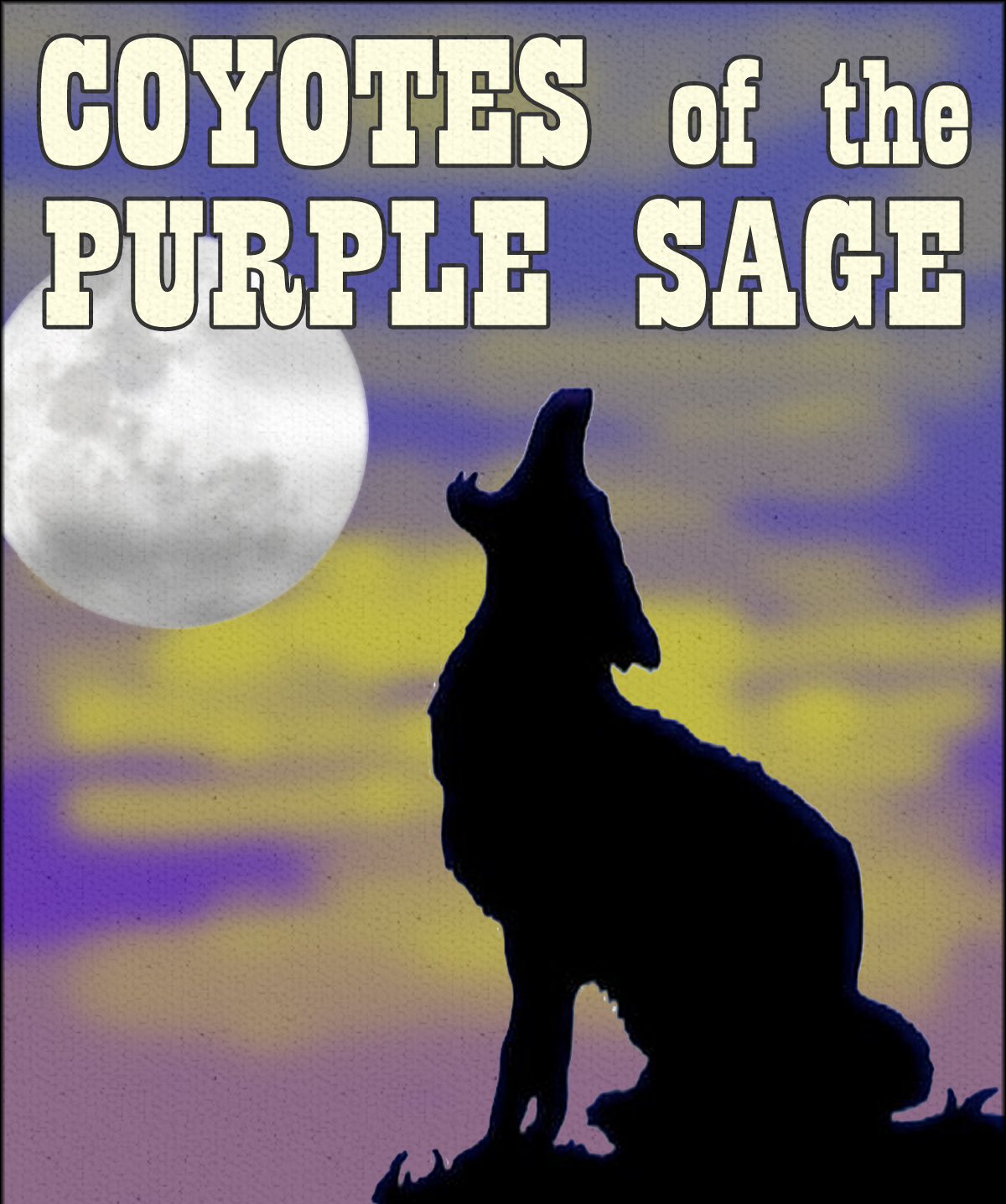
The fundraiser is for the Yellowstone Wildlife Sanctuary here in Red Lodge, and two of the well-known noisy critters right by the entrance are a pair of coyotes named Bonnie and Clyde. We wrapped everything up by tying in the Wildlife Sanctuary and naming the tea Coyotes of the Purple Sage.
My logo is an homage to the cover of the first copy of Riders of the Purple Sage that I read, shown in the banner at the top of this article.

The Lady Greystoke logo

Does it seem like I’ve got a theme going on this blog lately? I’ve had quite a few posts about the fun we’ve been having with logos for our house blend teas. Some great artist friends have done logos for us, including Al Jones (Hammer & Cremesickle Red Tea and Robson’s Honey Mint), Brandon Pope (Mr. Excellent’s Post-Apocalyptic Earl Grey), and Suzanna Bailey (MaterniTEA). Now, I’d like to introduce the latest in the series: Doug Bailey (Suzanna’s husband) made us a logo for our Lady Greystoke tea (the story behind the blend is here).
As with the other artists, I didn’t give Doug any direction at all beyond explaining the origin of the name and the ingredients in the blend. He picked up on the “wild yet civilized” aspect of Jane Greystoke, and being Doug (his nickname is “the Beerbarian”), he added a saber-toothed tiger. I don’t remember any saber-toothed tigers in the Tarzan books, but that’s probably just because Edgar Rice Burroughs didn’t think of it.
Doug is a pencil kind of guy, so he gave me the logo as a pencil sketch and I colorized it. I’ve always done my colorizing by scanning the image, loading it into Photoshop, making the background transparent, and then painting behind the image. This has the disadvantage of taking out light shading and fine detail from the original sketch, and Doug did a lot of shading in this one.
This time around, I added the color by creating new layers for each element (16 layers in this case) and setting the layer to a linear burn. That way, I don’t have to modify the original layer at all, and any shading—no matter how subtle—shows through the color.
As an aside, I’ve always preferred to drink my Earl Grey teas hot. I got to thinking about iced Earl Grey today when a customer ordered an iced Lady Greystoke at the Tea Bar, so I had to give it a try. The addition of the lavender, rooibos, and vanilla really seems to make this a smooth iced tea. I may be drinking more of it iced.

Fun Blends: MaterniTEA for Morning Sickness
I am a tea lover, not an herbalist. Let me repeat that for emphasis: I am not an herbalist. I am not trained in the healing powers of herbs (and I believe that most of the claims about most of the herbs are horse-hockey, but that’s another story), but I know what people ask for at the tea bar. We seem to have a lot of pregnant women in town these days, and most of them come in requesting either ginger or mint for their morning sickness.
I did some reading, and found that most of the published studies agree that those are two herbs that settle the stomach well. I know ginger works for me. Doing a straight ginger-mint blend, however, tasted pretty wretched. I started monkeying around with combinations—carefully avoiding caffeine—and came up with MaterniTEA. It uses green rooibos, Egyptian chamomile, and honeybush as its base, along with the aforementioned organic peppermint and ginger. A touch of orange extract for flavor, and we have something that tastes good as well as helping with the nausea that triggered this whole thing.
The Logo
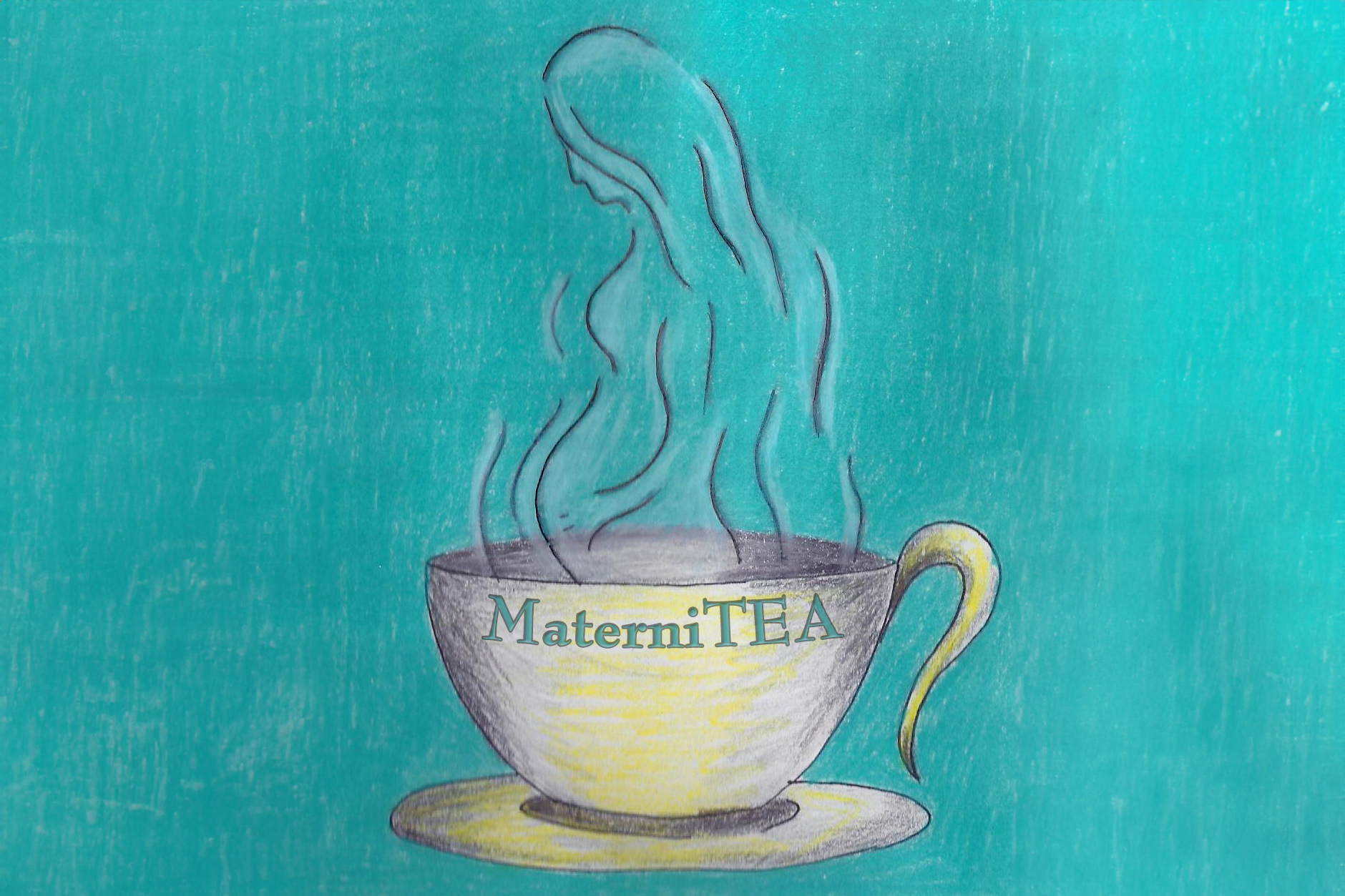
This logo was drawn by the lovely and talented Suzanna Bailey.In keeping with the philosophy I described in the last tea label post, I didn’t give Suzanna any specific instructions. I just described the tea and threw out a few adjectives like “soothing” and “relaxing,” and got out of her way. She came back with several pages of ideas and sketches, and one of them really caught my eye. My wife, Kathy, and I absolutely loved the look of the steam rising from a teacup in the shape of a pregnant woman.
Suzanna has an amazing eye for color, so she did all of the drawing and the coloring for this one—she just asked if I could fill in the lettering. Once again I am thrilled with the results and we’re having posters made of all of our custom tea logos.
Thank you, Suzanna!

Yet another new logo: Mr. Excellent’s Post-Apocalyptic Earl Grey

Such a delay! It was about eight months ago that I came up with the Mr. Excellent’s Post-Apocalyptic Earl Grey Tea blend (see my blog post about it here), and we finally have a logo for it! This one was drawn by my daughter’s friend from college, Brandon Pope.
I’ve found that logo art comes out better if I don’t tell the artist what I want, so I gave Brandon little more information than the name of the tea and what it is (an Earl Grey lapsang souchong). If I could draw, I probably would have done something with a dude sitting in the middle of a burned-out town, his shotgun at his side, drinking a cup of tea as the zombies eye him from a distance. In other words, something way too complex to use as a logo.
Brandon came up with the skull and gas mask, with one of the air filters replaced by a teacup. Very simple, yet immediately recognizable. His original was a hand-lettered pencil sketch (see below), which I needed to colorize. Brandon’s shading was great, especially where the texture of the paper showed, so I just added solid blocks of color behind the skull, mask, and teacup.
I really, really wanted to put this one on a black background, and I just couldn’t seem to make that work using his text. I re-did the text using a fun font called “Disgusting Behavior,” stretched vertically to achieve the look and aspect ratio that I was after. A blood-red color for the text with a subtle glow and an emboss effect finished it off perfectly.
For comparison, here is Brandon’s original pencil sketch (below) and the final logo (above). You can click on the final logo for a larger image.

This whole program of guest artists for tea logos (kicked off by Al Jones and his Hammer & Cremesickle logo) has been a blast. Thank you very much to Brandon for the artwork, and watch this space for guest logos by husband and wife team Doug and Suzanna Bailey, coming up soon.
 Tea With Gary