Author Archives: Gary D. Robson

Active vs. Passive Tea Consumption
There’s a big difference between the way tea is usually served in U.S. tea shops, and the way it’s served in Asia. I’ve been trying for a while to come up with the right words to describe it, and my friend Kory did the job for me last week.
Kory was sitting at my tea bar, trying to decide what he wanted as I was preparing myself some wild shu pu-erh in a gaiwan. I offered him a taste, and he said he’d give it a try. He watched as I went through the ritual and filled a small cup for him. He tasted it and said, “I’m looking for something more passive.”

My first thought was that he was referring to the process of preparing the tea (he wasn’t, but more on that later), and I realized that he’d just given me the words I was looking for. American/European tea drinking is passive, while Asian tea drinking is more active.
When my daughter and I went to Bellingham and Seattle last month, two of the tea shops we visited exemplified this perfectly.
The first was an English-style tea house called Abbey Garden Tea Room. We sat at a table and ordered our food and tea. They steeped the tea in the kitchen, and brought us teapots (with the tea leaves removed), tea cozies, and cups. All that was required of us was to pour the tea in a cup and drink it. The pots were large enough that we didn’t need refills during our meal.
The second was a Chinese tea house called Vital Tea Leaf. We sat at the counter and talked to the tea expert on staff (her name was Fang). She asked what kind of tea we liked, and set up a gongfu tray in front of us with an assortment of teaware. For each tea, we smelled the dry leaves and the wet leaves, and watched as she prepared a few ounces of tea in the gaiwan, gently agitating the leaves and fanning the aroma toward us.
The Abbey Garden experience was passive tea drinking. We picked tea we liked, and it became secondary to the rest of our lunch. We focused on the food and chatting with each other. With the larger British-style cups, we only had to refill a few times during the meal. At most American-style tea houses, those cups would have been even bigger — probably 12 to 16 ounces, and there would have been no refills required.
The Vital Tea Leaf experience was active tea drinking. There were no distractions, and we only got a couple of ounces of tea at a time. We were engaged in the process the entire time, and it was all about the tea.
Most of the time, passive tea drinking is fine with me. I am sipping on a large mug of houjicha as I write this, and although I’m enjoying it, the tea in my mug isn’t my primary concern at the moment.
But there’s a lot to be said for the active tea drinking experience. Watching the tea steep (experiencing the “agony of the leaf”), comparing the changes from the first infusion to the next, smelling, sipping, tasting, and concentrating on the tea you drink. I think after I press the “post” button for this article, I shall pull out the gongfu tray and gaiwan and actively drink some tea!
Sidebar: What Kory really meant
In my opening paragraphs, I spoke about my friend who gave me the idea for the terms active and passive, and mentioned that the whole subject of this article isn’t really what he meant.
What he was trying to say is that the taste of the tea itself can be active vs. passive. For you beer drinkers out there, here’s a comparison. You’ve gotten together with a bunch of friends to watch the game on TV. Your friend hands you a glass of beer just as there’s some great action going on. You drink the whole beer without having any idea what it was (it was probably Bud Light). There just wasn’t enough taste to get your attention. That’s a passive drink.
On the other hand, if he had handed you an oatmeal stout, a lambic, or a double IPA, you probably would have stopped what you were doing to focus on the beer. “Wow. What is that?” You would have smelled and sipped, savoring the beer and missing the touchdown that put your team in the lead. That’s an active drink.
The wild shu pu-erh I spoke of at the beginning of the article is most definitely active. There’s a lot going on in that tea. It’s rich, deep, and complex, with flavors and aromas that are very hard for me to identify. Kory was interested in a good, but passive tea. Perhaps a Keemun black. You taste it, notice it, and then drink the rest of the cup without paying attention.
Okay, Keemun tea lovers. I’ve painted the target on my back. I await your wrath.
Seasons of Tea
As my tea bar does more direct tea buying (as opposed to buying through distributors), I have an opportunity to taste some absolutely fascinating teas. As I tasted some estate-grown Darjeelings the other day, I was reminded of how much difference the picking time makes on the character of the tea.
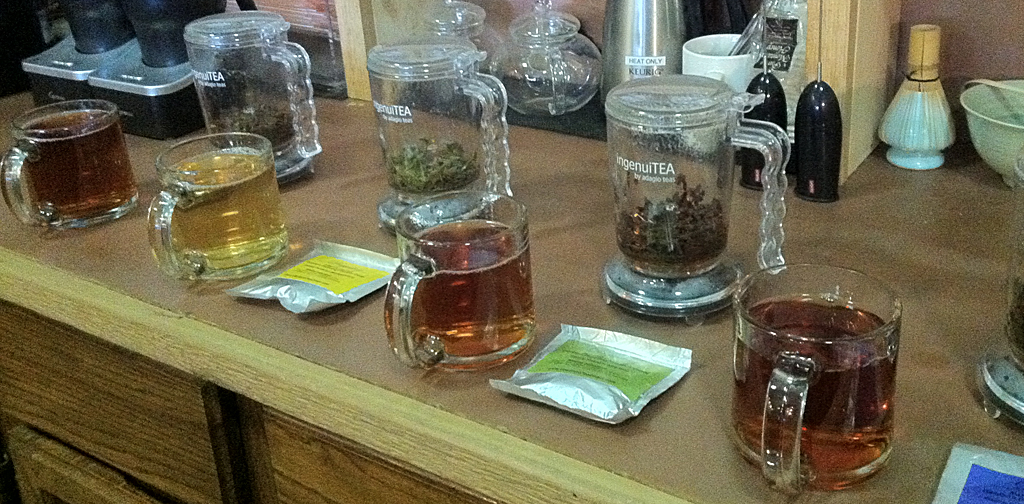
The three teas on the right side of the picture above are all Darjeeling teas from the Glenburn estate. The terroir is identical. It’s the same varietal of Camellia sinensis var sinensis (the Chinese tea plant) — all FTGFOP1 clonals. They are all black teas. They were steeped for the same amount of time using the same water at the same temperature. I used the same amount of tea leaf for each cup. What’s the difference?
- The light golden tea second from left is a first-flush Darjeeling, picked on March 20th. At that time of year, the spring rains are over and the tea plants are covered with fresh young growth. The tea is very light in color, and the flavor is mild but complex with a touch of spiciness. Although all four of the teas in the picture were steeped 2-1/2 minutes, I actually prefer my first flush Darjeelings steeped for a considerably shorter time (although everyone has different opinions on that). I’m drinking a cup as I write this, and it’s just about right at a minute and a half.
- The amber cup to the right of the first-flush is a second-flush, picked in June. The drier summer climate produces a heartier cup of tea, with a flavor often described as “muscatel.” There is more body and a bit more astringency as well.
- The darkest cup of tea on the far right is called an Autumnal Darjeeling. This one was picked on November 10th. By then, the monsoons are over and the new growth on the tea plants has matured. An autumn-picked Darjeeling will be darker in color, stronger in flavor, and fuller-bodies, but without as much of the spicy notes Darjeelings are known for.
These seasonal differences account for massive differences in caffeine content as well. Early in the season, tea plants will have more caffeine concentrated in the new growth, which is what’s picked for the delicate high-end teas. The data that Kevin Gascoyne presented at World Tea Expo last year showed a 300% increase in caffeine between two pickings at different times of year in the same plantation.
Comparing Darjeeling teas can be difficult, as much of the “Darjeeling” tea on the market isn’t authentic. According to this 2007 article, the Darjeeling region produces 10,000 tonnes of tea per year, but 40,000 tonnes is sold around the world. Even if you don’t consider the local consumption, that means 3/4 of the tea sold as Darjeeling is grown somewhere else. That’s why it’s so important to buy from a trusted source.
When selecting teas, we tend to look first at the production style (black, green, white, oolong, pu-erh), and then for the origin (a Keemun black tea from China is quite different from an Assam black tea from India). As consumers, we rarely know the exact varietal of the plant or the picking season, but those factors are every bit as important to the final flavor.
I suppose the main message of this article is that you can’t judge a tea style on a single cup. You may love autumnal Darjeeling and dislike first-flush. You may enjoy a second flush from Risheehat and not the one from Singbulli.
Teas, Tisanes, and Terminology
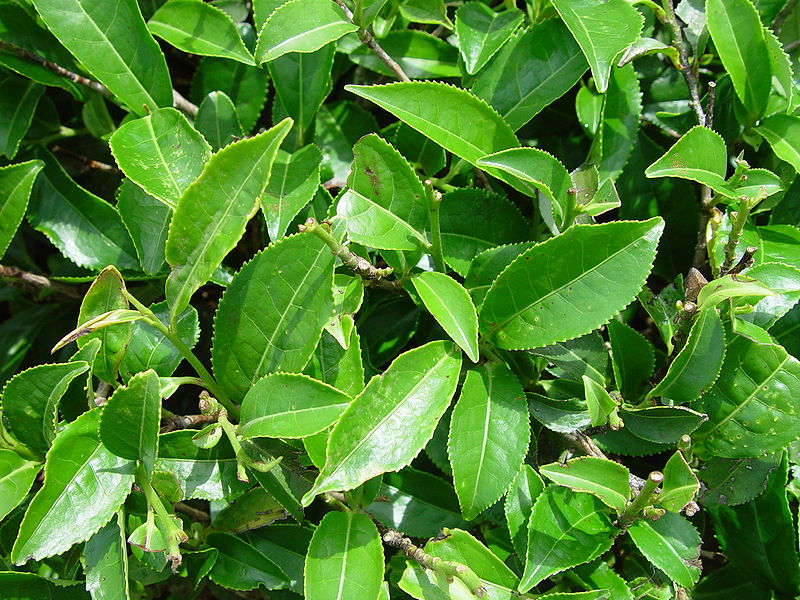
Language evolves. I get that. Sometimes changes make communication easier, clearer, or shorter. Sometimes, however, the evolution of the meaning of a word does exactly the opposite. The subject of this blog is a good example.
The word “tea” refers to the tea plant (Camellia sinensis), the dried leaves of that plant, or the drink that is made by infusing those leaves in water.
The word “tisane” refers to any drink made by infusing leaves in water. Synonyms include “herbal tea” and “herbal infusion.”
Technically speaking, all teas are tisanes, but most tisanes are not teas.
In today’s culture, however, practically anything (except coffee and cocoa) that’s made by putting plant matter in water is called a tea. What’s my problem with that? It makes communication more difficult, less clear, and less terse.
- There is no other single word that means “a drink made with Camellia sinensis.” If we call everything tea, then we have to say “real tea” or “tea from the tea plant” or “Camellia sinensis tea” or something similarly ludicrous every time we want to refer specifically to tea rather than to all tisanes.
- There is a perfectly good word for “leaves infused in water.” There is no need to throw away “tisane” (or “herbal tea” or “infusion”) and replace it with a word that already has another meaning.
“But Gary,” I hear you cry, “people have been calling herbal infusions ‘tea’ for a long time!”
That’s true. I sometimes slip and call rooibos a tea myself. “Herbal infusion” is even an alternate definition of tea in the OED. I still maintain, however, that it makes clear, precise communication more difficult when trying to differentiate between tea (made from the Camellia sinensis plant) and drinks made from chamomile, honeybush, and willow bark.
Rooibos
Other words that go through this process are forced through it. Rooibos, for example, is the name for a specific tisane and the plant it’s made from (Aspalathus linearis). The word is Afrikaans for Red Bush. Despite the longtime use of the term in South Africa (the only place the rooibos plant grows), it was almost unknown in the United States in 1994 when Burke International of Texas registered “rooibos” as a trademark. This meant that in the United States, only Burke and its subsidiaries could use the common name of the plant. Had Burke not surrendered the trademark after starting to lose lawsuits, people would have been forced to come up with a new word.
Unfortunately, that wasn’t a decisive victory, as the South African Rooibos Council is being forced to repeat the process now with a French company.
As more people in the U.S. discover green rooibos, the name “red bush” becomes more confusing anyway. Rooibos, in my humble opinion, should remain the generic term here.
Oxidation vs. fermentation
There are other words in the tea industry that suffer from ambiguity and questionable correctness. You will find quite a bit of tea literature that refers to the oxidation of tea as fermentation. I had a bit of a row with Chris Kilham — The “Medicine Hunter” on Fox News — about this subject (it starts with “Coffee vs. Tea: Do your homework, Fox News” and continues with “Chris Kilham Responds“).
Fermentation and oxidation are closely related processes. That’s certainly true. But oxidation is the aerobic process that is used in the production of black and oolong tea, and fermentation is the anaerobic process that’s used in the production of pu-erh tea. Using the word “fermentation” to describe the processing of black tea may fit with a lot of (non-chemist) tea industry writers, but it makes it difficult to explain what real fermented tea is.
Precision matters
In chatting with friends, imprecise use of words doesn’t matter. If someone asks what kind of tea you want and you respond, “chamomile,” it’s perfectly clear what you want. But you’re an industry reporter, medical writer, or marketing copywriter, your job is to communicate unambiguously to your readers. Using the most correct terminology in the right way is a great way to do that.

Quick and Easy Masala Chai Rice

Sometimes you want to add flavor to a dish without doing something complicated. A perfect example is plain white or brown rice. Here’s a nice trick, especially if you’re cooking Indian food.
All you have to do is follow the recipe for your rice, but substitute masala chai tea for the water. I recommend brewing the tea strong, using twice as much leaf as you’d normally use in that quantity of water. Add boiling water to the leaves and give it five to seven minutes to steep. Then strain off the leaves and spices, add the tea infusion to your rice, and follow the rest of the directions as normal.
This even works with instant rice, which can otherwise be pretty bland.

Fun Blends: Fifty Shades of Earl Grey

At the height of popularity of the Fifty Shades of Grey books, we still owned a combo bookstore and tea bar. I was working on some Earl Grey recipes, and thought it would be fun to do a Fifty Shades parody since the books were still selling well. It was just for fun, and I didn’t think it would earn a permanent spot on our tea menu, but this odd blend became one of our top sellers.
DISCLAIMER: There is no connection whatsoever between this tea and the Fifty Shades of Grey books. This is not a licensed product, and it has not been endorsed or authorized. It is strictly a parody.
The tea is based on a Kenyan black tea with a bit of Ceylon and purple tea mixed in. Then, of course, it gets the bergamot oil that characterizes an Earl Grey—a lot of bergamot. On top of that is a melange of cinnamon, orange, lemongrass, cornflower petals, and other goodies. Some of the ingredients were added for flavor, and some for looks. I wanted a black & blue tea, and I wanted something with a dominating flavor. What can I say? I just couldn’t resist the wordplay.
Coincidentally, it’s certainly one of the prettiest teas we have. People couldn’t resist the tea shot through with color, especially the cornflower petals, which added nothing whatsoever to the taste.

The Logo
After a variety of local artists had been having the fun of producing logos for our house blends, I thought it was about time to do another one myself. Since drawing isn’t my strong suit, I decided to pick a blend where I could work from a stock photo to start, and Fifty Shades of Earl Grey would be a good one to start with.

For the background picture, I wanted to capture the feel of the book cover artwork without using any of their imagery. I found a stock photo I liked, clipped out a portion of the pot with the steam, extended the dark background, and then adjusted the tone to get that bluish-grey color we ended up with. For the text, I chose a typeface with the look & feel of an old typewriter font, but proportionately spaced, and then I kerned it to suit.
The tagline at the bottom? Well, once again, I just couldn’t resist.
What’s the difference between Japanese and Chinese green tea?
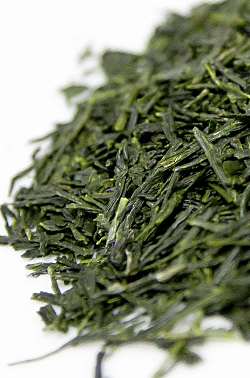
Japanese sencha leaves
As I did last month and the month before, I took a look at some of the search terms that brought people to this blog and found a question that I didn’t really address. This time: “What’s the difference between Japanese and Chinese green tea?” The obvious smart-aleck answer is that one comes from Japan and the other comes from China, but it runs a bit deeper than that.
First off, it’s not the plants themselves. The first varietal discovered of the tea plant is Camellia sinensis var. sinensis: the Chinese tea plant. About 1400 years ago, during the Sui Dynasty, Buddhist monks introduced tea — and the tea plant — to Japan. This means that the same varietal of tea plant is growing in China and Japan.
Terroir, on the other hand, can definitely have an effect. The climate, soil, and other factors can definitely affect the taste of the tea. Also, the Japanese have been crossbreeding and developing their strains of tea plant for over a millennium.
The biggest factor in the taste, though, is a very simple one: the process.
The difference between black tea and green tea is oxidation. Black tea is fully (or near-fully) oxidized, while green tea is not oxidized at all. There is an enzyme in the tea leaf that starts the oxidation process as soon as the leaf has been broken or bruised. Making green tea requires a “kill green” step that destroys the enzyme and stops the tea from oxidizing. That step requires heating the tea leaves quickly to at least 140 degrees.
To make Japanese green teas, such as sencha, bancha, and gyokuro, the leaves are steamed. To make Chinese green teas, such as dragonwell or gunpowder tea, the leaves are pan-fired. Just this simple difference in processing gives Japanese teas a rich grassy flavor and Chinese greens more of a vegetal character.
Granted, I am oversimplifying, but this is the fundamental answer to the question.
Tasseomancy
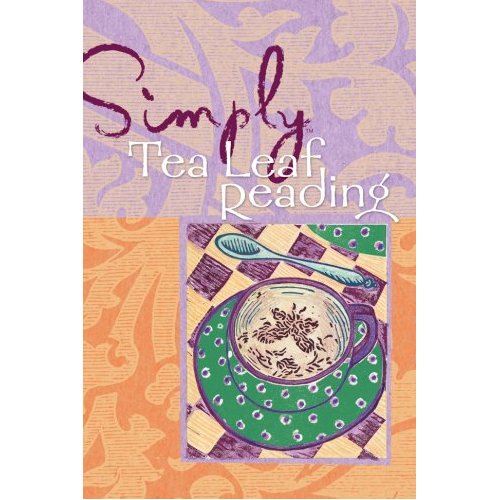
While perusing the Tea Guy Speaks blog, I came across an entry from last May about reading tea leaves (a.k.a. tasseomancy or tasseography). William does a great job of presenting a bunch of books about fortunetelling with tea leaves without really stating how he feels about tasseomancy. He doesn’t judge.
Well, I suppose somebody has to be the judgmental one, so I humbly volunteer my services.
For those unfamiliar with the practice, tasseomancy is the “art” of telling people’s fortunes by analyzing the positions of leftover leaves in a teacup. It is related to tea drinking in the same sense that astrology is related to astronomy. The former two involve Camellia sinensis leaves, and the latter two involve stars and planets. There, the resemblance ends.
Tea drinking certainly isn’t a hard science like astronomy is, but there’s a lot of science involved in proper analysis of the health benefits of tea, development and maintenance of new strains and varietals, developing repeatable and scalable production and farming techniques, and much more. Tea leaf reading, on the other hand, is an arbitrary assignment of meaning to the arbitrary positions of leaves in a cup, cultivated and developed into a complex fraud.
Yep, I used the word “fraud.” I went there. Performing tasseomancy can be a harmless party trick, or it can be a way of extracting cash from credulous people.
If someone accepts money for reading your fortune in tea leaves, they had might as well be stealing it. If five different fortunetellers read your leaves, they’ll get five different results. Heck, if the same one reads your leaves five times, they will get five different results. There’s no scientific basis for tasseomancy. I’ve never been able to find a study where a tasseomancer’s results were compiled and checked for accuracy.
I sell tea-related books in my bookstore/tea bar, but books on tea leaf reading are conspicuously absent. I’ll order one for anyone who asks, but I really don’t want to imply any kind of endorsement of the practice to my customers.
Please don’t misconstrue this as a complaint or condemnation of William’s blog post. I love his blog. Knowledge is power, and I believe in making information available to people. I also believe, however, in exposing scam artists, and that’s what people who perpetuate reading tea leaves for profit are.
Whole Leaf Tea
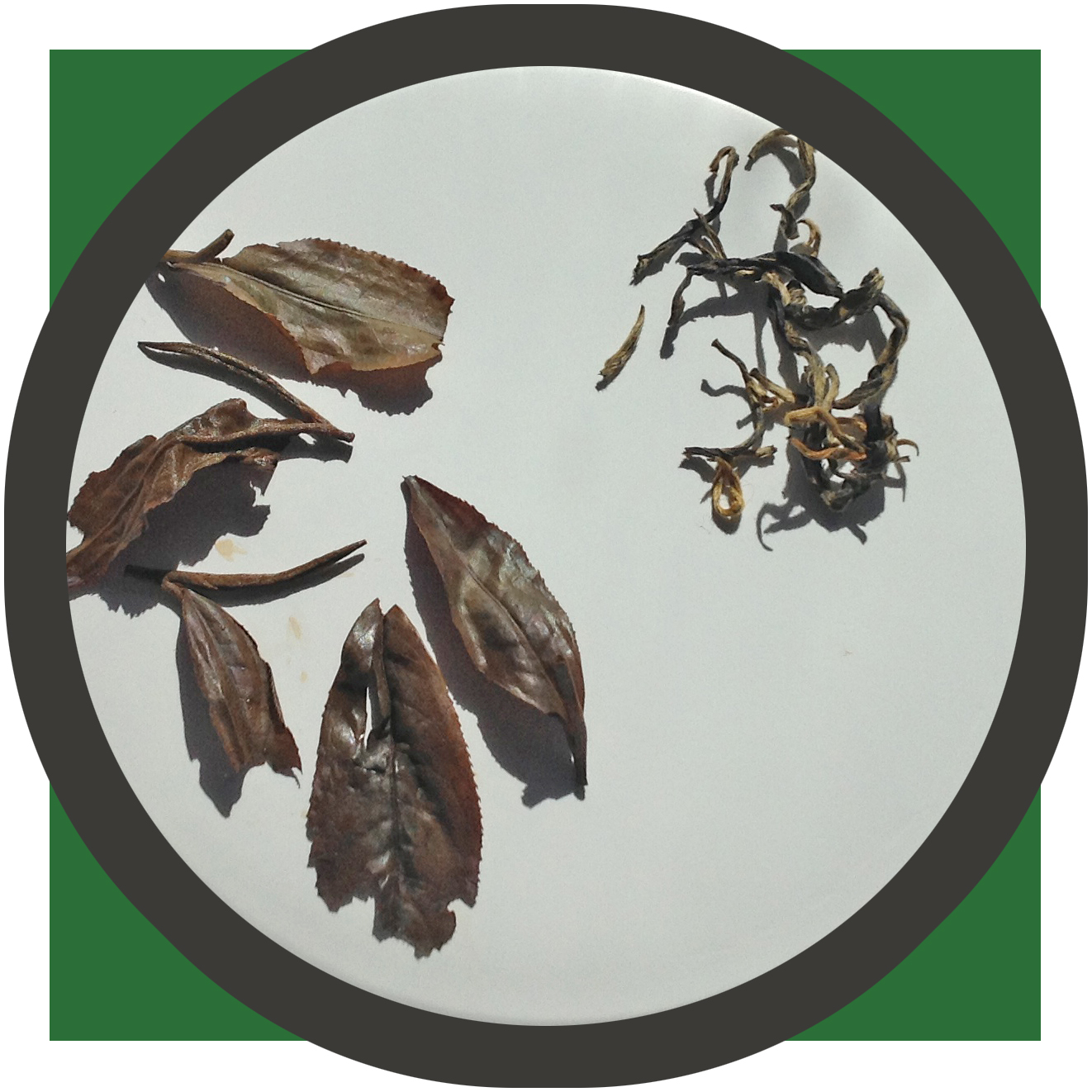 I try not to be a tea snob (or a Tea Nazi). You drink what you like and I’ll drink what I like. But being a part of the tea industry means I hear from a lot of people with — shall we say — very strong opinions. One thing we all seem to agree on is that we really prefer loose leaf tea to teabags. But why is that?
There’s a quality difference, perceived if not always actual. Ask a tea snob about Lipton tea and they’ll tell you those teabags are filled with the floor sweepings left over after all of the good stuff was packed up. There’s a hint of truth to it: the tea isn’t swept up from the floor, but it’s often fannings or dust. There’s a good reason for that, too. By breaking those tea leaves into tiny pieces, the water has much more surface area to interact with. That’s why teabags often produce a heartier, stronger, and more “brisk” cup of tea.
You can get larger leaf teas in bags, though, and the “pyramid” or “sachet” bags allow much more flow of the water through the leaves. Still, argue many in the business, the highest grades of tea are typically reserved for sale as bulk loose leaf tea, and that gives us a better-tasting cup when we use loose leaf.
There’s another factor, though. One that’s as much based on aesthetics as taste. I like the whole leaf teas because I like the leaves themselves. The picture above shows dry and wet leaves from a whole leaf Royal Golden Safari, one of my favorite black teas. It’s a whole-leaf black tea from Kenya. After you’ve steeped it, you can see the leaves and buds fully unrolled. You can smell the leaf, feel the texture. You can see the size and shape of the leaf. Experiencing the leaves becomes a part of experiencing the cup of tea.
Wine drinkers enjoys more than just the taste of the wine. They’ll swirl the wine in the glass to bring out the nose, watch the legs as it runs down from the rim, examine the cork for hints of how the wine aged. The tea equivalent is watching the “agony of the leaf” as the tea leaves expand fully in the pot or infuser, holding the leaf and comparing its smell to the aroma of the brewed tea, and examining the leaves to glean what information you can about the origin and preparation of the tea.

What is “brisk”? The Lipton people say it means “astringent.” I might say it refers to a cool afternoon on the back deck watching tea leaves unfurl in hot water as I anticipate the luscious cup that I am soon to enjoy.

How Are Samovars Used?

Following up on last month’s coffeemaker post, I was reviewing search results that brought people to my blog again and found a question I really didn’t answer. The search was about how to use a samovar to make tea. In my other samovar post, I talked about what samovars are, but not so much about how to actually use one. Let’s see if I can rectify that situation.
A traditional samovar has two parts: the water heating unit and a small teapot on top. Originally, the water was heated by coal or charcoal, with a chimney rising through the center. Nowadays, electric samovars are common — as much as you can call a samovar “common,” anyway. Either way, you can draw the hot water off from a spigot near the bottom. The spigot is visible, albeit not too clear, on the Turkish samovar pictured in this post.
The samovar would sit in the center of the room (and would help to heat the room, in fact). The main compartment of the samovar contained only water. The little teapot on top was loaded with rich black tea and allowed to steep all day long. When anyone wanted a cup of tea, they would pour a bit of the strong tea from the pot and then fill the cup the rest of the way with hot water.
After steeping that long, and being brewed so strong, the tea would be quite bitter. Depending on whether the samovar was being used by Russians, Turks, Georgians, or some other group, they might add anything from sugar to yak milk to the tea to cut the bitterness.
Today, the main compartment of the samovar may be used to brew tea — or just to keep it hot after being brewed in another vessel. That way, you can serve the tea from the spigot at the bottom of the samovar. The pot, if present, is often simply ornamental.

Old familiar blends vs. creative house blends

It’s a dilemma for anyone who owns or manages a tearoom: how many different teas shall I carry and how many of them should be funky house blends? Looking at last year’s sales, our top four sellers were very traditional teas: an earl grey, a breakfast blend, a masala chai, and a Moroccan mint (note that only one of those is unflavored). The next six were all creative flavored teas.
Reading that may make you think that the classics aren’t important for the tea bar, but let’s look behind those numbers:
First of all, those only reflect our bulk tea sales, not sales by the cup. I don’t have a good system in place for tracking sales by the cup—especially since we make some special by the cup blends for our regulars—but I’d guess that a lot more of our cup sales are straight traditional tea than the bulk numbers indicate. When I’m behind the bar, I sell a lot of Darjeeling, assam, sencha, silver needle, dragonwell, Scottish breakfast, jasmine green, taiguanyin, and shu pu-erh by the cup.
Second, those numbers include web sales. On the web, there are many many sources for sencha or Darjeeling, and we compete against the huge Internet retailers who can undercut our prices. On the other hand, there is only one source for our house blends like Mr. Excellent’s Post-Apocalyptic Earl Grey or Coyotes of the Purple Sage. We sell very little dragonwell on the web site compared to our house blends.
When deciding what tea to carry in your shop, the first thing to ask yourself is, who is your target audience? If you want to capture the Celestial Seasonings fan, you want to have a lot of flavored blends with colorful logos and clever names. If you want to capture the serious tea fan, you’d better have a good selection of unflavored tea of various styles and origins.
Of the styles, a casual shop would be expected to have black and green at the very least, with at least one white and one oolong. A more serious shop should expand the oolong selection significantly and add a couple more white teas and at least one or two pu-erhs. The sign of a teahouse that really caters to the connoisseur would be an extensive collection of ripe (shu) and raw (sheng) pu-erh in both loose and cake form, and a yellow tea or two.
When it comes to origins, a shop can go two different ways: specialized or generalized. It’s easy to put together a tea selection covering every style if all of the tea comes from China. It’s possible to cover the four basic styles from countries like India and Kenya, although the selection of oolongs and whites will be pretty sketchy. In my opinion, a generalized shop should have tea from, at the very least, China, Japan, Taiwan, India, Kenya, and Sri Lanka.
If you are going to offer house blends, I’ve found that they do best with unique names, preferably tied to your theme or location. Your customers can find English Breakfast and Moroccan Mint anywhere, and many would argue that you should use exactly those names so that your customers can find something familiar. On the other hand, hearty adventurers who find a tea shop in New York offering Buffalo Breakfast and Manhattan Mint are likely to come back for more if they like it instead of just grabbing generic English Breakfast and Moroccan mint at the next store they see.
You’ll want to offer some caffeine-free alternatives as well. It’s a philosophical decision whether you want to offer decaffeinated tea, naturally caffeine-free alternatives (e.g., rooibos), or both. Lately, we have a lot more customers specifically looking for rooibos. Most of them want flavored blends, but there’s enough demand to keep plain organic red and green rooibos available as well.
The bottom line is that your tea shop should reflect your personality. If people want a drab corporate-looking shop, they’ll go to Teavana. An independent tearoom should be unique, and the tea selection is even more important than the decor in conveying that uniqueness.
 Tea With Gary