Blog Archives

Tall Montanan is Tall?
I was perusing a post from a fellow tea blogger about World Tea Expo 2013 … well, perhaps I shouldn’t call it a “post.” It’s more of an essay. Or perhaps a minor tome. If you bound it in creepy leather and added a few paragraphs about demons, you could even call it a small grimoire. But I digress…
Ahem. Anyway. Geoffrey F. Norman (a.k.a. “the Lazy Literatus“) wrote about his experiences at the expo and featured a little snippet about me in which he mentioned one of my blends: Mr. Excellent’s Post-Apocalyptic Earl Grey tea. I mention this for four reasons:
1) He posted this picture of us with the caption, “Tall Montanan is Tall.”

Photo courtesy of Geoffrey F. Norman.
Copyright Geoffrey F. Norman 2013.
2) It’s a good blog post. If you’re interested in tea and/or World Tea Expo, I recommend giving it a look.
3) It reminded me that I promised to send him a sample of Mr. Excellent’s Post-Apocalyptic Earl Grey and forgot in all the hubbub. Sorry, Geoffrey. I’ll get that on its way ASAP.
4) And, last but not least, he’s a perfect example of not blogging on a schedule!

If I learn just one new thing…

Back in my days in the software industry, I used to put on a lot of educational seminars. One day, I was teaching an all-day session and noticed one of my customers, a gentleman by the name of Ken Combs, sitting about fifteen rows back in the audience. At the first break, I went over to him and said, “What are you doing here, Ken? You could be teaching this seminar!” I absolutely loved his response: “I figure if I can learn one new thing, then the whole day is worth it.”
Before using this insightful little anecdote to segue into the subject of this blog, I have to tell a little tale of that seminar. It was, as I said, an all-day seminar. I’m pretty good at projecting my voice, and when I’m dealing with small groups, I usually eschew microphones. This particular day, however, I had an audience of about 120 people and we were in a hotel ballroom with dubious acoustics, so I had a sound system. Like most hotel ballrooms, this one had accordion-style dividers that could separate it into smaller rooms, and we were using about a third of the room.
The morning session went well, but the afternoon became Public Speaker Nightmare #23™: there was a wedding reception in the other part of the ballroom. They had a live DJ. He had a much more powerful sound system than I did. After about an hour with my sound system cranked up all the way, shouting into the microphone, I called a quick break and strolled over to the reception, where I asked the DJ if he’d mind taking the volume down a bit because he was making my job impossible. “Not my problem, dude,” he said as he cranked his volume up higher.
We tried everything. We appealed to the bride. We called the hotel’s booking desk. We tried to find the weekend manager. And throughout it all, I shouted my voice raw trying to be heard in the back of the room. I couldn’t talk for two days after that (I’m not sure whether my wife wrote a thank you note to the bride for that or not), and we did end up getting a portion of our rent for the room refunded, but it made for one miserable seminar.
Despite all of that, Ken learned his one new thing and I applied his philosophy from my side of the lectern and got much more careful about room bookings for future events. Remember I promised to bring this back to tea? Well, fast forward twenty years or so, and here I am at the World Tea Expo. I still try to follow Ken’s philosophy, and it serves me well.
I attended two good educational sessions yesterday, which I’ll probably be writing more about: “Le Nez du Thé” (the nose of tea) and a tea blending workshop. I certainly learned more than one thing in each. After the exhibit hall closed, I went to the Tea Bloggers Roundtable. Mostly, I went for networking purposes, to meet some of these people I know only through their blog posts and tweets. It was a wonderful networking event, but even without that I learned something.
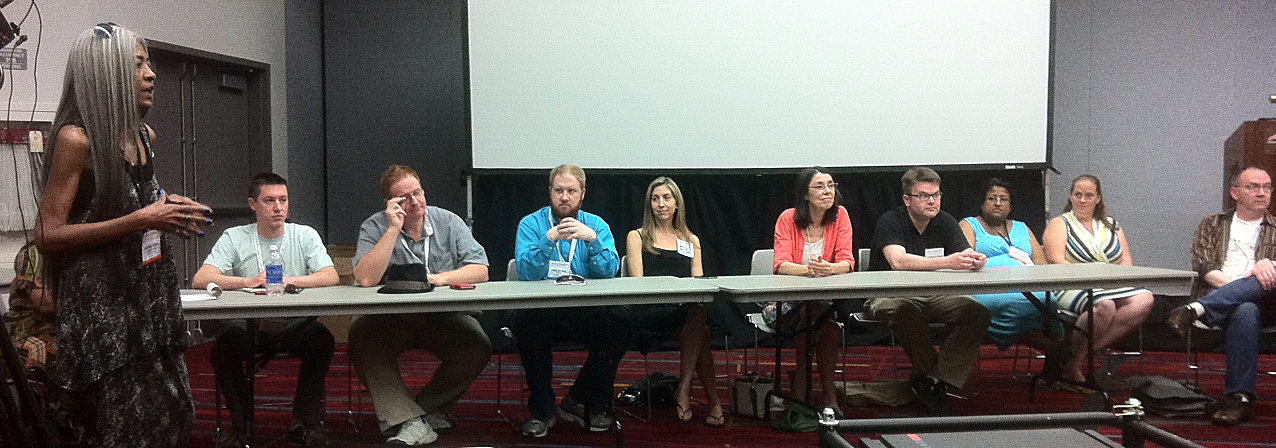
Yes, there was a bit of the mutual admiration society going on there, and the interplay was fun to watch (Godden and Coffey should take their show on the road), but it was also a very worthwhile session. There were more bloggers in the audience — including yours truly, of course — and the format was flexible enough that the distinction between panelist and audience member blurred. As everyone talked and questions were asked (and sometimes answered), it became clear that no two bloggers in the room really had the same objectives. For all of us, the blog is a representation of our personality enveloping the world of tea. Some of the blogs consist almost entirely of tasting notes (e.g., Nicole Schwartz’s “AmazonV” blog) and some have no tasting notes at all. We talked about tea, but mostly about the art of blogging, the expectations of our readers, and the trials and tribulations of trying to keep up any kind of a schedule for blog posts. I hope there’s another blogging event like this one again very soon!
Spelling Madness: Tieguanyin

In my first day at the 2013 World Tea Expo, I believe I have seen “Tieguanyin” (a wonderful oolong often called “Iron Goddess of Mercy” in English) spelled at least six different ways. In fact, a quick scan of this blog shows that I have spelled it at least three different ways. Tieguanyin, Tie Guanyin, Tae Guan Yin, Ti Kuan Yin, Tie Gwan Yin, Tie Kwun Yin… which one is right?
In reality, none of them are “right.” The name of the tea is Chinese, which is written in Chinese characters. Even in Chinese, there are two different ways to write it (鐵觀音 in traditional Chinese and 铁观音 in simplified Chinese). Some of the sounds in Chinese don’t translate clearly and unambiguously into English, and translations vary over time as well.
How important is it to have a consistent standardized spelling? I think a quick Google experiment will solve that. Let’s try Googling some different spellings and see how many hits we get (NOTE: I did this in 2013. Your mileage may vary):
- tieguanyin: 483,000 results
- tie guanyin: 776,000
- tie guan yin: 488,000
- ti kuan yin: 379,000
- tie kwun yin: 1,200,000
- tae guan yin: 39,000
And when I Googled “Iron Goddess of Mercy,” I got 341,000 results.
I’m not sure how much this reflects how common any given spelling is, and how much it reflects how good Google is at guessing what you mean. The Wikipedia entry for Tieguanyin came up as the top result for almost all of those searches, even though the article doesn’t use most of those spellings. How can we expect to reach agreement on the spelling of the name when producers can’t reach agreement on how much to oxidize the tea?
As with most ambiguous names, the best way to handle it is to pick a spelling and stick with it, something I’m still struggling with myself. You’ll never change the rest of the world, but at least you’ll be consistent.
Joining the Association of Tea Bloggers
 I (well, technically this blog) have been accepted for membership in the Association of Tea Bloggers. If you don’t work in the tea business, this probably doesn’t mean much to you, but I am very excited about it.
The association has been around for four years this month. It is comprised of people who blog primarily about tea, and there is a list of criteria for membership. What I really like about it is the connection with like-minded people. Some blog far more frequently than I do (you must write at least three posts a month to be accepted as a member) and some less. Some do straight text and some mix in video and audio. Some blogs are run by a single individual, and some by a group.
One of the benefits of membership is access to members-only discussion forums. I’ve used such forums in other businesses and found them invaluable when you’re looking for advice.
I’m hoping that some of the other members of the association will be attending World Tea Expo next week in Las Vegas. It would be nice to meet them face to face. If you’re a tea blogger and you’ll be there, let me know. We can get together for a cup and a chat. Or maybe even — dare I say it? — a beer.
Members of the general public who are interested in tea will find a different benefit from the association: the feed aggregator. This aggregator collects all of the posts from all of the member blogs and shows them all in one place. If you want to get a feeling for what’s going on in the world of tea, just browse through this feed and click on any post that looks interesting.
If you are a Facebook user, you can also pick up an aggregated feed of many of the blogs by visiting the Association of Tea Bloggers Facebook page.
As I get more involved with the Association of Tea Bloggers, I’ll make sure to write more about it.
Deepest Africa – The Tea of Kenya: Stop 5 on the World Tea Tasting Tour
When you think of tea, Africa probably isn’t the first place to pop into your mind, but Kenya is the largest exporter of tea in the world. Tea has revitalized their economy, and tea lovers everywhere became winners. Red Lodge Books & Tea works with family owned plantations in Kenya, and was the first tea bar in the United States to serve Kenya’s unique purple tea.

Kenya is known for its black tea, but with their expanding tea economy, the country has expanded into other styles. We tasted some green and white tea from Kenya, along with traditional estate-grown Kenyan black teas and with some fun and different tea you just can’t get anywhere else.
The teas we tasted were:
- White Whisper
- Rift Valley Green Tea
- Golden Safari (black)
- Lelsa Estate FBOP (black)
- Royal Tajiri (black)
- Purple Tea
A quick bit of background on Kenyan tea before we go any farther. As I mentioned earlier, Kenya is the largest exporter of tea in the world, and the third largest producer (after China and India). Largely because of the population difference, Kenya doesn’t consume as much of its product as China and India do. Kenya produces about 345,000 tons of tea per year, but consumes only about 32,000 tons of that. About 9.6% of the world’s total tea production comes from Kenya.
Those are fascinating statistics, but let’s put some human faces on them. When I wrote my first blog post about purple tea in 2011, I was contacted shortly afterwards by a Kenyan woman by the name of Joy W’Njuguna. I had the pleasure of meeting her in 2012 at the World Tea Expo, as you can see in the picture below. She’s not actually that short — it’s just that I’m six-foot-five and I’m wearing a cowboy hat, so she does look like a tiny little thing.
CAUTION: Before doing business with Royal Tea of Kenya or Joy W’Njuguna, please read my post from May 2014. There are at least a dozen companies (mine included) that report paying for tea and never receiving it!

I’ve learned a lot from Joy about Kenya and its tea industry. One telling tidbit is that about half of Kenya’s tea is produced by corporate farms, and the other half by independent growers. I have a soft spot in my heart for the independents, since I own a (very) independent bookstore and tea bar. Joy, in addition to representing her own family business, is involved in a collaborative export business that represents a coalition of independent family farms in Kenya. The big producers there are focused on producing very high volumes of CTC (Crush, Tear, and Curl) tea that ends up in grocery store teabags. The independent growers are focused instead on producing high-quality handmade tea that will catch the attention of the rest of the world.
I like being able to put a face to the products I buy. I like being able to show my customers a picture and say, “See these people? These people hand-picked the tea you’re drinking. Not machines. We know where the tea came from and we know what we’re buying.”

Some of the people who picked the tea we tasted at this class.
Well, that’s probably enough of a soapbox for the day — or maybe even the month. Let’s move on to the teas that we tasted. If you’re like most of my customers, you didn’t even know Kenya produced a white tea. Heck, until about a year and a half ago, I didn’t know either. So let’s start there:
White Whisper

Silver Needle is one of the flagship teas of China. White Whisper is not a clone, but a Kenyan tea made with the same process. The vast differences in terroir make show from the first sniff. It’s richer and earthier than Silver Needle. Even at the 5:00 steep time we used, it’s less delicate. Personally, though, I love the complexity of this tea. Just pay close attention to that water temperature. You pour boiling water over these leaves and you’re going to ruin it.
Rift Valley Green Tea

The first time I tried this green tea, I wasn’t really impressed. Since it’s a pan-fired tea, I followed the general guidelines for Chinese greens and steeped it for three minutes. Next pass, I read the tasting notes from Royal Tea of Kenya, which recommend a thirty-second steep. Really? Thirty seconds? Yep. That’s all this tea needs.
I love the fact that this tea comes from the slopes of Mount Kenya. Some of my best memories of my trip to Kenya when I was in high school center around that area and the day and night we spent at the Mount Kenya Safari Club. What a wonderful place!
Royal Golden Safari

I’ve written about this tea before. It’s one of my favorite black teas. In this session, as in most of my tastings, I got raised eyebrows from people when I poured this and told them it was a black tea. It brews up pale red with just a touch of astringency and appeals to many oolong drinkers. Unlike most black teas, I regularly get four or five infusions out of Golden Safari.
Lelsa Estate FBOP

Next, we moved on to a much more traditional Kenyan black. This FBOP is one of the ingredients I use in Gary’s Kilty Pleasure (my Scottish breakfast blend). The estate in Kericho participates in the Ethical Tea Partnership program, which I appreciate, and the tea has a deep red color and characteristic Kenyan “jammy” notes. The maltiness blends well with Assam tea, and those who take their tea English-style will appreciate how well it takes milk.
Royal Tajiri

“Tajiri” is the Swahili word for “rich,” and this tea lives up to its name. The finely broken leaves mean an intense extraction. If you’re a black tea lover, this one will give you everything you’re looking for — assertive astringency, deep red (almost black) color, and a very complex flavor profile.
Royal Purple Tea

I’ve written so much about purple tea on this blog (here, here, and here) that I’ll skip the background data — although the picture on that slide is new: the tea on the left is a traditional Camellia sinensis, and the one on the right is the purple tea varietal TRFK306/1. The molecular structure in the background of the slide is the anthocyanin. I didn’t have my shipment of handcrafted purple tea yet (and the sample didn’t last long!), so we were unable to compare the orthodox to the handcrafted. I will put up separate tasting notes on that when my main shipment arrives.
I will note that we brewed the orthodox purple tea for this tasting with 170 degree (F) water instead of boiling, as I’ve done in the past. The cooler water brought out more of the complex undertones of the tea and backed the astringency down, making it more to my liking. We tasted this side by side with and without milk. If you haven’t had this tea with milk before, add a bit just to see the fascinating lavender color that the tea turns!
Nandi Chai

I confess. I was bummed that we didn’t get our handcrafted purple tea in time for this event. I kind of unloaded on Joy about it, and she was good enough to find me something else fascinating and unique for this event: an African chai. The tea (a blend of purple and traditional black) is from Kenya and the spices are all from Ethiopia.
We closed the tasting with this unique chai, and it went over very well. Instead of taking up half of this post talking about it, I’m going to dedicate a whole blog post to Nandi chai in the near future.
This was the fifth stop on our World Tea Tasting Tour, in which we explore the tea of China, India, Japan, Taiwan, England, South Africa, Kenya, and Argentina. Each class costs $5.00, which includes the tea tasting itself and a $5.00 off coupon that can be used that night for any tea, teaware, or tea-related books that we sell.
For a full schedule of the tea tour, see my introductory post from last month.
Tea and caffeine part II: Exploding the myths

A misunderstood molecule
This article is the second of a three-part series.
Part I: What is caffeine?
Part II: Exploding the myths
Part III: Decaf and low-caf alternatives
It’s amazing. It seems like the more I learn about tea, the less I know — and the more I have to unlearn. Over the many years that I’ve been drinking and enjoying tea, I’ve picked up a lot of misconceptions. I’ve even been guilty of spreading a few of those. In the last couple of years, though, as I’ve been more actively studying tea, I’ve discovered the errors of my ways, and this article will serve both as an educational tool and a mea culpa for repeating things without doing my homework.
I already started the myth busting in the previous article with some discussion of decaffeination (Myth: decaf tea has no caffeine. Fact: decaf tea has had some of its caffeine removed). With no further ado, then, let’s continue the process by taking a look at a series of common myths and misconceptions about tea and caffeine, and the relevant facts for each.
You can decaffeinate tea at home with a short “wash”
I picked up this one in several books and numerous articles on the web. In its most common form, the myth says that if you add boiling water to your leaves, swish it around for a short time (most commonly 10 to 30 seconds) and then dump it, you’ve just removed most (claims range from half to 80% or more) of the caffeine.
Bruce Richardson debunked this in his article, Too Easy to be True: De-bunking the At-Home Decaffeination Myth, which appeared in the January 2009 Edition of Fresh Cup magazine. Working with a chemistry professor at Asbury College and one of his students, they determined that it took a 3-minute infusion to extract 46-70% of the caffeine from the tea leaves. You could do a 3-minute wash, I suppose, but you’d be extracting 46-70% of the flavor, too.
Kevin Gascoyne presented some of his research in a 2012 World Tea Expo seminar: A Step Toward Caffeine and Antioxidant Clarity. He used a batch of Long Jing Shi Feng (a green “Dragonwell” tea), which he steeped for varying amounts of time. He measured caffeine content of each infusion and graphed the results. At 30 seconds, a bit over 20% of the caffeine had been removed. By 3 minutes, it was around 42% (even lower than Richardson’s numbers). It was 8 minutes before 70% of the caffeine was extracted, and the graph pretty much flattened out there.
This process is roughly cumulative, so if you infuse your tea for 6 minutes, you’re getting about the same total caffeine as if you’d infused those same leaves 3 times, at 2 minutes per infusion. My favorite shu pu-erh may not have more caffeine than, say, your favorite sencha, but by the time I’ve finished off my 7th infusion — and you’ve infused your leaves once — I’ve probably consumed more caffeine than you have (although I’ve had 7 cups of tea and you’ve had 1).
Green tea has less caffeine than black tea
Pretty much every piece of research in the last decade has debunked this myth. And when I say “debunked,” I’m not saying that the opposite is true; I’m saying that different teas have different caffeine content, but the processing method has little to do with it.
For example, Kevin Gascoyne, in the seminar I mentioned above, presented a chart of the teas that he’d tested, ranked by caffeine content. Aside from the pu-erh teas clustering toward the center (we’ll look at why in a moment), the distribution of styles (white vs. green vs. oolong vs. black vs. pu-erh) was almost random. Even very similar teas had very different caffeine levels, like the Sencha Ashikubo with 48 mg of caffeine and the Sencha Isagawa with 12 mg.
As Gascoyne analyzed his data, he came to the conclusion that there’s a certain amount of caffeine in the tea leaves, and the processes of picking, crushing, steaming, pan-firing, rolling, oxidizing, fermenting, drying, and tearing neither create nor destroy caffeine (one exception to this, according to an article on RateTea, is that roasting a tea like houjicha can dramatically reduce caffeine). If a particular tea bush in Taiwan produces a very high-caffeine oolong tea, then that exact same bush would produce a very high-caffeine black or green tea.
The caffeine content depends on many things, including the varietal of bush, the type of soil, the fertilizer used (if any), the weather, the season when the leaves are picked, and maybe even the time of day. Richardson’s article says that adding nitrogen fertilizer can raise caffeine content by 10%. Gascoyne said he analyzed tea picked from the same plantation at different times of year and found dramatically different caffeine levels.
White tea has no caffeine (or very little)
This one is not only a bad generalization like the previous myth, but often completely backwards!
Another thing that affects caffeine extraction is the part of the plant you use. Caffeine is a natural insecticide. The caffeine tends to congregate in the newer growth, thus protecting the plant from bugs that might eat its tender shoots and young leaves. Richardson’s article described research results from Nigel Melican, the student doing the analysis. His caffeine percentage findings were:
Bud-6.3%
First leaf-4.6%
Second leaf- 3.6%
Third leaf-3.1%
Fourth leaf-2.7%
Leaf stalk-2.0%
Two leaves and a bud-4.2%
Since the finest white tea is often made from all buds or a bud-and-a-leaf, it will actually have significantly higher caffeine than a strong black tea made from the whole stalk or the 2nd-4th leaves.
When hydrating, you should avoid caffeinated beverages
According to Kyle Stewart and Neva Cochran in their seminar, Tea, Nutrition, and Health: Myths and Truths for the Layman, at World Tea Expo 2012, “studies show no effect on hydration with intakes up to 400 mg of caffeine/day or the equivalent of 8 cups of tea.”
The Food and Nutrition Board of the Institute of Medicine agreed. In their 2004 reference intakes for water, they state: “caffeinated beverages appear to contribute to the daily total water intake similar to that contributed by non-caffeinated beverages.”
In other words, if you want to drink six pints of water per day for health reasons, it’s perfectly fine to steep some tea leaves in that water before you drink it!
You shouldn’t drink tea with caffeine at night
Stewart and Cochran cited another study in their seminar which analyzed tea and sleep. They found that people unused to caffeine would experience longer times to fall asleep and lower sleep quality, as would people who consumed more than 400 mg of caffeine per day (around 8 cups of typical tea).
People who spread their consumption out through the day, maintaining caffeine in the system (cups at 9:00 am, 1:00 pm, 5:00 pm, and 11:00 pm) were able to sleep with little disruption.
But what if you have no tolerance for caffeine, or you need to maintain very low levels? In the third and final part of this series, we’ll explore some alternatives you might want to try.
Tea and caffeine part I: What is caffeine?
The most popular drug?
This article is the first of a three-part series.
Part I: What is caffeine?
Part II: Exploding the myths
Part III: Decaf and low-caf alternatives
In his excellent book, A History of the World in 6 Glasses, Tom Standage selected the six beverages that he felt had the greatest influence on the development of human civilization. Three of the six contain alcohol; three contain caffeine. Tea was one of the six.
Is it the caffeine that has made tea one of the most popular beverages in the world? The flavor? Its relaxing effects? I think that without caffeine, Camellia sinensis would be just another of the hundreds of plant species that taste good when you make an infusion or tisane out of it. Perhaps yerba maté would be the drink that challenged coffee for supremacy in the non-alcoholic beverage world.
“Caffeine is the world’s most popular drug”
The above quote opens a paper entitled Caffeine Content of Brewed Teas (PDF version here) by Jenna Chin and four others from the University of Florida College of Medicine. I’ll be citing that paper again in Part II of this series. Richard Lovett, in a 2005 New Scientist article, said that 90% of adults in North America consume caffeine on a daily basis.
But yes, caffeine is a drug. It is known as a stimulant, but its effects are more varied (and sometimes more subtle) than that. It can reduce fatigue, increase focus, speed up though processes, and increase coordination. It can also interact with other xanthines to produce different effects in different drinks, which is one reason coffee, tea, and chocolate all affect us differently.
Tea, for example, contains a compound called L-theanine, which can smooth out the “spike & crash” effect of caffeine in coffee and increase the caffeine’s effect on alertness. In other words, with L-theanine present, less caffeine can have a greater effect. See a great article from RateTea about L-theanine here.
Even though Part II of this series is the one that dispels myths, I really need to address a common misconception right now. First, I’m going to make sure to define my terms: for purposes of this series, “tea” refers to beverages made from the Camellia sinensis plant (the tea bush) only. I’ll refer to all other infused-leaf products as “tisanes.” Okay, now that we have that out of the way:
“All tea contains caffeine”
Yes, I said ALL tea. The study I mentioned a couple of paragraphs ago measured and compared the caffeine content of fifteen regular black, white, and green teas with three “decaffeinated” teas and two herbal teas (tisanes). With a five-minute steep time, the regular teas ranged from 25 to 61 mg of caffeine per six-ounce cups. The decaf teas ranged from 1.8 to 10 mg per six ounce cup.
That’s right. The lowest caffeine “regular” tea they tested (Twinings English Breakfast) had only 2-1/2 times the caffeine of the most potent “decaffeinated” tea (Stash Premium Green Decaf).
There are two popular ways to remove caffeine from tea. In one, the so-called “direct method,” the leaves are steamed and then rinsed in a solvent (either dichloromethane or ethyl acetate). Then they drain off the solvent and re-steam the leaves to make sure to rinse away any leftover solvent. The other process, known as the CO2 method, involves rinsing the leaves with liquid carbon dioxide at very high pressure. Both of these methods leave behind some residual caffeine.
(As a side note: I’m not a fan of either process. When I don’t want caffeine, I’d much rather drink rooibos than a decaf tea. I only have one decaf tea out of over 80 teas and 20 tisanes at my tea bar, and I’m discontinuing that one.)
This is why tea professionals need to make a strong distinction between the terms “decaffeinated” (tea that has had most of its caffeine removed) and “naturally caffeine-free” (tisanes that naturally contain no caffeine such as rooibos, honeybush, and chamomile).
“Coffee has more caffeine than tea”
Almost everyone will agree with the statement. For the most part, it is true, assuming you add some qualifiers: The average cup of fresh-brewed loose-leaf tea contains less than half the caffeine of the average cup of fresh-brewed coffee. In the seminar, Tea, Nutrition, and Health: Myths and Truths for the Layman, at World Tea Expo 2012, the studies Kyle Stewart and Neva Cochran quoted showed the plain cup of fresh-brewed coffee at 17 mg of caffeine per ounce versus the plain cup of fresh-brewed tea at 7 mg per ounce (that’s 42 mg per six-ounce cup, which agrees nicely with the numbers from the caffeine content study I quoted above).
Interestingly, though, a pound of tea leaves contains more caffeine than a pound of coffee beans. How can that be? Because you use more coffee (by weight) than tea to make a single cup, and caffeine is extracted more efficiently from ground-up beans than from chunks of tea leaf. Tea is usually not brewed as strong as coffee, either.
At another 2012 World Tea Expo seminar, A Step Toward Caffeine and Antioxidant Clarity, Kevin Gascoyne presented research he had done comparing caffeine levels in dozens of different teas (plus a tisane or two). The difference between Kevin’s work and every other study I’ve seen is that he prepared each tea as people would actually drink it. For example, the Bai Mu Dan white tea was steeped 6 minutes in 176-degree water, while the Tie Guan Yin (Iron Goddess of Mercy) oolong was steeped 1.5 minutes in 203-degree water. Matcha powder was not steeped per se, but stirred into the water and tested without filtering.
The results? Caffeine content ranged from 12mg to 58mg for the leaf teas, and 126mg for the matcha — which is higher than some coffees.
In our next installment, I’ll look at the myths regarding caffeine in tea, including what kinds of tea have the most caffeine and how you can remove the caffeine at home all by yourself — or can you?
Steeping Times

The World Tea Expo in Las Vegas has been a phenomenal (and somewhat overwhelming) experience. It will take quite a while for everything to sink in. There were some fascinating trends discussed at the show, and I also learned a lot about just how differently people enjoy their tea.
As I’ve mentioned in the past, I am not a tea Nazi. It matters not to me whether you make your green tea with boiling water, steep your Darjeeling for ten minutes, or whisk your matcha with an electric frother. However you enjoy your tea is the right way for you. Personally, I like my tea steeped much less than most of my friends. A couple of minutes is plenty for most robust black teas in my humble opinion, and I give many of them less than that.
Opening day at the Expo for me was the World Origins Tea Tour. We had presentations from representatives of eight different countries, and tasted teas from each one. The conference organizers were clever enough to put the seminar rooms directly across the hall from the restrooms and give us a 15-minute break between countries. Speaking on behalf of the entire audience, I’d like to give the World Tea Expo a hearty “thank you” for that move! I’d also like to compliment the staff on providing 140 people with 30 different teas to sample and getting them all out to us promptly, and prepared perfectly. In case you didn’t do the math in your head on that previous sentence, they served 4,200 cups of tea at the right temperature with both dry and wet leaves to pass around the table. That’s pretty darned impressive.
The audience members at the World Origins Tea Tour asked lots of questions, and many of them were about how the presenters preferred to make their tea. The first country presented was China, and the speaker said that he rarely steeped tea for himself more than about 30 seconds. I’ve been known to steep a nice aged pu-erh (or pu’er or puer or puerh or…) for 30 seconds, but have never actually tried such short steep times on other teas. He drove me to experiment. He also drove me to ask more questions around the show floor.
I came across a brochure that said the traditional way to prepare pu-erh tea was a ten-second “wash” (rinse the leaves in hot water and discard the water) followed by a twenty to thirty-second steep. I also came across a company that was handing out samples of some beautifully packaged single-serving pu-erh discs. The samples suggested a four-second steep time. Yes, I said four seconds. I asked the woman running the booth if that was right, and she said it was. She placed some tea leaves in the infuser of a glass teapot and poured boiling water through the infuser into the pot. The total steep time of the tea was the few seconds it took for the water to drain through the slits in the glass. She poured some for us, and it had plenty of flavor: rich and complex without being overwhelming.
A whole new world has opened to me. I’m going to be playing around quite a bit with über-short steeping times to see what I get. I’m anxious to get back to the Tea Bar and experiment with some of my friends.
As a side note, by the way, we were staying in the LVH (formerly known as the Las Vegas Hilton) in the block of rooms reserved for the Tea Expo. As with my previous experience at Bally’s, the front desk refused to provide any means of heating water in the room so that I could make my own tea. I went to the front desk and asked to speak to the manager. I explained that if their hotel was hosting the WorldTea Expo, they really should let us make tea. He explained that we could rent water heaters, but they only had two, and it cost twice as much to rent one as it would cost to run out to the store and buy one.
Unlike Bally’s, however, the LVH manager said that I could call room service and request hot water a few times a day if I wished. They would rush it up to the room at no charge and do their best to keep it hot. That still leaves them a notch below every cheap motel in Montana (which all provide free coffeemakers and wi-fi), but several notches above Bally’s. I know the decision not to offer a microwave in the room was made way above this manager’s pay grade, so I don’t blame him for the situation. In fact, I’d like to offer him a hearty thank-you for his exemplary customer service.
 Tea With Gary