Blog Archives

Jasmine Tea

Even purists who eschew “flavored” teas will often enjoy a cup of jasmine green tea. Perhaps it is because when you look at the loose tea, all you see is tea leaves; there are no visible indications that your tea leaves have been adulterated in any way. Perhaps it is because the affect of the jasmine in a well-made jasmine tea is delicate and subtle. Perhaps it is the rich history of jasmine teas.
Jasmine first made its way to China from Persia (now known as Iran) over 1,700 years ago, and it took hundreds of years before it was used to scent tea. Even then, it spread quite slowly, and it wasn’t until the Qing Dynasty, which began in 1644, that it became widespread.
The making of jasmine tea is quite different from typical flavored teas. Most flavored teas are either blends, where dry ingredients are mixed together, or tea leaves sprayed with flavor extracts, like Earl Grey with its bergamot oil. Jasmine tea, on the other hand, is scented rather than flavored.
In the traditional process, jasmine flowers are picked early in the morning, when the blossoms are still tightly rolled. Trays of processed and dried tea leaves (usually, but not always, green tea) are stacked in alternation with trays of jasmine. The trays have woven mesh or screens as bottoms, so as the jasmine blossoms open up and release their scent, it travels freely into the tea leaves over the course of about four hours.
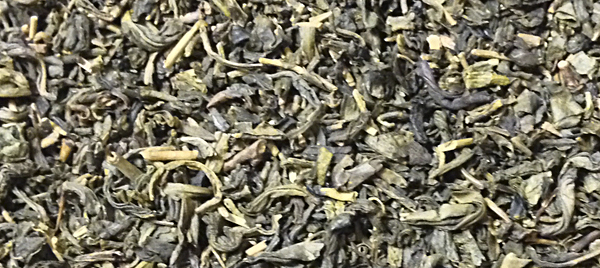
The tea leaves pick up moisture from the flowers along with the jasmine scent, so they have to be re-dried before they can be packaged. In the finest quality jasmine teas, this scenting process may be repeated half a dozen times or more. The finished tea has no jasmine blossoms in it — only the scent that has transferred.
How you prepare a cup of jasmine tea depends on the base tea used. If it is made form a green tea, as most of them are, then you’ll want to use 175-185°F (80-85°C) water, and steep for three minutes or less. Using boiling water is a quick way to ruin a good cup of jasmine tea — or any other green tea, for that matter — by bringing out unwanted bitterness.
Grades of jasmine tea vary with the quality of the tea and the process used. One of the popular higher-end styles involves tea leaves that are tightly rolled, often known as “jasmine pearls.”
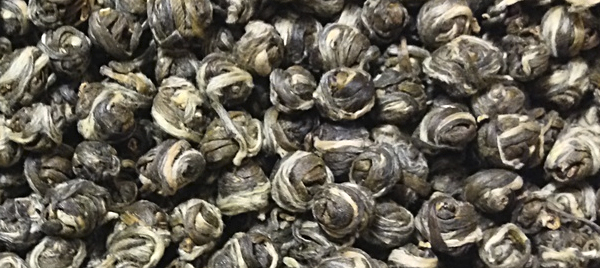
When drinking jasmine pearls, seven balls are placed in a small cup. Seven is considered good luck, so with jasmine pearls you don’t weigh them out or measure them in a tablespoon. Each rolled ball contains two leaves attached to a bud, which will slowly unfurl when the hot water is added.
Unlike most loose tea, jasmine pearls are infused right in the cup with no screens or filters, and you don’t remove them before drinking. The unbroken leaves assure that if you sip carefully, you won’t get a mouthful of leaf. If you’re drinking jasmine pearls with friends, the host should make sure that there’s always more hot water available to keep refilling the cups.
Jasmine blossoms certainly aren’t the only flowers used to scent tea — I’ve written about Vietnamese Lotus Tea, for example — but jasmine is definitely the best-known and most popular.
Japan – Bancha to Matcha: Stop 4 on the World Tea Tasting Tour

We’re very excited to be working with resident artist Karin Solberg from the Red Lodge Clay Center, and we are featuring some of her matcha bowls in the store, and she came in to talk about them at this stop in the tour.
The teas we tasted were:
- Organic Sencha
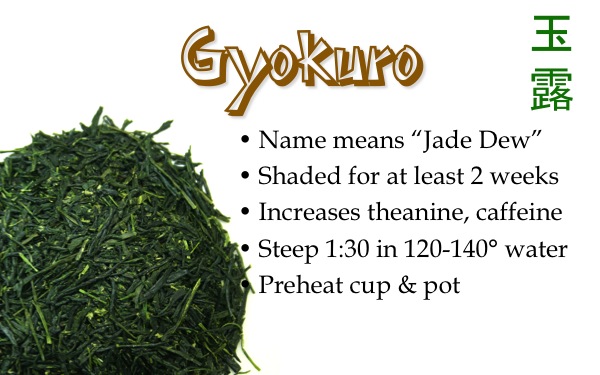
- Gyokuro
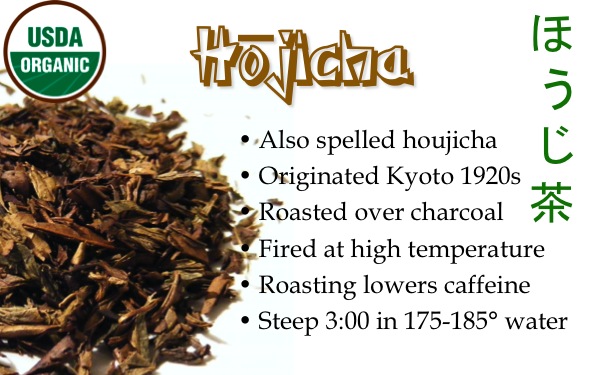
- Organic Houjicha (roasted green tea)
- Organic Genmaicha (toasted rice tea)
- Organic Matcha
- Kukicha (“twig tea”)
- Bancha (“coarse sencha”)
- Sencha (“decocted tea”)
- Gyokuro (“jade dew”)



What’s the difference between Japanese and Chinese green tea?
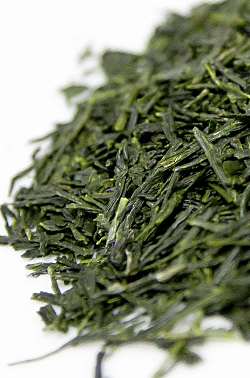
Japanese sencha leaves
As I did last month and the month before, I took a look at some of the search terms that brought people to this blog and found a question that I didn’t really address. This time: “What’s the difference between Japanese and Chinese green tea?” The obvious smart-aleck answer is that one comes from Japan and the other comes from China, but it runs a bit deeper than that.
First off, it’s not the plants themselves. The first varietal discovered of the tea plant is Camellia sinensis var. sinensis: the Chinese tea plant. About 1400 years ago, during the Sui Dynasty, Buddhist monks introduced tea — and the tea plant — to Japan. This means that the same varietal of tea plant is growing in China and Japan.
Terroir, on the other hand, can definitely have an effect. The climate, soil, and other factors can definitely affect the taste of the tea. Also, the Japanese have been crossbreeding and developing their strains of tea plant for over a millennium.
The biggest factor in the taste, though, is a very simple one: the process.
The difference between black tea and green tea is oxidation. Black tea is fully (or near-fully) oxidized, while green tea is not oxidized at all. There is an enzyme in the tea leaf that starts the oxidation process as soon as the leaf has been broken or bruised. Making green tea requires a “kill green” step that destroys the enzyme and stops the tea from oxidizing. That step requires heating the tea leaves quickly to at least 140 degrees.
To make Japanese green teas, such as sencha, bancha, and gyokuro, the leaves are steamed. To make Chinese green teas, such as dragonwell or gunpowder tea, the leaves are pan-fired. Just this simple difference in processing gives Japanese teas a rich grassy flavor and Chinese greens more of a vegetal character.
Granted, I am oversimplifying, but this is the fundamental answer to the question.
Copywriters and tea marketing experts

These days, you can’t be too careful what you say on a tea website. Last year, Unilever was warned by the FDA for claims they made about “Lipton Green Tea 100% Natural, Naturally Decaffeinated.” A week later, they warned Dr. Pepper Snapple Group about claims they made concerning “Canada Dry Sparkling Green Tea Ginger Ale.” Earlier this year, the FDA’s target was Diaspora Tea & Herb (d.b.a. Rishi Tea) for a wide variety of health claims on Rishi Tea’s website.
Given these warning shots fired across the bows of the big boys, the whole industry is being careful about making nutritional claims for tea. But we still need to say more about tea than just “this stuff tastes really, really good” — although that’s generally good enough for me.
For an example of how far companies are going these days, we got a promotional mailer today from Numi Tea. They are a fine company, and I’d be happy to resell some of their products in our tea bar. The mailer has some traditional marketing language (with appropriate footnotes, of course), just as I’d probably write myself:
“[Pu-erh]’s unique fermentation process results in more antioxidants than most green teas and is traditionally known to help weight management*, improve digestion and naturally boost energy.”
Well, I hope I wouldn’t write it exactly like that, but given a bit of tweaking to the grammar and punctuation, it’s a reasonable sentence.
The first claim is footnoted “*Along with a healthy diet and exercise.” Okay. I’ll buy that. Given enough healthy diet and exercise, lots of things help with weight management. The other two claims are very difficult to measure and/or prove. Vague claims typically don’t draw the ire of the FDA, so they’re probably safe.
But it was the next section that made me chuckle. It says, and I quote:
“Every blend is freshly brewed, made with full-leaf tea and uses 100% real ingredients for a pure Pu-erh tea taste.”
Wow! It uses 100% REAL INGREDIENTS! Is that the best they could do? Really? Can you imagine the certification process for that? “Is this an ingredient? Yep!” I carry 100 different teas in my tea bar, and I can guarantee you that every single one of them carries 100% real ingredients. Yep. Not an unreal ingredient in the bunch.
I did a bit of further looking, and found that the front cover of their mailer says, “Real ingredients. 100%. Nothing else.” There’s a whole section of their website called “100% real ingredients.” There’s a paragraph on that page of their site that says:
“For a pure, authentic taste, we blend premium organic teas and herbs with only real fruits, flowers and spices. We never use ‘natural’ flavorings or fragrances like other teas do.”
I’m pleased to hear that they only use “real” ingredients, and not “natural” ones like everyone else. Come on, Numi. You make some absolutely fantastic teas, and your organic and fair-trade programs are excellent. I’d like to see you spend more time talking about that — which really does differentiate your products — and less time talking about being “real,” which means absolutely nothing.
 Tea With Gary