Blog Archives

Tea plants as props? Thanks, #TeaAcrossAmerica!
When we first joined #TeaAcrossAmerica, I had visions of a big bushy tea plant in the front window at the shop. I still think we can build a neat window display around it at some point. When our tea plant, Tea H. White, arrived, the temperature outside was well below zero Fahrenheit. Even the windowsill seemed awfully cold for a little cutting that had just been shipped halfway across the country. So we set him on the tea bar instead.

Tea H. White today, about two months after his arrival in Montana.
Tea H. started out as a decoration and a passive tool for raising awareness of American-grown tea. Every now and then, I’d point at him and say, “that’s a tea plant.” Perhaps I’d explain what the significance is of Camellia sinensis and talk about Tea Across America. Perhaps not. But that slowly began to change.
I found myself saying things like, “we could make black tea, white tea, green tea, oolong, and pu-erh, all from this plant here.” I was pointing at the plant a lot.
Then it got more specific. I’d point at the bud and leaf at the end of a branch and say, “this right here is where the plant concentrates its caffeine.” I’d point at a smaller, brighter-colored leaf and say, “this leaf would find its way into something like this oolong tea we’re drinking, but this big leaf down the stem would probably be broken into dust and stuffed in a Lipton teabag.”
In the last week, I’ve referred to little Tea H. White every day.
I brewed up some taiguanyin, and showed a customer the dried, rolled-up, tadpole-shaped leaves. Then I pulled an unraveled leaf from the infuser and held it next to a similar-sized leaf on the tea plant to show that it really is a whole tea leaf.
I showed someone the soil in the plant’s pot and explained that Camellia sinensis can grow on steep hillsides at high altitudes where other crops can’t thrive, and talked about what that’s done for the economy in places like Kenya’s Rift Valley.
I was talking about the ancient tea forests near Mannong and Manmai in the Yunnan province of China, and I walked over to Tea H. White and said, “little tea plants like this one can grow into 30-foot trees and live for a thousand years or more.”
Just today, someone asked what variety of tea Orange Pekoe is. I started to explain that it’s not a variety, it’s a grade. Then I went over to the tea plant and showed them what a pekoe is.
My tea plant has become an educational tool.
As I’ve said many times before, the primary job of a tea vendor today is education. Learn everything you can about tea, and then pass it on to your customers. It pays back in spades when you can find the perfect tea for somebody and they turn into a tea fan (and a loyal customer)! I live for the aha moment, when somebody really “gets” what tea is all about. Having a real, live tea plant sitting on the tea bar makes for more of those moments.
Someday, that plant will grow into a tea bush, and we’re going to produce a batch of tea from it. Between now and then, however, the plant will help to educate hundreds of people about the world of tea.
Champagne, Tequila, Darjeeling, and Dark Tea
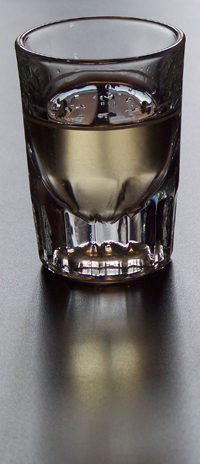
If you make a carbonated white wine, it’s called a “sparkling wine,” unless you are producing it in the Champagne region of France. Then, and only then, should it be called Champagne. I say “should” because there are a number of countries that didn’t sign (or don’t honor) the treaties involved, but that’s a whole different blog post.
The same applies to beverages made from distilling blue agave cactus. If you are in the Mexican state of Jalisco, or designated portions of certain other states, you may call that beverage Tequila. Otherwise, you have made mezcal.
The theory behind these distinctions is not so much the strict corporate trademark enforcement that governs most usage of names in the U.S. It is more a question of terroir. If you were to take two cuttings from the same grape vine and plant one in Napa Valley, California and the other in the Rhine Valley of Germany, you would get different wines from the two vines. Terroir describes the effect that the soil, weather, drainage, and related geographical factors have on the resulting taste of the beverage, whether it be wine or tea.
Darjeeling tea is often called the Champagne of tea (this appellation is usually reserved for first flush Darjeeling tea, but we’ll ignore that distinction for the moment). This little factoid has little to do with the subject of the article, but does make for a marvelous segue from alcoholic beverages to teas, n’est pas?
Like Champagne and Tequila, Darjeeling refers not only to a particular style of tea, but to the origin of that tea: the Darjeeling district of West Bengal, India. Darjeeling tea is unique because of its terroir, but also because of the varietal of the tea plant that they use. Most tea grown in India comes from Camellia sinensis var assamica (the varietal native to India), but Darjeeling tea comes from Camellia sinensis var sinensis (the varietal native to China). Combining the terroir of West Bengal with the flavor of the Chinese tea plant produces the tea we’ve all come to know and love.
And, finally, we get to dark tea
Another geographically-named tea style is pu-erh (also spelled pu’er or puer), named for the town in the Yunnan province of China where the style originated. Only recently has the tea industry really started using the more generic name of “dark tea” to refer to fermented (as opposed to oxidized) teas.
There are two ways to make pu-erh: sheng and shu (also spelled shou).
SHENG (a.k.a. raw or green pu-erh) is the more prized by collectors. The tea is stored in a slightly damp humidity-controlled environment and allowed to slowly ferment. It’s generally not considered ready to drink for years after being picked. Shengs have the same vegetal flavors and aromas as a good Chinese green tea, but with very complex earthy undertones.
SHU (a.k.a. ripe or cooked or black pu-erh) gets a bacterial “kick-start” to the fermentation process, so it’s ready to drink within a matter of months instead of years. Shu pu-erh requires very little steeping time (I’ve spoken to producers that recommend as little as ten seconds), and many pu-erh drinkers start with a “wash,” where you add boiling water, swirl for a few seconds, and pour it off before doing a “real” steeping. Shu pu-er tends to be extremely earthy, with a “composty” undertone. The flavor profile is even richer and deeper than a strong black tea (often reminiscent of a good Keemun), but with very little astringency.
There are several common shapes of pu-erh cakes, including rectangular bricks, bird-nest shapes (“tuo cha”), and flat disks (“beeng cha”).

The standard size for a beeng cha (like the one pictured above, which I wrote more about) is 357 grams, although they can be found in smaller sizes as well. I’ve found several suppliers for 100g beeng chas lately, which is a more affordable alternative for someone new to dark teas or someone sampling a new variety.
Tuo chas, on the other hand, are available in a wide variety of sizes usually centered around 80-120g. Mini tuo chas have become quite common. Each is a single serving of tea, roughly 5g.
Bricks can be found in a variety of sizes as well.
Something new (to me, anyway) is the log-shaped dark tea. My wife, Kathy, and I found these at the World Tea Expo (the big annual industry trade show for tea people) a couple of weeks ago. The ones we purchased for our tea bar are logs about 3.625 kilos (8 pounds), 25 inches long by 5 inches in diameter. We’re selling a single log in its bamboo wrapping with a canvas carry tote for $99.99, but most people will be more interested in slices taken from the log.
In the picture below, Kathy and I are posing with what the tea grower calls the world’s largest log of dark tea. If it puts the size of that tea log in perspective, I am 6’5″ tall (195 cm) not counting the hat and boots. Not having a spare thousand dollars laying around, we didn’t buy that one!

All the Tea in China: Stop 1 on the World Tea Tasting Tour
 Legend says that tea originated in China in 2737 B.C., over 100 years before the first Egyptian pyramid was built. In this first stop on our tasting tour, we explored China’s best-known tea growing areas in Yunnan, Anhui, Zhejiang, and Fujian provinces. We also took a look at traditional Chinese teaware, including gaiwans and guangzhou teapots.
The teas we tasted were:
- Organic Longjing Dragonwell (green)
- Organic Pinhead Gunpowder (green)
- Jasmine Dragon Tears (green)
- Silver Needle (white)
- Organic Shui Xian Wuyi Oolong
- Organic Keemun Mao Feng (black)
- Organic Golden Yunnan (black)
We started out by taking a look at the legend of the history of tea, going back to Emperor Shennong in 2737 B.C., and then talking about the major tea growing provinces of China. Four provinces were represented in our sampling: Yunnan, Anhui, Zhejiang, and Fujian. Obviously, this is just a beginning, but in a single short class, we can’t hit them all.
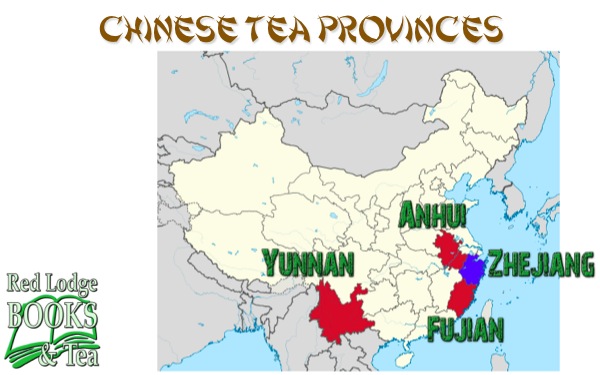
After the background was covered, including varietals of the tea plant, we launched into the individual teas, organized by style.
White Tea
First was white tea, the most lightly processed. I chose a Silver Needle blend from Rishi instead of a single-origin tea for this one mostly because our focus was comparing Chinese white tea with green and oolong teas. At some point down the road, we’ll do a comparative white tea tasting where the focus will be on terroir and origin.

One of the bullet points on the slide is an important one: busting the caffeine myth of white tea. The fact that this tea is made from early-picked buds means that there is a high concentration of caffeine. The preparation style does nothing to change that. The longer steep times we typically use on white tea just accentuates this.
We steeped the tea for five minutes in 165 degree water.
Green Tea
I chose three different green teas for the tasting. Each brought something completely different to the party.

First – a straight green tea very typical of Chinese fare, with a history dating back well over a millennium. The name of the tea comes from the finely-rolled leaves resembling gunpowder.
We steeped the gunpowder tea for three minutes in 175 degree water.

I simply couldn’t resist including the original story (fable?) of Longjing tea here, which I’ll be covering in much more detail in the future. Of all of the green teas I’ve tried, this is the one I keep coming back to as my favorite.
We steeped the dragonwell tea for three minutes — although I only do two minutes when I’m brewing it for myself — in 175 degree water.
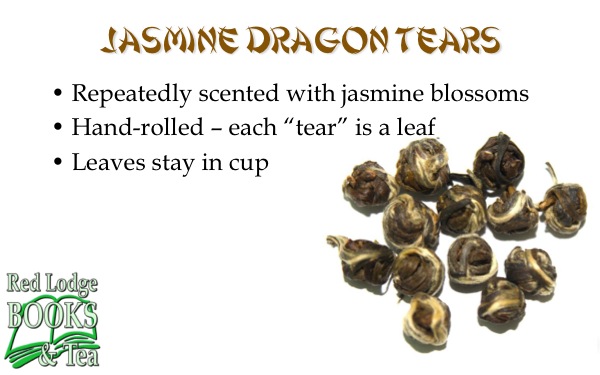
And finally, we come to the only flavored tea of the evening. We followed tradition with this tea, placing seven tears in each cup and sipping the tea as the leaves unfurl. Unlike all of the other teas we tasted, this one didn’t have a fixed steeping time. Everyone began sipping after a minute or two and kept sipping as the character changed over the next few minutes. We used 175 degree water.
Oolong Tea
We could have easily set up an entire evening just tasting Chinese oolongs (we are, in fact, doing this with Taiwanese oolongs on March 29), but for tonight we chose only one: an oolong from the Wuyi mountains.

It was a very difficult choice deciding which oolong to include. My first temptation was Tieguanyin (Iron Goddess of Mercy), but since I had two rolled teas already I decided to go with an open-leaf oolong.
We brewed this for three minutes in 195 degree water.
Black Tea
And finally, we moved on to black tea. Choosing only two black teas to represent China wasn’t easy (although it was a lot easier than choosing a single oolong), so I simply went with my two “leaf and a bud” favorites: one fully oxidized rich black with overtones of red wine (Keemun Mao Feng) and one lightly oxidized golden tea from Yunnan.

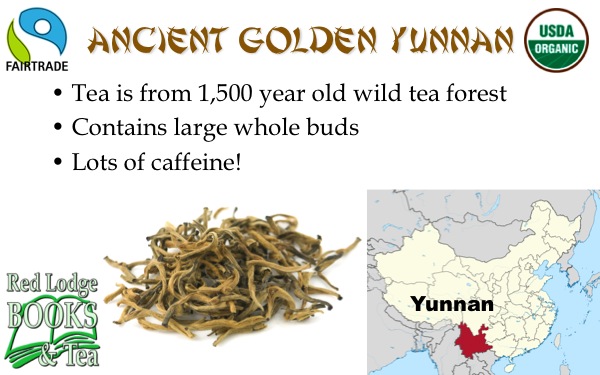
This was another case where I steeped the teas both at three minutes in boiling water for a better comparison, but when I drink them myself I prefer about 2:30 for the Keemun and 4:00 for the Yunnan.
We closed out the evening with a discussion of steeping times, water temperatures, multiple infusions, and other factors involved in preparing a great cup of tea. As always, I ended with the admonition to ignore the Tea Nazis and drink your tea however you like it.

If you live in the area and were unable to attend this session, I sure hope to see you at one of our future stops on our World Tea Tasting Tour. Follow the link for the full schedule, and follow us on Facebook or Twitter for regular updates (the event invitations on Facebook have the most information).
 Tea With Gary