Blog Archives

Phong Sali 2011 Pu-erh from Laos
I first wrote this post in October of 2013. As I wrote back then, this was a pretty good sheng pu-erh, but it needed to be aged more. With much going on in life, I ended up putting it away in the back of the tea cabinet and forgetting about it. I pulled it out in 2019 or so and it was much better. It’s now 2024. The tea is 13 years old, and it’s excellent. I’ve been drinking infusions of it all day—as one can do with pu-erhs—and thoroughly enjoying it.
At World Tea Expo this year, I picked up a Laotian pu-erh (well, technically a “dark tea,” since it doesn’t come from Yunnan) from Kevin Gascoyne at Camellia Sinensis Tea House. I mentioned this in a blog post back in June, and said I’d be tasting it and writing about it “soon.” Well, since it’s a very young sheng (a.k.a. “raw”) pu-erh, I figured it wasn’t a big hurry, and “soon” ended up being October. Oh, well. Had to get all that Oktoberfest stuff out of the way first, I suppose.

Let me begin by explaining the label and the style of this tea.
That big “2011” on the label is the year that it was produced. Most pu-erh drinkers will tell you that a sheng pu-erh should be aged a minimum of five years before you drink it. I certainly won’t argue that the flavors improve and ripen as the tea ages, but in my humble opinion there’s nothing at all wrong with drinking a young sheng. I enjoyed the bit that I took off of this 357-gram beeng cha (pressed cake), but I’ll be saving most of it to drink as it matures. Will I be able to hang on another three years or more to drink the majority of it? That remains to be seen.
The words “Phong Sali” do not refer to the style of the tea, but to its origin. Phong Sali (or, more commonly, Phongsali) is the capital of Phongsali province in Laos. Technically, as I mentioned above, this tea style should be called by its generic name (“dark tea”) rather than its regional name (“pu-erh”), because it doesn’t come from the Yunnan province of China. Since the little town of Phongsali (population about 6,000) is only about 50 miles from Yunnan (which borders Phongsali province on the west and north), I think we can let that bit of terminology slide.
“Old tree” refers to the tea plants themselves. In most modern plantations, the tea is pruned to about waist height to make it easy to pick. In many older plantations, the tea has been allowed to grow into trees, which can reach heights of thirty feet or more. The particular tea trees from which this tea comes are over 100 years old.
Tasting the tea
Unwrapping the beeng cha provided my first close look at the tea. The leaves are quite large, and the cake is threaded with golden leaves that didn’t oxidize fully.

There is still enough moisture in the cake to make it fairly easy to flake off some tea from one edge. Shu pu-erh is often dried very hard, as it is “force fermented” so that it will be ready to drink earlier. Sheng pu-erh, on the other hand, needs a bit of moisture in it to continue fermenting over time. I decided to try it in a gaiwan rather than making a large cup, so that it would be easier to experiment with multiple infusions and smell/taste the tea as I went.
I used water just a bit cooler than boiling (water boils at 202°F at this altitude, and I used 195°F water for this tea), and roughly 7 or 8 grams of tea. Unscientific, I know, but I didn’t measure it. I steeped the tea for just a minute the first time, and got a delicate but flavorful cup of tea. The flavor is similar to a characteristic Chinese green tea (think dragonwell), but more woody and with a bit of spice.
The picture on the right shows the leaves, uncurled after the first steeping. They are large, supple, and fragrant.
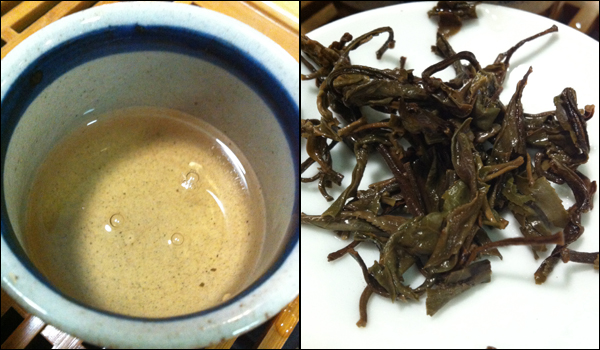
That one-minute steep wasn’t really enough to hydrate the leaves, so I went for a second steep at 1:30 (pictured at left above). Much more flavor, but still extremely delicate compared to a fully-aged sheng pu-erh. I enjoyed a third and fourth steep, which had only minor changes in flavor, but was interrupted before I had a chance to keep going and see how it stood up to eight or ten steeps. An experiment for a quieter day, I suppose.
This tea is definitely worth enjoying a bit early, and I will definitely be coming back to it. Again, we’ll see how much survives to full maturity. I’m not very good at waiting!

Five bits of tea trivia that are WRONG!

I suppose tea trivia is like any other kind of trivia. Some of the most fascinating trivia is also some of the least accurate. I did a little bit of searching around the web for tea trivia, and found some that were a little bit off, some that were just badly phrased, and some that were flat-out wrong. Here, for your reading enjoyment, are five of those inaccurate gems I dug up.
1. Iced tea was invented at the 1904 St. Louis World’s Fair by an Englishman named Richard Blechynden.
WRONG! This was the first “fact” in the top Google search for tea trivia (“51 Tea Facts Every Tea Lover Should Know”). They present a compelling explanation that it was hot, and his tea wasn’t selling, so he poured it over ice, thus inventing iced tea!
That’s a cool story — and it’s one you can find all over the Internet, but it’s all ruined if you happen to take a peak at Housekeeping in Old Virginia, by Marion Cabell Tyree. It was published in 1877, proving that iced tea had been around long before the St. Louis World’s Fair.

As a side note, Mrs. S. T. wouldn’t have had to “correct the astringent tendency” if she had used cooler water and not left the leaves sitting in them all day long.
2. The only tea plantation in the United States is located in South Carolina.
WRONG! Or at least quite out-of-date. This is the first piece of trivia on the tea page at funtrivia.com. There is, indeed, a fairly sizable plantation called the Charleston Tea Plantation in South Carolina, but they are far from being the only tea plantation in the U.S. There are also producing tea plantations in Washington (I have some of their white tea), Oregon, and Alabama. There are dozens of small growers in Hawaii, and new plantations that aren’t in production yet in various other states.
3. Tea bags were invented in 1908 in the United States by Thomas Sullivan.
WRONG! We’re going back here to the “51 Tea Facts” website from our first false “fact” above. This is their second piece of trivia, and so far, they’re batting zero. Again, they tell a fun story, but the story doesn’t address United States Patent #723,287, which was filed in 1901 and issued in 1903.
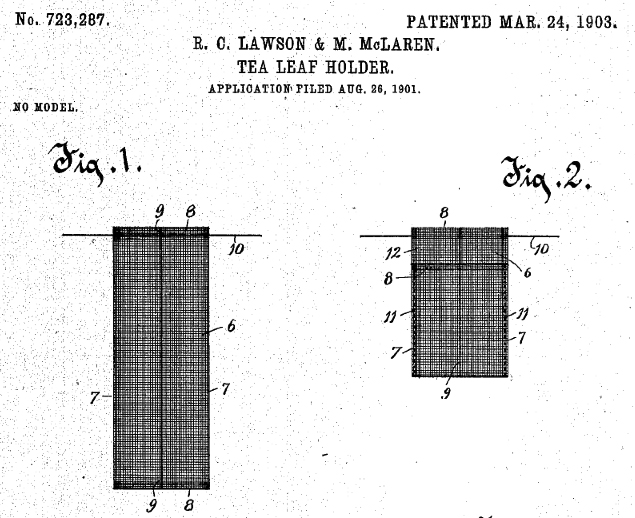
This pretty clearly indicates that Roberta C. Lawson and Mary McLaren invented the teabag well before Thomas Sullivan supposedly sent out little fabric pouches of tea that confused people put in their teapots.
4. Restaurants in Georgia are required by law to serve sweet tea
WRONG, but with a kernel of truth. Georgia Representative John Noel (D-Atlanta) did indeed file a bill with four co-sponsors just before April Fools Day 2003. He said it was “an attempt to bring a little humor to the Legislature.” The bill never made it out of committee. It said:
(a) As used in this Code section, the term ‘sweet tea’ means iced tea which is sweetened with sugar at the time that it is brewed.
(b) Any food service establishment which serves iced tea must serve sweet tea. Such an establishment may serve unsweetened tea but in such case must also serve sweet tea.
(c) Any person who violates this Code section shall be guilty of a misdemeanor of a high and aggravated nature.”
Although I have a lot of friends in the South that would have supported this bill, it definitely did not become law.
5. The tea dumped in Boston Harbor in 1773 was in bricks
WRONG! I’ve seen this picture all over social media today with the caption, “This is what the tea looked like that was dumped into the Boston harbor.”

No. No it isn’t. As this excellent debunking points out, historians at the Boston Tea Party Ships and Museum say that the three ships that were raided that night contained 240 chests of Bohea, 15 of Congou, 10 of Souchong (all black teas), 60 of Singlo, and 15 of Hyson (both green teas), all in loose-leaf form. Not a brick of compressed tea to be seen.
While writing this post, I’m enjoying a cup of wild shu (“ripe”) pu-erh, which has been out of stock in my tea bar for months. I’m very happy that we just got it back in. It’s a 6-year-old pu-erh that comes in brick form (unlike the tea at the Boston Tea Party), and it is one of the richest, earthiest, most complex shu pu-erh teas I have. I love this stuff.

Gold Nugget Pu-Erh
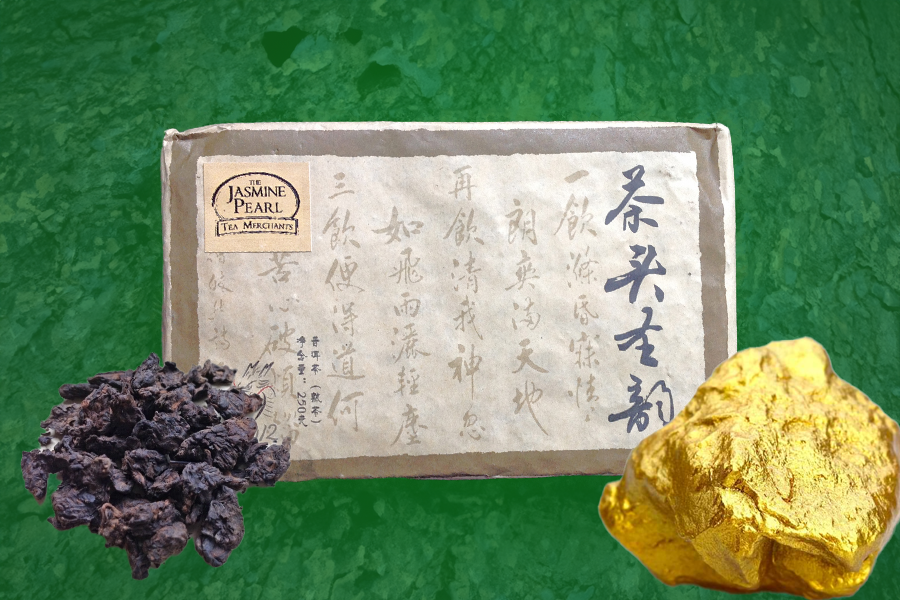
We went to Portland, Oregon for a book show last week. I was there to roll out my new book (Who Pooped in the Cascades?) and to take a look at interesting books from other authors — not to mention a whole lot of networking. While we were there, I took some time out to meet fellow tea blogger Geoffrey Norman for a cup or three of tea (and maybe a beer or two, but that’s completely beside the point). I told Geoffrey to pick his favorite tea shop in Portland and take me there. He chose The Jasmine Pearl on NE 22nd, and the adventure went from there…
My daughter, Gwen, accompanied Geoffrey and I to the shop, and we entered to the wondrous smell of tea blending and brewing. We met the owners and several other staff members, and then settled in to browse.
As I typically do when entering a new tea shop, I explored their tea list to see what they had available. They had the usual selection of flavored teas & scented tea (Earl Grey, Moroccan mint, jasmine pearls…) and old standbys (tieguanyin, English breakfast, gunpowder green…). They also had some very interesting-looking varietals and single-source teas, including kukicha, dong ding oolong, and Gaba oolong.
After we looked around a bit, they informed us that tasting was free and pretty much everything was available to taste. One of the staff pulled out a couple of gaiwans, along with cups, strainers, and other related accoutrements, and asked where we’d like to start.

We started with the kukicha and dong ding oolong, and they were both good. The Gaba oolong, on the other hand, was an absolutely wonderful, and it has a great story behind it, too — but that’s for another blog post.
After going through the oolongs, Gwen chose to try her favorite black tea, a lapsang souchong, and she ended up loving it.
I, on the other hand, wanted to try pu-erhs.
I asked what was their richest, earthiest, most complex pu-erh. She immediately guided me to the Gold Nugget. Not to spoil the ending to this story, but I ended up buying some to bring home.
It looks like any other brick of pu-erh when it’s wrapped up like that, but when the wrapper comes off, it gets different. It seems that it has the name “Gold Nugget” for a reason.

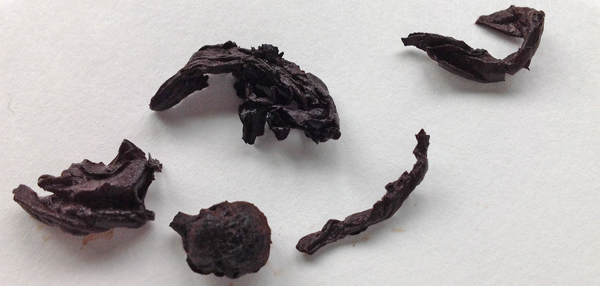
Most pressed tea is made with larger leaf varietals of Camellia sinensis, and the leaves are laid out rather randomly. This requires flaking off bits of the tea with a pu-erh knife or some similar implement. This shu (“ripe”) pu-erh uses whole leaves, but they are rolled up like an oolong or gunpowder tea first. These “nuggets” are then pressed into the cake.
When I’m comparing tea, I like to keep the variables to a minimum. The little pile of nuggets in the picture weighs 7 grams. I put them in my infuser and did a 10-second wash with boiling water, which I drained out completely. Then I added 16 ounces of boiling water and let it steep for three minutes.
To me, three minutes is a long steep time for a shu pu-erh. When I’m drinking my favorite pu-erhs, I usually go for more like 90 seconds. Our first taste of this in the tea bar, on the other hand, was steeped for five minutes, because I told her I liked it strong.
I do, indeed, like it strong, but after steeping for five minutes, the flavors are rather muddled together. That’s why my first pass at home was for three.
The result was exactly what I had asked for: rich and complex are great adjectives for this tea. This is pretty much the polar opposite of the last pu-erh I blogged about. I will, however, be using longer steep times than usual for my first infusion, simply because those nuggets are rolled so tight that it takes a couple of infusions to open them up all the way.
All in all, it was a great trip, and I came back with some great tea, lots and lots of autographed books, and some fond memories. After the tea tasting, we met my wife at a sushi restaurant and had some wonderful sushi rolls and interesting beers. I wouldn’t say Geoff knows as much about beer as he does about tea, but I think we’ll be having some future conversations about the differences and similarities in teas and beers.

Random observations from the tea bar

Looking for something pithy and educational about tea today? Well, you picked the wrong blog post. Today I am just posting a free association of recent observations and happenings at the my tea bar.
Never give up. Never surrender.

I love pu-erh tea. I have far more of it in the tea bar than our local population can justify, especially if you include the “dark tea,” which is tea fermented like a pu-erh but not produced in Yunnan. I have grown used to having to explain pu-erh to every person I mention it to. It’s part of the education mission of the tea world.
Then, one of my regulars brought in a friend from out of town. He bought a quarter-pound each of Irish Breakfast and my own Scottish Breakfast blend (which I call “Gary’s Kilty Pleasure”). He asked for something different, and I asked if he’d tried pu-erh. He knew what it was! He liked it! We probably spent 15 minutes talking about pu-erh and he bought a tuo-cha (bird’s nest shaped pu-erh cake) and some loose pu-erh. The education efforts of tea shops around the country are paying off!
I hate cheap equipment.
Some of the equipment in the tea bar has worked beautifully since the day we bought it. Some has been a source of endless frustration.
The milk heater/frother units we got from Keurig? One broke in just over 3 months, the other in just under a year. Fragile parts, hard to clean, cheap construction. The ones we got from a company I’d never heard of, on the other hand, are both working beautifully.
Tea timers? I suppose it’s not the manufacturer’s fault that we drop them from time to time. But some timers survive multiple drops and some die after the first.
Frothing wands? I just had to deal with our third dead wand in a year. They really should last more than six months. This just isn’t acceptable.
Never put out pressed tea samples
Found this out the hard way. One of our distributors carries these wonderful little pressed hearts of tea they call Antony & Cleopatra. I thought it was a cool novelty idea and ordered a pound of them. They’re black tea, not a pu-erh like most pressed teas. They are actually halfway decent black tea, which makes them better than just a novelty item. Just drop it in the teapot, pour in boiling water, and in a few minutes you have a cup of tea.
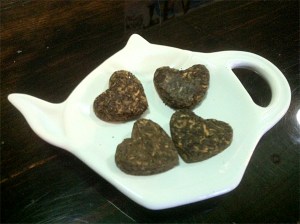
I put a big jar of them (sealed, of course) on the tea bar and a little plate (actually a cute little teapot-shaped teabag holder) in front of the jar with some of the tea hearts on it. Can anyone guess what happened? Anyone? Bueller? Yeah, that’s right. People ate them. Apparently compressed tea leaves make pretty yucky-tasting cookies. Who’d have guessed?
Bleach is your friend
Ever hear commercials for cleaning products that say “even gets out tough tea stains?” There’s a reason for that. Tea stains everything, especially infusers, filters, and teapots. Luckily, a tablespoon of bleach in a pint of water will get rid of all those tea stains in no time flat. Of course, you’ll be rinsing the bleach smell out for a little while, but it’s worth it. Sparkly clean!
Everybody thinks lattes have to have coffee in them
“Latte” is used in English as a short form of the Italian “caffè latte,” which simply means “coffee with milk.” Other drinks can have milk in them, too. Tea lattes are absolutely wonderful drinks. Generally speaking, they have two ingredients: tea and heated/frothed milk. Sometimes a sweetener. So why is it that people keep asking what kind of coffee we add to our tea lattes? They aren’t tea caffè lattes. They are tea lattes.
There. I feel better now.
Champagne, Tequila, Darjeeling, and Dark Tea
If you make a carbonated white wine, it’s called a “sparkling wine,” unless you are producing it in the Champagne region of France. Then, and only then, should it be called Champagne. I say “should” because there are a number of countries that didn’t sign (or don’t honor) the treaties involved, but that’s a whole different blog post.
The same applies to beverages made from distilling blue agave cactus. If you are in the Mexican state of Jalisco, or designated portions of certain other states, you may call that beverage Tequila. Otherwise, you have made mezcal.
The theory behind these distinctions is not so much the strict corporate trademark enforcement that governs most usage of names in the U.S. It is more a question of terroir. If you were to take two cuttings from the same grape vine and plant one in Napa Valley, California and the other in the Rhine Valley of Germany, you would get different wines from the two vines. Terroir describes the effect that the soil, weather, drainage, and related geographical factors have on the resulting taste of the beverage, whether it be wine or tea.
Darjeeling tea is often called the Champagne of tea (this appellation is usually reserved for first flush Darjeeling tea, but we’ll ignore that distinction for the moment). This little factoid has little to do with the subject of the article, but does make for a marvelous segue from alcoholic beverages to teas, n’est pas?
Like Champagne and Tequila, Darjeeling refers not only to a particular style of tea, but to the origin of that tea: the Darjeeling district of West Bengal, India. Darjeeling tea is unique because of its terroir, but also because of the varietal of the tea plant that they use. Most tea grown in India comes from Camellia sinensis var assamica (the varietal native to India), but Darjeeling tea comes from Camellia sinensis var sinensis (the varietal native to China). Combining the terroir of West Bengal with the flavor of the Chinese tea plant produces the tea we’ve all come to know and love.
And, finally, we get to dark tea
Another geographically-named tea style is pu-erh (also spelled pu’er or puer), named for the town in the Yunnan province of China where the style originated. Only recently has the tea industry really started using the more generic name of “dark tea” to refer to fermented (as opposed to oxidized) teas.
There are two ways to make pu-erh: sheng and shu (also spelled shou).
SHENG (a.k.a. raw or green pu-erh) is the more prized by collectors. The tea is stored in a slightly damp humidity-controlled environment and allowed to slowly ferment. It’s generally not considered ready to drink for years after being picked. Shengs have the same vegetal flavors and aromas as a good Chinese green tea, but with very complex earthy undertones.
SHU (a.k.a. ripe or cooked or black pu-erh) gets a bacterial “kick-start” to the fermentation process, so it’s ready to drink within a matter of months instead of years. Shu pu-erh requires very little steeping time (I’ve spoken to producers that recommend as little as ten seconds), and many pu-erh drinkers start with a “wash,” where you add boiling water, swirl for a few seconds, and pour it off before doing a “real” steeping. Shu pu-er tends to be extremely earthy, with a “composty” undertone. The flavor profile is even richer and deeper than a strong black tea (often reminiscent of a good Keemun), but with very little astringency.
There are several common shapes of pu-erh cakes, including rectangular bricks, bird-nest shapes (“tuo cha”), and flat disks (“beeng cha”).

The standard size for a beeng cha (like the one pictured above, which I wrote more about) is 357 grams, although they can be found in smaller sizes as well. I’ve found several suppliers for 100g beeng chas lately, which is a more affordable alternative for someone new to dark teas or someone sampling a new variety.
Tuo chas, on the other hand, are available in a wide variety of sizes usually centered around 80-120g. Mini tuo chas have become quite common. Each is a single serving of tea, roughly 5g.
Bricks can be found in a variety of sizes as well.
Something new (to me, anyway) is the log-shaped dark tea. My wife, Kathy, and I found these at the World Tea Expo (the big annual industry trade show for tea people) a couple of weeks ago. The ones we purchased for our tea bar are logs about 3.625 kilos (8 pounds), 25 inches long by 5 inches in diameter. We’re selling a single log in its bamboo wrapping with a canvas carry tote for $99.99, but most people will be more interested in slices taken from the log.
In the picture below, Kathy and I are posing with what the tea grower calls the world’s largest log of dark tea. If it puts the size of that tea log in perspective, I am 6’5″ tall (195 cm) not counting the hat and boots. Not having a spare thousand dollars laying around, we didn’t buy that one!


Fun Blends: Terracotta Army Chocolate Pu–erh
My wife, Kathy, is a chocoholic who loves tea. She has tried chocolate tea blends from various companies, and decided that she’s not a fan of chocolate tea blends using mild-flavored tea. She likes to be able to taste the chocolate and the tea.
Gwen and Kathy and I experimented and came up with a blend based on a loose-leaf shu (ripe) pu-erh blended with cocoa nibs and vanilla. It was a struggle getting the balance just right, but the result was so good, we decided to give it a permanent home on the tea bar’s menu. After struggling for a while to come up with a name reflecting its Chinese origins: Terracotta Army Chocolate Pu-erh.
The Logo
I love having fun with tea logos. As I’ve mentioned before (see list below), a series of local artists have been creating logos for our house blends. This one was produced by artist (and art history professor) Kory Rountree:

We love that Kory started with one of the soldiers in the real Terracotta Army, made him chocolate, and gave him a cup of tea. He actually provided two logos for us to choose between. We picked the one above because it is clear, simple, and easy to identify even at small sizes. I actually prefer the alternative (shown below), but it’s just too complex to put on a little tea label.

The details are what really make this one. Note the eyes on the soldier above and left of the chocolate soldier. You can almost hear him thinking “Yummy!” The one above and to the right has a similar, but more subtle expression. It’s not obvious at first glance, but if you look closely, the soldier to the right of the chocolate fellow is holding a piece of the melted/broken chocolate arm in one hand, and a cup of chocolate pu-erh tea in the other.
Thank you, Kory! Another awesome logo for the collection!
This is the latest in a collection of labels I’ve written about here before:

Active vs. Passive Tea Consumption
There’s a big difference between the way tea is usually served in U.S. tea shops, and the way it’s served in Asia. I’ve been trying for a while to come up with the right words to describe it, and my friend Kory did the job for me last week.
Kory was sitting at my tea bar, trying to decide what he wanted as I was preparing myself some wild shu pu-erh in a gaiwan. I offered him a taste, and he said he’d give it a try. He watched as I went through the ritual and filled a small cup for him. He tasted it and said, “I’m looking for something more passive.”

My first thought was that he was referring to the process of preparing the tea (he wasn’t, but more on that later), and I realized that he’d just given me the words I was looking for. American/European tea drinking is passive, while Asian tea drinking is more active.
When my daughter and I went to Bellingham and Seattle last month, two of the tea shops we visited exemplified this perfectly.
The first was an English-style tea house called Abbey Garden Tea Room. We sat at a table and ordered our food and tea. They steeped the tea in the kitchen, and brought us teapots (with the tea leaves removed), tea cozies, and cups. All that was required of us was to pour the tea in a cup and drink it. The pots were large enough that we didn’t need refills during our meal.
The second was a Chinese tea house called Vital Tea Leaf. We sat at the counter and talked to the tea expert on staff (her name was Fang). She asked what kind of tea we liked, and set up a gongfu tray in front of us with an assortment of teaware. For each tea, we smelled the dry leaves and the wet leaves, and watched as she prepared a few ounces of tea in the gaiwan, gently agitating the leaves and fanning the aroma toward us.
The Abbey Garden experience was passive tea drinking. We picked tea we liked, and it became secondary to the rest of our lunch. We focused on the food and chatting with each other. With the larger British-style cups, we only had to refill a few times during the meal. At most American-style tea houses, those cups would have been even bigger — probably 12 to 16 ounces, and there would have been no refills required.
The Vital Tea Leaf experience was active tea drinking. There were no distractions, and we only got a couple of ounces of tea at a time. We were engaged in the process the entire time, and it was all about the tea.
Most of the time, passive tea drinking is fine with me. I am sipping on a large mug of houjicha as I write this, and although I’m enjoying it, the tea in my mug isn’t my primary concern at the moment.
But there’s a lot to be said for the active tea drinking experience. Watching the tea steep (experiencing the “agony of the leaf”), comparing the changes from the first infusion to the next, smelling, sipping, tasting, and concentrating on the tea you drink. I think after I press the “post” button for this article, I shall pull out the gongfu tray and gaiwan and actively drink some tea!
Sidebar: What Kory really meant
In my opening paragraphs, I spoke about my friend who gave me the idea for the terms active and passive, and mentioned that the whole subject of this article isn’t really what he meant.
What he was trying to say is that the taste of the tea itself can be active vs. passive. For you beer drinkers out there, here’s a comparison. You’ve gotten together with a bunch of friends to watch the game on TV. Your friend hands you a glass of beer just as there’s some great action going on. You drink the whole beer without having any idea what it was (it was probably Bud Light). There just wasn’t enough taste to get your attention. That’s a passive drink.
On the other hand, if he had handed you an oatmeal stout, a lambic, or a double IPA, you probably would have stopped what you were doing to focus on the beer. “Wow. What is that?” You would have smelled and sipped, savoring the beer and missing the touchdown that put your team in the lead. That’s an active drink.
The wild shu pu-erh I spoke of at the beginning of the article is most definitely active. There’s a lot going on in that tea. It’s rich, deep, and complex, with flavors and aromas that are very hard for me to identify. Kory was interested in a good, but passive tea. Perhaps a Keemun black. You taste it, notice it, and then drink the rest of the cup without paying attention.
Okay, Keemun tea lovers. I’ve painted the target on my back. I await your wrath.
Steeping Times

The World Tea Expo in Las Vegas has been a phenomenal (and somewhat overwhelming) experience. It will take quite a while for everything to sink in. There were some fascinating trends discussed at the show, and I also learned a lot about just how differently people enjoy their tea.
As I’ve mentioned in the past, I am not a tea Nazi. It matters not to me whether you make your green tea with boiling water, steep your Darjeeling for ten minutes, or whisk your matcha with an electric frother. However you enjoy your tea is the right way for you. Personally, I like my tea steeped much less than most of my friends. A couple of minutes is plenty for most robust black teas in my humble opinion, and I give many of them less than that.
Opening day at the Expo for me was the World Origins Tea Tour. We had presentations from representatives of eight different countries, and tasted teas from each one. The conference organizers were clever enough to put the seminar rooms directly across the hall from the restrooms and give us a 15-minute break between countries. Speaking on behalf of the entire audience, I’d like to give the World Tea Expo a hearty “thank you” for that move! I’d also like to compliment the staff on providing 140 people with 30 different teas to sample and getting them all out to us promptly, and prepared perfectly. In case you didn’t do the math in your head on that previous sentence, they served 4,200 cups of tea at the right temperature with both dry and wet leaves to pass around the table. That’s pretty darned impressive.
The audience members at the World Origins Tea Tour asked lots of questions, and many of them were about how the presenters preferred to make their tea. The first country presented was China, and the speaker said that he rarely steeped tea for himself more than about 30 seconds. I’ve been known to steep a nice aged pu-erh (or pu’er or puer or puerh or…) for 30 seconds, but have never actually tried such short steep times on other teas. He drove me to experiment. He also drove me to ask more questions around the show floor.
I came across a brochure that said the traditional way to prepare pu-erh tea was a ten-second “wash” (rinse the leaves in hot water and discard the water) followed by a twenty to thirty-second steep. I also came across a company that was handing out samples of some beautifully packaged single-serving pu-erh discs. The samples suggested a four-second steep time. Yes, I said four seconds. I asked the woman running the booth if that was right, and she said it was. She placed some tea leaves in the infuser of a glass teapot and poured boiling water through the infuser into the pot. The total steep time of the tea was the few seconds it took for the water to drain through the slits in the glass. She poured some for us, and it had plenty of flavor: rich and complex without being overwhelming.
A whole new world has opened to me. I’m going to be playing around quite a bit with über-short steeping times to see what I get. I’m anxious to get back to the Tea Bar and experiment with some of my friends.
As a side note, by the way, we were staying in the LVH (formerly known as the Las Vegas Hilton) in the block of rooms reserved for the Tea Expo. As with my previous experience at Bally’s, the front desk refused to provide any means of heating water in the room so that I could make my own tea. I went to the front desk and asked to speak to the manager. I explained that if their hotel was hosting the WorldTea Expo, they really should let us make tea. He explained that we could rent water heaters, but they only had two, and it cost twice as much to rent one as it would cost to run out to the store and buy one.
Unlike Bally’s, however, the LVH manager said that I could call room service and request hot water a few times a day if I wished. They would rush it up to the room at no charge and do their best to keep it hot. That still leaves them a notch below every cheap motel in Montana (which all provide free coffeemakers and wi-fi), but several notches above Bally’s. I know the decision not to offer a microwave in the room was made way above this manager’s pay grade, so I don’t blame him for the situation. In fact, I’d like to offer him a hearty thank-you for his exemplary customer service.
Tasting purple tea

Today, I received my first shipment of the purple tea that I blogged about back in August. I opened the bag with no preconceptions, as I haven’t read anyone else’s tasting notes.
The leaves look like pretty much any black tea. Not surprising, as the purple tea plant (TRFK306/1) can be prepared using any tea process, and this was oxidized like a traditional (orthodox) black tea. This is a very dense tea. The kilogram bag I purchased was the same size as the half-kilo (500g) bag of Golden Safari (a Kenya black I’ll be writing about soon).
I took a deep whiff, and picked up a slight earthiness to it that isn’t present in the other Kenya black teas I’ve tried. Not as extreme as a shu pu-erh, of course, as there was no fermentation in the process, but enough to distinguish the aroma from a traditional black tea.
Actually, despite my previous comment, I did come in to this with one preconception. Since this is a high-tannin tea, I expected a fair amount of astringency (“briskness,” as Lipton calls it), so I decided to take it easy on the first cup and make it like I make my 2nd-flush Darjeelings: 5 grams of leaves, 16 ounces of water at full boil, and a scant two-minute steep time.
“I did not expect purple, as the anthocyanin that gives purple tea its name doesn’t affect the color of black tea.”
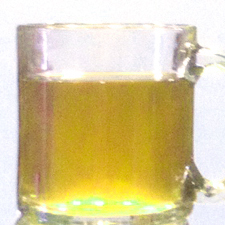
The leaves settled immediately to the bottom of the pot, and I was taken by surprise by the color. I did not expect purple, as the anthocyanin that gives purple tea its name doesn’t affect the color of black tea. But I also didn’t expect the pale greenish tan color that immediately appeared (it later mellowed to a deep black with — you guessed it, a purplish tinge). We don’t have any analyses yet of total antioxidant content, but we know that the anthocyanin does contribute quite a bit.
My first taste of the purple tea was impressive. Rich, complex, and a bit more astringent than you’d expect with only a two-minute brewing time. The earthiness in the aroma comes through subtly in the taste, and there’s a silky mouthfeel that lingers on the back of the tongue.
I figured that there was enough going on in that tea that it could hold up to a second infusion, so I brewed a second cup off of the same leaves. This time I gave it a three-minute steep, and it came out tasting very similar to the first brew, although a bit more pale in color.
“Purple tea is certainly not cheap.”
All in all, I’m pleased and excited to have this new varietal available at the tea bar. Purple tea is certainly not cheap. At $16.00 per ounce, it’s one of the priciest teas on our menu, but I expect it to build a fan base quickly. Our new tea website isn’t quite ready to launch yet (I’ll make a big announcement here when it is), but if you’d like to order some Royal Purple tea, just call the store (406-446-2742) or send an email to gary (at) redlodgebooks (dot) com. We’re ready to ship right away.
UPDATE MAY 2012: Our tea website is up and running, and Royal Purple tea is now available for purchase.
More more information about purple tea, please see my earlier blog post announcing and describing the varietal.
Copywriters and tea marketing experts

These days, you can’t be too careful what you say on a tea website. Last year, Unilever was warned by the FDA for claims they made about “Lipton Green Tea 100% Natural, Naturally Decaffeinated.” A week later, they warned Dr. Pepper Snapple Group about claims they made concerning “Canada Dry Sparkling Green Tea Ginger Ale.” Earlier this year, the FDA’s target was Diaspora Tea & Herb (d.b.a. Rishi Tea) for a wide variety of health claims on Rishi Tea’s website.
Given these warning shots fired across the bows of the big boys, the whole industry is being careful about making nutritional claims for tea. But we still need to say more about tea than just “this stuff tastes really, really good” — although that’s generally good enough for me.
For an example of how far companies are going these days, we got a promotional mailer today from Numi Tea. They are a fine company, and I’d be happy to resell some of their products in our tea bar. The mailer has some traditional marketing language (with appropriate footnotes, of course), just as I’d probably write myself:
“[Pu-erh]’s unique fermentation process results in more antioxidants than most green teas and is traditionally known to help weight management*, improve digestion and naturally boost energy.”
Well, I hope I wouldn’t write it exactly like that, but given a bit of tweaking to the grammar and punctuation, it’s a reasonable sentence.
The first claim is footnoted “*Along with a healthy diet and exercise.” Okay. I’ll buy that. Given enough healthy diet and exercise, lots of things help with weight management. The other two claims are very difficult to measure and/or prove. Vague claims typically don’t draw the ire of the FDA, so they’re probably safe.
But it was the next section that made me chuckle. It says, and I quote:
“Every blend is freshly brewed, made with full-leaf tea and uses 100% real ingredients for a pure Pu-erh tea taste.”
Wow! It uses 100% REAL INGREDIENTS! Is that the best they could do? Really? Can you imagine the certification process for that? “Is this an ingredient? Yep!” I carry 100 different teas in my tea bar, and I can guarantee you that every single one of them carries 100% real ingredients. Yep. Not an unreal ingredient in the bunch.
I did a bit of further looking, and found that the front cover of their mailer says, “Real ingredients. 100%. Nothing else.” There’s a whole section of their website called “100% real ingredients.” There’s a paragraph on that page of their site that says:
“For a pure, authentic taste, we blend premium organic teas and herbs with only real fruits, flowers and spices. We never use ‘natural’ flavorings or fragrances like other teas do.”
I’m pleased to hear that they only use “real” ingredients, and not “natural” ones like everyone else. Come on, Numi. You make some absolutely fantastic teas, and your organic and fair-trade programs are excellent. I’d like to see you spend more time talking about that — which really does differentiate your products — and less time talking about being “real,” which means absolutely nothing.
 Tea With Gary