Category Archives: Tea Biz

A Matcha Mill at World Tea Expo 2014

Last week at World Tea Expo 2014, most of my time was focused on finding new things. I tasted new tea blends and fresh varietals, while browsing through billions of new gadgets, accessories, and tea-related products. I did try to make time to visit with our existing vendors and friends, and when we stopped at AOI, the company we buy our matcha from, I found something old rather than something new.
Have you ever looked at matcha powder and wondered how it’s made? Oh, it sounds very simple: take some high quality Japanese steamed green tea and powder it. But how do you powder it? Today, there are high-volume machines for absolutely everything, but matcha has been around for a very long time (see my posts about matcha and the Japanese tea ceremony for more information). How did they make matcha before the advent of machines?
AOI had the answer in their booth: a hand-carved millstone designed for tea leaves.

The upper stone has a hole in the top where dried tea leaves are inserted, and a vertical wooden shaft in the lower stone keeps it centered. There are grooves that move the ground-up leaves out to the lower stone’s dish. Of course, I had to try it, and then I made a short video of my daughter, Gwen using the mill:
I saw a lot of cool gadgets, but this is the one I’d like to have sitting next to my desk at home. Unfortunately, it wasn’t for sale…

World Tea Expo 2014, Day 3: Revenge of the Pu-erh

If you haven’t already read Day 1: The Saga Begins, Day 2: Attack of the Clonals, and Tea Bloggers Roundtable, you might want to read them first for context. If not, that’s fine. Read on. No biggie.
The third day of World Tea Expo 2014 started rather unexpectedly, as we pulled into the parking garage and encountered Harley Quinn. On roller skates. As we walked to the expo center, we met up with a variety of other comic characters, along with some characters from movie and TV shows. Yes, it was cosplay time at a comic book convention. Parked in front of the expo center, we saw a variety of vehicles: Kit from Knight Rider, three (Count em! Three!) Jurassic Park tour vehicles, the Back to the Future DeLorean, complete with a dead ringer for Doc Brown, and quite possibly the most awesome Batmobile I’ve ever seen.

Once we got past the Star Wars crowd, however, it was back to the business of tea. And most of that consists of placing orders on the last day of expo to catch all of the show specials. Most of what we purchased was pu-erh tea, which I drink a lot of these days. A good part of the reason we buy so much pu-erh at the World Tea Expo is that there’s a rich variety available, but it can be hard to find in the U.S.
Looking for a nice first-flush Darjeeling? Every major tea importer or distributor has one. Sencha? There’s hardly a catalog without at least one. Earl Grey? Even grocery stores in Montana are likely to carry more than one. But if you’re looking for unique and tasty pu-erh teas, you just might have a long (and pleasant) task ahead of you.
At World Tea Expo, there’s a broad variety of pu-erh laid out on tables all across the expansive show floor, almost all of it compressed into cakes of some form or another. One of the most intriguing we came across this year is a jasmine sheng pu-erh. It has the same jasmine aroma that any Chinese green jasmine tea has, but the underlying flavor is much more robust. A touch of the expected pu-erh earthiness comes through, along with more astringency than most. Part of the astringency is explained by the relatively long steeping time that LongRun used in their booth. They steeped for about four minutes. When I got it home, I played around and decided two minutes is more my speed on this one.

Yes, I can hear the faux gagging sounds coming from the purists, aghast at the idea of scenting a pu-erh tea. Pish tosh, I say to you. I’ll drink my straight pu-erh in the morning, but this lightly scented jasmine delight is just the thing for mid-afternoon. Also, being such a young fermented tea (2012), it will continue to get better and smoother for many years, aging like a fine wine. If you end up with enough self-control to put some away for five more years, it will be awesome!
Two other interesting things about that picture: the color of the tea in the glass in the background, and the pu-erh knife in the foreground. If you’re used to shu (“ripe”) pu-erh, which brews up very dark red, this pale green concoction will look mighty odd. I suppose if I wanted to really show the color, I wouldn’t have set it on a dark wood counter, but that’s beside the point. Sheng (“raw”) pu-erhs are much lighter and more delicate than the “in your face” shu pu-erhs.
For breaking apart pu-erh cakes, you don’t want a regular sharp knife. Cutting it will tear the leaves. What you want is a pointed knife that will slide between the layers of leaves and flake them apart. This pu-erh knife, which they call a “needle,” has a very sharp tip and basically no edges at all. I also like the ceramic handle.
In addition to the other pu-erh cakes we bought, my friend and fellow tea blogger Geoffrey Norman slipped me a little present: two “pu-erh” teas from different countries.

I’ve talked about spelling of Chinese teas here before, so don’t let Geoff’s “puer” and my “pu-erh” throw you off. The transliteration from Chinese into English will never be perfect, and often you’ll find different translators spelling the same words in different ways. The spelling Geoff uses is how the town of Puer appears on most maps, so it may end up winning out eventually if we ever come to consensus, but until then I’ll stick with my way.
Speaking of the town name, that’s why “puer” appears in quotes on the tube. Technically speaking, you’re not supposed to use the name pu-erh unless the tea comes from the Yunnan province of China, where the style originated. The tea is named for the town where it was processed and marketed. A fermented tea from anywhere else should be called a dark tea rather than a pu-erh. We’ll see if that works out as well as “masala chai.” Translated into English, that one should be “masala tea,” indicating a tea made with a masala spice blend. Instead, most Americans call it “chai tea,” which translates to “tea tea” and loses the whole meaning. *sigh*
There are fermented teas (pu-erh style dark teas) made in a number of places outside of Yunnan. In addition to the Taiwanese and Vietnamese I got from Geoff, I bought dark teas from Fujian and Anhui provinces, and I am carefully aging a Laotian beeng cha as well.
There is no other style of tea that has the variety pu-erh does. Some I steep for minutes, and some for mere seconds. Some brews so dark you can’t see through it, and some as light as a short-steeped dragonwell. The colors range from yellowish-green to orange to deep red. The flavors are all over the map. You can steep pu-erh leaves a dozen times, and each infusion will be different from the last. If you haven’t experienced pu-erh before, don’t blindly order some online. Go to a tea shop and talk to someone who really knows the style. Try several different ones to narrow it down. Only then, make the investment in a good pu-erh cake to take home and enjoy.

Tea Bloggers Roundtable 2014

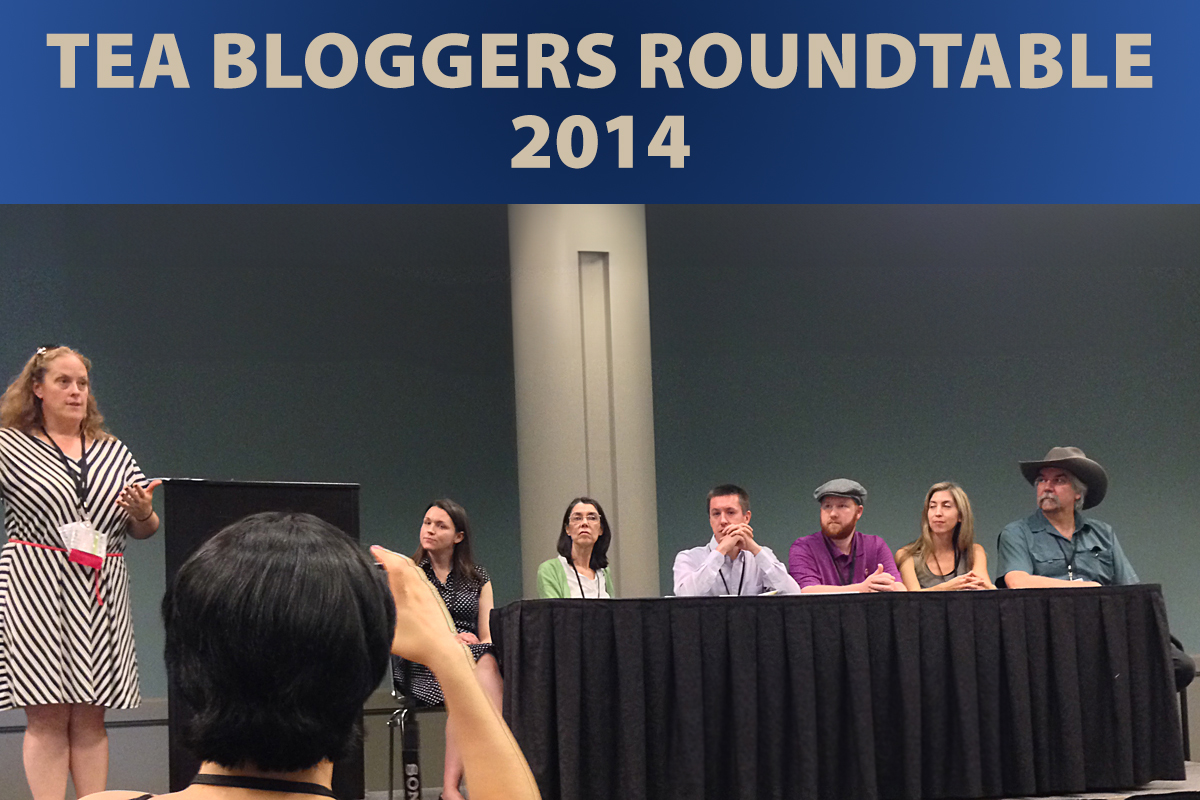
Last night at World Tea Expo 2014, we had fun on the Tea Bloggers Roundtable.
The moderator, Naomi Rosen (Joy’s Teaspoon) asked us questions, guided the discussion, and took comments from the audience. The panel consisted of (left to right):
- Nicole Martin (Tea For Me Please)
- Linda Gaylard (the Tea Stylist)
- Jason Walker (Walker Tea Review)
- Chris Giddings (the Tea-Guy)
- Jen Piccotti (An International Tea Moment)
- Gary Robson (that would be me)
Nicole Schwartz (AmazonV) live tweeted questions and answers for those who couldn’t attend, and Geoffrey Norman (Lazy Literatus), who was on the panel last year, heckled us from the audience.
Our friend TeaPigeon from the exhibit floor (pictured below) was unable to attend the roundtable. Something about too much oolong.

We answered questions on a number of topics, and got some great audience participation, too. Among the topics were:
Q: What do you do if someone sends you a sub-par tea to review?
A: Most of us review only what we like, so if we get a bad product we don’t talk about it. If we do, we tend to lay it on the line.
Q: What’s the best time of day to update the blog and social media?
A: For the most part, we don’t post to the blogs on a schedule (except for Nicole, who posts at noon Eastern time), but we try to do the social media links early in the morning, as most folks check their Facebook and Twitter feeds first thing when they get up. Some of us repeat links in the afternoon, typically with different text.
Q: Do you blog about tea and health?
A: That’s a topic that’s in much demand, but there’s so little proper scientific research that we’re all hesitant to do it. Studies tend to be myopic (good word, Chris!), and media coverage of the studies often distorts the results. The dearth of data means everyone’s looking for solid information, but the research is time-consuming and can be expensive; not all of the studies are available for free on the Internet.
Q: How do you deal with word count?
A: Some tea bloggers (Geoffrey, for example) worry about whether their posts are too long and rambling. Others (like me) want to make sure there’s enough content to make them worth reading. The beauty of the Internet, though, as compared to print media, is that we don’t have hard limits. Gwen Gunn pointed out from the audience that for the first time in history, we have a medium with infinite scrolling. You can fit ten thousand words as easily as you can fit ten words. There’s no reason to trim it back.
Well, I need to get going and hit the last day of Expo, so I’ll cut this post short and talk more about tea blogging later. In case you’re interested, I started my day with a lovely golden tip Yunnan tea from TeaSource. That’s my kind of black tea!
World Tea Expo 2014, Day 2: Attack of the Clonals
There’s more than one way to skin a cat … er … build a tea plantation. The common theme through much of what we saw today was exactly that: how to make tea plants.
Traditionally, humans have allowed plants to go to seed, and then planted those seeds. That involves a male plant and a female plant, and the mixing of DNA, which can have unpredictable results. For many crop plants, farmers came to realize that taking cuttings meant the new plant was identical to the parent plant. If you have a perfect cultivar, don’t pollute the DNA with random Mendelian fluctuations; keep the strain pure.
This process, whether it entails planting cuttings or grafting varietals onto different rootstock, is known as cloning. Today at the World Tea Expo, clonals and interesting varietals of tea plants turned into a bit of a theme for the day.
The day began with fellow tea blogger Geoffrey Norman (the Lazy Literatus) rushing up to me after reading yesterday’s post. “Bacon tea?” he asked frantically, “Where did you find this bacon tea?” I took him down to the appropriate booth and as we waited for them to brew bacon tea, he said, “Did you hear about the smoked green Assam at Tealet?”
I’ve been looking for a good green Assam for quite a while. The overwhelming majority of the world’s green tea comes from Camellia sinensis var sinensis: the Chinese varietal of the tea plant. Camellia sinensis var assamica, the Indian varietal, is quite different.
We wandered over to Tealet’s booth and found that they were in the middle of a video recording. We met up with TJ Williamson, who said that they did, indeed have green Assam (both smoked and unsmoked), but we’d have to wait until they finished the video thing. After we chatted for a bit, he said that he’d like to interview us for the World Tea Podcast. We spent the next hour sipping tea and talking into TJ’s microphone.

The smoked green Assam was unique. The first hit on the tongue was very astringent, and very different from the aroma. It had a full mouthfeel, and it mellowed to a light smoky malty flavor that was very pleasant. They steeped the first infusion with 188-190 degree (F) water, and the second infusion with 175 degree water was much less astringent and much smoother.
Much of our afternoon consisted of placing orders and tasting tea — two of my favorite things to do. We found a lot of different cultivars (many of them clonals), and ordered some great new tea for the tea bar.
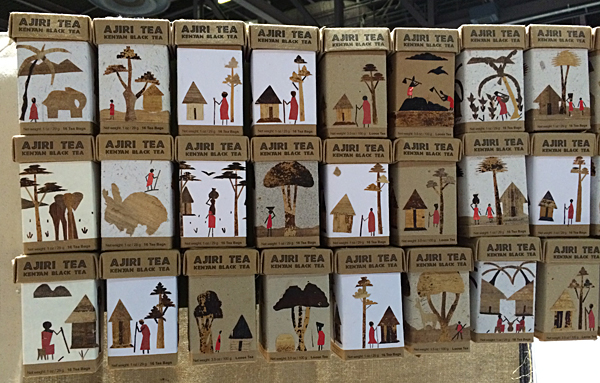
One particularly significant stop was at Ajiri Tea. I know I have said a few unflattering things about one particular Kenyan tea company, but I’d like to note for the record that I’ve never had a problem with Kenyan tea in general. Ajiri in particular is doing some wonderful things.
When Kenya gained independence from Great Britain in 1963, many of the huge tea conglomerates retained their land and operations. Many tracts of land, however, were broken up into family farms and cooperatives, which now represent almost 60% of Kenya’s huge tea industry. That’s who we prefer to buy from.
Ajiri was founded not just to export tea, but to create jobs (the word “ajiri” is Swahili for “employ”), especially for women. The boxes for their tea are hand-made, as are the beaded string ties for the bags. All of the labeling and decoration on the outside of the boxes is handmade from dried banana tree bark, and profits go back to Kenya for educating orphans. This is a tea operation we can get behind. Look for their products on our shelves next month.

The day continued with a class in rolling oolong teas, and the tea bloggers roundtable you’ve all been waiting for, but it’s after midnight and I am growing weary. I shall sign off now, and continue tomorrow with the World Tea Expo saga…
World Tea Expo 2014, Day 1: The Saga Begins
So here I am at World Tea Expo 2014. The day didn’t start all that well. I’ve been attending expos and trade shows for decades, and this has to be the hardest one to find ever. Very little signage, and the parking area had no directions to the expo area. We got there late, there was an issue with my badge, and we didn’t get breakfast.
The day got better quickly, though. One of the first booths we visited had BACON TEA! That’s right. Tea with maple and BACON! Yeah, it sounds weird, but it was quite tasty. Also, my magic press pass has a sticker on it that allows me to take pictures on the show floor. I know, I took pictures last year, too, but a large security guard offered to escort me out of the building and take my badge away if I didn’t stop it. This year, it’s kosher.

I won’t even try to cover everything in this one post. Steampunk and vacuum tea infusion systems are going to get their own article. I’ll be writing book reviews separately. There will be an upcoming post comparing yaupan with the other caffeinated holly infusions (guayusa and yerba mate). And smokable mate? That’s definitely another subject all on its own!

The bacon tea is from the Tovah Group. Its ingredients, among other things, are maple black tea, lapsang souchong (for a smoky flavor), maple hickory smoked bacon jerky, and various masala chai spices. I think this will go really well with breakfast!
The next person to improve my day was Lillie at the Modern Tea Girl. She was showing off a line of tea-based frosting mixes (“just add two sticks of butter…”). To demonstrate, she had tasting cups with little tasting spoons, but that’s not all! She went above and beyond the call of duty by making little cupcakes. After Gwen and I sampled them — just a few, of course — we decided that the Lady Grey and the Chocolate Chai were definitely standout flavors!

With some cupcakes in my belly and tea samples from a half-dozen booths, I finally felt that I could settle into my rhythm for the day.
With hundreds of booths showing off approximately 4.3 zillion products, you can’t get overly caught up in one booth unless it’s (a) a good fit for the tea bar or (b) a great subject for a blog post. Oh, since I’m with my 21-year-old (single) son, there’s also a (c) that has to do with pretty girls in the booth, but we won’t get into that one.
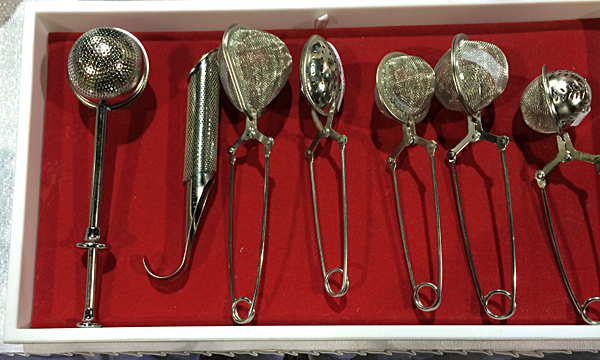
As I said, there will be more posts, so I won’t describe the plethora of tea storage containers, yixing teapots, infusers, travel mugs, food products, RTD (ready-to-drink) beverages, tea blends, raw spices, electric kettles, and other wondrous things we looked at. We’ll be buying a lot of this stuff and taking it back to the shop. Some of what we looked at had me itching for a bigger budget (would you buy a $400 teacup with real gold in the ceramic glaze?), and some had me scratching my head.
Two of the tea blends I encountered caught my eye, and the merchandizing part of my brain immediately jumped to the conclusion that they should be displayed side-by-side:
Elmwood Inn Fine Teas has a new small batch bourbon black tea. No, it doesn’t actually have bourbon in it, but they’ve put together a collection of teas and spices (including a smoky lapsang souchong) that really evoke the flavor of bourbon. It reminds me of what Vintage Tea Works did with their line of wine-inspired tea blends last year.
To go with it, we have Hancook Tea’s “Hang-Over (sic) No More” blend. This South Korean company has blended lotus leaf, persimmon leaf, hydrangea serrata leaf, and mulberry leaf to come up with a surprisingly sweet (but sugar-free) hangover remedy. It’s not something I’d drink just for the flavor, but it’s still rather pleasant — and who drinks hangover remedies for the flavor, anyway?

Have you ever seen a toy that you really wanted, but you just couldn’t have? AOI (our matcha supplier) had a matcha grinding stone device in their booth. It’s two pieces of hand-carved stone with some wooden parts. You place dried green tea leaves in the top, crank the handle, and it mills those leaves into matcha powder.
We tried it out, and it works wonderfully. The kind folks at AOI took it apart and showed us how it works. I’m not likely to ever start grinding my own matcha, and this device isn’t for sale anyway, but I’d sure love to have it in the tea bar, just to show off!
We finished out the day with the networking party, which featured the most 70s band ever, complete with bell-bottoms, afros, and Earth, Wind & Fire songs, and headed back to the hotel to wind down, blog a bit, and put together some orders for tomorrow.
And now, it is time to sleep. There will be more tomorrow. Lots more…
If you follow me on Twitter (@TeaWithGary), you can get updates all day long. Otherwise, check the blog at the end of the day.
And if you’re here in Long Beach, don’t miss the Tea Bloggers Roundtable, which will feature me along with a half-dozen or so of my fellow tea bloggers. They’re not all as strange as me (Robert Godden isn’t here, so I guess I have to be the weird one this year), but it should be a great panel discussion. It’s at 5:00 p.m. in room 104B.

Tea plants as props? Thanks, #TeaAcrossAmerica!
When we first joined #TeaAcrossAmerica, I had visions of a big bushy tea plant in the front window at the shop. I still think we can build a neat window display around it at some point. When our tea plant, Tea H. White, arrived, the temperature outside was well below zero Fahrenheit. Even the windowsill seemed awfully cold for a little cutting that had just been shipped halfway across the country. So we set him on the tea bar instead.

Tea H. White today, about two months after his arrival in Montana.
Tea H. started out as a decoration and a passive tool for raising awareness of American-grown tea. Every now and then, I’d point at him and say, “that’s a tea plant.” Perhaps I’d explain what the significance is of Camellia sinensis and talk about Tea Across America. Perhaps not. But that slowly began to change.
I found myself saying things like, “we could make black tea, white tea, green tea, oolong, and pu-erh, all from this plant here.” I was pointing at the plant a lot.
Then it got more specific. I’d point at the bud and leaf at the end of a branch and say, “this right here is where the plant concentrates its caffeine.” I’d point at a smaller, brighter-colored leaf and say, “this leaf would find its way into something like this oolong tea we’re drinking, but this big leaf down the stem would probably be broken into dust and stuffed in a Lipton teabag.”
In the last week, I’ve referred to little Tea H. White every day.
I brewed up some taiguanyin, and showed a customer the dried, rolled-up, tadpole-shaped leaves. Then I pulled an unraveled leaf from the infuser and held it next to a similar-sized leaf on the tea plant to show that it really is a whole tea leaf.
I showed someone the soil in the plant’s pot and explained that Camellia sinensis can grow on steep hillsides at high altitudes where other crops can’t thrive, and talked about what that’s done for the economy in places like Kenya’s Rift Valley.
I was talking about the ancient tea forests near Mannong and Manmai in the Yunnan province of China, and I walked over to Tea H. White and said, “little tea plants like this one can grow into 30-foot trees and live for a thousand years or more.”
Just today, someone asked what variety of tea Orange Pekoe is. I started to explain that it’s not a variety, it’s a grade. Then I went over to the tea plant and showed them what a pekoe is.
My tea plant has become an educational tool.
As I’ve said many times before, the primary job of a tea vendor today is education. Learn everything you can about tea, and then pass it on to your customers. It pays back in spades when you can find the perfect tea for somebody and they turn into a tea fan (and a loyal customer)! I live for the aha moment, when somebody really “gets” what tea is all about. Having a real, live tea plant sitting on the tea bar makes for more of those moments.
Someday, that plant will grow into a tea bush, and we’re going to produce a batch of tea from it. Between now and then, however, the plant will help to educate hundreds of people about the world of tea.
Tea Blogger’s Roundtable in Long Beach
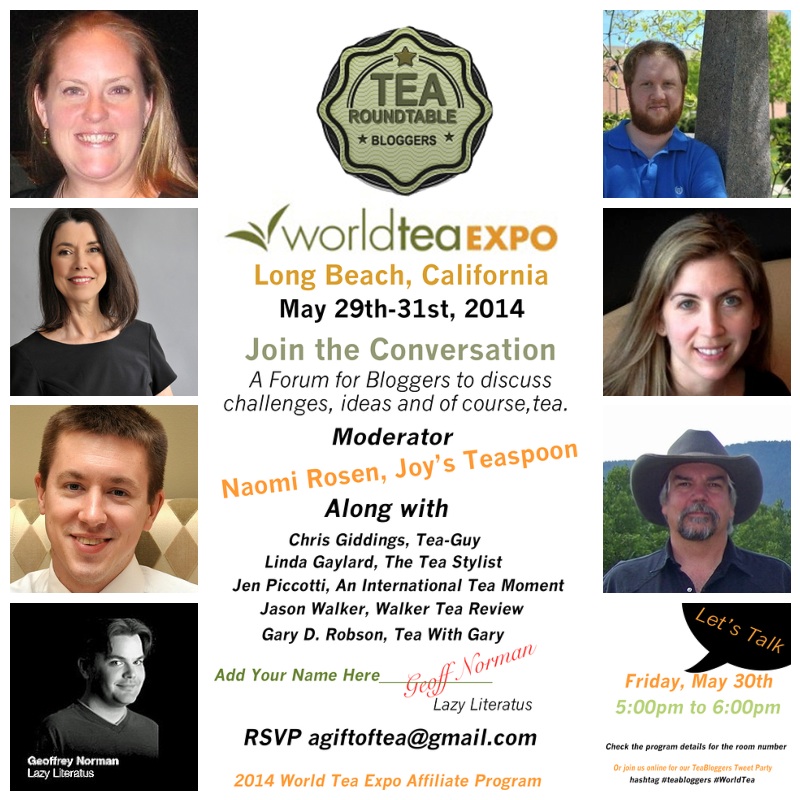
Last year at World Tea Expo in Las Vegas, I attended a Tea Blogger’s Roundtable. It was a great opportunity to talk with some of the big tea bloggers, share experiences, and discuss challenges. This year in Long Beach, California, I’m pleased to be one of the panelists.
The panel will be on Friday, May 30th, starting at 5:00 p.m. Anyone registered for World Tea Expo or Healthy Beverage Expo is welcome to attend. If you can make it, please let us know using the email address in the poster above. Prepare questions for your favorite tea bloggers (and the ones you just tolerate, too). Take some time to check out the blogs before you attend, too. We all love getting new readers!
The event is being coordinated by A Gift of Tea (Twitter feed @AGiftOfTea). I will also be posting updates here and on my Twitter feed (@TeaWithGary). The bloggers on the panel (in alphabetical order) are:
- Linda Gaylard (the Tea Stylist)
- Chris Giddings (the Tea-Guy)
- Geoffrey Norman (Lazy Literatus)
- Jen Piccoti (An International Tea Moment)
- Gary Robson (Tea With Gary)
- Naomi Rosen (Joy’s Teaspoon)
- Jason Walker (Walker Tea Review)
I’m really not sure what they were thinking when they replaced Robert Godden (Lord Devotea’s Tea Spouts) with me. Maybe he’s too edgy and controversial. Or maybe he’s just getting old and everyone thought his 45-minute PowerPoint presentation on Australian eucalyptus tea was too darned boring. (I have a feeling I’m going to pay for that comment!)
See you there (except for Robert, unfortunately)!

Tea H. White arrives in Montana

Back in November, I wrote about #TeaAcrossAmerica, a program that’s putting tea bushes in all fifty states plus the District of Columbia. By joining the program, I agreed to host Montana’s tea plant, which arrived at my tea shop yesterday. The plant, which we named “Tea H. White,” is a China bush (Camellia sinensis var. sinensis), which is tolerant of cold, but not nearly tolerant enough to spend a Montana winter outdoors. The plant can take an occasional light frost, but not temperatures like the -27(F) we had for a couple of days early last month. This means that Tea H. White will be living indoors.
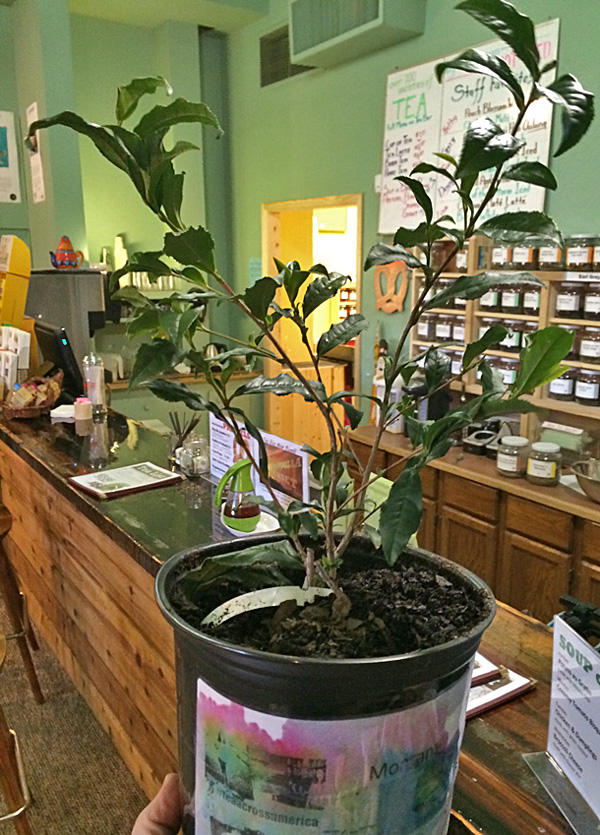
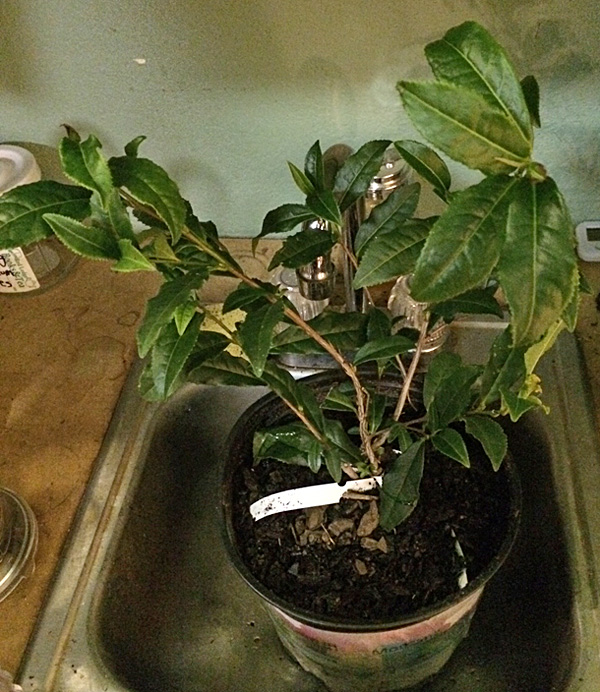
My tea bar has east-facing bay windows that should be a great place to keep the plant, with full morning sun and afternoon shade. We’ll have to work on the humidity, since it’s pretty dry out here, but we can do that. In the picture above, you can see that our cutting came out of the shipping box a wee bit dehydrated, which is to be expected after a few days in USPS trucks and planes. The first thing I did — after dragging him around the store and showing him to everybody — was get him into the sink, where he soaked up a lot of water and started perking back up.
Why the name? Well, our shop is a bookstore, which is why we’ve gone with literary names for some of our tea blends (e.g., Lady Greystoke and Fifty Shades of Earl Grey). In looking for the author-related puns, Tea S. Eliot was the first to pop to mind, but Shannon Brewer Land already used that name for the Alaskan Tea Across America plant — although she later changed it to Captain James Tea Kirk.

As it turns out, Tea H. White is a better name for our plant anyway. T. H. White is the author of the groundbreaking The Once and Future King series, which tells the King Arthur legend starting with Arthur’s childhood. We are definitely lovers of fantasy novels and Arthurian stories, and as a children’s author myself, I really enjoy good young adult literature.
As soon as little Tea H. White started perking up, our assistant manager, Gwen, was ready to pluck a leaf and start drying it. After fighting her off with my trusty pu-erh knife Excaliber, we decided to let the plant turn into a bush before we start trying to drink it. I sympathize with Gwen, though. Patience is not my strong suit either.
I am curious. I’d like to know whether this is the first tea bush in Montana. Has anyone else tried this experiment? Is there a little tea garden growing in a greenhouse in Missoula? A tea bush in a shop in Helena? A cutting thriving in someone’s sun room in Bozeman? If any of my readers know about another Camellia sinensis bush in Montana, let me know. I’d love to compare notes with someone else who’s done this!
Joining Tea Across America
The more I learn about tea, the more I want to learn. The more I experience, the more I want to experience. I experiment, I read books, I read blogs, I attend tea conferences, and I take classes. I buy tea from all over the world, and try out different blends and combinations. Basically, I do whatever my budget allows.

One thing my budget has not, alas, allowed has been traveling to the world’s great tea growing areas and getting familiar with tea bushes. My tea experiences all start with processed leaves, not with the plants themselves. Today marked the first step in changing that.
I got a phone call this afternoon from Naomi Rosen, of Joy’s Teaspoon. I met Naomi at a blogger’s panel at World Tea Expo 2013 this summer (CAUTION: this link to World Tea Expo plays video and makes noise — careful where you are when you click it). Naomi was calling because she’s working with Jason McDonald of FiLoLi Tea Farm and the United States League of Tea Growers on a new initiative they call #TeaAcrossAmerica.
Their simple yet ambitious objective: put a tea plant into every state and the District of Columbia. Some U.S. states already have established tea plantations. Others have hobbyists with a few bushes going. Many states have climates that Camellia sinensis considers inhospitable. I happen to live in one of those states: Montana.
Naomi asked if I’d be willing to represent Montana in #TeaAcrossAmerica, and I jumped at the opportunity. To participate, I need to take a cutting from FiLoLi Tea Farm in Brookhaven, Mississippi, and grow it here in Montana. Jason has written up some directions to make caring for the cutting easier, and I’ll be able to keep it indoors where the harsh Montana winters won’t kill it. My tea bar has east-facing bay windows that should be a great place to keep the plant, with full morning sun and afternoon shade. The only problem will be humidity — it’s very dry here — but we can deal with that.
It’s going to be a month or two before my little tea bush arrives, so we have plenty of time to prepare. I will keep everyone up-to-date on the progress as we get things going. In the meantime, thanks to Jason for the opportunity and to Naomi for suggesting me as a volunteer!


The intimidation factor in tea
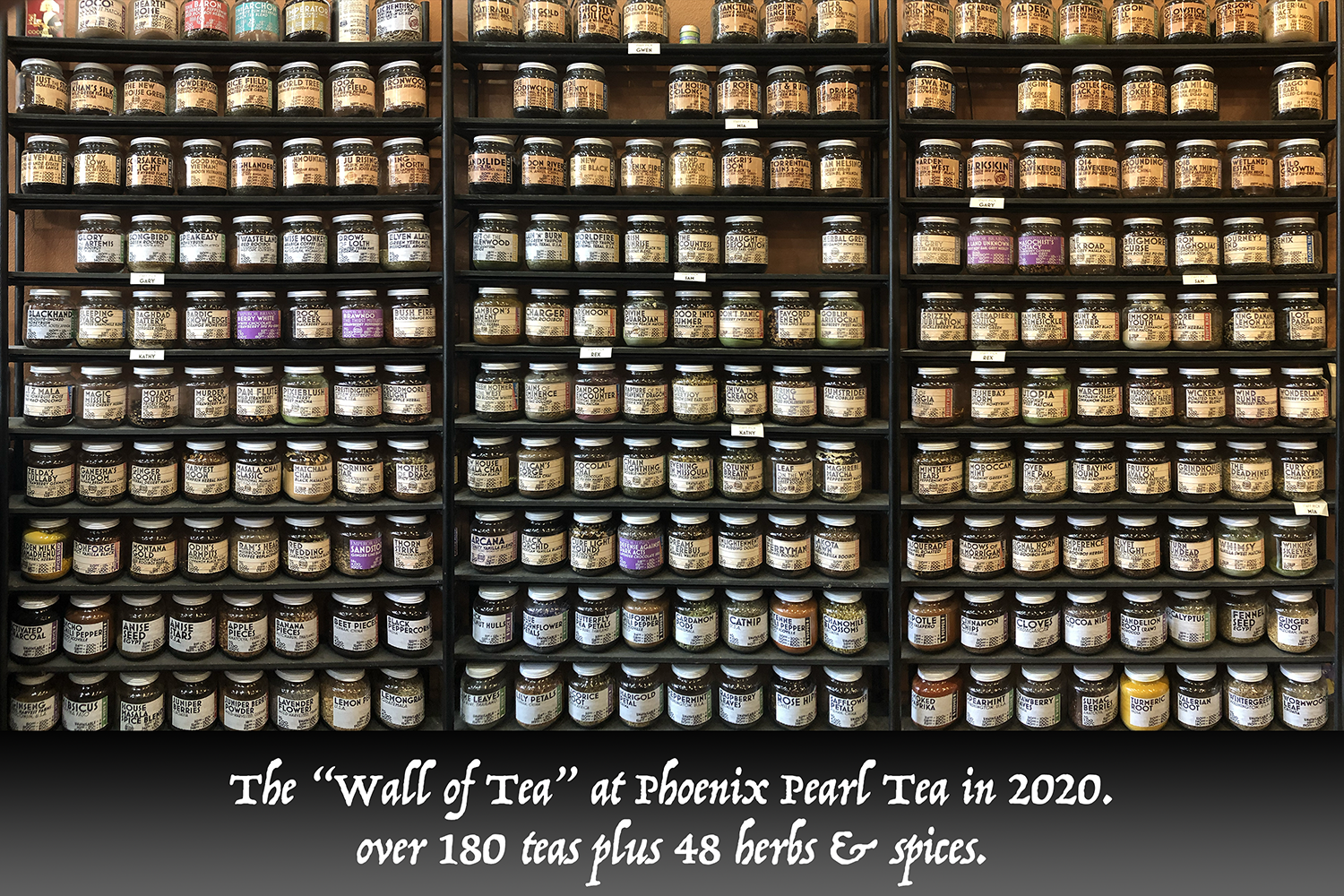
In terms of consumer education, the tea industry is where the coffee industry was a couple of decades ago. When I was in college in the 1970s, going into a coffee shop and ordering a vente half-caf no-foam skinny vanilla latte with a shot of white chocolate and a half-pump of peppermint would have gotten you some very strange looks. Starbucks created the terminology and spent years teaching it to their customers—and convincing their customers that it was the standard terminology in all coffee shops. Coffee aficionados have become very comfortable with the terminology and the technology behind their drinks.

Most of my tea customers, on the other hand, are completely overwhelmed by the array of 120 different teas laid out before them. They don’t know the difference between an oolong and a green tea, they’ve never heard of pu-erh, and they think orange pekoe is an orange-flavored tea. They aren’t going to make a complex drink order, largely because the consumer terminology hasn’t standardized and partially because they don’t know what they want. Instead, we have to walk them through it question by question without sounding bothered or talking down to them.
Every day I have conversations like this one:
Customer: I’d like a chai, please.
Me: Masala chai? Okay. We have nine to choose from. Do you want something traditional, or do you want to experiment?
Customer: Experiment?
Me: We have chocolate chai, spice apple chai, rooibos chai, vanilla chai…
Customer: Wow. I think I’ll go traditional.
Me: Here’s our most popular masala chai. It’s a house blend that uses a nice estate grown Assam tea as the base.
Customer: [sniffs] That smells great. I’ll go with that one.
Me: Hot or iced?
Customer: Oh, definitely hot.
Me: Sounds good. Then would you like it prepared as a latte with frothed milk, or just as a cup of straight tea?
Customer: A latte sounds good.
Me: What kind of milk would you like? I have nonfat, 2%, whole, half-and-half, vanilla soy, or coconut.
Customer: Hmmm. What would you recommend?
Me: The vanilla soy is good, but the whole milk is more traditional and makes a pretty nice froth.
Customer: I’ll go with whole milk then.
Me: And would you like it sweetened at all?
Customer: How do most people do it?
Me: In India, you’d probably get it sweetened with sugar. I tend to prefer agave nectar myself, although I don’t sweeten my own masala chais very much.
Customer: Do you have stevia? I’d like a bit of that.
Me: Sure thing. One last question: would you like that for here or to go?
Customer: I’ll drink it here, please.
Me: Okay, then. I’ll have that ready for you in about five minutes.
[This conversation is a lot longer than it would be for a typical non-latte tea, where I just check to see whether they want it hot or iced, here or to go, and they add their own sweetener and milk if they want any.]
Our job as tea experts is to make tea as friendly as possible. If the customer looks exasperated after the first question, I’ll point them at the staff favorites board or just ask if they’d like it made the way most of our customers take it.
I visited a lovely tea shop in Seattle last winter called Vital T-Leaf. Just my kind of place. They set out a gongfu set and we must have sampled a dozen different pu-erh teas. The woman doing the serving had the ceremony down pat, and all of the equipment arrayed before her: tray, kettle, cups, strainers, gaiwan, spoons, and more. We examined the dry leaf and wet leaf and tasted and discussed each tea.
To me, that was the perfect tea shop for the trained tea lover—and I spent plenty of money there in appreciation, but that would not work in Red Lodge, Montana. Most of my customers are intimidated just by the tea list itself. Add the presentation they used in Seattle, and few would even approach the tea bar. Even the way the tea is delivered to the customer matters. To me, the gonfu-style presentation when I ordered at the Teahouse Kuan Yin (see picture above) was perfect. A non-tea person wouldn’t have the slightest idea what to do with that. We prepare the tea and deliver it fully steeped, so our customers don’t have to worry about what kind of equipment we use and what we do with it. After all, they aren’t paying us a few bucks a cup to make them prepare their own tea!

Over the last couple of years, though, I’ve noticed more and more customers coming in and knowing what they want. Many of the regulars are starting to ask detailed questions about the equipment, the process, and the tea styles themselves. They want to know the origins of the funny names (one of the reasons I’m writing the Myths & Legends of Tea book that will hopefully be out by Christmas), the regional differences in style, and the reasons for the differences.
Update: The book is out now, and available in paperback and ebook.
More customers come in knowing what they want, or asking what’s new.
One huge difference remains between coffee aficionados and tea aficionados, though. Most of the coffee people I know neither know nor care what kind of coffee beans are being used — their custom order is all about the additives and preparation methods, so it stays the same every time. Tea people, on the other hand, are more likely to come in and experiment: a longjing dragonwell from China yesterday, a gyokuro from Japan today, and a first-flush Darjeeling from India tomorrow.
We encourage this, of course. The coffee shop down the street sells dozens of different coffee beans, but on any given day they’ll only be serving one or two of them. The differences among plain coffee beans are much more subtle than the differences in tea leaves, so that works for them. If we want our customers coming in to our shop instead of buying Lipton’s in tea bags at the grocery store, that approach won’t work for us. We need to educate our customers on style, terroir, and infusing methods. But we need to do it without being snobbish or intimidating.
It’s a delicate balance, but all of the good tea shops have figured it out. Mayhaps that’s what defines a good tea shop?
 Tea With Gary