Last Friday, Fox News ran a “Q&A with Dr. Manny” segment to address the question, “Coffee vs. Tea: Which is Healthier?” Dr. Manny Alvarez handed the question off to someone named Chris Kilham, who I assumed was a scientist or another doctor. I was wrong, but we’ll get to that later.
Manny Alvarez photo from Fox News website
Kilham began with some general statements (e.g., “For centuries, coffee has been praised for its invigorating properties. And it is truly healthy for you.”) and then stated his opinion: “For the most part, coffee is healthier for you.” Wow. That took me by surprise. Let’s continue and see what kind of well-researched and scientifically-backed justification he puts forth to back that conclusion.
The very next sentence is “The majority of people who drink tea, drink it black, and there’s no question that naturally occurring compounds in coffee are exceptionally good for you.” Really? I’m not sure what the first half of that sentence has to do with the second half, but let’s look at the first half.
I’m going to assume that he meant “most tea drinkers drink black tea” as opposed to “most tea drinkers don’t add milk or cream.” If he’s speaking of the United States, then the Tea Association of the USA backs him up. Their Tea Fact Sheet says that 80% of the tea consumed in the U.S. in 2010 was black tea. Worldwide, statistics vary. Teavana, for example, in the “Types of Tea” section of its website, says that “Green tea is the most popular type of tea, mainly because it is the beverage of choice in Asia.” The Food and Agriculture Organization of the United Nations (FAO) disagrees, however, stating that projected 2010 tea production was 2,443,000 tonnes of black tea vs. 900,000 tonnes of green tea. No offense, Teavana, but I think I’ll go with FAO’s numbers on this one. One accuracy point for Kilham.
Next, he proceeds to say that, “Two large cups of coffee, or 300 milligrams of caffeine per day, can improve a negative mood.” Assuming he’s referring to studies like Rogers & Dernoncourt, Haskell et al, or Peeling & Dawson, it’s the caffeine that has the effect, not the coffee per se. So it not only applies equally to coffee and tea, but you could get the same effect from swilling a two-liter bottle of Mountain Dew.
“Rusting of cells in our bodies? Rusting? And they quoted this guy as an expert?”
His next claim starts with, “Research into the chemical properties of coffee show that a cup of Joe contains potent, protective antioxidants, which inhibit the rusting of cells in our bodies.”
Whoa! Back up there. “Rusting of cells in our bodies?” Rusting? And they quoted this guy as an expert? Metal rusts. Cells don’t. Oxygen is the basic fuel that keeps our cells going. Our entire cardiovascular system exists to get oxygen to our cells. *sigh*
But yes, coffee does contain antioxidants. So, in fact, does tea. He proceeds to tell us, “Coffee is especially high in one group of antioxidants, flavonoids.” I attempted to find out whether coffee or tea contains more flavonoids, but there are just too many variables. Suffice it to say they both have plenty.
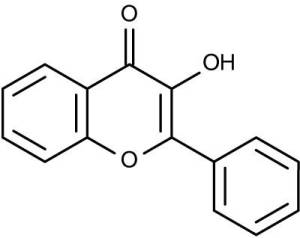
Oh, look! A flavonol! This stuff must be really, really healthy!
And this next paragraph is where Kilham really shows his ignorance about tea: “But if you’re drinking green tea, which is simply tea that hasn’t been fermented, then I would probably have to say that green tea is the healthier drink. It’s rich in flavenols [sic], which are lost when the tea is fermented.” Where do I even start with this?
First of all, green tea isn’t simply “tea that hasn’t been fermented.” Black tea hasn’t been fermented, either. Nor have white tea and oolong tea. Either Kilham doesn’t know the difference between fermentation and oxidation, or he doesn’t know the difference between black tea (which is oxidized) and pu-erh tea (which is fermented). I’m guessing both, and I’ll henceforth assume he means oxidized whenever he says fermented.
Next, it’s “flavonols,” not “flavenols.” If you’re going to babble pseudoscience, at least spell the words right.
Flavonols aren’t “lost” during oxidation; most (but not all) are converted into different antioxidants called theaflavins, and some convert to thearubigins (which produce the reddish hue of black tea).
Flavonols aren’t the only basis for measuring the healthiness of a drink. Focusing on them to the exclusion of everything else shows that Kilham just didn’t bother to do any research on tea.
He finishes his answer with the standard platitude of the underinformed: “The bottom line: If you’re talking about coffee and black tea, coffee is the healthier choice. If you’re a green tea drinker, green tea is the healthier choice.”
What’s wrong with that conclusion? It oversimplifies the issue and ignores all of the tea styles other than green and black. It doesn’t look at different types of black tea (or variants like the new purple tea from Kenya) or different ways of preparing them.
When I first wrote this response (before Firefox crashed and killed it), I didn’t know who Chris Kilham was. As I mentioned earlier, I assumed he was a medical doctor, researcher, or scientist. When I went to his website, however, I found that he’s a “medicine hunter, author and educator” who “travels the world in search of traditional, plant-based medicines, and works with shamans, healers, growers, harvesters, scientists, trade officials and other plant medicine experts in dozens of countries.” Yep, when I want accurate scientific health information, I go to shamans and healers.
There’s a quote from Dr. Alvarez that says, “I love adventure! That’s why I love teaming up with The Medicine Hunter, Chris Kilham.” Very telling. Alvarez didn’t call Kilham because he loves accurate information or well-researched responses. He called him because he loves adventure! Of course.
I think I’ll have another cup of tea and improve my mood.
Isn’t it fun how names develop for tea blends? The naming process is almost as much fun as the blending process itself.
For weeks, I had been trying to come up with a tea that invoked the taste of the creamsicles I used to enjoy so much as a kid (Who am I kidding? I still enjoy them!). Frozen orange over a vanilla bar. Yum! My initial attempts were based on black teas, and the flavor of the tea kept overwhelming the flavor of the orange and vanilla.
Finally, I hit on something that seemed to work. A blend of rooibos and honeybush as a base, which adds a rich, creamy texture. Orange and natural vanilla for the cremesicle flavor, and just a touch of carob to round everything out. I tried it both hot and iced and decided I liked it.
Some friends, Al and Ranetta, popped by the tea bar, and I asked if they’d like to sample my newest concoction. Being willing guinea pigs, they acquiesced. They tasted, we talked, and they liked it. Ranetta asked if she could buy a few ounces. As I started to write out the label, my hand stopped, poised to write, as I realized I hadn’t named the new blend yet.
I decided to write “orange creamsicle,” but Al was talking and distracting me (It’s all Al’s fault. Really it is). I misspelled the word. Unbelievable, isn’t it? But I threw an extra K in there. I noticed the error and commented on it.
“How did you spell it?” Al asked.
“Sickle with a K,” I replied. “As in ‘hammer and sickle’.”
It struck us both at about the same time that this is a red tea (the rooibos plant is also called the African redbush), so that could end up as a very fitting name. Al asked for a sheet of paper and set to work sketching a logo. I scanned, tweaked, and colorized his masterpiece (sorry, Al) and included it at the top of this blog post.
(Please imagine, in the following paragraph, that I’m speaking with the same accent as Mickey Rourke used when playing Whiplash in the second Iron Man movie. If you can’t do that, I’ll settle for Boris Badenov from the Rocky & Bullwinkle show.)
You must buy Hammer & Creamsickle Red now, comrade. Will take you back to childhood summers at family dacha on Volga river. Decadent treat from American capitalists. We have our own capitalism now; our own pravda. We have no money, but tea is cheap. Try now.
These days, you can’t be too careful what you say on a tea website. Last year, Unilever was warned by the FDA for claims they made about “Lipton Green Tea 100% Natural, Naturally Decaffeinated.” A week later, they warned Dr. Pepper Snapple Group about claims they made concerning “Canada Dry Sparkling Green Tea Ginger Ale.” Earlier this year, the FDA’s target was Diaspora Tea & Herb (d.b.a. Rishi Tea) for a wide variety of health claims on Rishi Tea’s website.
Given these warning shots fired across the bows of the big boys, the whole industry is being careful about making nutritional claims for tea. But we still need to say more about tea than just “this stuff tastes really, really good” — although that’s generally good enough for me.
For an example of how far companies are going these days, we got a promotional mailer today from Numi Tea. They are a fine company, and I’d be happy to resell some of their products in our tea bar. The mailer has some traditional marketing language (with appropriate footnotes, of course), just as I’d probably write myself:
“[Pu-erh]’s unique fermentation process results in more antioxidants than most green teas and is traditionally known to help weight management*, improve digestion and naturally boost energy.”
Well, I hope I wouldn’t write it exactly like that, but given a bit of tweaking to the grammar and punctuation, it’s a reasonable sentence.
The first claim is footnoted “*Along with a healthy diet and exercise.” Okay. I’ll buy that. Given enough healthy diet and exercise, lots of things help with weight management. The other two claims are very difficult to measure and/or prove. Vague claims typically don’t draw the ire of the FDA, so they’re probably safe.
But it was the next section that made me chuckle. It says, and I quote:
“Every blend is freshly brewed, made with full-leaf tea and uses 100% real ingredients for a pure Pu-erh tea taste.”
Wow! It uses 100% REAL INGREDIENTS! Is that the best they could do? Really? Can you imagine the certification process for that? “Is this an ingredient? Yep!” I carry 100 different teas in my tea bar, and I can guarantee you that every single one of them carries 100% real ingredients. Yep. Not an unreal ingredient in the bunch.
I did a bit of further looking, and found that the front cover of their mailer says, “Real ingredients. 100%. Nothing else.” There’s a whole section of their website called “100% real ingredients.” There’s a paragraph on that page of their site that says:
“For a pure, authentic taste, we blend premium organic teas and herbs with only real fruits, flowers and spices. We never use ‘natural’ flavorings or fragrances like other teas do.”
I’m pleased to hear that they only use “real” ingredients, and not “natural” ones like everyone else. Come on, Numi. You make some absolutely fantastic teas, and your organic and fair-trade programs are excellent. I’d like to see you spend more time talking about that — which really does differentiate your products — and less time talking about being “real,” which means absolutely nothing.
After my blog post a couple of weeks ago about Twinings changing their Earl Grey formulation, I went to my favorite online forum (the Straight Dope Message Boards) and started a poll to see what people thought about it. I never thought at the time that it would lead to a whole new spin on Earl Grey tea.
What picture could I possibly use to illustrate this blog post? Ah, The Four Hoursement of the Apocalypse by Vasnetsov, of course!
During the discussion, a fellow who uses the online moniker “Mr. Excellent” commented that:
“But yah, Twinings is acceptable, but I prefer to get my tea from a local tea shop. And lapsang souchong is more my thing, anyway. (Though adding bergamot could be neat …) “
The idea of a smoky lapsang souchong with bergamot just seemed wonderful to me, and I commented that I was going to give a shot at creating one. Mr. Excellent responded with:
“I’m looking forward to hearing how the Post-Apocalyptic Earl Gray works out! (Named thus because, with the smokiness of the lapsang, it should be like Earl Gray that survived some firey holocaust and came out awesome.) “
Over the course of the day, I played with recipes, and drank a lot of tea. By mid-afternoon, I was getting fairly close to what I wanted, and described it thus:
“The various strong flavors in this tea hit you at different times. As you bring the cup up to your mouth, the bergamot is the first thing to hit the nose, cutting through the smokiness of the lapsang souchong. When you take the first sip, the bergamot all but disappears, leaving the pine smoke flavor, which fades into the base tea (an organic black Yunnan) as it swirls through your mouth. After you swallow, the bergamot returns, blending with the smoke to create a lingering aftertaste.”
My goal was to create a blend that would make you feel like you were sitting among the smoldering remains of civilization, enjoying a nice cup of tea before hefting your shotgun and going back to fighting off the zombies. After another week or so of experimentation, I think I hit it. “Mr. Excellent’s Post-Apocalyptic Earl Grey” has officially gone on the menu at our tea bar, and as soon as I have the new tea website finished you will be able to buy it online.
Thank you, Mr. Excellent, for the idea and the name. I hope you enjoy the tea!
[UPDATE May 2015: My book, “Myths & Legends of Tea, volume 1” is out, and there’s a chapter devoted to the (fictional) backstory of Mr. Excellent’s Post-Apocalyptic Earl Grey. It’s set in Australia, 20 years from now…
The tea world is all a-twitter because British tea giant Twinings has changed the formulation of their Earl Grey tea after over a century and a half. This is being likened to the “New Coke” fiasco. It’s difficult to address a subject like this without puns, so let me get this out of the way and call it a tempest in a teapot.
When it comes to Earl Grey tea, we are swimming in a sea of alternatives. Every tea company has their own twist on the blend, and the only things they have in common are black tea and bergamot. In fact, even the black tea part is optional these days. You can get Earl Grey made from Chinese tea, Indian tea, Ceylon tea, or Kenya tea. You can even get white Earl Grey, green Earl Grey, red Earl Grey (which is made with rooibos rather than tea), or Mr. Excellent’s Post-Apocalyptic Earl Grey. The amount of bergamot can vary from just a hint to enough to knock your socks off. You can get your Earl Grey with lavender or dozens of other additives.
I am most amused by the Earl Grey variants that they call “citrus” Earl Grey. Hey, guys, all Earl Grey is citrus. That’s what bergamot is. It’s a variety of orange.
The bergamot orange.
We’ve done some experimentation in our tea bar. Since Earl Grey tea is hugely popular — one of my personal favorites, in fact — we started out with four Earl Greys: an Ancient Tree Earl Grey, Empire’s Earl Grey Supreme, a rooibos Earl Grey for the caffeine-free crowd, and our own lavender Earl Grey blend we call The Countess (here’s why we don’t call it Lady Grey). Yes, we know that’s not what’s in Twinings’ Lady Grey. We don’t care.
We knew those last two were going to be specialty drinks. The purists wouldn’t be interested in either one. The first two would be a horse race for popularity.
Rishi’s offering is my personal favorite. It’s a very straightforward Earl Grey made from organic fair-trade Yunnan Dian Hong. The Earl Grey Supreme from Empire Tea includes quite a bit more bergamot and some other citrus as well. The horse race became a runaway. Rishi’s Ancient Tree Earl Grey is the most popular tea at the tea bar (judging by ounces sold), outselling the high-bergamot Supreme by a four-to-one margin. If I were the type to draw conclusions based on a single data point, I’d say that adding more bergamot to Earl Grey isn’t a good thing.
That, however, is exactly what Twinings just did (and a touch of lemon, too).
This isn’t really going to affect me. They may have been first out of the gate with Earl Grey, but theirs has never been my favorite formulation. I think it will be a good thing for the tea business, though, as it will drive the old-line Twinings Earl Grey purists to get out and experiment a bit. We’ll see where it goes.
Update: 7 September 2011
That didn’t take long. Andrew Brown at the Telegraph blogged (actually before my post came out, so I suppose my research was inadequate) that Twinings has released “Earl Grey: The Classic Edition” to satisfy discontented fans. It’s an interesting post. The thing I find most interesting is the biography line at the top, which says, “Andrew M Brown is a writer with an interest in mental health and the influence of addiction on culture.” Good qualifications for someone writing about tea, eh?
About 40% of the teas we offer at our tea bar are certified organic. Generally speaking, those teas run about 50% higher in price than the non-organic alternatives. In most cases, however, they outsell their non-organic counterparts by a fairly healthy margin. In tough economic times, that says something. But what does it say?
UPDATE 2017: The price difference between organic and non-organic teas is a lot smaller now. There are also a lot of alternatives to USDA organic programs, like the ones I wrote about in 2015.
Let’s say you were to prepare two cups of tea, processed identically, with tea grown in neighboring plantations. Identical weather and soil, but one organic and the other not. Would you be able to tell those two cups of tea apart? I doubt that I would. Yet as I write this I’m drinking a cup of USDA Organic Earl Grey tea, for which I paid quite a bit more than the “brand X” earl grey that I could have prepared instead. Why? Because I like it better. But the real question is why I started drinking that particular earl grey in the first place.
To me, the “organic” label doesn’t necessarily mean you have a better product. Conversely, lack of organic certification doesn’t mean there’s anything wrong with it. But when I’m looking at new tea for home or the tea bar, I look for the “USDA Organic” logo because it means somebody went to a lot of effort to get that certification. They cared enough to wade through the mounds of required paperwork and certify the origins of every ingredient. That’s a lot of work, and it means they take pride in their product.
On the front page of the current issue of our local paper, The Carbon County News, there’s an extensive interview with Bonnie Martinell, one of the owners of the On-Thyme Gourmet, the farm that grows the sage and apple mint tea we sell. They quoted her as saying:
“We were certified organic but the process became so burdensome. We tried to keep up with the forms but they are about five inches deep to start with and they keep coming back for changes with another five inches. You can’t function with all the paperwork.”
I’ve heard the same thing from other farmers and ranchers in this area. When I had my ranch, I couldn’t certify my cattle as organic because they had grazed for six months on BLM land, where I had no control over what they might have eaten.
If there’s an organic tea that I like, which sells well in my tea bar, I’m not going to stop selling it if it suddenly becomes non-certified. To me, it’s still the same product. I consider the “Certified Organic” label to be a shopping aid, not a label requirement. It guides me to producers who care enough to put extra effort into their product. I think it helps me to find good tea.
What about the price issue? Well, most tea is pretty inexpensive. The majority of our organic loose-leaf teas sell for $3.00/ounce or less. Even a big 16-ounce mug like the one I use at home only needs 7 grams of tea, which means about four cups per ounce. I generally use my leaves twice, which doubles the yield to eight cups per ounce. That’s 38 cents per cup for the organic tea, versus about 25 cents for a non-organic equivalent. About a dime a cup difference. I’d have to drink a lot of tea before a dime a cup would break my budget!
And in the tea bar, I charge the same price for a cup of just about every tea in the store (we do charge more for some specialties, like boba and chai), so as a consumer, you’d pay the same for the organic as you would for the non-organic.
My conclusion: argue all day long about what “organic” really means, but I don’t think it matters. When I’m buying unfamiliar tea, I’m going to look for that label!
According to Business Daily in Africa, farmers in Kenya have been given permission to start growing purple tea, a varietal they’ve been developing for the last 25 years. The new varietal, called TRFK306/1, was developed by the Tea Research Foundation of Kenya (TRFK), and is expected to provide dramatically higher profits for farmers than existing tea plants.
Unlike white, green, and black tea — which all refer to different ways of processing tea leaves — purple tea is actually a variant of the plant. It can be processed in different ways to yield “black purple tea” or “green purple tea,” as confusing as that terminology might be (kind of like the “green red rooibos” I wrote about recently.
On the left, regular tea plants. On the right, the purple tea varietal.
All “true” tea is produced from the same plant: Camellia sinensis. There are two main variants of the plant, known as var. sinensis (Chinese) and var. assamica (Assam), and hundreds of sub-varieties. The new purple tea cultivar is what’s known as a “clonal” cultivar, meaning it is propagated by cutting and grafting rather than seed.
It is called “purple” because of high amounts of anthocyanin. The anthocyanin gives the leaves a purplish color in the fall, and contributes more astringency (what Lipton calls “briskness”) to the taste than standard varieties. People who drink tea for its healthy properties will be more interested, however, in the powerful antioxidant properties of anthocyanin.
According to New Agriculturalist, the strain is also higher yielding than existing Kenya teas, and is drought-resistant and frost-resistant. (Hmmm. Drought and frost resistant tea plants. I wonder how they would do here in Montana?) The TRFK told Reuters that the seeds “produce oil suitable for cooking, cosmetics and the pharmaceutical industries.” Kenya is the world’s third-largest producer of tea, after China and India, but it is the largest exporter of tea, according to FAO statistics.
How will this affect us in the U.S.?
Fans of black teas typically prize astringency (the “puckeriness” provided by the tannins in the tea, also found in wines like merlot), which purple tea processed like oolong will provide more of. People looking for a healthier beverage often seek out the teas with the highest antioxidant content, which lead them to white and green teas. Green purple tea should provide more of the antioxidants (although the jury is still out on the affect of anthocyanin on free radicals) while filling a new taste niche. I’ve only found one review of the flavor (apparently it’s “earthy and rustic”), so I’m holding off on expressing an opinion there until I get some myself.
It will probably be next year or the following before any significant quantity of purple tea shows up in the United States. I’m not going to jump on the health bandwagon, but I’ll certainly be one of the first to give it a taste and bring some in for the tea bar when the price becomes a bit more reasonable.
Lapsang souchong is a fascinating tea. People either love it or hate it. I’ve been winning some converts for it, though, by recommending a use other than drinking it: cooking with it.
When using a nice whole-leaf lapsang souchong like this one, it’s very important to crush the leaves before using them as a rub. I use a mortar & pestle to grind them to a powder. Photo courtesy of Phoenix Pearl Tea.
For those unfamiliar with it, lapsang souchong is a black tea that’s smoked instead of using typical tea drying techniques. Traditionally, it is dried in bamboo baskets over a wet pine fire, which gives it an aroma much like sitting near a campfire. A couple of my pipe smoking friends have compared it to a Latakia tobacco. It’s also one of the primary types of tea used in the Russian Caravan blend. I know. Lapsang souchong sounds like a very strange tea—and I’ll confess it’s not your run-of-the-mill Lipton.
I was visiting another tea shop and chatting with the owner earlier this year. As I was buying some lapsang souchong to drink, she asked if I’d tried using it as a rub. That, by golly, got my mind spinning. Since then, my wife and I have tried variations on several different kinds of meats and fish—and on meatballs, too!
Give this recipe a try, and let me know what you think. If you tweak it for your taste, please share that, too. I used a rich, strong lapsang souchong from our tea bar for this.
Salmon Souchong
Ingredients
Four salmon fillets (the ones we use are about 1/2″ thick — thick fillets require longer cooking times)
1 ounce lapsang souchong leaves
1 tbsp fresh ground black peppercorns
2 tsp sweet Hungarian paprika
4 tbsp butter
4 cloves fresh garlic
1 small lime
Procedure
Cut lime in quarters.
Crush garlic in press and put in a skillet with butter over low heat.
Moisten salmon filets.
Grind tea into powder using mortar & pestle.
Add pepper and paprika to tea powder and mix well.
Remove excess moisture from fish and place skin side down on plate or cutting board.
Apply tea powder mixture liberally to top side of fillets.
Once butter is melted, turn heat up to medium-high and place salmon in pan, skin-side down.
Cook for about 5 minutes, then flip salmon. If you wish to remove the skin, now is the time to do it. It should lift right off with a spatula.
Cook about another 5 minutes, until salmon is flaky.
Remove from skillet and serve with lime wedges.
Give it a try. It’s also great on the barbecue (my wife prefers that to the pan-fried version). And for goodness’ sake, drink some of that lapsang souchong along with your dinner!
When starting up a new venture, it’s a good idea to minimize the amount of cash you put in until you’re sure it’s going to work. In keeping with that philosophy, when we started our tea bar at the bookstore, we bought what the health inspector said we had to buy (e.g., a triple-basin sink and a sanitizing hand soap dispenser) and what the state said we had to buy (a Federally-certified and State-inspected scale that cost ten times what a standard kitchen food scale costs), but we were careful beyond that.
Oh, we bought a Zojirushi machine to keep our tea water at exactly the right temperature and some IngenuiTEA brew pots to prepare the tea for our customers. We did not, however, buy any other fancy equipment. We decided to spend the money on tea instead. One of the things in the “fancy equipment” category was an ice machine.
We figured we would sell some iced tea in the warm days of summer, but our bookstore had a waitress station in the back corner from the old days when the building housed a restaurant. That waitress station had an ice bin. We decided to just buy bags of ice at the grocery store and put them in the ice bin. Our old freezer in the back could hold an extra bag or two, so we’d be all set, right?
We soon discovered the error of our ways. The not-too-well-insulated ice bin allowed the ice to melt all too fast, and we served a lot more iced tea than we had anticipated. The grocery store is just far enough that you can’t really make an ice run when there are customers waiting, so we often bought more ice than we really needed. Bags of ice are pretty pricey at the grocery store, too: about $1.70 for a 7-pound bag. When you’re going through two or three bags a day, it really adds up.
Then we realized that the liquor store right next to us had an ice machine. Perfect! I negotiated a price so we could just run over there with a bucket, fill it with ice, and have them put it on our tab. More convenient for us, a better price for us, no work at all for the liquor store. There were a few minor inconveniences, like the fact that they opened later in the morning than we did and they are closed Sundays, but we could easily deal with that.
Then things began to get surreal. We’d run over and the scoop would be hidden away somewhere. We’d have to wait while someone found it. They shut the ice machine down for a week (without telling us), so there was no ice available. We found ourselves having to run over to the grocery store anyway. And still, we were spending $4 or $5 per day for ice.
I decided to start shopping for ice machines. I got an email from Sysco that they were having an ice machine sale. What perfect timing! Until I found that the sale price on their cheapest unit was close to $2,000. I searched high and low, and then my friend Martha, who runs the Café Regis, suggested a fellow named Mike who deals in used kitchen equipment.
After a whole bunch more research and several discussions with Mike, we finally settled on a Hoshizaki counter-top ice making machine. It was still pricey, although the $875 we spent is a lot less than the $2,800 list price, but it makes us independent. I know we’ll spend less on ice in the winter than we do in the summer, but I still figure that machine will pay for itself in less than a year, and it’s far more convenient. Not only that, we can put a filter on the line and gain control over the quality of the water used to produce the ice.
Unfortunately, I don’t deal well with plumbing. After three hours of fiddling around and running back and forth to the hardware store, we still didn’t have a functional water line and filter. I ended up having to get a plumber just because none of the connectors would mate without leaking (I still can’t believe you have to fabricate custom hoses and connectors to hook up a water filter to this line — it boggles the mind).
So, at last, we produce our own ice. Nice little pellets of ice — not the big cubes we were using before — which cool the hot tea down swiftly.
Postscript: Just as I finished typing this, I got a call from the bookstore (it’s my day off). The machine is leaking all over the floor. *sigh* I hate plumbing with the burning passion of 1,000 leaky hot-water lines. I really, really do.
I’ve been drinking rooibos (a.k.a. “African redbush,” a.k.a. “red tea”) for years, and stocked our tea bar liberally with varieties of it. All of them use the same base plant — Aspalathus linearis — prepared with an oxidation process similar to what’s used for black tea. The plant is naturally caffeine-free, which is a great boon for those of us who aren’t fans of chemical or pressure decaffeination techniques.
In green rooibos, the leaves (shaped like needles) are heated after picking to stop the oxidation process and keep the green color and mild flavor.
Rooibos has developed quite a following, especially with all of the press it’s been getting for being high in antioxidants. Only recently, however, have requests started coming in at the tea bar for “green” rooibos.
I am in the tea business because I love the flavors of tea. I’m not an herbalist, so everything I do with tea starts with the taste. I ordered in some green rooibos for the tea bar, and gave it a try. Green rooibos has minimal tannin content, so bitterness isn’t a danger. For my first try, I made a cup using 195-degree water (I’m at 5,500 feet altitude, so that’s about 7 degrees below boiling), and steeped it for 5 minutes. I used one tablespoon for a 13-ounce cup, and did not add anything (no lemon, sugar, milk…).
The first thing I noticed was the color. The liquid is a beautiful golden honey color, quite different both from most green teas and from the traditional red rooibos. The tea is smooth and woody, with just a hint of grassiness and nut flavor. True to promise, there’s no bitterness at all, and no need for additives. Just to push the limits, I re-used the leaves, steeping them for 10 minutes this time. The flavor and aroma were almost identical to the first cup.
There are a lot of claims out there about green rooibos being significantly higher in antioxidants than traditional red rooibos. A quick perusal of the research still shows mixed results on that, so I’m not going to take a position on the health effects. As I’ve mentioned before, I’m in it for the taste!
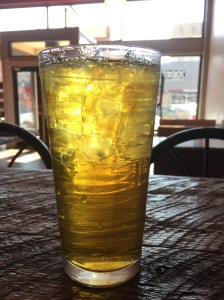
While writing this, I realized that I had tried it hot, but not iced. The folks over at Suffuse Rooibos say green rooibos makes a fantastic iced tea, so I took a break to make a cup of iced green rooibos (the research is the best part of this job!). I brewed it the same way (5-minute steep time), and poured it directly over a cup of ice cubes — again, I didn’t add anything to it. I found it refreshing and tasty; excellent for a hot day when I don’t want to overload with caffeine. I will definitely be drinking more of this!


 Isn’t it fun how names develop for tea blends? The naming process is almost as much fun as the blending process itself.


 The tea world is all a-twitter because British tea giant Twinings has changed the formulation of their Earl Grey tea after over a century and a half. This is being likened to the “New Coke” fiasco. It’s difficult to address a subject like this without puns, so let me get this out of the way and call it a tempest in a teapot.


 After a whole bunch more research and several discussions with Mike, we finally settled on a Hoshizaki counter-top ice making machine. It was still pricey, although the $875 we spent is a lot less than the $2,800 list price, but it makes us independent. I know we’ll spend less on ice in the winter than we do in the summer, but I still figure that machine will pay for itself in less than a year, and it’s far more convenient. Not only that, we can put a filter on the line and gain control over the quality of the water used to produce the ice.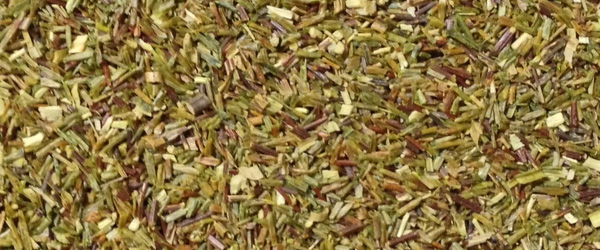
 Tea With Gary