Author Archives: Gary D. Robson

Why Does My Tea Taste Like Coffee?

I try not to obsess over web statistics, for that way lies madness. I do, however, enjoy looking over what web searches bring people to my humble tea blog. One caught my eye today, as it seemed to be just begging for a blog post: “Why does my tea taste like coffee”?
I mentioned in my Keurig K-Cup post last month that the tea it produced did not taste like coffee. There’s a reason that was notable enough to mention: every other coffeemaker I’ve ever used is unable to produce decent tea once it’s been used for coffee. The oils in the coffee may clean off of the glass from the carafe, but they will impregnate the plastic parts of the coffeemaker and there’s not a darned thing you can do about it.
If you want to perform a test, try running a pot of plain hot water through the coffeemaker and take a deep sniff. Then take a sip and hold the hot water in your mouth for a moment. If you can detect coffee at all, then you aren’t going to be able to brew a proper cup of tea from that water.
If, however, you brew mostly strong black teas and don’t detest coffee, you can reach an acceptable compromise. Run that plain water through, but this time add a couple of tablespoons of vinegar to it. It will take another few pots of plain water to get the vinegar smell out, but it will help with the coffee. Once you’ve done that, run one last full carafe of plain water with a tablespoon of bleach. Rinse everything thoroughly and let it dry overnight.
It’s not something you can do with a hotel coffeemaker, but if you want to switch your coffeemaker into a hot water maker for tea, this is a great start.

Fun Blends: Coyotes of the Purple Sage

With new tea blends, sometimes we come up with the tea first and struggle to think of the perfect name. Sometimes we come up with a cool tea name and then spend weeks tweaking the formula until we find just the right taste. And then the logo works its way into the equation.
Sometimes, however, everything comes together in a flash, and that’s what happened with this tea.
We were looking for ideas for a fundraiser, using a tea that had a real American West flavor to it. Being a tea bar/bookstore combo, a literary allusion makes things even better. As we were throwing out ideas, someone said “Zane Grey.” The next obvious leap was “a Zane Grey Earl Grey.” The next obvious leap was to Zane Grey’s best-known book, Riders of the Purple Sage.
The ingredients for the tea came together pretty quickly as well. Black tea and bergamot oil are the base for most Earl Greys. Sage was pretty much a mandatory ingredient. A bit of lemon verbena and lemon thyme added more citrus notes and the thyme goes well with the sage (I will resist breaking into song here), and a subtle touch of peppermint finished off the blend.
The Logo

The fundraiser is for the Yellowstone Wildlife Sanctuary here in Red Lodge, and two of the well-known noisy critters right by the entrance are a pair of coyotes named Bonnie and Clyde. We wrapped everything up by tying in the Wildlife Sanctuary and naming the tea Coyotes of the Purple Sage.
My logo is an homage to the cover of the first copy of Riders of the Purple Sage that I read, shown in the banner at the top of this article.
Book Review: 20,000 Secrets of Tea

I read a lot about tea (what a surprise, eh?), and try to carry a decent selection of tea books in my bookstore. When somebody recommended the book 20,000 Secrets of Tea: The Most Effective Ways to Benefit from Nature’s Healing Herbs by Victoria Zak, I decided to give it a look. I confess I was put off by the subtitle, because it sounds more like a book of herbal medicine than a book about tea. Then I flipped the book over and took a look at the back cover. There I saw this:
“An Ancient Chinese Legend: Once there was a man who knew 100,000 healing properties of herbs. He taught his son 80,000 secrets. On his deathbed, he told his son to visit his grave in five years, and there he would find the other 20,000 secrets. When the son went to his father’s grave, he found, growing on the site, the tea shrub…”
Okay, that’s more promising. Especially this line in the next paragraph: “A simple cup of tea not only has the power to soothe and relax but to deliver healing herbal agents to the bloodstream more quickly than capsules, tinctures, or infusions.” That line indicates that they know the difference between tea and infusions/tisanes, and that this book is going to be about tea.
Oh, my, was I wrong.
Page one starts out with a description of the legend of the origin of tea. Chapter one continues on, repeating the story from the back cover and then providing some of the history of tea as a drink. Within five pages, it has transitioned to herbal infusions, and that’s pretty much the end of discussion of the tea plant (Camellia sinensis).
I flipped through the next 220 pages looking for more information about tea (after all, the next 20,000 secrets are all about the tea shrub, right?) and I all found was descriptions of various herbs along with multitudinous health claims about each (more on that in a moment).
I went to the index looking for tea. The index is 15 pages long, normally a good sign in a reference book. Under “tea” I found reference to pages 1-4, mentioned above. Under Camellia sinensis, nothing. Flipping through the alphabetical collection of herbs, tea isn’t even listed. I checked under “black tea” and found a two-page spread in the middle titled “Green, Oolong, Black: the legendary teas.”
Zak begins by repeating the origin legend from page 1, and then proceeds to talk about fermentation (none of those teas are fermented, although black and oolong are oxidized) and rates the three styles in order of “medicinal strength: (green, then oolong, then black). Nowhere does she mention white or pu-erh tea, and nowhere does she define what “medicinal strength” actually means. Obviously, when there’s so little information, it leads to gross overgeneralization. When you use up that little bit of space with statements like “Green tea’s polyphenols are powerful antioxidants are reputed to be two hundred times stronger than vitamin E. It has anticancer catekins (sic), which protect the cells from carcinogens, toxins, free radical damage, and help to keep radioactive strontium 90 out of the bones,” there’s no room left to describe the differences between tea styles, how to properly steep a cup, or any of the other subjects that I expected this whole book to be about.
Incidentally, none of those rather incredible health claims are footnoted, no studies are cited, and no backup data is provided.
All in all, this book is tailor-made for herbalists — especially those that don’t worry much about the scientific basis of their health claims — but pretty well useless for tea enthusiasts.
Rooibos: The African Red Bush
How have I been at this blog for so long without writing about rooibos? Oh, I know this blog is about tea, and I did write a post about green rooibos last year, but I haven’t covered straight red rooibos yet.
Rooibos comes from a bush called Aspalathus linearis, which grows in the west cape of South Africa. The name “rooibos” is from the Dutch word “rooibosch” meaning “red bush.” The spelling was altered to “rooibos” when it was adopted into Afrikaans.

The rooibos bush (Aspalathus linearis) in bloom
Rooibos is also often called “red tea,” but most tea professionals shy away from that name for several reasons:
- The term “red tea” is used by the Chinese to refer to what we call “black tea.” No sense having two different drinks with the same name.
- Rooibos isn’t tea, since it doesn’t come from the Camellia sinensis plant. Instead, it is a tisane or herbal infusion.
- Rooibos only has that rich red color when it’s processed like a black tea. Green rooibos is more of a golden honey-colored infusion.
 Rooibos is a tasty drink that is also good for cooking. Hopefully, I’ll have a chance sometime soon to write a review soon of the cookbook A Touch of Rooibos. I have been looking through it lately and it’s filled with interesting ideas. Generally, when used for cooking, the rooibos is steeped for quite a while and then reduced to a thick syrupy consistency. Unlike black tea, it can be steeped for ten minutes or more without becoming unpalatable and bitter.
Unlike “real” tea, which all has caffeine, rooibos is naturally caffeine-free. Since the flavor is similar to a mild black tea, this makes it a favorite bedtime beverage for many tea drinkers. Rooibos is also high in antioxidants.
Herbalists make many claims about the health properties of the rooibos tisanes. The Web site for the South African Rooibos Council (SARC), in fact, has very little information that isn’t in some way tied back to health claims. There are more and more studies being done, but available data are lacking in specifics (in my opinion, anyway) so I’m not going to quote any of those there. Feel free to check SARC’s site for lots of studies.
I don’t mean to imply that rooibos is only about the health benefits. It is, in fact, a very tasty drink. Most rooibos drinkers in the U.S. enjoy it straight or with a bit of sweetener (honey or sugar). In South Africa, it is commonly served with a bit of milk or lemon as well as honey. A group funded by SARC and Stellenbosch University has recently developed a “sensory wheel” for rooibos, describing both the desirable and undesirable aspects of flavor and mouthfeel. If you are interested in more information, click on the wheel below.
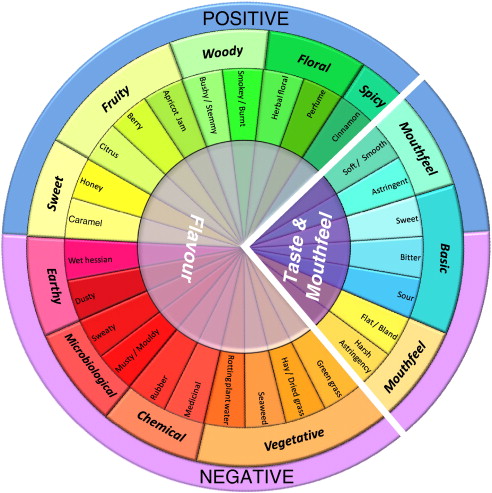
Rooibos Sensory Wheel as described in the article “Sensory characterization of rooibos tea and the development of a rooibos sensory wheel and lexicon,” available on Science Direct. Click the wheel above to view the article — there is a charge for the full text version.
 Also, there is an article you can download in PDF format (click the thumbnail to the right to download) that describes the sensory wheel and the process used to create it.
Compared to tea, rooibos is a pretty small market. South Africa’s annual rooibos production is about 12,000 tons. That output is about equivalent to annual tea production of the Darjeeling region of India, or about a tenth of the tea production of Japan (the 8th largest tea producing country). Nonetheless, rooibos is important to South Africa, employing about 5,000 people and generating about $70 million in revenues.
The leaves of the rooibos bush are more like needles than the broad leaves of a tea plant. To produce red rooibos, the leaves are harvested, crushed, and oxidized using a process based on the one used in making Chinese black tea. Typically, the leaves are sprayed with water and allowed to oxidize for about 12 hours before being spread out in the sun to dry.
Green rooibos, as the name implies, is unoxidized or very lightly oxidized, and is processed more like a green tea.
For more information about the rooibos industry, I recommend the article Disputing a Name, Developing a Geographical Indication, from the World Intellectual Property Organization.

Sweetening Tea with Stevia Leaf

I rarely sweeten my tea, with a few notable exceptions (masala chai just doesn’t taste right if I don’t add some honey and milk to it). That doesn’t, however, mean I have a problem with you sweetening your tea. I’ve written before about tea absolutists (a.k.a. “tea Nazis”) and their attitudes. I hope I never become one.
What does kind of bother me, however, is preparing a cup of a new and interesting tea for a guest and having them sweeten it before they taste it. For some people, though, they know how they like their particular favorite tea, and they assume that’s how they’ll like all tea. I think it indicates a general unawareness of the breadth of flavors in different varieties of tea.
A friend of mine came by the tea bar the other day, and I was excited to pull out a new tea for her to try. She was born in Ireland, and lived in the British Isles for most of her early life. I know she likes strong black tea, so I figured she’d really like this Royal Tajiri. I asked her, “would you like to taste it plain before you add your milk?”
She looked at me like I was nuts and said, “plain is with milk.”
Back on the subject of sweetening, times are changing. Used to be, a tea bar or coffee shop could put out a bowl with some of the white packets (sugar), some of the blue packets of aspartame (NutraSweet/Equal), and some of the pink packets of saccharin (Sweet’N’Low), and everyone was happy. Expectations have gone up, though. Now, you really need to have the green packets of stevia (Truvia/PureVia), yellow packets of sucralose (Splenda), and brown packets of natural brown sugar. And perhaps a jar of honey, a jar of agave nectar, and a jar of pure maple syrup.
Some want the most “natural” sweetener they can get. Others have a particular sweetener that they like the taste of. Others are primarily worried about the calories. For those who wish to experiment, I’ve been trying something a little different lately.
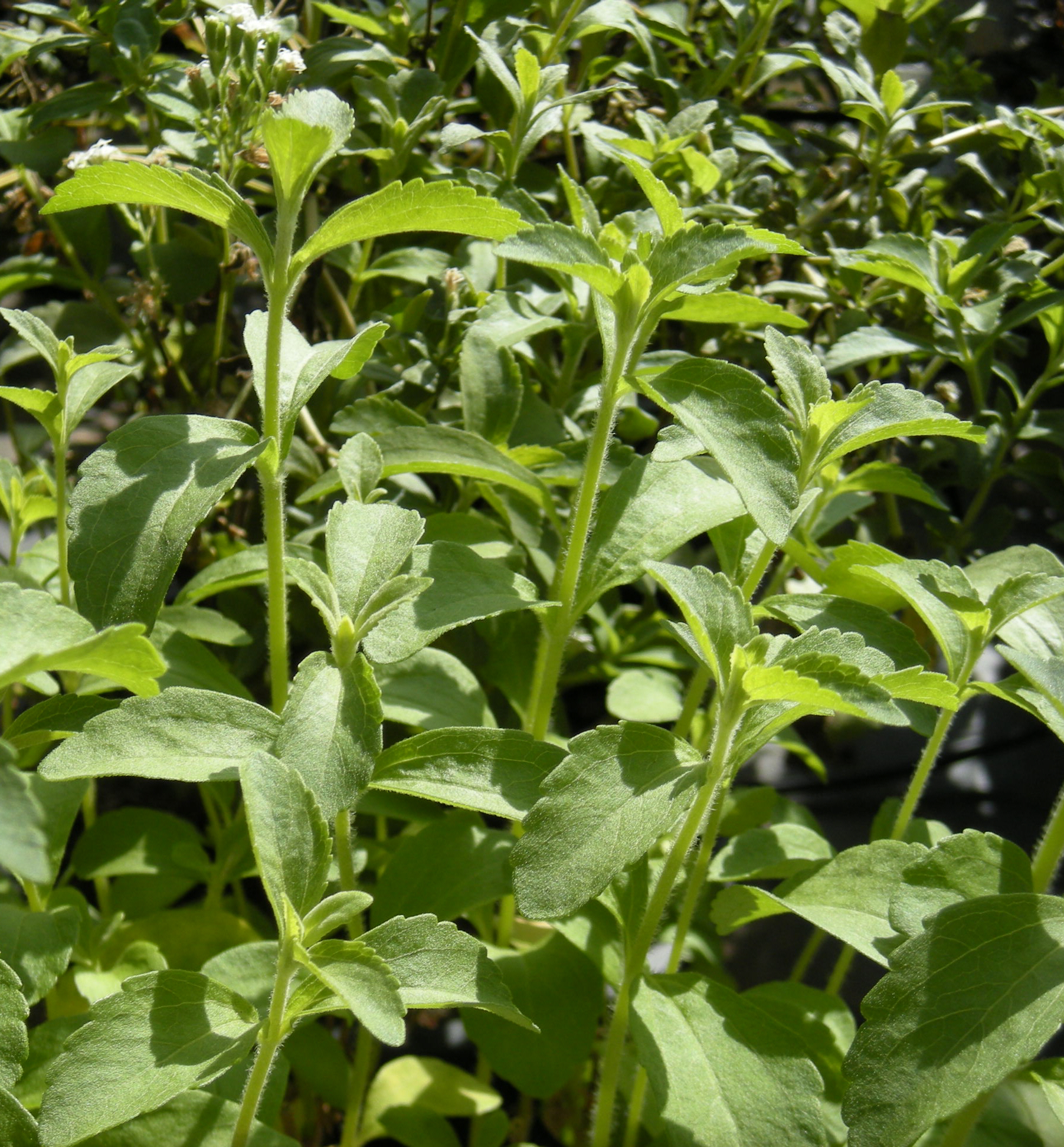
Stevia is a plant native to Paraguay that’s now being grown in a bunch of countries. It has a number of sweet components to its leaves, and the most potent (Rebaudioside A) is the base compound used to produce the powder in the green packets. That powder has a slight but noticeable flavor, which you’ll definitely pick up in a delicate tea (not that any of you would actually sweeten a delicate tea, would you?).
I’m now stocking dried raw stevia leaf in the tea bar. I use it — quite sparingly — in a couple of my house blends to add a touch of sweetness, and I’m starting to get more customers asking me to drop a pinch of stevia leaf in the pot when I’m brewing their tea. The flavor from the raw leaf is different from the flavor you get from the processed powder. Is it any more “natural” than the powder? I really don’t think so. But it feels different to add some leaves to your infusion instead of stirring a powder from a packet into the finished tea.
Going back to my mantra: whatever method of preparation works for you is the right one — for you.

Keurig K-Cups and Tea
We checked into the Lake Hotel in Yellowstone last week for the latest stop on my book signing tour. As usual, I schlepped in all of my tea stuff so I could have a decent cup in the morning: electric kettle, teapot, a selection of loose-leaf tea.
Frequently, hotels have coffee makers in the room (unless you’re in Las Vegas), but I don’t like having my tea water taste like coffee, so I don’t use them.
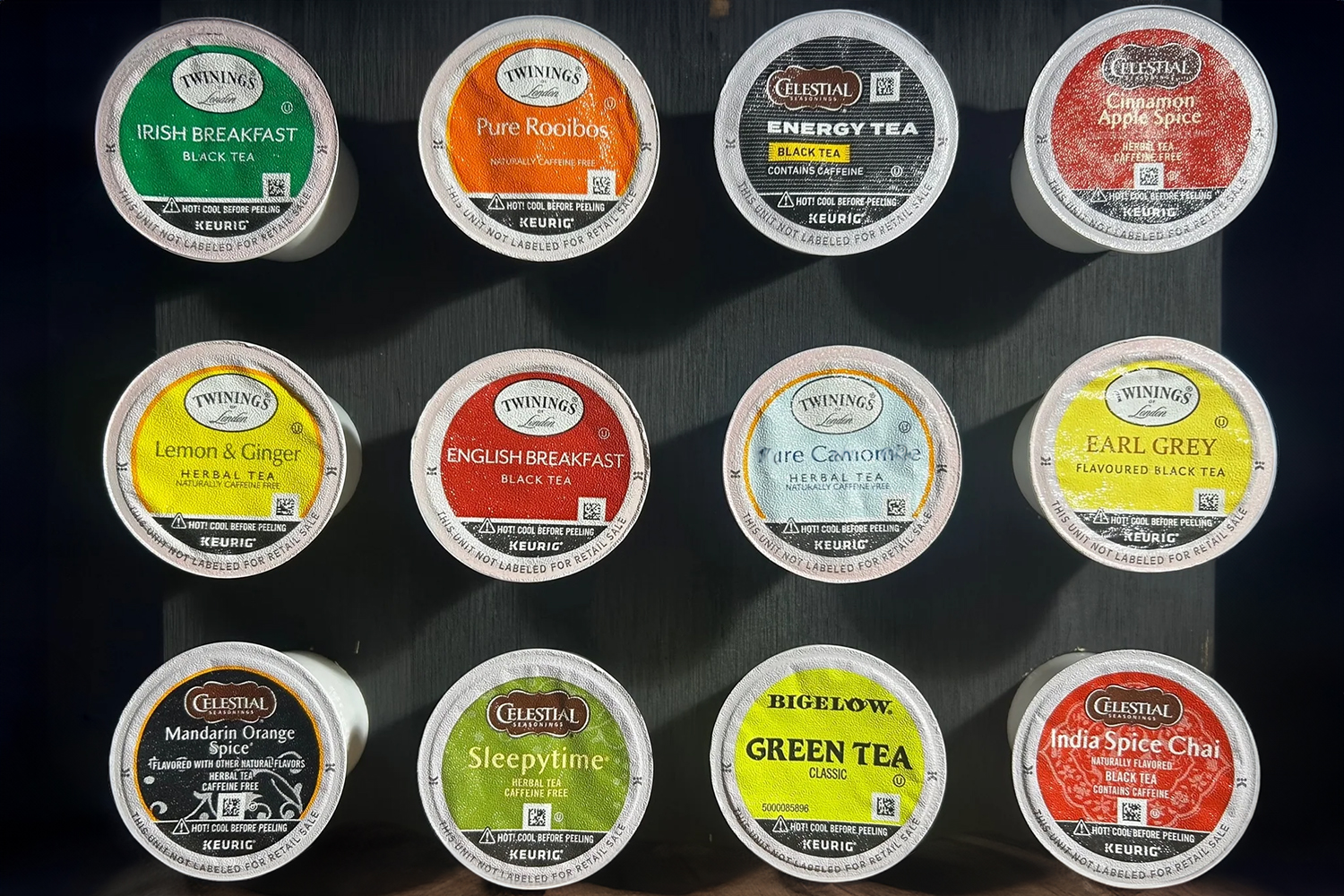
In this room, however, was a Keurig® B130 In-Room Brewing System, the kind that uses the single-serving K-Cups. The sampling of K-Cups in the room included two regular coffees, two decaf coffees, one tea, and one herbal blend. I decided to give their Celestial Seasonings English breakfast tea a try. For some reason, Celestial Seasonings decided not to capitalize “English.” Because of my Scottish heritage, that makes me smile, but that’s irrelevant to the subject at hand.

Following their instructions, I took the sealed cup, which had its lid puffed out from the altitude, and inserted it in the machine. When I closed it (puncturing the top & bottom of the cup), the top of the coffee maker popped open. I added a cup of water, set the mug in its place, and looked for adjustments. Finding none, I just pressed “brew.”
The cup was ready surprisingly fast (one point for the machine), with much hissing and burbling. And it tasted like … your basic cup of breakfast tea in a restaurant. I don’t take milk or sugar in my tea, so I use shorter steeping times than the British generally do. Unfortunately, there are no adjustments on this machine, so I got a stronger, more astringent brew than I wanted. Minus one point.
I couldn’t taste any coffee at all in my tea — and I am pretty sensitive to that flavor — so that’s plus one point.
After my wife removed the tea K-Cup and made herself some coffee, I decided to see if I could get a second infusion out of the tea. I carefully lined up the puncture hole on the bottom of the cup and reinserted it. I followed the rest of the process as before, and got a pretty decent second cup. It was weaker than the first, of course, and similar to what you’d get if you reused a tea bag.

Opening the used cup gave some insight into the workings. As you’d expect with a mass-market breakfast tea, they used CTC (crush, tear, curl) processed leaves, broken into quite small pieces. This provides the large surface area needed for the accelerated brewing process Keurig uses.
I understand you can purchase special empty K-Cups to fill yourself. It would be interesting to play around with whole-leaf teas and tweak the amount of leaf. Unfortunately, since you can’t adjust water temperature, the Keurig would destroy delicate white or green teas, and since you can’t adjust steep times, it would produce bitter oversteeped pu-erh or Darjeeling.
Interestingly, I took a look at the list of tea K-Cups on Keurig’s website, and it does include green and white tea. I’m guessing that their target audience probably uses boiling water in green tea anyway, and doesn’t realize it’s not supposed to taste like that. Most of their 50 selections are black tea, of course, and many are herbal tisanes rather than tea. There are a couple of chai selections there, and I’m guessing those would work.
In conclusion, if you’re looking for a fast, easy way to replicate your basic restaurant-style black tea, the Keurig will work admirably. If you want more than that, it’s a lot cheaper to buy an electric kettle and an IngenuiTEA, and you’ll get much better tea, too. The Keurig Brewer is at heart a coffee maker, and using it for making tea is like driving nails with a wrench: you can do it, but it’s a sub-optimal solution.

A Nice Cup of Tea

On January 12, 1946, the Evening Standard published an essay by George Orwell entitled “A Nice Cup of Tea.” Like almost everyone else in my generation, I had to read his books Nineteen Eighty-Four and Animal Farm in school. They told us a lot about society and a lot about English culture, but not much about tea.
Orwell was British, and born in 1903. These two facts tell you a lot about how he viewed tea. I’ve written before about “Tea Nazis,” who believe that their way of preparing tea is the only way to prepare tea, and this essay is a marvelous example of that philosophy in action.
He opens the essay by saying that if you look up “tea” in a cookbook it’s likely to be unmentioned. That was very true in 1946. It is less true now, but even though there are a lot of wonderful books about tea, mainstream cookbooks generally find it unnecessary to describe how to prepare a pot (or a cup) of tea.
Orwell continues by pointing out that tea is a mainstay of civilization in England, yet the “best manner of making it is a subject of violent disputes.” Judging from conversations I’ve had with British friends, I’d have to agree with that. His next paragraph sets the tone for everything that follows:
“When I look through my own recipe for the perfect cup of tea, I find no fewer than eleven outstanding points. On perhaps two of them there would be pretty general agreement, but at least four others are acutely controversial. Here are my own eleven rules, every one of which I regard as golden:”
Since in my humble opinion just about everything related to preparing tea is subjective, I’d like to present my own take on Orwell’s eleven rules. Lets look at them one at a time.
“First of all, one should use Indian or Ceylonese tea. China tea has virtues which are not to be despised nowadays — it is economical, and one can drink it without milk — but there is not much stimulation in it. One does not feel wiser, braver or more optimistic after drinking it. Anyone who has used that comforting phrase ‘a nice cup of tea’ invariably means Indian tea.”
Here, I must vehemently disagree with Mr. Orwell. Perhaps the fact that he was born in India is showing through here. There is excellent tea from China (and Japan and Kenya and Taiwan…). If you want a beverage that will make you feel “wiser, braver or more optimistic,” I would recommend tequila. If you want tea that tastes good, you can find it all over the world.
Incidentally, when Orwell refers to “Ceylonese” tea, he means tea from the country that was called Ceylon when he wrote this essay, but became Sri Lanka when it achieved independence in 1948. We still typically call tea from Sri Lanka “Ceylon” tea.
“Secondly, tea should be made in small quantities — that is, in a teapot. Tea out of an urn is always tasteless, while army tea, made in a cauldron, tastes of grease and whitewash. The teapot should be made of china or earthenware. Silver or Britannia-ware teapots produce inferior tea and enamel pots are worse; though curiously enough a pewter teapot (a rarity nowadays) is not so bad.”
He has an excellent point about the small quantities. To me, this means preparing it by the cup rather than by the pot, and there is a lot of excellent teaware available for that purpose. Although china, earthenware, and ceramic teapots do add something to the tea, using plastic or glass pots allows you to watch the tea steep. It also adds (and detracts) nothing to the flavor.
“Thirdly, the pot should be warmed beforehand. This is better done by placing it on the hob than by the usual method of swilling it out with hot water.”
I agree that pre-warming the pot helps to keep the water hot as the tea steeps.
“Fourthly, the tea should be strong. For a pot holding a quart, if you are going to fill it nearly to the brim, six heaped teaspoons would be about right. In a time of rationing, this is not an idea that can be realised on every day of the week, but I maintain that one strong cup of tea is better than twenty weak ones. All true tea-lovers not only like their tea strong, but like it a little stronger with each year that passes — a fact which is recognized in the extra ration issued to old-age pensioners.”
My biggest problem with this “rule” is the statement that “all true tea-lovers not only like their tea strong.” In fact, many tea lovers like a shorter steeping time so that the flavor of the tea isn’t overwhelmed by the bitterness and tannins that come out later in the steep.
“Fifthly, the tea should be put straight into the pot. No strainers, muslin bags or other devices to imprison the tea. In some countries teapots are fitted with little dangling baskets under the spout to catch the stray leaves, which are supposed to be harmful. Actually one can swallow tea-leaves in considerable quantities without ill effect, and if the tea is not loose in the pot it never infuses properly.”
Philosophically, he’s right. Allowing the water to circulate freely through the leaves does improve the infusion process. I do prefer not to consume the leaves (unless I’m drinking matcha), but a proper modern infuser will catch pretty much all of them.
“Sixthly, one should take the teapot to the kettle and not the other way about. The water should be actually boiling at the moment of impact, which means that one should keep it on the flame while one pours. Some people add that one should only use water that has been freshly brought to the boil, but I have never noticed that it makes any difference.”
Clearly, Mr. Orwell was aware of only one kind of tea: black. While boiling water is the right way to go for black and pu-erh tea, you get much better results with green and white tea if you use cooler water. I won’t get into the oolong debate at the moment…
The little aside that he snuck in here about freshly-boiled water is perhaps the biggest point of argument I hear from tea lovers. Does your tea really taste different if the water is heated in a microwave instead of being boiled in a teapot? Does the tea taste different if you reboil water that has been boiled before? In a blind taste test, I can’t tell the difference. Perhaps you can.
“Seventhly, after making the tea, one should stir it, or better, give the pot a good shake, afterwards allowing the leaves to settle.”
I confess. I do this.
“Eighthly, one should drink out of a good breakfast cup — that is, the cylindrical type of cup, not the flat, shallow type. The breakfast cup holds more, and with the other kind one’s tea is always half cold — before one has well started on it.”
Your cup is as personal as your clothing or your car. Most of the time, I use a 16-ounce ceramic mug made by a local potter. When I’m trying a new tea, I make the first cup in a glass mug so I can see it better. I typically use a smaller cup for matcha, a bigger one for chai lattes, and a bigger one than that for iced tea.
“Ninthly, one should pour the cream off the milk before using it for tea. Milk that is too creamy always gives tea a sickly taste.”
Unless I’m drinking chai, I do not add milk to my tea. I have made the occasional exception (I actually like milk in purple tea), but I generally prefer to taste the tea, not the milk.
“Tenthly, one should pour tea into the cup first. This is one of the most controversial points of all; indeed in every family in Britain there are probably two schools of thought on the subject.
The milk-first school can bring forward some fairly strong arguments, but I maintain that my own argument is unanswerable. This is that, by putting the tea in first and stirring as one pours, one can exactly regulate the amount of milk whereas one is liable to put in too much milk if one does it the other way round.”
When I make chai, I don’t use either of Orwell’s methods. I find that the spices extract better with the lipids in the milk present than they do in water alone. In other words, I heat the milk and add it to the water while the tea is steeping. It changes the flavor considerably.
When I’m adding milk to any other tea, I typically put it in the cup first and then add tea to it.
“Lastly, tea — unless one is drinking it in the Russian style — should be drunk without sugar. I know very well that I am in a minority here. But still, how can you call yourself a true tea-lover if you destroy the flavour of your tea by putting sugar in it? It would be equally reasonable to put in pepper or salt.”
Good point, Mr. Orwell. Now please substitute the word “milk” for “sugar” in this paragraph. Then go back and read rule nine. I don’t sweeten my tea (chai being the exception again — I like some honey in it), but I see nothing wrong with doing so. Adding a bit of sugar is no different than adding a bit of milk.
Oh, and by the way, tea was traditionally prepared in salt water in ancient China. And one of my favorite chai blends does, indeed, contain pepper.
Orwell continues…
“Tea is meant to be bitter, just as beer is meant to be bitter. If you sweeten it, you are no longer tasting the tea, you are merely tasting the sugar; you could make a very similar drink by dissolving sugar in plain hot water.
Some people would answer that they don’t like tea in itself, that they only drink it in order to be warmed and stimulated, and they need sugar to take the taste away. To those misguided people I would say: Try drinking tea without sugar for, say, a fortnight and it is very unlikely that you will ever want to ruin your tea by sweetening it again.”
Again, Orwell is speaking only of black tea here. I do not expect bitterness in, for example, a Long Jing Dragonwell green tea. And I would argue that there are a lot of fine black teas that have minimal bitterness: Royal Golden Safari from Kenya, to pick a favorite of mine.
If I had to pick one issue to argue in this essay, it would be that George Orwell considers all tea to be the same (after eliminating the majority of the world’s production by limiting himself to India and Sri Lanka). Even within the world of black tea, there is immense diversity. I don’t use the same preparation methods or expect the same results for a malty Assam tea and a delicate first flush Darjeeling — much less a smoky Chinese lapsang souchong.
My recommendation? Experiment. Try new teas, and try them first without adding milk or sweetener. Use your supplier’s recommended water temperature and steeping time. Taste the tea. THEN decide whether you want to steep it for a shorter or longer time; whether it needs a bit of milk; whether you’d prefer to sweeten it.
The best tea is your favorite tea, prepared just the way you like it.
Tea and caffeine part III: Decaf and low-caf alternatives

This article is the second of a three-part series.
Part I: What is caffeine?
Part II: Exploding the myths
Part III: Decaf and low-caf alternatives
So you’ve decided you like tea, but you really don’t want (or can’t have) the caffeine. What are your alternatives?
Well, first there’s decaf tea. As Part I of this series explained, decaffeination processes don’t remove 100% of the caffeine, so this is a reasonable alternative if you want less caffeine, but not if you want none at all. There’s another problem with switching to decaf: the selection of high-quality decaffeinated tea is — let’s just say, limited.
It’s easy to find a decaf Earl Grey or a decaf version of your basic Lipton-in-a-bag. But if your tastes run more to sheng pu-erh, sencha, dragonwell, lapsang souchong, silver needle, Iron Goddess of Mercy, or organic first-flush Darjeeling, you have a problem.
You can try the “wash” home-decaffeination method, but I explained a couple of days ago why that process is overrated. You’re likely to be able to remove 20% or so of the caffeine that way, but that’s about it.
Another alternative is simply to brew weaker tea and/or use more infusions. Let’s do the math for an example. Assume you’re a big fan of an oolong that contains 80 mg of caffeine in a tablespoon of leaves, and you drink four cups of tea per day.
If you use a fresh tablespoon of leaves for each cup, and you steep it for three minutes, you will be extracting about 42% of the caffeine in each cup, which equals 34 mg per cup, or a total of 136 mg of caffeine for the day. If you shorten your steep time to two minutes, the extraction level drops to about 33% (total of 106 mg). Alternatively, you could use the leaves twice each time, so you’re extracting about 63% of the caffeine, but using a total of half as many leaves (total of 101 mg). Or, if you don’t mind significantly weaker tea, just use 1-1/2 teaspoons of leaves instead of a full tablespoon. Half the leaves means half the caffeine (total of 68 mg).
No caffeine at all
If you look through the selection of teas in a health-food store, you’ll notice that most of them have no tea at all, and the vast majority of those non-tea drinks have no caffeine. The problem is that chamomile for a tea drinker is like Scotch to a wine drinker; it’s just not the same.
There are a couple of beverages, however, that are somewhat similar to tea. Both come from South Africa and both are naturally caffeine-free.
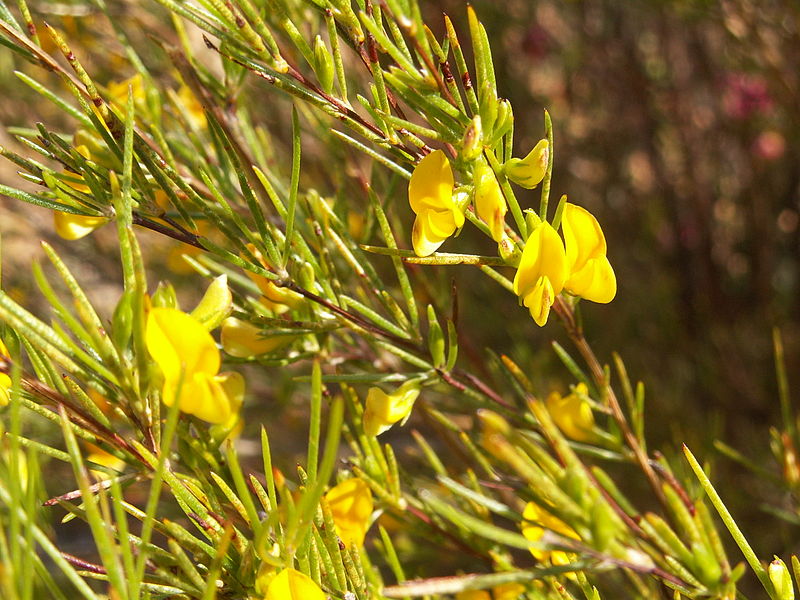
Rooibos is often called “red bush” in the United States because the way it’s usually prepared leaves a deep red infusion. Typically, rooibos is oxidized (not fermented) like a black tea. It can also be prepared more like a green tea. I blogged about green rooibos last August if you’d like to know more about it.
North American news shows, along with people like Oprah and Dr. Oz, have been singing the praises of rooibos lately, bringing it more into the mainstream awareness. It is very high in antioxidants and much lower in tannins than a black tea. Unfortunately, there isn’t a lot of independent research published about it yet, so many of the claims can’t really be backed up. The one that can be backed is that it has no caffeine and it tastes kind of like black tea (green rooibos is a bit grassy with malty undertones, more like a Japanese steamed green tea with a touch of black Assam).

Honeybush, like rooibos, grows only in South Africa. Also like rooibos, it is naturally caffeine-free and can be prepared either as a red or a green “tea.” When blooming, the flowers smell like honey, and honeybush tends to be somewhat sweeter than rooibos. Honeybush isn’t nearly as well-known as rooibos in the U.S., and the green version is very hard to find. I’ve found that if you want a flavored honeybush, citrus complements it very well. My “Hammer & Cremesickle Red” is the most popular honeybush blend in our tea bar (here is a blog post about it, and you can find it on the store website here).
A blended approach
If you like the idea of reducing your caffeine intake, but you don’t like the idea of a weaker tea (as I described above) or switching to rooibos or honeybush, you might want to consider blending. If you mix your tea half-and-half with something containing no caffeine, then you can still brew a strong drink, but get only half the caffeine from it. Combine that with the other tricks, like taking two infusions, and you can cut it even farther.
Tea and caffeine part II: Exploding the myths
A misunderstood molecule
This article is the second of a three-part series.
Part I: What is caffeine?
Part II: Exploding the myths
Part III: Decaf and low-caf alternatives
It’s amazing. It seems like the more I learn about tea, the less I know — and the more I have to unlearn. Over the many years that I’ve been drinking and enjoying tea, I’ve picked up a lot of misconceptions. I’ve even been guilty of spreading a few of those. In the last couple of years, though, as I’ve been more actively studying tea, I’ve discovered the errors of my ways, and this article will serve both as an educational tool and a mea culpa for repeating things without doing my homework.
I already started the myth busting in the previous article with some discussion of decaffeination (Myth: decaf tea has no caffeine. Fact: decaf tea has had some of its caffeine removed). With no further ado, then, let’s continue the process by taking a look at a series of common myths and misconceptions about tea and caffeine, and the relevant facts for each.
You can decaffeinate tea at home with a short “wash”
I picked up this one in several books and numerous articles on the web. In its most common form, the myth says that if you add boiling water to your leaves, swish it around for a short time (most commonly 10 to 30 seconds) and then dump it, you’ve just removed most (claims range from half to 80% or more) of the caffeine.
Bruce Richardson debunked this in his article, Too Easy to be True: De-bunking the At-Home Decaffeination Myth, which appeared in the January 2009 Edition of Fresh Cup magazine. Working with a chemistry professor at Asbury College and one of his students, they determined that it took a 3-minute infusion to extract 46-70% of the caffeine from the tea leaves. You could do a 3-minute wash, I suppose, but you’d be extracting 46-70% of the flavor, too.
Kevin Gascoyne presented some of his research in a 2012 World Tea Expo seminar: A Step Toward Caffeine and Antioxidant Clarity. He used a batch of Long Jing Shi Feng (a green “Dragonwell” tea), which he steeped for varying amounts of time. He measured caffeine content of each infusion and graphed the results. At 30 seconds, a bit over 20% of the caffeine had been removed. By 3 minutes, it was around 42% (even lower than Richardson’s numbers). It was 8 minutes before 70% of the caffeine was extracted, and the graph pretty much flattened out there.
This process is roughly cumulative, so if you infuse your tea for 6 minutes, you’re getting about the same total caffeine as if you’d infused those same leaves 3 times, at 2 minutes per infusion. My favorite shu pu-erh may not have more caffeine than, say, your favorite sencha, but by the time I’ve finished off my 7th infusion — and you’ve infused your leaves once — I’ve probably consumed more caffeine than you have (although I’ve had 7 cups of tea and you’ve had 1).
Green tea has less caffeine than black tea
Pretty much every piece of research in the last decade has debunked this myth. And when I say “debunked,” I’m not saying that the opposite is true; I’m saying that different teas have different caffeine content, but the processing method has little to do with it.
For example, Kevin Gascoyne, in the seminar I mentioned above, presented a chart of the teas that he’d tested, ranked by caffeine content. Aside from the pu-erh teas clustering toward the center (we’ll look at why in a moment), the distribution of styles (white vs. green vs. oolong vs. black vs. pu-erh) was almost random. Even very similar teas had very different caffeine levels, like the Sencha Ashikubo with 48 mg of caffeine and the Sencha Isagawa with 12 mg.
As Gascoyne analyzed his data, he came to the conclusion that there’s a certain amount of caffeine in the tea leaves, and the processes of picking, crushing, steaming, pan-firing, rolling, oxidizing, fermenting, drying, and tearing neither create nor destroy caffeine (one exception to this, according to an article on RateTea, is that roasting a tea like houjicha can dramatically reduce caffeine). If a particular tea bush in Taiwan produces a very high-caffeine oolong tea, then that exact same bush would produce a very high-caffeine black or green tea.
The caffeine content depends on many things, including the varietal of bush, the type of soil, the fertilizer used (if any), the weather, the season when the leaves are picked, and maybe even the time of day. Richardson’s article says that adding nitrogen fertilizer can raise caffeine content by 10%. Gascoyne said he analyzed tea picked from the same plantation at different times of year and found dramatically different caffeine levels.
White tea has no caffeine (or very little)
This one is not only a bad generalization like the previous myth, but often completely backwards!
Another thing that affects caffeine extraction is the part of the plant you use. Caffeine is a natural insecticide. The caffeine tends to congregate in the newer growth, thus protecting the plant from bugs that might eat its tender shoots and young leaves. Richardson’s article described research results from Nigel Melican, the student doing the analysis. His caffeine percentage findings were:
Bud-6.3%
First leaf-4.6%
Second leaf- 3.6%
Third leaf-3.1%
Fourth leaf-2.7%
Leaf stalk-2.0%
Two leaves and a bud-4.2%
Since the finest white tea is often made from all buds or a bud-and-a-leaf, it will actually have significantly higher caffeine than a strong black tea made from the whole stalk or the 2nd-4th leaves.
When hydrating, you should avoid caffeinated beverages
According to Kyle Stewart and Neva Cochran in their seminar, Tea, Nutrition, and Health: Myths and Truths for the Layman, at World Tea Expo 2012, “studies show no effect on hydration with intakes up to 400 mg of caffeine/day or the equivalent of 8 cups of tea.”
The Food and Nutrition Board of the Institute of Medicine agreed. In their 2004 reference intakes for water, they state: “caffeinated beverages appear to contribute to the daily total water intake similar to that contributed by non-caffeinated beverages.”
In other words, if you want to drink six pints of water per day for health reasons, it’s perfectly fine to steep some tea leaves in that water before you drink it!
You shouldn’t drink tea with caffeine at night
Stewart and Cochran cited another study in their seminar which analyzed tea and sleep. They found that people unused to caffeine would experience longer times to fall asleep and lower sleep quality, as would people who consumed more than 400 mg of caffeine per day (around 8 cups of typical tea).
People who spread their consumption out through the day, maintaining caffeine in the system (cups at 9:00 am, 1:00 pm, 5:00 pm, and 11:00 pm) were able to sleep with little disruption.
But what if you have no tolerance for caffeine, or you need to maintain very low levels? In the third and final part of this series, we’ll explore some alternatives you might want to try.
 Tea With Gary
Complicated drinks, education, and consistency
Jul 7
Posted by Gary D. Robson
Is there some particular tea concoction that’s “your” tea drink? Is it something complicated? You’ll hear people every day in Starbucks ordering coffees that take twenty words to describe, but we don’t run in to that much in the tea bar … yet.
Why is it that more coffee drinkers than tea drinkers tend to be like the guys in this PVP Online comic? I think it’s a matter of education and consistency.
Most of our regulars at the tea bar are like me: they order something different each time they come in. I may go through phases where I drink nothing but malty Assam for a few days, but then I’m back to switching it up. I also drink different tea in the morning than I do in the afternoon or evening. Of course, I’m also that annoying guy that will go into a bar four times, order something completely different each time, and then ask for my “regular” on the fifth visit.
We do have some regulars that are consistent, but their drinks tend to be simple: a cup of sencha, Scottish breakfast with a touch of milk, or iced mango oolong. As people learn the menu and zero in on what they like, that is beginning to change a bit, though.
Amber is from the South. She likes her tea sweet, and she loves boba tea (a.k.a. “bubble tea”). I finally put the “Amber special” on the menu so she didn’t have to describe her boba tea made with Cinnamon Orange Spice tea, vanilla soy milk, and triple the usual sweet syrup.
Phyllis isn’t much of a tea fan, but she found herself drawn to Hammer & Cremesickle Red, which is a rooibos/honeybush blend. She likes it prepared as a latte with frothed 2% milk and a bit of honey.
Starbucks has dramatically changed coffee culture, much as McDonald’s has changed restaurants (I’m going to catch grief for that one, I know, but keep reading). You can go into a McDonald’s in an unfamiliar city, and you know that Big Mac and fries will be just like the ones back home. Similarly, you can go into any one of 19,555 Starbucks franchises and be comfortable that your half-caf double-shot venti skinny hazelnut macchiato will taste just like it would from the franchise back home. They have taught the world their own terminology (education) and made sure that the drinks are prepared exactly the same at each franchise (consistency).
Let’s look at those two factors as they apply to tea:
Consistency
The world of tea is generally not a good place for consistency. Even for fans of a single type of tea, the options are legion. There are dozens of matchas, hundreds of oolongs, and each has its own unique flavor. My tea bar offers six types of milk (nonfat, 2%, whole, half-and-half, vanilla soy, and almond), where another may offer 1%, light soy, and whole. When I went into the tea business’ closest thing to a national chain (Teavana – you can read about my visit here), they didn’t offer milk at all. You may go into one tea shop that has a hundred Chinese green and white teas and an English tea shop that has only black teas.
There’s a strong parallel to be drawn here with independent bookstores and big chains. You can find exactly the same books at a Barnes & Noble in Austin, Texas as you’d find in San Francisco, Denver, or New York. On the other hand, two indie bookstores a block apart can offer completely different experiences.
Tea aficionados revel in this. I enjoy wandering into a tea shop that has dozens of different pu-erhs available and tasting something I’ve never had before, even though I know the odds of finding that 1935 Double Lions Tongqing Hao anywhere else are close to zero (and the odds of being able to afford it are similar).
Tea shops can help a lot with this problem by proper labeling and by knowing the products well enough to compare our wares with popular brands from elsewhere. If someone walks into my shop that likes Constant Comment, I can guide them to my closest loose-leaf blend (that would be the aforementioned Cinnamon Orange Spice). If someone buys a mountain-grown Wuyi oolong in my shop, the next tea shop they visit should be able to give them something with a similar flavor profile.
Consumers can help by asking questions. If I have a breakfast tea I enjoy, I’ll ask the shopkeeper what’s in the blend. Then I’ll know to ask for an Assam/Tanzanian black breakfast tea blend next time I want something similar. I watch (or ask) how much leaf they use and what temperature the water is. Again, if I don’t know how they brewed it, I can’t ask for it to be prepared that way next time.
Education
The tea industry is where coffee and wine were a few decades ago. The average person has no idea what the difference is between a green tea and a white tea, but they know the difference between Merlot and Chardonnay. Tea people need to focus on education the same way wine and coffee people have done.
Educating customers is a bad thing for the mediocre shops. The more people learn about tea, the less likely they are to buy lower-grade products, and the less likely they are to buy from people who don’t know what they’re talking about. Once the person who’s been buying pre-sweetened chai from a box tastes fresh-brewed chai, they won’t be switching back.
On the other hand, education is a great thing for consumers and for good tea shops.
The more you know as a consumer, the better you’re able to find what you like and recognize the good products (and good prices). Educated consumers will frequent the better shops, and spend more money there, benefiting both the shop and the customer.
Share this:
Posted in Brewing
2 Comments
Tags: boba tea, chai, coffee, consistency, Constant Comment, education, McDonald's, PVP Online, Scott Kurtz, Starbucks, tea, wine