Monthly Archives: February 2013
All the Tea in China: Stop 1 on the World Tea Tasting Tour
 Legend says that tea originated in China in 2737 B.C., over 100 years before the first Egyptian pyramid was built. In this first stop on our tasting tour, we explored China’s best-known tea growing areas in Yunnan, Anhui, Zhejiang, and Fujian provinces. We also took a look at traditional Chinese teaware, including gaiwans and guangzhou teapots.
The teas we tasted were:
- Organic Longjing Dragonwell (green)
- Organic Pinhead Gunpowder (green)
- Jasmine Dragon Tears (green)
- Silver Needle (white)
- Organic Shui Xian Wuyi Oolong
- Organic Keemun Mao Feng (black)
- Organic Golden Yunnan (black)
We started out by taking a look at the legend of the history of tea, going back to Emperor Shennong in 2737 B.C., and then talking about the major tea growing provinces of China. Four provinces were represented in our sampling: Yunnan, Anhui, Zhejiang, and Fujian. Obviously, this is just a beginning, but in a single short class, we can’t hit them all.

After the background was covered, including varietals of the tea plant, we launched into the individual teas, organized by style.
White Tea
First was white tea, the most lightly processed. I chose a Silver Needle blend from Rishi instead of a single-origin tea for this one mostly because our focus was comparing Chinese white tea with green and oolong teas. At some point down the road, we’ll do a comparative white tea tasting where the focus will be on terroir and origin.

One of the bullet points on the slide is an important one: busting the caffeine myth of white tea. The fact that this tea is made from early-picked buds means that there is a high concentration of caffeine. The preparation style does nothing to change that. The longer steep times we typically use on white tea just accentuates this.
We steeped the tea for five minutes in 165 degree water.
Green Tea
I chose three different green teas for the tasting. Each brought something completely different to the party.

First – a straight green tea very typical of Chinese fare, with a history dating back well over a millennium. The name of the tea comes from the finely-rolled leaves resembling gunpowder.
We steeped the gunpowder tea for three minutes in 175 degree water.

I simply couldn’t resist including the original story (fable?) of Longjing tea here, which I’ll be covering in much more detail in the future. Of all of the green teas I’ve tried, this is the one I keep coming back to as my favorite.
We steeped the dragonwell tea for three minutes — although I only do two minutes when I’m brewing it for myself — in 175 degree water.
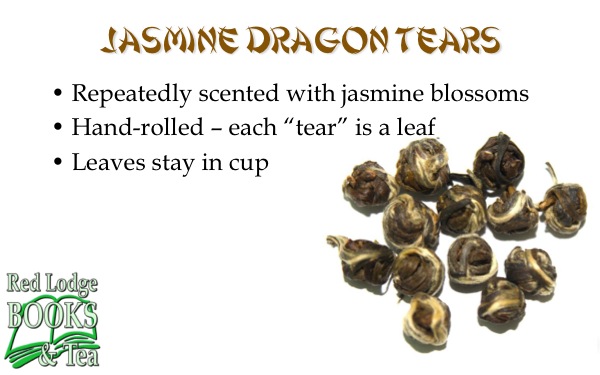
And finally, we come to the only flavored tea of the evening. We followed tradition with this tea, placing seven tears in each cup and sipping the tea as the leaves unfurl. Unlike all of the other teas we tasted, this one didn’t have a fixed steeping time. Everyone began sipping after a minute or two and kept sipping as the character changed over the next few minutes. We used 175 degree water.
Oolong Tea
We could have easily set up an entire evening just tasting Chinese oolongs (we are, in fact, doing this with Taiwanese oolongs on March 29), but for tonight we chose only one: an oolong from the Wuyi mountains.

It was a very difficult choice deciding which oolong to include. My first temptation was Tieguanyin (Iron Goddess of Mercy), but since I had two rolled teas already I decided to go with an open-leaf oolong.
We brewed this for three minutes in 195 degree water.
Black Tea
And finally, we moved on to black tea. Choosing only two black teas to represent China wasn’t easy (although it was a lot easier than choosing a single oolong), so I simply went with my two “leaf and a bud” favorites: one fully oxidized rich black with overtones of red wine (Keemun Mao Feng) and one lightly oxidized golden tea from Yunnan.

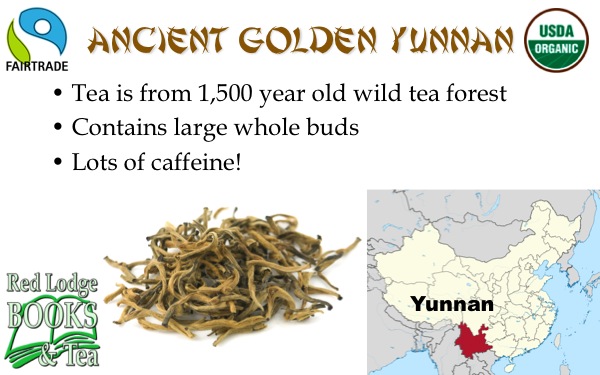
This was another case where I steeped the teas both at three minutes in boiling water for a better comparison, but when I drink them myself I prefer about 2:30 for the Keemun and 4:00 for the Yunnan.
We closed out the evening with a discussion of steeping times, water temperatures, multiple infusions, and other factors involved in preparing a great cup of tea. As always, I ended with the admonition to ignore the Tea Nazis and drink your tea however you like it.

If you live in the area and were unable to attend this session, I sure hope to see you at one of our future stops on our World Tea Tasting Tour. Follow the link for the full schedule, and follow us on Facebook or Twitter for regular updates (the event invitations on Facebook have the most information).

Fun Blends: Terracotta Army Chocolate Pu–erh
My wife, Kathy, is a chocoholic who loves tea. She has tried chocolate tea blends from various companies, and decided that she’s not a fan of chocolate tea blends using mild-flavored tea. She likes to be able to taste the chocolate and the tea.
Gwen and Kathy and I experimented and came up with a blend based on a loose-leaf shu (ripe) pu-erh blended with cocoa nibs and vanilla. It was a struggle getting the balance just right, but the result was so good, we decided to give it a permanent home on the tea bar’s menu. After struggling for a while to come up with a name reflecting its Chinese origins: Terracotta Army Chocolate Pu-erh.
The Logo
I love having fun with tea logos. As I’ve mentioned before (see list below), a series of local artists have been creating logos for our house blends. This one was produced by artist (and art history professor) Kory Rountree:

We love that Kory started with one of the soldiers in the real Terracotta Army, made him chocolate, and gave him a cup of tea. He actually provided two logos for us to choose between. We picked the one above because it is clear, simple, and easy to identify even at small sizes. I actually prefer the alternative (shown below), but it’s just too complex to put on a little tea label.

The details are what really make this one. Note the eyes on the soldier above and left of the chocolate soldier. You can almost hear him thinking “Yummy!” The one above and to the right has a similar, but more subtle expression. It’s not obvious at first glance, but if you look closely, the soldier to the right of the chocolate fellow is holding a piece of the melted/broken chocolate arm in one hand, and a cup of chocolate pu-erh tea in the other.
Thank you, Kory! Another awesome logo for the collection!
This is the latest in a collection of labels I’ve written about here before:
Far Too Good For Ordinary People
 Part of the fun of the tea business is the names. The names of the teas themselves are wonderful — from classics like Iron Goddess of Mercy to house blends like Mr. Excellent’s Post-Apocalyptic Earl Grey — but the industry terminology is fun as well. Let’s take the “orange pekoe” grading system used for black teas from Sri Lanka (Ceylon) and India.
I can’t count the number of times someone has come into the tea bar telling me they like flavored teas. “You know, something like that Orange Pekoe stuff.”
“Actually,” I have to explain, “that’s not a style of tea, but a grade. And it has no flavorings at all. Nope. No orange in it.”
What I generally don’t go on to explain is how that whole pekoe grading system works. Let’s start with the words “orange” and “pekoe.” A pekoe is a tea bud, the unopened leaf at the very tip of a branch. A pekoe tea, then, would contain the buds and smallest leaves adjacent to the buds. To further confuse matters, the word “pekoe” in grading tea doesn’t mean quite the same thing as it means when speaking of tea buds. We’ll get to that in a moment.
“Orange,” as I mentioned above, has nothing to do with fruit. What it does actually mean is open to debate. It could refer to the color of the oxidized leaves. It could refer to the color of the brewed tea. It could refer to the Dutch royal family (the House of Orange). All that really matters is that in tea grading, any whole-leaf black tea qualifies as an Orange Pekoe.
So what about all those other letters? The joke in the tea business is that FTGFOP stands for “Far Too Good For Ordinary People.” In reality, it stands for “Fine (or Finest) Tippy Golden Flowery Orange Pekoe.” Referring to a grade of tea as the “finest” isn’t good enough, of course, so there are actually several grades above that. Here are the basic grades:
- OP (Orange Pekoe): A whole-leaf black tea.
- FOP (Flowery Orange Pekoe): Long leaves with some tips (pekoes).
- GFOP (Golden Flowery Orange Pekoe): An FOP with more tips.
- TGFOP (Tippy Golden Flowery Orange Pekoe): A GFOP with a whole lot of tips.
- FTGFOP (Finest Tippy Golden Flowery Orange Pekoe): Traditionally the highest-quality grade of black tea.
- SFTGFOP (Special Finest Tippy Golden Flowery Orange Pekoe): Sorry, we needed one more grade.
For the true connoisseur, a grading system can never have fine enough gradations, so you can also elevate each of these grades another half-point by adding the number “1” after it. Thus, despite the industry joke, there are three grades of tea better than FTGFOP (FTGFOP-1, SFTGFOP, and SFTGFOP-1).
Let me reinforce an important point here: this grading system is used only for black teas, and only in a few countries. China, for example, rarely grades its teas using this system, although Kenya is doing more of it as their teas increase in quality.
Are there lower grades?
I thought you’d never ask.
The majority of tea consumed in the U.S. and U.K. is in teabags. In a traditional teabag, there’s little room for the hot water to circulate or the leaves to expand as they absorb water. The solution? Break those leaves into smaller pieces. That exposes more of the surface area of the leaf to water and allows more tea (by weight) to fit into a smaller area.
OP-grade teas use whole leaves. There is a series of grades below OP that include the letter B for “Broken.” BOP (Broken Orange Pekoe), FBOP, GBOP, and so on. There are also a couple of broken grades below BOP, including BP (Broken Pekoe) and BT (Broken Tea).
So that’s what’s used in teabags? Nope. Let’s drop another grade.
After the processing facility has sorted out all of the Pekoe and Broken Pekoe grades, what’s left is known as “fannings.” Grades like PF (Pekoe Fannings), FOF (Flowery Orange Fannings), and TGFOF (Tippy Golden Flowery Orange Fannings). These are the grades used in most decent-quality teabags (high-end teabags may use whole-leaf teas, typically in a sachet-style bag).
“Decent-quality teabags?” I hear you cry. “Are you implying there’s another grade below fannings?”
Yes. Yes I am.
The smallest-sized particles of tea — too small to be fannings — are called “dust.” There are different grades of dust, of course, depending on the tea leaves they come from. You may encounter PD (Pekoe Dust), GD (Golden Dust), FD (Fine Dust), and others. Typically, though, grades like that don’t make it onto commercial packaging.
So these lower grades suck?
No, I didn’t say that.
Fannings from an extraordinary tea will produce a much better drink than whole leaves from a mediocre tea. There are a lot of factors to take into consideration, but the number one factor is your own preferences. As I’ve said before on this blog, I’m not a tea Nazi. It won’t hurt my feelings a bit if you prefer the cheapest grade of Lipton teabags to my shop’s whole-leaf FTGFOP-1 First Flush Darjeeling. In fact, it would be quite a waste of money to buy a tea you don’t like.
In a way, buying tea that’s highly-graded on the pekoe system is like buying organic. What it really tells you is that you’re dealing with a legitimate tea producer that cares enough about their product to pick it right and have it graded by experts.
The World Tea Tasting Tour
Over the next couple of months, I will be taking you on a world tour of tea with a series of tastings and classes focused on teas from all around the world. The events will be at our tea bar on Fridays from 5:00 to 6:30. At each session, we’ll taste five to seven teas from a different country as we explore a bit of the country’s geography and tea culture. I will put a quick summary of each stop on the tour up here on the blog for those who can’t attend or who don’t remember which teas we covered.
The full tour consists of:
Friday, Feb 15 — All the Tea in China
Friday, Mar 1 — Tea. Earl Grey. Hot. (England)
Friday, Mar 8 — It’s Always Tea Time in India
Friday, Mar 15 — Japan: Bancha to Matcha (notes Part 1 and Part 2)
Friday, Mar 22 — Deepest Africa: The Tea of Kenya
Friday, Mar 29 — The Oolongs of Taiwan
Friday, Apr 5 — Rooibos from South Africa
Friday, Apr 12 — Yerba Maté from Argentina
Friday, Apr 26 — China part II: Pu-Erh
Friday, May 3 — India part II: Masala Chai
Each class will cost $5.00, which includes the tea tasting itself and a $5.00 off coupon that can be used that night for any tea, teaware, or tea-related books that we sell.
There will be more information posted on Facebook before each event, including a list of the teas that we will taste in each event.
UPDATE MARCH 9: As I blog about each of these experiences, I’m going to create a link from this post to the post containing the outline and tasting notes. I’ve linked the first two.
UPDATE MARCH 23: I changed the dates of the last two events. There will not be a tasting on April 19.
 Tea With Gary