Blog Archives

My dog ate my matcha whisk

We have this thing we used to do called #TeakuTuesday. Every Tuesday a group of us would write tea-related haiku and post them on various social media, or just share them at the tea shop. That tradition died out years ago, but I’m working to bring it back on Instagram (see @TeaWithGary). This was today’s. And yes, today is Wednesday, but I’m doing them more frequently for a while until it catches on.
And in case you’re wondering, yes this did happen. We got a new dog. She’s about a year old (she’s a rescue, so we’re not sure exactly), and she’s a husky/bulldog cross. And I screwed up. I left a bunch of my teaware on a low enough shelf that she could reach it. She ignored the gaiwan, the matcha bowl, the pots, the cups, the gongfu tray, and (thank goodness!) the books.
But that matcha whisk must have looked like it would be fun to chew on. Or perhaps she liked the faint scent of matcha. I do clean it each time I use it, but that aroma persists. In any case, I’m down a whisk. Oh, well. It could be worse.
Grumpiness alert!
As long as I’m talking about Instagram, let me add a bit to this story. The go-to social media platforms for tea bloggers and other tea industry folks were Facebook and Twitter. I’m off of Twitter now that Elon Musk bought it and turned it into X, so I turned to tea friends to see where the action is these days.
Instagram, they said.
I have an Instagram account that I set up years ago. I messed with it for a few days, posted a few pictures, and moved on. A couple of weeks ago I figured it was time to get back at it, so I created @TeaWithGary. It was promptly suspended because it “looked like I was trying to impersonate someone.” I challenged the suspension and got the account back in a day or two.
I’m not sure of the etiquette on Instagram, but I figured that as I get going, every time someone follows me I will follow them back. I was off for a day and a half (long drive), and found about a dozen new followers when I signed back in. I went down the list hitting “Follow” on each one. After about eight of them, I got this:

It was two days before I could follow someone again. I tried hitting “Report a problem,” but Instagram promptly crashed. As of this morning, everything was working again. I started hitting that Follow button for my new followers, and it locked me out of following anyone after the 6th one.
Is Instagram really this annoying for everyone? Do people love it, or do they just tolerate it because that’s where the people they want to follow are? Oh, well, if you can enlighten me, please do so in the comments below or follow me on Instagram. Hopefully, I’ll be able to follow you back soon!

Quick and Easy Peppermint Matcha Fudge

When I had a tea shop, I used to do tea tasting/classes on Saturday afternoons. One was about mint. We examined peppermint, spearmint, and wintergreen, and then tasted a variety of teas and tisanes that we blend with the various mint leaves and extracts.
My wife, Kathy, decided that since it was a couple of days before Christmas, we should have a special treat. We’ve done a fair amount of cooking with tea, especially matcha (you can browse through some of the recipes here), and we have a brand-new peppermint matcha at the shop, so she decided to do a quick and easy matcha fudge.
It’s a white chocolate bakeless recipe; Kathy calls it “cheater” fudge.
Ingredients
- 16 oz white chocolate
- 1 ten-oz (300 ml) can of sweetened condensed milk
- A pinch of salt
- 2 tsp unsweetened matcha (we used the Maghreb Mint from Phoenix Pearl)
- 1/2 cup of chopped unsalted almonds
Process
- Combine the white chocolate and condensed milk in a double boiler over simmering water (a microwave works too). Stir regularly and make sure everything is completely melted.
- Stir in the matcha and pinch of salt. Blend it very thoroughly and make sure there are no little patches of dry matcha powder left.
- Once it’s completely smooth, pour into a greased 8×8 inch baking dish.
- Sprinkle the nuts over the top, and press them down gently to make sure they’re well attached.
- Chill overnight in the fridge, (at least three hours) and then cut into small pieces (about 1″ to 1-1/2″ square)
You can use this same process with other flavored matcha, although you probably won’t want to use sweet matchas designed for lattes.

A Matcha Mill at World Tea Expo 2014

Last week at World Tea Expo 2014, most of my time was focused on finding new things. I tasted new tea blends and fresh varietals, while browsing through billions of new gadgets, accessories, and tea-related products. I did try to make time to visit with our existing vendors and friends, and when we stopped at AOI, the company we buy our matcha from, I found something old rather than something new.
Have you ever looked at matcha powder and wondered how it’s made? Oh, it sounds very simple: take some high quality Japanese steamed green tea and powder it. But how do you powder it? Today, there are high-volume machines for absolutely everything, but matcha has been around for a very long time (see my posts about matcha and the Japanese tea ceremony for more information). How did they make matcha before the advent of machines?
AOI had the answer in their booth: a hand-carved millstone designed for tea leaves.

The upper stone has a hole in the top where dried tea leaves are inserted, and a vertical wooden shaft in the lower stone keeps it centered. There are grooves that move the ground-up leaves out to the lower stone’s dish. Of course, I had to try it, and then I made a short video of my daughter, Gwen using the mill:
I saw a lot of cool gadgets, but this is the one I’d like to have sitting next to my desk at home. Unfortunately, it wasn’t for sale…
Chanoyu: The Way of Tea
This is part two of my article on the Japanese stop of our World Tea Tasting Tour. Part one was posted a few days ago.

The Japanese tea ceremony has been around for a very long time, but it was solidified into its current form in the 1500s by a man named Sen no Rikyū. He was an adherent of a philosophy called wabi-sabi, which honors and treasures simplicity, transience, asymmetry, and finding the beauty in imperfection. Rikyū applied this to the tea ceremony, developing what became known as chanoyu: the Way of Tea.
He removed unnecessary ornamentation from tearooms, typically reducing the decor to a single scroll on the wall and a flower arrangement designed to harmonize with the garden outside. Everything else in the room was functional. Chanoyu teaches four fundamental principles known as wa kei sei jaku, intended to be not only the core of the tea ceremony, but a representation of the principles to incorporate into daily life.

Wa (harmony) was his ultimate ideal. From harmony comes peace. Guest and host should be in harmony and man should strive for harmony with nature, rather than attempting to dominate nature.
Kei (respect) allows people to accept and understand others even when you do not agree with them. In a tea ceremony the guest must respect the host and the host must respect the guest, making them equals. The simplest vase should be treated as well as the most expensive, and the same politeness and purity of heart should be extended to your servant as to your master.
Sei (purity) is a part of the ritual of the tea ceremony, cleaning everything beforehand and wiping each vessel with a special cloth before using it. But that is only an outward reflection of the purity of the heart and soul that brings the harmony and respect. In accordance with wabi-cha, imperfection was to be prized here as well. To Rikyū, the ultimate expression of purity was the garden after he spent hours grooming it and several leaves settled randomly on the assiduously manicured walkway.
Finally, Jaku (tranquility) is the ultimate goal of enlightenment and selflessness. It is also the fresh beginning as you go back with fresh perspective to examine the way you have chosen to implement harmony, respect, and purity into your life.

There is a long list of implements that are used in the preparation of matcha, which is the powdered tea used in the tea ceremony. The four that I concentrated on in this class were the bowl, scoop, whisk, and caddy. It could be argued that others are as important, or even more important, but I chose to focus on the ones that are used at home when you make matcha, even if you are not participating in a tea ceremony. The link in the slide above is a great place to learn all about the ceremony itself, and the site contains a detailed list of chanoyu utensils.
In preparing matcha, the bamboo scoop is used to take tea powder and place it in the bowl. After adding water, the whisk is used not only to mix the powder, but to aerate the mixture, leaving it slightly frothy.
Of all of the tools of chanoyu, the bowl is probably the most personal.

We were lucky enough to have Karin Solberg, who created the matcha bowls we sell at our store, talk about the process of creating and decorating the bowls. Karin has done some lovely work, and we enjoyed learning from her. There is a picture showing some of her bowls in part 1 of this article.
I have said many times before that tea is a very personal thing. Nobody can tell you what tastes good to you. The “right” way for me to enjoy a particular tea could be quite different than the “right” way for you to enjoy that same tea. To Rikyū, however, the tea ceremony was not about what made your matcha taste the best. It was all about using the ritual to clear your mind and help you to see things more clearly. It was about achieving harmony, respect, purity, and tranquility.
Outside of the ceremony, however, I would argue that your way of relaxing is the right way of relaxing, whether it means sitting on your front porch with a steaming hot cup of Earl Grey, preparing a delicate silver needle tea to enjoy with a friend, or laying back in the bathtub with a fragrant jasmine green tea. Tea should be a pleasure, not a chore, and the ceremony is about sharing that pleasure with your friends and guests.

If you live in the area and were unable to attend this session, I sure hope to see you at one of our future stops on our World Tea Tasting Tour. Follow the link for the full schedule, and follow us on Facebook or Twitter for regular updates (the event invitations on Facebook have the most information).
Japan – Bancha to Matcha: Stop 4 on the World Tea Tasting Tour

We’re very excited to be working with resident artist Karin Solberg from the Red Lodge Clay Center, and we are featuring some of her matcha bowls in the store, and she came in to talk about them at this stop in the tour.
The teas we tasted were:
- Organic Sencha
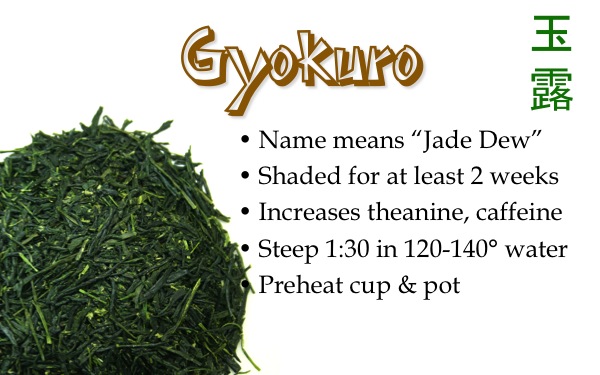
- Gyokuro
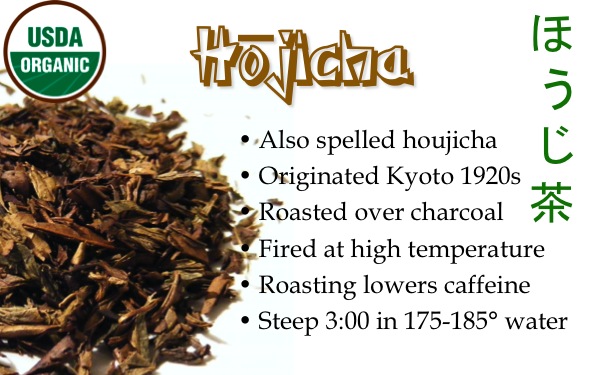
- Organic Houjicha (roasted green tea)
- Organic Genmaicha (toasted rice tea)
- Organic Matcha
- Kukicha (“twig tea”)
- Bancha (“coarse sencha”)
- Sencha (“decocted tea”)
- Gyokuro (“jade dew”)



Tea and caffeine part I: What is caffeine?

The most popular drug?
This article is the first of a three-part series.
Part I: What is caffeine?
Part II: Exploding the myths
Part III: Decaf and low-caf alternatives
In his excellent book, A History of the World in 6 Glasses, Tom Standage selected the six beverages that he felt had the greatest influence on the development of human civilization. Three of the six contain alcohol; three contain caffeine. Tea was one of the six.
Is it the caffeine that has made tea one of the most popular beverages in the world? The flavor? Its relaxing effects? I think that without caffeine, Camellia sinensis would be just another of the hundreds of plant species that taste good when you make an infusion or tisane out of it. Perhaps yerba maté would be the drink that challenged coffee for supremacy in the non-alcoholic beverage world.
“Caffeine is the world’s most popular drug”
The above quote opens a paper entitled Caffeine Content of Brewed Teas (PDF version here) by Jenna Chin and four others from the University of Florida College of Medicine. I’ll be citing that paper again in Part II of this series. Richard Lovett, in a 2005 New Scientist article, said that 90% of adults in North America consume caffeine on a daily basis.
But yes, caffeine is a drug. It is known as a stimulant, but its effects are more varied (and sometimes more subtle) than that. It can reduce fatigue, increase focus, speed up though processes, and increase coordination. It can also interact with other xanthines to produce different effects in different drinks, which is one reason coffee, tea, and chocolate all affect us differently.
Tea, for example, contains a compound called L-theanine, which can smooth out the “spike & crash” effect of caffeine in coffee and increase the caffeine’s effect on alertness. In other words, with L-theanine present, less caffeine can have a greater effect. See a great article from RateTea about L-theanine here.
Even though Part II of this series is the one that dispels myths, I really need to address a common misconception right now. First, I’m going to make sure to define my terms: for purposes of this series, “tea” refers to beverages made from the Camellia sinensis plant (the tea bush) only. I’ll refer to all other infused-leaf products as “tisanes.” Okay, now that we have that out of the way:
“All tea contains caffeine”
Yes, I said ALL tea. The study I mentioned a couple of paragraphs ago measured and compared the caffeine content of fifteen regular black, white, and green teas with three “decaffeinated” teas and two herbal teas (tisanes). With a five-minute steep time, the regular teas ranged from 25 to 61 mg of caffeine per six-ounce cups. The decaf teas ranged from 1.8 to 10 mg per six ounce cup.
That’s right. The lowest caffeine “regular” tea they tested (Twinings English Breakfast) had only 2-1/2 times the caffeine of the most potent “decaffeinated” tea (Stash Premium Green Decaf).
There are two popular ways to remove caffeine from tea. In one, the so-called “direct method,” the leaves are steamed and then rinsed in a solvent (either dichloromethane or ethyl acetate). Then they drain off the solvent and re-steam the leaves to make sure to rinse away any leftover solvent. The other process, known as the CO2 method, involves rinsing the leaves with liquid carbon dioxide at very high pressure. Both of these methods leave behind some residual caffeine.
(As a side note: I’m not a fan of either process. When I don’t want caffeine, I’d much rather drink rooibos than a decaf tea. I only have one decaf tea out of over 80 teas and 20 tisanes at my tea bar, and I’m discontinuing that one.)
This is why tea professionals need to make a strong distinction between the terms “decaffeinated” (tea that has had most of its caffeine removed) and “naturally caffeine-free” (tisanes that naturally contain no caffeine such as rooibos, honeybush, and chamomile).
“Coffee has more caffeine than tea”
Almost everyone will agree with the statement. For the most part, it is true, assuming you add some qualifiers: The average cup of fresh-brewed loose-leaf tea contains less than half the caffeine of the average cup of fresh-brewed coffee. In the seminar, Tea, Nutrition, and Health: Myths and Truths for the Layman, at World Tea Expo 2012, the studies Kyle Stewart and Neva Cochran quoted showed the plain cup of fresh-brewed coffee at 17 mg of caffeine per ounce versus the plain cup of fresh-brewed tea at 7 mg per ounce (that’s 42 mg per six-ounce cup, which agrees nicely with the numbers from the caffeine content study I quoted above).
Interestingly, though, a pound of tea leaves contains more caffeine than a pound of coffee beans. How can that be? Because you use more coffee (by weight) than tea to make a single cup, and caffeine is extracted more efficiently from ground-up beans than from chunks of tea leaf. Tea is usually not brewed as strong as coffee, either.
At another 2012 World Tea Expo seminar, A Step Toward Caffeine and Antioxidant Clarity, Kevin Gascoyne presented research he had done comparing caffeine levels in dozens of different teas (plus a tisane or two). The difference between Kevin’s work and every other study I’ve seen is that he prepared each tea as people would actually drink it. For example, the Bai Mu Dan white tea was steeped 6 minutes in 176-degree water, while the Tie Guan Yin (Iron Goddess of Mercy) oolong was steeped 1.5 minutes in 203-degree water. Matcha powder was not steeped per se, but stirred into the water and tested without filtering.
The results? Caffeine content ranged from 12mg to 58mg for the leaf teas, and 126mg for the matcha — which is higher than some coffees.
In our next installment, I’ll look at the myths regarding caffeine in tea, including what kinds of tea have the most caffeine and how you can remove the caffeine at home all by yourself — or can you?
 Tea With Gary