It’s amazing. It seems like the more I learn about tea, the less I know — and the more I have to unlearn. Over the many years that I’ve been drinking and enjoying tea, I’ve picked up a lot of misconceptions. I’ve even been guilty of spreading a few of those. In the last couple of years, though, as I’ve been more actively studying tea, I’ve discovered the errors of my ways, and this article will serve both as an educational tool and a mea culpa for repeating things without doing my homework.
I already started the myth busting in the previous article with some discussion of decaffeination (Myth: decaf tea has no caffeine. Fact: decaf tea has had some of its caffeine removed). With no further ado, then, let’s continue the process by taking a look at a series of common myths and misconceptions about tea and caffeine, and the relevant facts for each.
You can decaffeinate tea at home with a short “wash”
I picked up this one in several books and numerous articles on the web. In its most common form, the myth says that if you add boiling water to your leaves, swish it around for a short time (most commonly 10 to 30 seconds) and then dump it, you’ve just removed most (claims range from half to 80% or more) of the caffeine.
Bruce Richardson debunked this in his article, Too Easy to be True: De-bunking the At-Home Decaffeination Myth, which appeared in the January 2009 Edition of Fresh Cup magazine. Working with a chemistry professor at Asbury College and one of his students, they determined that it took a 3-minute infusion to extract 46-70% of the caffeine from the tea leaves. You could do a 3-minute wash, I suppose, but you’d be extracting 46-70% of the flavor, too.
Kevin Gascoyne presented some of his research in a 2012 World Tea Expo seminar: A Step Toward Caffeine and Antioxidant Clarity. He used a batch of Long Jing Shi Feng (a green “Dragonwell” tea), which he steeped for varying amounts of time. He measured caffeine content of each infusion and graphed the results. At 30 seconds, a bit over 20% of the caffeine had been removed. By 3 minutes, it was around 42% (even lower than Richardson’s numbers). It was 8 minutes before 70% of the caffeine was extracted, and the graph pretty much flattened out there.
This process is roughly cumulative, so if you infuse your tea for 6 minutes, you’re getting about the same total caffeine as if you’d infused those same leaves 3 times, at 2 minutes per infusion. My favorite shu pu-erh may not have more caffeine than, say, your favorite sencha, but by the time I’ve finished off my 7th infusion — and you’ve infused your leaves once — I’ve probably consumed more caffeine than you have (although I’ve had 7 cups of tea and you’ve had 1).
Green tea has less caffeine than black tea
Pretty much every piece of research in the last decade has debunked this myth. And when I say “debunked,” I’m not saying that the opposite is true; I’m saying that different teas have different caffeine content, but the processing method has little to do with it.
For example, Kevin Gascoyne, in the seminar I mentioned above, presented a chart of the teas that he’d tested, ranked by caffeine content. Aside from the pu-erh teas clustering toward the center (we’ll look at why in a moment), the distribution of styles (white vs. green vs. oolong vs. black vs. pu-erh) was almost random. Even very similar teas had very different caffeine levels, like the Sencha Ashikubo with 48 mg of caffeine and the Sencha Isagawa with 12 mg.
As Gascoyne analyzed his data, he came to the conclusion that there’s a certain amount of caffeine in the tea leaves, and the processes of picking, crushing, steaming, pan-firing, rolling, oxidizing, fermenting, drying, and tearing neither create nor destroy caffeine (one exception to this, according to an article on RateTea, is that roasting a tea like houjicha can dramatically reduce caffeine). If a particular tea bush in Taiwan produces a very high-caffeine oolong tea, then that exact same bush would produce a very high-caffeine black or green tea.
The caffeine content depends on many things, including the varietal of bush, the type of soil, the fertilizer used (if any), the weather, the season when the leaves are picked, and maybe even the time of day. Richardson’s article says that adding nitrogen fertilizer can raise caffeine content by 10%. Gascoyne said he analyzed tea picked from the same plantation at different times of year and found dramatically different caffeine levels.
White tea has no caffeine (or very little)
This one is not only a bad generalization like the previous myth, but often completely backwards!
Another thing that affects caffeine extraction is the part of the plant you use. Caffeine is a natural insecticide. The caffeine tends to congregate in the newer growth, thus protecting the plant from bugs that might eat its tender shoots and young leaves. Richardson’s article described research results from Nigel Melican, the student doing the analysis. His caffeine percentage findings were:
Bud-6.3%
First leaf-4.6%
Second leaf- 3.6%
Third leaf-3.1%
Fourth leaf-2.7%
Leaf stalk-2.0%
Two leaves and a bud-4.2%
Since the finest white tea is often made from all buds or a bud-and-a-leaf, it will actually have significantly higher caffeine than a strong black tea made from the whole stalk or the 2nd-4th leaves.
When hydrating, you should avoid caffeinated beverages
According to Kyle Stewart and Neva Cochran in their seminar, Tea, Nutrition, and Health: Myths and Truths for the Layman, at World Tea Expo 2012, “studies show no effect on hydration with intakes up to 400 mg of caffeine/day or the equivalent of 8 cups of tea.”
The Food and Nutrition Board of the Institute of Medicine agreed. In their 2004 reference intakes for water, they state: “caffeinated beverages appear to contribute to the daily total water intake similar to that contributed by non-caffeinated beverages.”
In other words, if you want to drink six pints of water per day for health reasons, it’s perfectly fine to steep some tea leaves in that water before you drink it!
You shouldn’t drink tea with caffeine at night
Stewart and Cochran cited another study in their seminar which analyzed tea and sleep. They found that people unused to caffeine would experience longer times to fall asleep and lower sleep quality, as would people who consumed more than 400 mg of caffeine per day (around 8 cups of typical tea).
People who spread their consumption out through the day, maintaining caffeine in the system (cups at 9:00 am, 1:00 pm, 5:00 pm, and 11:00 pm) were able to sleep with little disruption.
But what if you have no tolerance for caffeine, or you need to maintain very low levels? In the third and final part of this series, we’ll explore some alternatives you might want to try.
In his excellent book, A History of the World in 6 Glasses, Tom Standage selected the six beverages that he felt had the greatest influence on the development of human civilization. Three of the six contain alcohol; three contain caffeine. Tea was one of the six.
Is it the caffeine that has made tea one of the most popular beverages in the world? The flavor? Its relaxing effects? I think that without caffeine, Camellia sinensis would be just another of the hundreds of plant species that taste good when you make an infusion or tisane out of it. Perhaps yerba maté would be the drink that challenged coffee for supremacy in the non-alcoholic beverage world.
“Caffeine is the world’s most popular drug”
The above quote opens a paper entitled Caffeine Content of Brewed Teas (PDF version here) by Jenna Chin and four others from the University of Florida College of Medicine. I’ll be citing that paper again in Part II of this series. Richard Lovett, in a 2005 New Scientist article, said that 90% of adults in North America consume caffeine on a daily basis.
But yes, caffeine is a drug. It is known as a stimulant, but its effects are more varied (and sometimes more subtle) than that. It can reduce fatigue, increase focus, speed up though processes, and increase coordination. It can also interact with other xanthines to produce different effects in different drinks, which is one reason coffee, tea, and chocolate all affect us differently.
Tea, for example, contains a compound called L-theanine, which can smooth out the “spike & crash” effect of caffeine in coffee and increase the caffeine’s effect on alertness. In other words, with L-theanine present, less caffeine can have a greater effect. See a great article from RateTea about L-theanine here.
Even though Part II of this series is the one that dispels myths, I really need to address a common misconception right now. First, I’m going to make sure to define my terms: for purposes of this series, “tea” refers to beverages made from the Camellia sinensis plant (the tea bush) only. I’ll refer to all other infused-leaf products as “tisanes.” Okay, now that we have that out of the way:
“All tea contains caffeine”
Yes, I said ALL tea. The study I mentioned a couple of paragraphs ago measured and compared the caffeine content of fifteen regular black, white, and green teas with three “decaffeinated” teas and two herbal teas (tisanes). With a five-minute steep time, the regular teas ranged from 25 to 61 mg of caffeine per six-ounce cups. The decaf teas ranged from 1.8 to 10 mg per six ounce cup.
That’s right. The lowest caffeine “regular” tea they tested (Twinings English Breakfast) had only 2-1/2 times the caffeine of the most potent “decaffeinated” tea (Stash Premium Green Decaf).
There are two popular ways to remove caffeine from tea. In one, the so-called “direct method,” the leaves are steamed and then rinsed in a solvent (either dichloromethane or ethyl acetate). Then they drain off the solvent and re-steam the leaves to make sure to rinse away any leftover solvent. The other process, known as the CO2 method, involves rinsing the leaves with liquid carbon dioxide at very high pressure. Both of these methods leave behind some residual caffeine.
(As a side note: I’m not a fan of either process. When I don’t want caffeine, I’d much rather drink rooibos than a decaf tea. I only have one decaf tea out of over 80 teas and 20 tisanes at my tea bar, and I’m discontinuing that one.)
This is why tea professionals need to make a strong distinction between the terms “decaffeinated” (tea that has had most of its caffeine removed) and “naturally caffeine-free” (tisanes that naturally contain no caffeine such as rooibos, honeybush, and chamomile).
“Coffee has more caffeine than tea”
Almost everyone will agree with the statement. For the most part, it is true, assuming you add some qualifiers: The average cup of fresh-brewed loose-leaf tea contains less than half the caffeine of the average cup of fresh-brewed coffee. In the seminar, Tea, Nutrition, and Health: Myths and Truths for the Layman, at World Tea Expo 2012, the studies Kyle Stewart and Neva Cochran quoted showed the plain cup of fresh-brewed coffee at 17 mg of caffeine per ounce versus the plain cup of fresh-brewed tea at 7 mg per ounce (that’s 42 mg per six-ounce cup, which agrees nicely with the numbers from the caffeine content study I quoted above).
Interestingly, though, a pound of tea leaves contains more caffeine than a pound of coffee beans. How can that be? Because you use more coffee (by weight) than tea to make a single cup, and caffeine is extracted more efficiently from ground-up beans than from chunks of tea leaf. Tea is usually not brewed as strong as coffee, either.
At another 2012 World Tea Expo seminar, A Step Toward Caffeine and Antioxidant Clarity, Kevin Gascoyne presented research he had done comparing caffeine levels in dozens of different teas (plus a tisane or two). The difference between Kevin’s work and every other study I’ve seen is that he prepared each tea as people would actually drink it. For example, the Bai Mu Dan white tea was steeped 6 minutes in 176-degree water, while the Tie Guan Yin (Iron Goddess of Mercy) oolong was steeped 1.5 minutes in 203-degree water. Matcha powder was not steeped per se, but stirred into the water and tested without filtering.
The results? Caffeine content ranged from 12mg to 58mg for the leaf teas, and 126mg for the matcha — which is higher than some coffees.
In our next installment, I’ll look at the myths regarding caffeine in tea, including what kinds of tea have the most caffeine and how you can remove the caffeine at home all by yourself — or can you?
If you’re looking for a whole afternoon of spirited discussion, ask an herbalist, a tea expert, and a doctor about the relaxing properties of tea. Any such discussion is immensely complicated by the dizzying variety of tea available, the thousands of herbal blends (“tisanes”) that herbalists call tea, and the dearth of comparative scientific studies.
My wife and I attended several sessions at World Tea Expo this month that discussed caffeine and health benefits of tea, and (since our tea bar is in our bookstore) I’ve read quite a bit on the subject. I think I know less now than I did when I started, but let me pass on a little of what I’ve learned.
All generalizations are wrong (including this one)
Virtually all of the comforting over-generalizations we pick up from Oprah or Dr. Oz are wrong. Green tea has no caffeine? Yes, it does. In fact, matcha (powdered Japanese green tea) had the highest caffeine content of any tea tested in the study presented at World Tea Expo 2012. White tea has the most antioxidants? Again, not necessarily. Oolong is just black tea that wasn’t allowed to ferment all the way? Wrong on two counts! Black tea isn’t fermented (it’s oxidized — pu-erh tea is fermented), and oolong uses a completely different process from black tea.
I have a different take on the subject, though. When I’m thoroughly stressed out and I fix a cup of tea, I don’t attribute the calming effects of the tea on chemical content, antioxidants, caffeine levels, or mystical magical herbal properties. I believe there are three factors at play: ritual, scent/taste memory, interruption, and expectation.
Ritual
Even before I have my first sip of the completed beverage, I can feel the stress slipping away just by going through the ritual of getting out my favorite cup, heating the water, measuring the leaves, and steeping the tea. Ritual is comforting and familiar; it is the basis of techniques like yoga.
When I got sick as a little boy, the ritual was always the same: my mother would tuck me in to bed and make me a hot cup of tea and a couple of pieces of toast. Then, it was just cheap teabags and white toast. Today, it would be Huang Jin Gui oolong and rye toast. But either way, the ritual has a soothing effect all its own.
This is one of the advantages to brewing a fresh cup of tea instead of pouring some iced tea from a pitcher or popping the top off of a can or bottle.
Scent/Taste Memory
Much has been written about the power of scent memory. A whiff of rose and I’m transported back 25 years, walking through a rose garden in San Jose, California with my wife. One sniff of skunk and I’m in junior high school with my best friend, Brian, rubbing tomato juice into his dog’s fur. A hint of rum and … well, let’s not go there.
If tea is a part of your relaxation ritual and you make a point of relaxing with a cup of tea, then the aroma and taste of tea will have a calming effect, whether your tea of choice is a strong malty Assam, a delicate silver needle, or a rich shu pu-erh. Slurping down a bottle of RTD (ready-to-drink) tea just isn’t the same as savoring the aroma of a fresh-brewed cup of tea and swirling that first taste around your mouth.
Interruption
Never underestimate the power of interruption. My father always told me when I got frustrated or angry I should take a break and do something else. When I hit a roadblock in my writing, I can often get past it by stepping away from the keyboard for a little while. Again, this is why it works to prepare a cup of tea. The whole time you’re putting the water on to steep and browsing the cabinet for the right tea to drink, you are focused on something other than the problems of the day. Take a deep breath, take your time, and you’ll feel the soothing effects of the tea before you even drink the tea.
Expectation
If you think something will calm you down, it will. Doctors call this the placebo effect, and it really does work — it’s the entire basis of homeopathy, for example, where they give you very expensive water and it actually has an effect on some people because they believe it will work. Since the word “placebo” carries negative connotations, I will just refer to the power of expectation.
This works with no appeal to authority at all, but it works better when someone you trust makes the suggestion. If a shady-looking huckster on a street corner sells you some tea that’s “guaranteed to mellow you out,” it probably won’t help you. If a doctor (or herbalist, or your mother) gives you the exact same tea and says it will calm and relax you, it probably will.
If you put all of these elements together, you realize that there’s no magic to the relaxing properties of tea. It works, and it works for a lot of reasons. In fact, it worked very well for me earlier today. So grab a spot of tea, keep calm, and stay relaxed!
Photo of Chris Kilham from the Medicine Hunter website
A few days ago, I posted an admittedly rather snarky article on this blog entitled “Coffee vs. Tea: Do your homework, Fox News.” The main subject of the article was Chris Kilham, the “Medicine Hunter” from Fox News. Chris has responded to the article in email, expressing an interest in carrying on a dialog. Here is what he sent me (verbatim, and in its entirety):
Hi Gary- I saw your mistaken response to my segment on FOX, and thought I’d take time out to reply. Having studied coffee and tea deeply for decades, and having read thousands of pages of science on both, I stand by the claim that coffee is more potently antioxidant ounce per ounce. More Americans do drink black tea rather than green, the fermenting of tea does degrade the antioxidants, and no, the benefits of coffee are not limited to caffeine. I referred to the work of Astrid Nellig, who compiled over 300 human studies on coffee, not the others you noted. And yes, oxidation is in fact “rusting.” The exact same process occurs to cells that occurs to metal, though metal is not living tissue. I see you leave no place on your blog for intelligent feedback. Good idea. Before you rant off on a tangent, you really should get your science together. I have. Point by point I will be happy to go toe to toe. Enjoy.
Chris Kilham (left) and Dr. Manny from Fox News
First, Chris, I hope it was okay to use the thumbnail picture from your Medicine Hunter website. If you would prefer that I didn’t have it on my blog, let me know and I’ll remove it post haste.
Thank you for responding to my post. I appreciate getting feedback direct from the source, and I know you’re busy. Before going through your email point by point, I’d like to start by addressing the very last issue you raise: that there’s “no place on [my] blog for intelligent feedback.” As I said, I actively encourage intelligent feedback. There’s a place on every single blog post for people to leave their comments. If you’re looking at the front page of the site, it’s a link at the end of the post. If you’re looking at an individual article, it’s a section at the end with two tabs: one to see existing comments and one to leave your own. Please feel free to leave your comments on this or any other post on my blog, whether you agree with me or not.
Now, let’s—as you said—go point-by-point, toe-to-toe. I will quote your email, and then respond.
“Having studied coffee and tea deeply for decades, and having read thousands of pages of science on both, I stand by the claim that coffee is more potently antioxidant ounce per ounce.”
I did not dispute this. I said that I was unable to find meaningful studies regarding flavonoid content that covered multiple types of tea and coffee and various ways of preparing them, so I have no way of disproving your claim. What I did say is, “Flavonols aren’t the only basis for measuring the healthiness of a drink.” I will expand that to say that antioxidants in general aren’t the only things that make a drink healthy.
But if you can show me a study comparing antioxidants in coffee with antioxidants in black, green, white, oolong, purple, and pu-erh tea, I would love to see it. Really. I get that question a lot and I don’t have an answer for it.
“More Americans do drink black tea rather than green…”
I agree with you. In fact, I said “One accuracy point for Kilham” after I verified the claim with FAO’s statistics.
“…the fermenting of tea does degrade the antioxidants…”
Black tea is not fermented. This little piece of misinformation is a pet peeve of mine, and it’s one of the things that prompted me to write the original article. Black tea is oxidized. Fermentation is an anaerobic process. There are fermented teas (a favorite style of mine called shu pu-erh is both oxidized and fermented), but they represent such a miniscule percentage of the tea consumed in the United States that they don’t factor into this discussion. I will continue the discussion assuming you meant to say “oxidized” rather than “fermented.”
I am neither a chemist nor a nutritionist, so you’re going to have to tell me what “degrade” means in this context. You had originally said that they were “lost,” and I responded that “Flavonols aren’t ‘lost’ during oxidation; most (but not all) are converted into different antioxidants called theaflavins, and some convert to thearubigins (which produce the reddish hue of black tea).” Am I wrong?
“…and no, the benefits of coffee are not limited to caffeine.”
Did I say they are? No. I said, “But yes, coffee does contain antioxidants. So, in fact, does tea.” My reference to caffeine was specifically related to your claim that coffee can improve a bad mood. Every study that I found showed that you are absolutely correct. Coffee can improve a bad mood because of the caffeine, which means that tea and Mountain Dew can improve bad moods as well.
“I referred to the work of Astrid Nellig, who compiled over 300 human studies on coffee, not the others you noted.”
I am unfamiliar with Nellig’s work, but if the studies are specifically on coffee, they wouldn’t have pinged my radar (I am uninterested in coffee). If any of Nellig’s studies compare coffee with various types of tea, I’d like to read them, though.
“And yes, oxidation is in fact ‘rusting.'”
This could be an interesting discussion. When I was taking chemistry in school, I would have been smacked for saying that, for example, copper had rusted. Oxidizing was presented as the more general term. All rusting is oxidation, but not all oxidation is rusting. Perusing Merriam-Webster’s dictionary, however, I see that one of the definitions of rust as a verb is “to form rust: to oxidize.” And since the primary definition of oxidize is “to combine with oxygen,” I suppose the first part of your statement is true, based on current dictionary definitions. But do you really want to use “rust” as a synonym for “oxidize” in discussing living organisms? Try this:
Substituting “rust” for “oxidize,” a simplified description of the cardiovascular system would say that you inhale air into your lungs, where oxygen in the air is used to rust your red blood cells. Your arteries and capillaries carry those rusted blood cells to the rest of your body, where the red blood cells “un-rust” as they cause other cells in your body to rust. The de-rusted blood cells then return, via veins, to be rusted once again in the lungs.
Accurate, using those current Merriam-Webster definitions, but it sure sounds strange.
“The exact same process occurs to cells that occurs to metal, though metal is not living tissue.”
Really? To the best of my knowledge, metal is unable to use up oxygen and become un-rusted. Living cells can. It’s not the same process.
The “oxidation vs. rusting” discussion is largely semantic, though, and I don’t want this to turn into a massive debate about free radicals and properties of antioxidants. That wasn’t the point. The point was that your “Q&A With Dr. Manny” article went on a great length about health benefits of coffee without acknowledging that many (all?) of those benefits are shared with various types of tea. The only health benefits of tea that you brought up were antioxidants, and that’s only a single piece of the puzzle.
“Before you rant off on a tangent, you really should get your science together. I have.”
Okay, if you want to call my post a “rant,” I’ll have to agree. It was. But it was by no means “off on a tangent.” It directly addressed your Fox News story, directly on-point. It wasn’t off-topic. And I haven’t seen you call out one single scientific error in what I said (unless you want to call my bullheaded prescriptivism on the definition of “rust” a scientific error).
Last Friday, Fox News ran a “Q&A with Dr. Manny” segment to address the question, “Coffee vs. Tea: Which is Healthier?” Dr. Manny Alvarez handed the question off to someone named Chris Kilham, who I assumed was a scientist or another doctor. I was wrong, but we’ll get to that later.
Manny Alvarez photo from Fox News website
Kilham began with some general statements (e.g., “For centuries, coffee has been praised for its invigorating properties. And it is truly healthy for you.”) and then stated his opinion: “For the most part, coffee is healthier for you.” Wow. That took me by surprise. Let’s continue and see what kind of well-researched and scientifically-backed justification he puts forth to back that conclusion.
The very next sentence is “The majority of people who drink tea, drink it black, and there’s no question that naturally occurring compounds in coffee are exceptionally good for you.” Really? I’m not sure what the first half of that sentence has to do with the second half, but let’s look at the first half.
I’m going to assume that he meant “most tea drinkers drink black tea” as opposed to “most tea drinkers don’t add milk or cream.” If he’s speaking of the United States, then the Tea Association of the USA backs him up. Their Tea Fact Sheet says that 80% of the tea consumed in the U.S. in 2010 was black tea. Worldwide, statistics vary. Teavana, for example, in the “Types of Tea” section of its website, says that “Green tea is the most popular type of tea, mainly because it is the beverage of choice in Asia.” The Food and Agriculture Organization of the United Nations (FAO) disagrees, however, stating that projected 2010 tea production was 2,443,000 tonnes of black tea vs. 900,000 tonnes of green tea. No offense, Teavana, but I think I’ll go with FAO’s numbers on this one. One accuracy point for Kilham.
Next, he proceeds to say that, “Two large cups of coffee, or 300 milligrams of caffeine per day, can improve a negative mood.” Assuming he’s referring to studies like Rogers & Dernoncourt, Haskell et al, or Peeling & Dawson, it’s the caffeine that has the effect, not the coffee per se. So it not only applies equally to coffee and tea, but you could get the same effect from swilling a two-liter bottle of Mountain Dew.
“Rusting of cells in our bodies? Rusting? And they quoted this guy as an expert?”
His next claim starts with, “Research into the chemical properties of coffee show that a cup of Joe contains potent, protective antioxidants, which inhibit the rusting of cells in our bodies.”
Whoa! Back up there. “Rusting of cells in our bodies?” Rusting? And they quoted this guy as an expert? Metal rusts. Cells don’t. Oxygen is the basic fuel that keeps our cells going. Our entire cardiovascular system exists to get oxygen to our cells. *sigh*
But yes, coffee does contain antioxidants. So, in fact, does tea. He proceeds to tell us, “Coffee is especially high in one group of antioxidants, flavonoids.” I attempted to find out whether coffee or tea contains more flavonoids, but there are just too many variables. Suffice it to say they both have plenty.
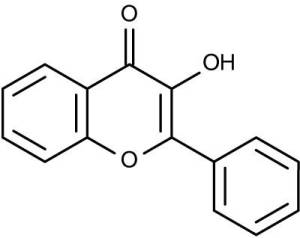
Oh, look! A flavonol! This stuff must be really, really healthy!
And this next paragraph is where Kilham really shows his ignorance about tea: “But if you’re drinking green tea, which is simply tea that hasn’t been fermented, then I would probably have to say that green tea is the healthier drink. It’s rich in flavenols [sic], which are lost when the tea is fermented.” Where do I even start with this?
First of all, green tea isn’t simply “tea that hasn’t been fermented.” Black tea hasn’t been fermented, either. Nor have white tea and oolong tea. Either Kilham doesn’t know the difference between fermentation and oxidation, or he doesn’t know the difference between black tea (which is oxidized) and pu-erh tea (which is fermented). I’m guessing both, and I’ll henceforth assume he means oxidized whenever he says fermented.
Next, it’s “flavonols,” not “flavenols.” If you’re going to babble pseudoscience, at least spell the words right.
Flavonols aren’t “lost” during oxidation; most (but not all) are converted into different antioxidants called theaflavins, and some convert to thearubigins (which produce the reddish hue of black tea).
Flavonols aren’t the only basis for measuring the healthiness of a drink. Focusing on them to the exclusion of everything else shows that Kilham just didn’t bother to do any research on tea.
He finishes his answer with the standard platitude of the underinformed: “The bottom line: If you’re talking about coffee and black tea, coffee is the healthier choice. If you’re a green tea drinker, green tea is the healthier choice.”
What’s wrong with that conclusion? It oversimplifies the issue and ignores all of the tea styles other than green and black. It doesn’t look at different types of black tea (or variants like the new purple tea from Kenya) or different ways of preparing them.
When I first wrote this response (before Firefox crashed and killed it), I didn’t know who Chris Kilham was. As I mentioned earlier, I assumed he was a medical doctor, researcher, or scientist. When I went to his website, however, I found that he’s a “medicine hunter, author and educator” who “travels the world in search of traditional, plant-based medicines, and works with shamans, healers, growers, harvesters, scientists, trade officials and other plant medicine experts in dozens of countries.” Yep, when I want accurate scientific health information, I go to shamans and healers.
There’s a quote from Dr. Alvarez that says, “I love adventure! That’s why I love teaming up with The Medicine Hunter, Chris Kilham.” Very telling. Alvarez didn’t call Kilham because he loves accurate information or well-researched responses. He called him because he loves adventure! Of course.
I think I’ll have another cup of tea and improve my mood.





 Tea With Gary