Category Archives: Growing Tea
Organic, Fair Trade, and the Ethical Tea Partnership

Ten years ago, I had a pretty simplistic view of the word “organic.” I figured there was some set of guidelines you had to follow, and *presto* — you could put the word organic on your product. As it turns out, things are much more complicated than that.
When my wife and I had our ranch, we had a neighbor that produced organic pork. One day, they were forced to make an unpleasant choice. A disease was circulating among the hogs in our area. They could inoculate their hogs, but it would cost them their USDA organic rating. Or they could keep the organic rating, and potentially lose the animals — possibly even the farm. In another post on this blog, I told a story of an herb farm near us that gave up their USDA organic rating simply because they couldn’t keep up with the paperwork. There is a daunting amount of documentation required for a small family business to be certified organic.
I learned even more about organic products when I got into the tea business.
I learned that if you take some organic tea leaves and mix them with organic peppermint leaves, you cannot call the resulting mint tea “organic” unless you go through the process of having your facility certified and document everything you do.
I learned that some of my customers will only buy tea that is certified organic — and others will only buy tea if it is not certified organic.
I also learned that there are countries that won’t produce USDA organic tea simply because they don’t want a U.S. government agency telling them what to do. That’s when I found out that not all organic tea is USDA organic. Japan has their JAS (Japanese Agricultural Standard) program, the logo in the center bottom of the header image for this blog post. The European Union countries have their EU organic program. All of these programs were designed to encourage natural and sustainable farming techniques, but they all do so in different ways.
There’s also Fair Trade. In their own words, “Products that bear our logo come from farmers and workers who are justly compensated. We help farmers in developing countries build sustainable businesses that positively influence their communities.”
In 1997, a group of tea companies grouped together to create a program that was more specific to tea. At first, it was about tea companies working to monitor and certify their supply chains. Eventually, it became the Ethical Tea Partnership. Many of the members are names you’d recognize, like Bigelow, Tazo, and Twinings. Others are boutique brands. All work with the entire chain of people involved in tea production, from the farmers all the way to the distributors.
The ETP certification process is unlike organic and fair trade certifications, but it has elements of both. Provisions of their global standard include:
- No bonded or forced labor. Employees can’t be forced to leave their identity papers with the employer, must be free to leave at any time, and may not be forced laborers from prisons
- Freedom of association. Employees must be allowed to join trade unions and bargain collectively if they so choose.
- A safe and healthy workplace. Tea businesses must provide clean, well-lit, and safe work areas. Workers in potentially hazardous areas must be provided with health and safety training and appropriate protective clothing.
- Safe and hygienic wash stations and restrooms.
- No child labor, and special treatment for workers under 18 years of age.
- Fair minimum wages and on-time payment of workers.
- Reasonable working hours, including a maximum of 48-hour regular weeks, paid overtime on a voluntary basis, maternity leave, and a minimum of one day off in every seven-day period.
- Equal opportunity employment, including equal pay for men and women and a written policy forbidding discrimination on the basis of race, caste, nationality, religion, age, gender, sexual orientation, and other factors.
- Environmental management systems, including policies for control and reduction of agrochemicals, and for prevention of soil erosion.
- Water and ecosystem conservation.
The entire global standard document is available online as a 30-page PDF file.
So the next time you’re looking for tea, don’t just look for that USDA logo. Keep an eye out for these other logos as well!

While writing this blog post, I was drinking Pi Lo Chun, a hand-processed Chinese green tea. I brewed this cup for 3:00 using 175 degree (F) water. If you’re squeamish, you may want to taste it before looking at the translation of its name (“green snail spring”) — but it contains no snails; it’s just straight green tea. It has a full body and an earthy flavor, but it’s not overpowering at all. In fact, I’d describe this tea as “soft.” It’s not like a hearty Japanese Sencha, which I almost feel I have to wrestle into submission.
I suppose I should be drinking something organic, or fairtrade, or at least ETP. Mea maxima culpa!

Tea plants as props? Thanks, #TeaAcrossAmerica!
When we first joined #TeaAcrossAmerica, I had visions of a big bushy tea plant in the front window at the shop. I still think we can build a neat window display around it at some point. When our tea plant, Tea H. White, arrived, the temperature outside was well below zero Fahrenheit. Even the windowsill seemed awfully cold for a little cutting that had just been shipped halfway across the country. So we set him on the tea bar instead.

Tea H. White today, about two months after his arrival in Montana.
Tea H. started out as a decoration and a passive tool for raising awareness of American-grown tea. Every now and then, I’d point at him and say, “that’s a tea plant.” Perhaps I’d explain what the significance is of Camellia sinensis and talk about Tea Across America. Perhaps not. But that slowly began to change.
I found myself saying things like, “we could make black tea, white tea, green tea, oolong, and pu-erh, all from this plant here.” I was pointing at the plant a lot.
Then it got more specific. I’d point at the bud and leaf at the end of a branch and say, “this right here is where the plant concentrates its caffeine.” I’d point at a smaller, brighter-colored leaf and say, “this leaf would find its way into something like this oolong tea we’re drinking, but this big leaf down the stem would probably be broken into dust and stuffed in a Lipton teabag.”
In the last week, I’ve referred to little Tea H. White every day.
I brewed up some taiguanyin, and showed a customer the dried, rolled-up, tadpole-shaped leaves. Then I pulled an unraveled leaf from the infuser and held it next to a similar-sized leaf on the tea plant to show that it really is a whole tea leaf.
I showed someone the soil in the plant’s pot and explained that Camellia sinensis can grow on steep hillsides at high altitudes where other crops can’t thrive, and talked about what that’s done for the economy in places like Kenya’s Rift Valley.
I was talking about the ancient tea forests near Mannong and Manmai in the Yunnan province of China, and I walked over to Tea H. White and said, “little tea plants like this one can grow into 30-foot trees and live for a thousand years or more.”
Just today, someone asked what variety of tea Orange Pekoe is. I started to explain that it’s not a variety, it’s a grade. Then I went over to the tea plant and showed them what a pekoe is.
My tea plant has become an educational tool.
As I’ve said many times before, the primary job of a tea vendor today is education. Learn everything you can about tea, and then pass it on to your customers. It pays back in spades when you can find the perfect tea for somebody and they turn into a tea fan (and a loyal customer)! I live for the aha moment, when somebody really “gets” what tea is all about. Having a real, live tea plant sitting on the tea bar makes for more of those moments.
Someday, that plant will grow into a tea bush, and we’re going to produce a batch of tea from it. Between now and then, however, the plant will help to educate hundreds of people about the world of tea.

Tea H. White arrives in Montana

Back in November, I wrote about #TeaAcrossAmerica, a program that’s putting tea bushes in all fifty states plus the District of Columbia. By joining the program, I agreed to host Montana’s tea plant, which arrived at my tea shop yesterday. The plant, which we named “Tea H. White,” is a China bush (Camellia sinensis var. sinensis), which is tolerant of cold, but not nearly tolerant enough to spend a Montana winter outdoors. The plant can take an occasional light frost, but not temperatures like the -27(F) we had for a couple of days early last month. This means that Tea H. White will be living indoors.
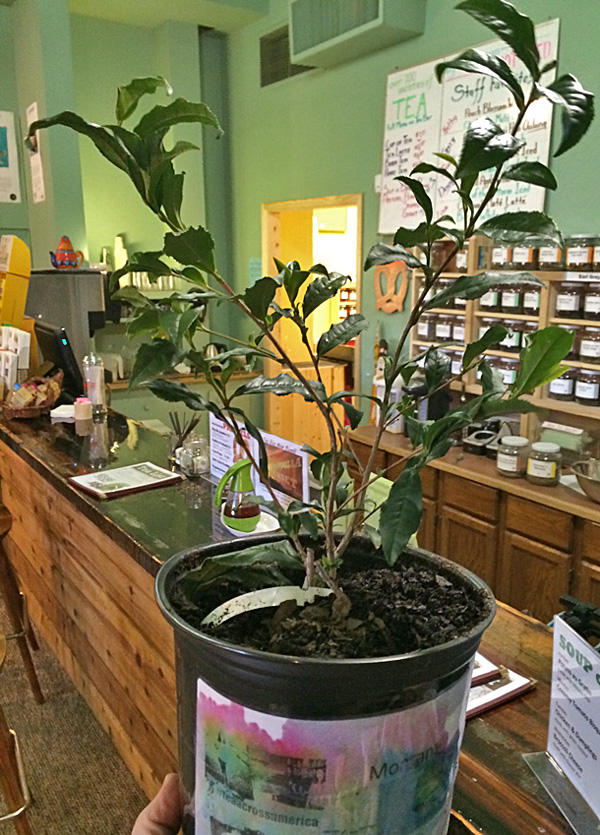
My tea bar has east-facing bay windows that should be a great place to keep the plant, with full morning sun and afternoon shade. We’ll have to work on the humidity, since it’s pretty dry out here, but we can do that. In the picture above, you can see that our cutting came out of the shipping box a wee bit dehydrated, which is to be expected after a few days in USPS trucks and planes. The first thing I did — after dragging him around the store and showing him to everybody — was get him into the sink, where he soaked up a lot of water and started perking back up.
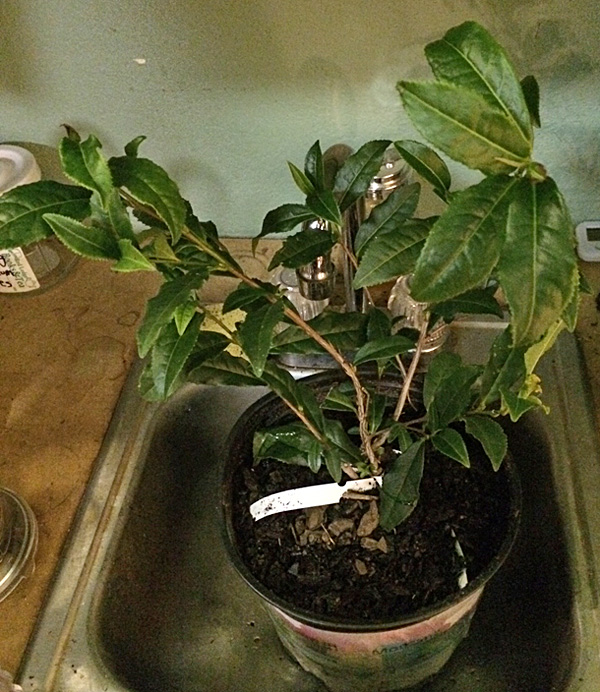
Why the name? Well, our shop is a bookstore, which is why we’ve gone with literary names for some of our tea blends (e.g., Lady Greystoke and Fifty Shades of Earl Grey). In looking for the author-related puns, Tea S. Eliot was the first to pop to mind, but Shannon Brewer Land already used that name for the Alaskan Tea Across America plant — although she later changed it to Captain James Tea Kirk.

As it turns out, Tea H. White is a better name for our plant anyway. T. H. White is the author of the groundbreaking The Once and Future King series, which tells the King Arthur legend starting with Arthur’s childhood. We are definitely lovers of fantasy novels and Arthurian stories, and as a children’s author myself, I really enjoy good young adult literature.
As soon as little Tea H. White started perking up, our assistant manager, Gwen, was ready to pluck a leaf and start drying it. After fighting her off with my trusty pu-erh knife Excaliber, we decided to let the plant turn into a bush before we start trying to drink it. I sympathize with Gwen, though. Patience is not my strong suit either.
I am curious. I’d like to know whether this is the first tea bush in Montana. Has anyone else tried this experiment? Is there a little tea garden growing in a greenhouse in Missoula? A tea bush in a shop in Helena? A cutting thriving in someone’s sun room in Bozeman? If any of my readers know about another Camellia sinensis bush in Montana, let me know. I’d love to compare notes with someone else who’s done this!
Joining Tea Across America
The more I learn about tea, the more I want to learn. The more I experience, the more I want to experience. I experiment, I read books, I read blogs, I attend tea conferences, and I take classes. I buy tea from all over the world, and try out different blends and combinations. Basically, I do whatever my budget allows.

One thing my budget has not, alas, allowed has been traveling to the world’s great tea growing areas and getting familiar with tea bushes. My tea experiences all start with processed leaves, not with the plants themselves. Today marked the first step in changing that.
I got a phone call this afternoon from Naomi Rosen, of Joy’s Teaspoon. I met Naomi at a blogger’s panel at World Tea Expo 2013 this summer (CAUTION: this link to World Tea Expo plays video and makes noise — careful where you are when you click it). Naomi was calling because she’s working with Jason McDonald of FiLoLi Tea Farm and the United States League of Tea Growers on a new initiative they call #TeaAcrossAmerica.
Their simple yet ambitious objective: put a tea plant into every state and the District of Columbia. Some U.S. states already have established tea plantations. Others have hobbyists with a few bushes going. Many states have climates that Camellia sinensis considers inhospitable. I happen to live in one of those states: Montana.
Naomi asked if I’d be willing to represent Montana in #TeaAcrossAmerica, and I jumped at the opportunity. To participate, I need to take a cutting from FiLoLi Tea Farm in Brookhaven, Mississippi, and grow it here in Montana. Jason has written up some directions to make caring for the cutting easier, and I’ll be able to keep it indoors where the harsh Montana winters won’t kill it. My tea bar has east-facing bay windows that should be a great place to keep the plant, with full morning sun and afternoon shade. The only problem will be humidity — it’s very dry here — but we can deal with that.
It’s going to be a month or two before my little tea bush arrives, so we have plenty of time to prepare. I will keep everyone up-to-date on the progress as we get things going. In the meantime, thanks to Jason for the opportunity and to Naomi for suggesting me as a volunteer!

Britain growing and exporting tea?
For hundreds of years, tea has flowed from the east (originally China) to the west, and has been a huge part of British culture. Just as in the U.S. and Canada, Britain’s favorite drinks aren’t grown in Britain. Until recently, that is.
The Tregothnan Estate in Cornwall, owned by Evelyn and Katharine Boscawen, is growing Camellia sinensis (tea bushes) for production, and is now starting to reverse the flow of tea by exporting their products to countries like China. Their production is small — projected to be about $3.14 million this year — but having even a small portion of that sold on the export market means the flow now goes both ways.

Although the estate has only been growing for production since 2005, rumor has it that Tregothnan was growing ornamental tea bushes in the early 1800s. They are now producing both black and green tea, using the Japanese (steamed) method for the green. They also grow a variety of flowers and herbs.
In addition to production facilities, Tregothnan also has a tea bar. As I perused their website, I came across a quote that reflects the philosophy of my own tea bar perfectly:
“Unlike the ubiquitous and characterless High Street coffee shop, the Tea Bar is all about taking time.”
This is a point that we heard over and over at the World Tea Expo last year. Coffee shops are all about energy. They are designed for a frenetic feel, for higher sound levels, for ramping up for the day. Tea shops fill a different niche. Although we serve a caffeinated beverage, we’re about relaxing, slowing down, and shedding the stress that we wear like a overly-bulky jacket during the workday.
For more information about the estate, visit their website (linked above).
 Tea With Gary