Author Archives: Gary D. Robson

Tea Lattes

The coffee industry would have you believe that the word “latte” means “espresso with steamed milk.” That basically is what “caffelatte” means, but “latte” just means “milk” in Italian. A tea latte is every bit as much a latte as a coffee latte, and the growing popularity of masala chai lattes has been bringing that point home to coffee drinkers of late. In the coffee world, a latte is typically made by preparing the espresso, mixing in the milk, and then adding foam on top. The milk is there to add flavor and to cut the espresso so it doesn’t taste as strong. In the tea world, the milk serves a somewhat different purpose. For the record here, I am not talking about Starbucks-style chai lattes, which are made with a sweet syrup. I’m talking about tea that’s fresh-brewed in milk and water.
Flavors and nutrients from tea leaves extract well in water. That’s why a straight cup of tea tastes so good. That’s why people who like milk in their tea traditionally add the milk after the tea is brewed. A lot of other things, however, don’t extract quite as well.
Many of the flavors in a masala spice blend (no, they aren’t chai spices; chai just means “tea” in Punjabi) are lipophilic. Directly translated, this means “fat-loving,” which means that they extract much better in fats (e.g., milk) than in water. That’s why it’s important to brew the masala chai in hot milk and water instead of just adding the milk later. In my tea bar, we’ve done side-by-side taste tests of tea lattes made both ways. We use a milk heater/frother instead of using the steamer that’s found on commercial espresso machines.
We tried steeping the tea in water and then adding the frothed milk vs steeping the tea in a 50/50 blend of hot water and frothed milk. In this entirely subjective set of tests using our employees and customers, the lattes brewed with milk won consistently. I realize that our production method wouldn’t work in a typical coffee shop where people are rushing in and out on their way to work. They want their drink now. They don’t want to wait four to seven minutes for a fresh-brewed cup. But in a tea bar like mine, things are different. We make a lot of lattes: close to 1/3 of all of the cups we serve. We offer a choice of milk (nonfat, 2%, whole, half-and-half, soy, almond…) and over 150 different types of tea.

The majority of our lattes are served unsweetened. For those who want it sweetened, however, we do the same thing we do when making traditional sweet tea: we add the sweetener when we’re brewing instead of at the end. Most of our customers go for either plain sugar or agave nectar, but we offer other options there, too: flavored hail sugars, honey, stevia leaf, stevia powder, and other artificial sweeteners. You can’t do something like this in a fast-moving production line environment, but you can do it at home.
A milk heater/frother is less expensive than a high-end home coffeemaker. We started out with Keurig units, but found they didn’t hold up to commercial use. There were too many fragile parts, and most of them broke in the first six months (that Keurig unit didn’t even end up on a list of the top 10 frothers this year). We switched to the Capresso frothPRO and we’ve been quite happy with them. They aren’t the fastest solution, but they’re solid, reliable, and easy-to-clean. It’s also easy to switch between heating/frothing and just heating.
If you don’t want to invest $50-$100 in a frother/heater, there’s another solution that works great at home. Just heat the milk in the microwave. Don’t let it go to a boil, but get it as hot as you can without boiling it. There are quite a few handheld battery-powered electric whisks available if you like it frothy; the list I linked in the previous paragraph includes three of them.

How do you know which types of tea work best in a latte? Experiment. One of the most popular tea lattes is called a London Fog. It’s very straightforward: just Earl Grey tea and a 50/50 mix of milk and tea. We usually start the tea steeping in water and add the milk halfway through. Make sure you use the right amount of tea leaf for the total volume of milk and water; if you’re using 8 oz of milk and 8 oz of water, use enough leaf for a 16 oz mug. Many of our blends with cinnamon make good lattes, as do fruity teas. We use sweetened matcha powder for our green tea lattes. Want something different? Try making a strong shu pu-erh latte with chocolate milk. Experiment, have fun, and then teach all of your coffee-drinking friends just how many kinds of latte there are!

What’s the Healthiest Tea?

Unlike some of the other questions I address here, this one has a very straightforward answer. The healthiest tea is the one you’ll actually drink.
Figuring out which specific tea has the most health benefits is a complex task. Most styles and brands don’t have lab analysis of their antioxidant content, caffeine levels, and other details. Many scientific reports and studies are being misinterpreted, and others are being oversimplified.
Here’s the bottom line, though: if you don’t like the taste of a tea, you won’t want to drink it. You’ll have fewer cups per day. You’ll use smaller cups. You’ll use less leaf.
But if there’s a variety that has a bit less benefit — perhaps half of those healthy amino acids you’re after — and you love the flavor, you’ll drink more. You’ll use one of those big American mugs instead of a dainty British teacup. You’ll make it stronger. You’ll sneak in extra cups because you enjoy it. And even though each cup has less of what you’re trying to get, you’ll get a lot more.
So if your goal is to drink more white tea, don’t just buy a pound of the first (or cheapest) white tea you find and choke it down. Experiment! Try a variety of white teas and buy the one you really enjoy drinking. If you want green tea and you don’t like the Chinese variety you tried, try a few Japanese green teas.
Whether you’re in this for the health benefits or for because you enjoy tea, it’s fundamentally all about the taste!

Organic, Fair Trade, and the Ethical Tea Partnership

Ten years ago, I had a pretty simplistic view of the word “organic.” I figured there was some set of guidelines you had to follow, and *presto* — you could put the word organic on your product. As it turns out, things are much more complicated than that.
When my wife and I had our ranch, we had a neighbor that produced organic pork. One day, they were forced to make an unpleasant choice. A disease was circulating among the hogs in our area. They could inoculate their hogs, but it would cost them their USDA organic rating. Or they could keep the organic rating, and potentially lose the animals — possibly even the farm. In another post on this blog, I told a story of an herb farm near us that gave up their USDA organic rating simply because they couldn’t keep up with the paperwork. There is a daunting amount of documentation required for a small family business to be certified organic.
I learned even more about organic products when I got into the tea business.
I learned that if you take some organic tea leaves and mix them with organic peppermint leaves, you cannot call the resulting mint tea “organic” unless you go through the process of having your facility certified and document everything you do.
I learned that some of my customers will only buy tea that is certified organic — and others will only buy tea if it is not certified organic.
I also learned that there are countries that won’t produce USDA organic tea simply because they don’t want a U.S. government agency telling them what to do. That’s when I found out that not all organic tea is USDA organic. Japan has their JAS (Japanese Agricultural Standard) program, the logo in the center bottom of the header image for this blog post. The European Union countries have their EU organic program. All of these programs were designed to encourage natural and sustainable farming techniques, but they all do so in different ways.
There’s also Fair Trade. In their own words, “Products that bear our logo come from farmers and workers who are justly compensated. We help farmers in developing countries build sustainable businesses that positively influence their communities.”
In 1997, a group of tea companies grouped together to create a program that was more specific to tea. At first, it was about tea companies working to monitor and certify their supply chains. Eventually, it became the Ethical Tea Partnership. Many of the members are names you’d recognize, like Bigelow, Tazo, and Twinings. Others are boutique brands. All work with the entire chain of people involved in tea production, from the farmers all the way to the distributors.
The ETP certification process is unlike organic and fair trade certifications, but it has elements of both. Provisions of their global standard include:
- No bonded or forced labor. Employees can’t be forced to leave their identity papers with the employer, must be free to leave at any time, and may not be forced laborers from prisons
- Freedom of association. Employees must be allowed to join trade unions and bargain collectively if they so choose.
- A safe and healthy workplace. Tea businesses must provide clean, well-lit, and safe work areas. Workers in potentially hazardous areas must be provided with health and safety training and appropriate protective clothing.
- Safe and hygienic wash stations and restrooms.
- No child labor, and special treatment for workers under 18 years of age.
- Fair minimum wages and on-time payment of workers.
- Reasonable working hours, including a maximum of 48-hour regular weeks, paid overtime on a voluntary basis, maternity leave, and a minimum of one day off in every seven-day period.
- Equal opportunity employment, including equal pay for men and women and a written policy forbidding discrimination on the basis of race, caste, nationality, religion, age, gender, sexual orientation, and other factors.
- Environmental management systems, including policies for control and reduction of agrochemicals, and for prevention of soil erosion.
- Water and ecosystem conservation.
The entire global standard document is available online as a 30-page PDF file.
So the next time you’re looking for tea, don’t just look for that USDA logo. Keep an eye out for these other logos as well!

While writing this blog post, I was drinking Pi Lo Chun, a hand-processed Chinese green tea. I brewed this cup for 3:00 using 175 degree (F) water. If you’re squeamish, you may want to taste it before looking at the translation of its name (“green snail spring”) — but it contains no snails; it’s just straight green tea. It has a full body and an earthy flavor, but it’s not overpowering at all. In fact, I’d describe this tea as “soft.” It’s not like a hearty Japanese Sencha, which I almost feel I have to wrestle into submission.
I suppose I should be drinking something organic, or fairtrade, or at least ETP. Mea maxima culpa!

How much caffeine is in my tea?
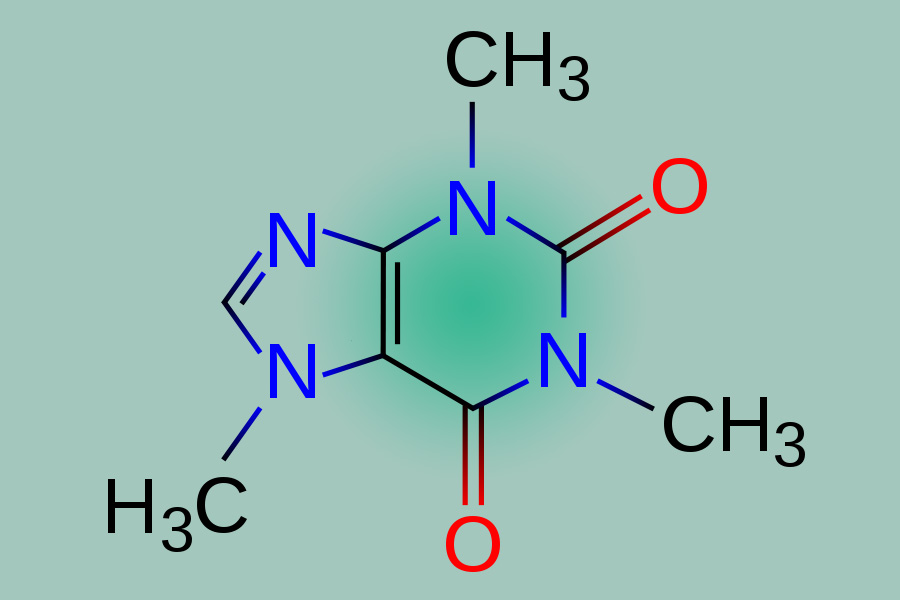
I wish there was a simple answer to this question. It would be ever so cool if I could just say, “black tea has 45 mg of caffeine per 8-ounce cup.” In fact, a number of people say it actually is that simple. Unfortunately, they’re wrong.
This graph came from the front page of the eZenTea website:

And this one is from a tweet from SanctuaryT (it said, “Finally, the truth about #tea and #caffeine!”):

They make it pretty simple, right? But that’s not very useful when they disagree with each other! The first chart shows the caffeine in green tea at 20 mg/cup and white tea at 10 mg/cup, showing that white tea has half as much caffeine as green tea. The second chart shows green tea at 25 mg/cup and white tea at 28 mg/cup, indicating that white tea has 12% more caffeine.
Then we get confusing (and frankly pretty silly) charts like this one from HellaWella:

All three charts have green tea in the same basic range (20-25 mg/cup), but the HellaWella chart breaks out black tea (which is 40-42 mg/cup in the other two charts) into “brewed tea” at 47 mg/cup and “brewed imported tea” at 60 mg/cup. Huh? “Imported”? HellaWella’s “about” page doesn’t say what country they’re from, but I’m going to guess from the spellings that they’re from the U.S. Sure, there are few small tea plantations in the U.S., but I would venture to guess that approximately zero percent of casual tea drinkers have ever had a domestically grown tea. In America, pretty much all tea is “imported.”
So why the discrepancies?
Because the people making these charts (a) don’t explain their methodology and/or (b) don’t understand tea.
As I explained in my three-part caffeine series (here’s part 1), green, white, oolong, black, and pu-erh tea all come from the same species of plant (Camellia sinensis), and in some cases, the same actual plant. We carry a black and a green Darjeeling tea that are picked from the same plants, but processed differently. No part of that process creates or destroys caffeine.
Let me make that clear: let’s say you pick a bunch of tea leaves on your tea farm. You divide them up into four equal piles. You turn one pile into green tea, one into white tea, one into black tea, and one into oolong tea. When you’re done, you make a cup of tea from each. Assuming you use the same water at the same temperature, use the same amount of leaf per cup, and steep them for the same time, they will all have the exact same amount of caffeine.
If that processing doesn’t change the caffeine content, what does?
- The part of the plant that’s used. Caffeine tends to be concentrated in the buds and leaf tips. A high-quality golden or white tea made from only buds will have more caffeine than a cheap tea made with the big leaves farther down the stem.
- The growing conditions. Soil, rainfall, altitude, and many other factors (collectively known as terroir) all affect how much caffeine will be in the tea leaves.
- The time of year the leaves were harvested. Tea picked from the same plants several months apart may have dramatically different amounts of caffeine.
- How long you steep the tea. The longer those leaves sit in the water, the more caffeine will be extracted into your drink.
- How much leaf you use in the cup. Use more leaves, get more caffeine.
- How big the cup is. This seems ridiculously obvious, but it’s something a lot of people miss. Anyone who went to elementary school in the United States knows that one cup = eight ounces. However, a four-cup coffee maker doesn’t make 32 ounces (8 x 4); it makes 24 ounces. They decided their coffee makers sound bigger if they use six-ounce cups.
Even if you and I measure the same amount of leaf out of the same tin of tea, your cup might have twice the caffeine of my cup, depending on how we like to fix it. Unless we both precisely followed the ISO 3103 standard for brewing the perfect cup of tea.
Unfortunately, the lab tests to assess caffeine content are expensive, so most tea shops never test their teas. On top of that, people can’t seem to agree on how to brew the tea they are testing. I read one study where every tea was brewed for five minutes in boiling water. That’s consistent, but it’s not realistic. You don’t brew a Japanese green tea that way, or you’ll have a bitter, undrinkable mess. Another, by Kevin Gascoyne, tested tea as most people drink it (e.g., black tea in boiling water, white tea in cooler water). That’s better but even still, Kevin’s way of brewing a particular tea may not be the way I do it.
The bottom line is that every tea is different. Very different. In fact, Kevin tested two different sencha teas and one had four times the caffeine of the other. If someone shows you a handy-dandy chart that indicates exactly how much caffeine a cup of tea has (as opposed to showing a range), it’s wrong.
While writing this blog post, I was drinking green rooibos from South Africa, which has no caffeine at all. It is a non-oxidized “redbush” tea has a much softer flavor than red rooibos. I brewed this cup for 4:00 using boiling water. It’s a remarkably forgiving drink, and I’ve steeped it for as long as 10 minutes without ruining it. It’s usually good for at least two infusions.

Tea Bloggers Roundtable 2015

Once again, World Tea Expo attendees will have an opportunity to share in the wacky (and occasionally educational) world of professional tea bloggers. You’re all invited to the Tea Bloggers Roundtable 2:30 to 3:30pm on Thursday, May 7. It will be a panel discussion featuring some of the names tea aficionados just might recognize.
The panel will consist of Rachel Carter (iHeart Teas), Chris Giddings (Tea Guy), Jo Johnson (A Gift of Tea), Nicole Martin (Tea for Me Please), Geoffrey Norman (Lazy Literatus), Jen Piccotti (An International Tea Moment), and Naomi Rosen (Joy’s Teaspoon). I’ll be moderating the panel, which has the theme this year of “Melding of Voices.” I know, all of those names are in that poster image right below this paragraph, but I wanted to include links to all of the blogs. Check us all out before the event!

One of the things I enjoy most about the world of tea blogging is the lack of competition. I don’t find myself thinking “oh, no, Geoff scooped me on that story,” or “how can I get more viewers than Robert (Lord Devotea’s Tea Spouts) this week?” Instead, we read each other’s posts; we talk about each other’s stories; we link to each other’s blogs; we gain inspiration from each other. We’re not in it to beat each other at the game. We’re in it to share our love of tea and each be the best we can be.
Our blogs all have different themes, too. Some of us just do tea reviews. Some talk about gadgets. Some are very professional in tone; and some are very personal. Some talk about the tea business, and some prefer to just focus on the tea itself. Some blogs, like mine, are all over the map. That’s what makes the tea blogging community such a great environment for newcomers.

It really gets to be fun when we open things up to questions from the audience, and that’s where we find out just how many people in the tea business are interested in blogging. In addition to the prepared questions, if past roundtables are any indication, we’ll also be dealing with questions like how to choose topics, how to get tea to review, the Association of Tea Bloggers, whether to schedule posts, what social media sites work best for promotion, the difference between a hobby tea blog and a professional tea blog, and much more.
If you have a conference badge, there’s no additional cost to attend the Tea Bloggers Roundtable, so take advantage of this opportunity to hobnob with experienced tea bloggers, writers, and social media marketers.
If you have questions, contact Jo Johnson at agiftoftea@gmail.com. She’ll take care of everything!

I wasn’t on it back then, so they had to add three extra people to compensate.
While writing this blog post, I was drinking a Vietnamese black tea called Good Morning Vietnam! I brewed this cup for 3:00 using boiling water. As usual, I did not add milk or sugar. Although this is a typical black tea in most ways, there is very little astringency. I don’t think your typical half-tea-half-milk breakfast tea drinker would find it overly satisfying, but it’s turning into my new favorite black tea.

Scottish Breakfast Tea
Have you ever sat down to a cup of hot, energizing breakfast tea and wondered what the heck makes it a breakfast blend? You never see anyone selling lunch teas or dinner teas. Why breakfast tea? And what’s the difference between Scottish, Irish, and English breakfast teas? Let me explain!
When we first get up in the morning, most of us aren’t in the mood for something delicate, flowery, and subtle. We want caffeine and we want it now! And by golly, we want to be able to taste it! Breakfast, as any nutritionist will tell you, is the most important meal of the day. You probably haven’t eaten in ten or twelve hours, and you need energy for your morning work. A full-flavored hearty breakfast will overwhelm the taste of a white tea or a jasmine tea, so Americans and Europeans, unlike our Eastern friends, usually go for a black tea (or perhaps a heavily-oxidized oolong) with our breakfast. This is the origin of the “breakfast tea.”
Breakfast teas in the U.K. were originally Chinese tea. When supplies from China were threatened and the British East India Company established tea plantations in Assam, those Indian teas began to replace the Chinese teas at breakfast, and that’s also when they started to become blends rather than straight tea. One of the words you’ll often hear to describe breakfast teas is “malty.” That flavor comes from the Assam teas. There isn’t a standard formula for any breakfast tea, and no two tea producers will agree on the perfect teas or the perfect blend percentages. Generally, though, the Assam is blended with a strong traditional black tea from Sri Lanka (a Ceylon tea) or Kenya. Some blends are simple combinations of two base teas; some are complex combinations of four or five.
There also isn’t a standard for strength. Generally, though, you can assume that Scottish and Irish breakfast teas will be stronger than English breakfast teas, and when you’re in the U.K., you can count on all of them being served with milk.
An American might start the day with biscuits and sausage gravy with an egg on top—or perhaps a big stack of pancakes. A Scotsman, however, may sit down to a “full breakfast,” which would include eggs, bacon (what an American would call “Canadian bacon” and a Canadian would call “back bacon”), toast, sausage, black pudding, grilled tomato, and—if he’s lucky—some haggis and tattie scones. No wimpy tea will work with a meal like that! It calls for a full pot of Scottish breakfast tea!
At my tea bar, I started out with stock blends for all three breakfast teas. Soon, though, my Scottish heritage gave me the urge to experiment. I’ve known the folks from the Khongea Estate in Assam for a while, and they have a variety that made the perfect start. Lots of malty flavor, lots of caffeine, but not too much astringency. Unlike my ancestors, you see, I don’t put milk in my tea, so I look for less bitterness than most Scots.
After playing around with other teas, I settled on another estate-grown variety as the second ingredient. It’s a fairly high-altitude tea that grows near the base of Mount Kenya. It adds strength and complexity to the Assam, and I decided no other ingredients were needed. Once I was happy with the flavor, I needed a name. Scottish Breakfast Tea is just a bit too boring for me, so I called it “Gary’s Kilty Pleasure.”

For the curious, that’s my plaid in the logo: the Clan Gunn weathered tartan.
I got a very big surprise from this tea. American tea tastes run toward flavored teas. The majority of sales at my tea bar are Earl Grey, masala chai, fruity blends, and the like. Despite that, Gary’s Kilty Pleasure has remained one of the top five sellers for four straight years, out of a field of well over 100 loose teas. The most common comment I get back is that it goes well with milk, but it is perfectly good without—and that makes me happy!
So whether you choose my Scottish breakfast tea or a blend from your favorite supplier, brew it up strong with a hearty breakfast, and get your day off to a great start!
I have started adding a paragraph at the end of each blog post describing the tea I was drinking when I wrote the post. It seems kind of silly at the end of this one! Come on, people. What do you THINK I was drinking?

The Logic of Tea Bar Redesign

It all started simply enough.
Gwen looked at the jars of tea behind the bar one day and said, “This cubbyhole-based system is too constricting. We have space for nine oolongs. If we want to add a new one, we have to drop one of the existing ones. What if we went to a more open system?”
Logical enough. If they are arranged in a linear system, we can drop a white tea and add a black one, and everything fits fine. But that led us to a much deeper discussion. Do our groupings make sense?
The old back bar had teas arranged by style. All of the green teas were together, including the dragonwell, sencha, raspberry hibiscus green, Moroccan mint, and jasmine green. But that’s not how people select a tea. That’s not how we select a tea. When a customer comes in that doesn’t know what he wants, we go through a decision tree.
We start with, “do you prefer straight tea, or something flavored?” If they choose straight tea, we ask if they like white, yellow, green, oolong, black, or pu-erh. If they choose flavored, we ask if they want something fruity, flowery, spicy, creamy, or minty.
So why not set up the shelves that way? Very few of the people asking for a berry tea care whether the base tea is green, black, or oolong. They just want a berry flavor. It makes more sense to put all of our huckleberry teas together instead of having one with the black teas, one with the rooibos, and one with the yerba maté.
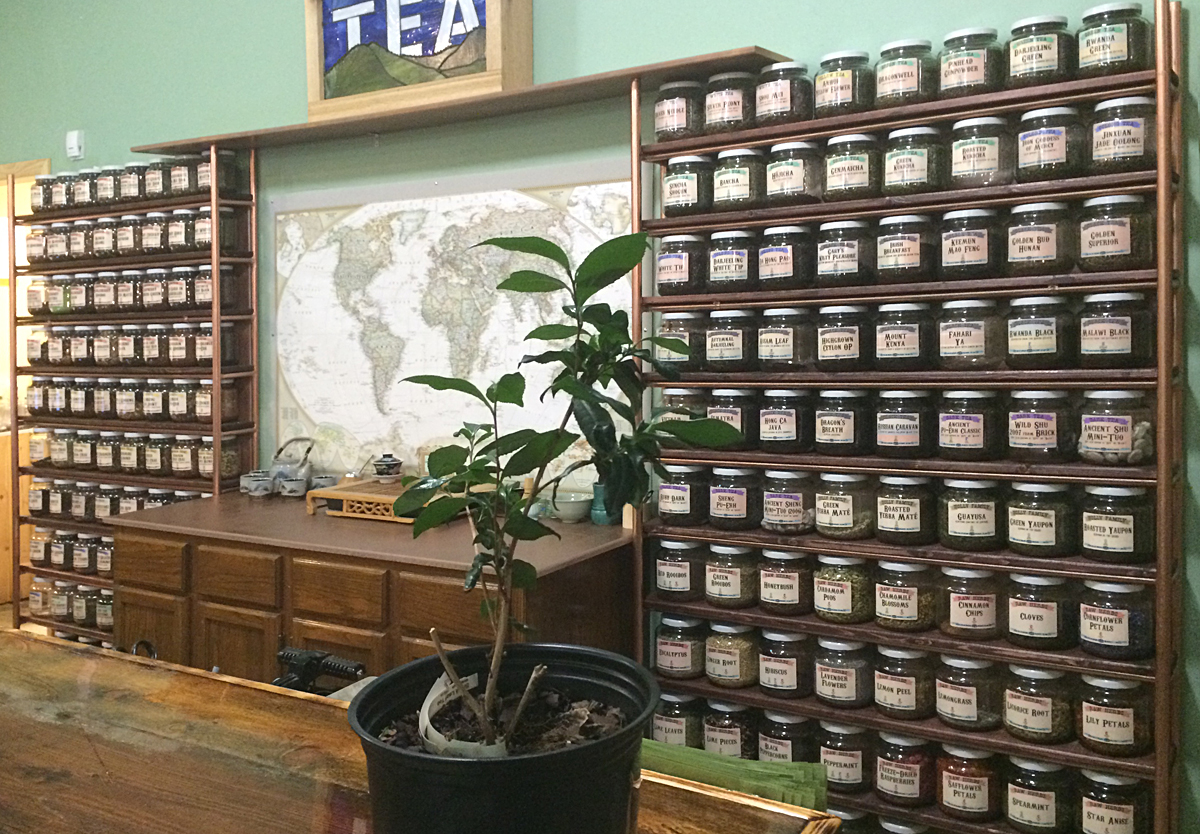
We went through our stock and found that if we grouped the herbs and tisanes (e.g., rooibos, yerba maté, guayusa…) with the straight tea, very close to half of our blends were flavored. So we arranged everything so that if someone says they’re looking for straight tea we take them to one side of the bar, and if they’re looking for something flavored, we go to the other.
Having an organization that customers can follow makes it less intimidating for people new to the tea world.
The straight teas are organized first by style, in order of oxidation (white, green, yellow, oolong, black, pu-erh). They are followed by the caffeinated herbs (maté, guayusa, yaupon) and then the caffeine-free herbs (rooibos, honeybush…). It’s nice to be able to point at the shelves and say, “everything from here up has caffeine, and from here down doesn’t.”

Within each style, the tea is arranged by origin, with blends coming first. In the picture above, you can see the black breakfast blends, and jars of black tea from China, Sri Lanka, Kenya, Rwanda, and Malawi. Most of our customers aren’t used to thinking about tea origins, and they’re intrigued by the diversity of sources.
“Where do you get your tea?” is one of the most common questions we get. It’s kind of difficult to answer. We deal with quite a few importers and distributors, but we also like to buy direct from estates and farms when we can; it helps us to be sure of what we’re getting. To answer the question, we included estate names on the labels where we can, and made a map to put between the two blocks of tea shelves.
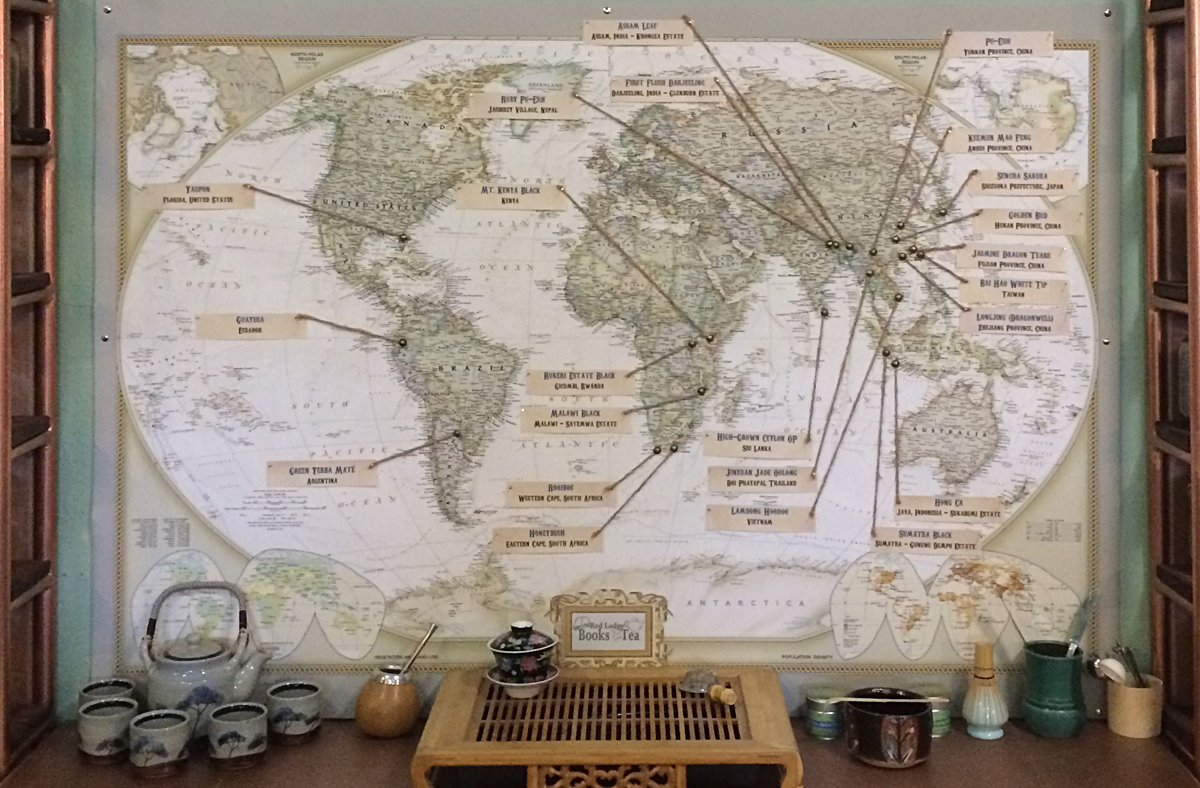
We’ve had very positive reactions to the map. People say, “I’ve never had a tea from Vietnam. I want to try that one!” Sales of some of more obscure tea are increasing, and people seem to be enjoying comparing tea from different parts of the world. It’s a great way to learn about terroir and regional differences in processing techniques.
When we move over to the flavored side, priorities are different. Few people care about the origins, and virtually all of them are blended from geographically-diverse ingredients. We couldn’t organize those by origin if we wanted to.
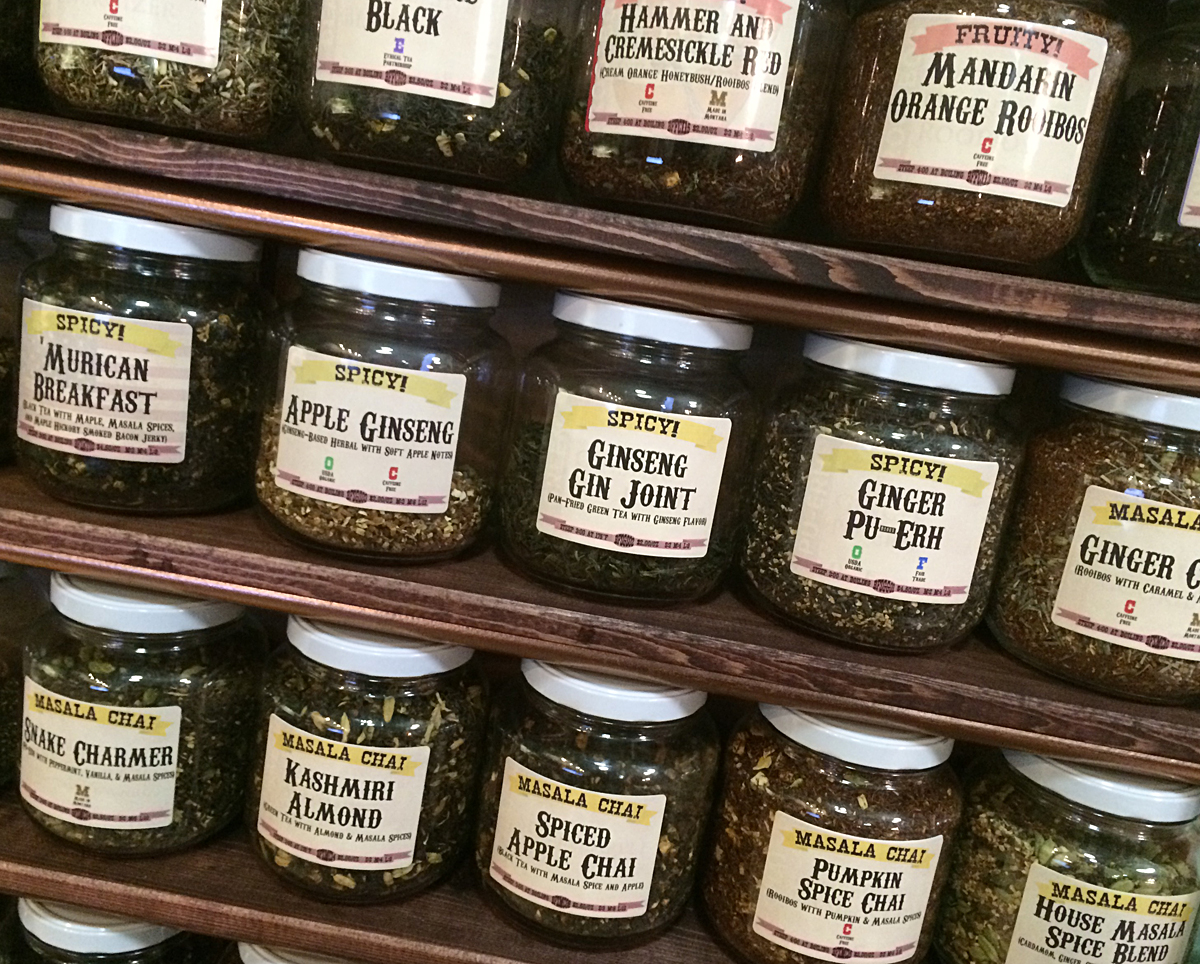
On that side, we start with fruity teas at the top, grouping all of the berry together, the citrus together, and so forth. We then proceed down through the spicy teas (with masala chai getting its own section), flowery teas, Earl Greys, mint teas, and on through the flavor profiles. Since caffeine isn’t taken into consideration in the sorting of the flavored teas, we put codes on the labels to help people find what they want: a green O for organic, blue F for fair trade, red C for caffeine-free, brown M for “made in Montana” (mostly our house blends), and purple E for Ethical Tea Partnership.
Is this the perfect organization for every tea shop? Of course not. An herbalist might want to group the teas and herbs by reputed health effects, or by Linnaean classification of the plants. A tea house focused on food might group them by the foods they pair well with. A café focused on tea by the cup rather than bulk sales might group their tea based on what’s best hot, what’s best iced, what works well in a latte, and so forth.
All indications at the moment, though, are that this is going to work well for us. I shall, of course, report back when we know more…
While writing this blog post, I was drinking Lamdong Hoodoo, a Vietnamese black tea. Since I don’t take milk or sugar in my tea, I prefer black teas with low astringency, but I still like plenty of flavor. This one definitely fits the bill. A nice spicy flavor and aroma, but no bitterness. I steep it for 2:30.

Masala Chai Molasses Cookies

I’m just getting around to posting the recipe for the cookies that my wife, Kathy, made for the Red Lodge Christmas Stroll, but here you go, just in time for Christmas!
Sometimes when you’re cooking with tea, the objective is to be subtle. In this case, it’s not. Kathy wanted to add ginger to her molasses cookie recipe, and it takes something strong to stand up to all of the flavor in these cookies. She selected the Ginger Cookie Chai from our shop, which is a caffeine-free, rooibos- and caramel-based blend with lots of ginger. You could use pretty much any masala chai blend for this, but if you want to duplicate these delicious results, pick one with caramel that’s heavy on the ginger!
Ingredients
- 4 tbsp ginger cookie chai (use loose tea, not syrup, powder, or tea bags!)
- 3/4 cup + 2 tbsp margarine
- 1 cup white sugar (to mix with other ingredients)
- 1/2 cup white sugar (to roll cookies in)
- 1 egg
- 1/4 cup molasses
- 2 cups all-purpose flour
- 2 tsp baking soda
- 1/2 tsp salt
- 2 tsp ground cinnamon
- 1 tsp ground cloves
- 1 tsp ground ginger
Process
- Melt the margarine, stir in the loose tea, and simmer on low heat for 20 minutes. Water is good for extracting flavor from tea leaves, but the masala spices need the fats in the margarine (or butter, if you’re a purist) to pull all of the flavor out.
- Pour the margarine through a strainer or cheesecloth, and squeeze out everything you can. You’ll lose a bit of margarine, but don’t worry about it – that’s what the two extra tablespoons in the ingredient list is for!
- Mix the margarine infusion with 1 cup of the sugar and the egg. Mix until it’s smooth, and then stir in the molasses.
- Combine the flour, baking soda, salt, cinnamon, cloves, and ginger, and then blend them into the molasses/margarine mixture. Cover and chill for at least an hour.
- Preheat the oven to 375°F (190°C).
- Roll dough into walnut-sized balls, and roll them in the remaining 1/2 cup of white sugar. Place them on ungreased baking sheets about 2 inches apart.
- Bake for about 10 minutes, until the tops are cracked.
- Cool on a wire rack.
This recipe makes about 3 dozen cookies.

Tea and Beer

I’m a big fan of beer. In fact, I used to write a beer column for a local newspaper a few years back. I’ll often have a beer when I start dinner, and switch to tea at the end. I even took a seminar at World Tea Expo about pairing tea and beer, looking for common flavor characteristics in different styles of the two beverages. A conversation with fellow tea blogger Robert Godden (Lord Devotea’s Tea Spouts), however, got me thinking about the possibility of actually combining the two. You know, putting beer and tea in the same glass. Yeah, Robert’s a strange one.
But why not?
There are beer styles exemplified by certain flavors, which you might get from additives like fruit or other grains, or you might get from doing strange things to the barley, like smoking it. Why not get those flavors from tea? Especially that smoky one…
A buddy of mine, Doug “Beerbarian” Bailey, works at our local brewery, Red Lodge Ales. Doug is a sales guy, but he still understands beer pretty well. He and I both go for smoky flavors. We drink lapsang souchong and Russian caravan tea. We drink smoky rauschbier. We drink Islay Scotches like Laphroaig, which just ooze peat and smoke. We even enjoy the same pipe tobaccos.
So Doug and I had a long discussion about flavoring beer with tea, especially about making our own variety of rauschbier by adding smoked tea to a nice robust beer. It was a wonderful discussion, but we didn’t follow through on it. And then, months later, I get a private message from him on Facebook:

Initially, we’d been talking about actually adding the tea leaves to the kettle while brewing the beer, but Doug was in a hurry. He proposed adding the tea to beer that was already brewed and sitting in the keg. This brings up a few complications, like how to avoid watering down the beer and how to pour tea into a full keg of carbonated beer.
The solution to the first problem was simple: just make the tea really strong so we don’t have to use much of it. In fact, to avoid diluting the flavor of the beer, we went right past “really strong” to “stupid strong.” And as for the second problem, Doug came up with a set of fittings that allowed us to put the tea into an empty keg, pressurize it, and then add the contents of a full keg of beer to it.
The more we talked about the solutions to the problems, the more we realized making just one beer wasn’t going to cut it, so when experiment day arrived, Doug grabbed the kegs of beer and I brewed three stupid strong batches of tea from the tea shop to match them.
We started by adding carefully measured amounts of the übertea to glasses of beer. Instead of wrecking our palates with the smoked tea, we started with a lighter one. The beer is Helio Hefeweizen, a light and citrusy unfiltered wheat beer. I paired that with a cinnamon orange spice rooibos tea. I had brewed the tea with 1 ounce of leaf to 8 ounces of boiling water and steeped it for six minutes. It didn’t take a whole lot of tea to give the beer a wondrous spicy flavor with an orangy nose. We settled on 940 ml of strong tea in the 5-gallon keg of beer. It was a rousing triumph. We made a bit extra so I could take a growler home with me.

Our second experiment was completely off the wall. Doug did say he wanted something “wacky,” so I paired their Beartooth Pale Ale with an infusion of one of my own special tea blends, which I call “Coyotes of the Purple Sage.” It’s an Earl Grey made with black tea, sage, and a hint of mint. I didn’t brew it quite as strong (same amount of leaf as the first one, but with a 5 minute infusion). Our first experiment was rather overwhelming, so we backed down the ratio, using 750 ml of tea in the 5-gallon keg.
I’m not going to call this one an overwhelming success. The sage and bergamot was just a little strange in the pale ale.

The final beer was the one that started all this. We used a Russian Caravan tea, 1 ounce of leaf per 8 ounces of water, brewed for 4 minutes. The base beer is Jack’s Scottish Ale. We played around with the proportions for a bit, and ended up using 900 ml of tea per five gallon keg. We made two kegs: one for Doug’s special event, and one to put on tap in the tasting room that night. Doug named it “Smokin’ Jack.” It was exactly what we were trying to accomplish!
This will not be the last time I bring together my loves of beer and tea. Maybe it’s getting to be time to dust off all of my old homebrewing equipment and get to work.

Comparing Apples and … Tea?
On our way back from a book conference in Tacoma, Washington, my wife pointed out that we were passing an awful lot of stands selling fresh apples. Since it was the season, we picked a big place and stopped.
What an experience!
I knew there were different varieties of apples (Granny Smith, Red Delicious, Fuji…), but I had no idea how many there were. Different colors, sizes, and flavors. Apples that are great for munching, others great for cider, and still others great for applesauce. There are over 7,500 cultivars of apple, and even though this farm had fewer than 50 of them, I was completely and utterly overwhelmed.
And then the epiphany hit me: The way I felt looking at these apples, that deer-in-the-headlights look on my face, was just what I’ve seen on people’s faces the first time they walk into my tea bar. As an aficionado, I walk into a tea shop and start hunting for things I’ve never tried, strange varieties I’ve heard of but never seen, and old favorites that they may bring in from a different source than I do. To a newcomer, though, those 150 jars behind the tea bar might as well be full of pixie dust as tea.
The way the apple farmer led us through our selection is different from the way we guide people at the tea bar, but the general philosophy is the same. His job, like our job, is to help a customer pick something that will make them happy. if you’re going to be making apple butter, he’s eager to help you find just the right apples and suggest just the right procedure. That way, you’ll be back the next time you need apples. We do the same with tea.
Sometimes, we have the customer who knows exactly what they want. “Do you have a jasmine green tea?” they’ll ask. Or, “Can I get an English Breakfast Tea with a spot of milk?” Those folks are easy.
We also have the people who have a general idea of what they’re looking for, but they’re eager to experiment. “I’m looking for a cup of strong tea. What’s the difference between your Rwandan and your Malawi black teas?”
But the challenge comes when somebody has no idea what they’re after. That’s when we play a kind of twenty-questions game.
Q. Are you looking for a straight tea or something flavored?
A. Oh, just straight tea, I think.
Q. Do you like black tea? Green tea? Oolong?
A. I like green tea.
Q. Do you prefer the grassy Japanese styles or the pan-fired Chinese styles?
A. I had a really good Japanese tea one time that tasted really nutty. They called it green tea but the leaves were brown.
Q. Was it roasted? Does the name Houjicha sound familiar?
A. I’m not sure.
Q. Here. Smell this.
A. That smells great! I’ll have a cup of that!
This kind of conversation is what it takes to guide someone to something new. Hopefully something they’ll like so much that they’ll keep coming back for more. To expedite the process, we’re reorganizing the teas behind the bar.
On one side, we’re putting straight tea, and some pure herbs and related tisanes like rooibos, honeybush, yerba mate, guayusa, and so forth. They’re organized first by style, so all of the white teas are together and all of the pu-erh teas are together. Within that grouping, they’re organized by origin: Ceylons, Assams, Kenyans, and so forth.
The other side has the flavored and scented teas, and it’s organized quite differently. Most people looking for a mango tea really couldn’t care less whether the base is white tea or green tea. All they care about is whether it has caffeine (and whether it tastes like mango, of course). To that end, the flavored side is grouped by flavor profiles: minty, fruity, flowery, and so forth. All of the berry teas are together, all of the masala chai is together, all of the Earl Grey is together, etc.
Hopefully, this will be a big help to people who think visually. They will be able to scan the jars and narrow in on something they like. When we’re done, we’ll post some pictures.
In the meantime, if you are a tea retailer, keep on talking to people. If you’re a tea consumer, keep on asking questions!
 Tea With Gary