Author Archives: Gary D. Robson

Temperature, Time, and Lying Kettles

So this guy walks into a tea shop… A joke? No, a story with a lesson in it.
This fellow clearly knew what he wanted when he walked into my shop. A traditional Earl Grey. I pulled out a couple of options and let him give them a sniff. He chose one, and then specified exactly how he wanted it brewed.
“Three minutes.” Easy. Check.
“Two tablespoons of milk.” No problem.
“212 degree water.” Well, now we have an issue.
What he really wanted was boiling water. This fellow lived quite close to sea level, and to him, boiling meant 212°F (100°C). What he didn’t know was that the boiling point of water changes with your altitude. At sea level, it is indeed 212°F, but the boiling point drops by about a degree for every 500 foot gain in altitude. Take a look at the graph above. The blue dot represents where my tea shop was, at an altitude of very close to 5,500 feet (1,680 meters). That makes the boiling point of water in the shop 202°F (94.4°C).
I explained to him that water simply can’t reach 212 at this altitude. It turns to steam at 202. I told him I would be happy to make his tea using boiling water, however, which is what everyone recommends for black teas like Earl Grey.
He wasn’t buying it. To him, tea must be made with 212° water. Period. End of sentence. I tried to explain that would mean he couldn’t have tea unless he was sitting on the beach. He said I was making excuses because I couldn’t boil water properly.
Luckily for me, my electric kettle lies
In the tea shop, I used Zojirushi electric kettles that keep water at a precisely specified temperature. I had one for black tea and one for green tea (I mixed it with cold water to get lower temperatures), so the right temperature water was always available at a moment’s notice.
I noticed something interesting soon after I bought my first Zoji: If you press the “quick temp” button, it will heat the water until it reaches your specified temperature. If you don’t, it will bring it all the way to a boil and then let it cool to your specified temperature. The interesting part is what happens when the water comes to a boil. It displays a temperature of 212°F (see the photo above). This, of course, made me mistrust their temperature readings, but more on that in a moment.
I added some water, told the fellow in the tea shop to wait a moment, and let the water come to a boil. I showed him the (completely wrong) temperature readout on the Zoji, made his tea, and let him leave my shop thinking he won. *sigh* The customer isn’t always right, but sometimes it’s not worth the trouble of introducing facts, no matter how solid the facts are and how easy they are to verify.
Postscript
As I said, the inaccurate temperature shown at boiling point is indisputably, inarguably, wrong. And I can’t see any way it was an accident. Zojirushi must have done it on purpose, as their temperature sensor in the water can’t possibly register 212°F at an altitude this high. Perhaps they did it to cut down on tech support calls, rather than trying to explain the bad reading.
I used a thermometer that I trusted to check the “hold” temperatures of 208, 195, 175, and 160. All of them were accurate to within a degree or two. That means that for everyday usage, it’s okay. It just means the marketing folks at Zoji must have overridden the engineers, who certainly know better.
As I write this, I’m drinking an excellent Tanzanian green tea. The fluffy twisted leaves provide a great “agony of the leaf” display as it steeps and the tea tastes excellent. I steeped it at 175°C for two minutes, and got three infusions from the leaves.

Blogging on a schedule
I originally wrote this article in 2013. I came across it a couple of weeks ago and decided it definitely needed to be updated. For those who read the original, please check out this new and improved version. For everyone else, strap yourself in and enjoy!

When I’m bored and not inspired enough to write something, I sometimes read silly things like blogging tips. They always seem to include the obvious, like “write interesting things” and “allow your personality to show through.” They also all seem to include, “always blog on a regular schedule.”
Somehow, this doesn’t seem to work for me. When I raised the question at the tea blogging roundtable at World Tea Expo last month, I couldn’t find a single serious tea blogger that blogged on a regular schedule. Why is that?

According to the pundits, having a regular update schedule gives your readers something to look forward to.
Perhaps so.
But what does a regular update schedule do to the quality of your blog?
I understand deadlines in the magazine and newspaper business. I’ve been on both sides of those. And books. The editor needs to know when the manuscript will be complete to schedule copyediting and cover design and all of that other fun stuff. None of that, however, applies to a blog.
In my humble opinion, a blog like this one can be badly damaged by the obsessive urge to post on a schedule.
“I love deadlines. I like the whooshing sound they make as they fly by.”
—Douglas Adams
I do not presume here to speak for other bloggers. In fact, I would love to hear the opinions of other bloggers in my comments. Speaking just for myself, then, I believe that two things inspire good blog posts: inspiration and breaking news. Neither of those things is enough by itself. They both require passion and at least a smidgeon of writing skill.
Neither of those things happens on a schedule.
I may see something new and interesting while scanning a news site, tea blog, newsletter, or social media. What would be the appropriate reaction?
(A) This is cool! I must let all of my readers know about this post haste while I’m still excited about it and it’s still news!
(B) This is cool! I must put this on my schedule of things to write about. How does three weeks from Thursday sound?
I don’t know about you, but for me writing it now produces a good blog post, and by the time three weeks from Thursday rolls around something else has caught my interest.
“I am definitely going to take a course on time management… just as soon as I can work it into my schedule.”
—Louis E. Boone
Or what about the flipside? It’s blog update day. My deadline is coming at me like an enraged ROUS (that’s Rodent of Unusual Size for those of you who aren’t fans of The Princess Bride; that’s an ROUS in the picture at the top of this post) with its tail on fire. I can’t think of a bloody thing to write about. I scratch out something marginally adequate, thus making my deadline. My dear readers say, “Gary’s certainly off his game lately, isn’t he? Mayhaps we should read Robert Godden instead. He’s not boring.” I’m having a hard time seeing the win in this scenario.
I will continue, then, writing when the spirit moves me or when I have something to write about. This is my sixth post this month on Tea With Gary. I think I’ll celebrate with a nice cup of pu-erh.
Mind if I throw in a little bit of xkcd? Of course you don’t. Unless you don’t like four-letter words. In that case, stop reading now (or skip ahead to the “AI artwork” section below).

AI artwork in a tea blog?
I have a confession to make. Sometimes creating the header images for my articles can take as long as writing the article. When I wrote this article from 11 years ago, it didn’t have a header image. I decided that since I had a reference to Rodents of Unusual Size from The Princess Bride, that’s what I should use as a header image.
DISCLAIMER: As a content creator, I do not approve of using artificial intelligence to replace human-generated content and deprive artists of income. In the case of Tea with Gary, however, the only artist I’m replacing is myself, so I have been having some fun with AI image generation here.
I plugged the prompt “princess bride enraged rodent of unusual size with its tail on fire holding a calendar” into some AI art generators. The images were nothing at all like what I wanted. I spent a good bit of time messing with the prompts and finally gave up, creating the header you see at the top of this post from a screen grab from the movie, edited to add the calendar and the flaming tail. That gave me the enraged vicious animal I wanted. By contrast, here’s what some of the AI art generators produced:




In order, starting with the squirrel with the crown (?), these were generated by Adobe Firefly, Dream by Wombo, Imagine with Meta, and PhChroma V3. Interestingly, Stable Diffusion 2.1 crashed with this prompt.
I did actually get some better results by adjusting the prompt, but nothing came close to the vibe I was after. The images above all came from the same original prompt.

Earl Grey vs Black Tea

Man, I see these questions all the time on places like Quora. I used to get them in the tea shop all the time, too: What’s the difference between Earl Grey and black tea? How much caffeine is there in Earl Grey? What are the health benefits of Earl Grey compared to black tea?
Well, strap in and let’s see if I can cover it all in one article!
First, let’s get the basic facts on Earl Grey out of the way:
The original Earl Grey tea was black tea

Specifically, it was Earl Grey tea with bergamot oil added to it. (I know, that raises a new question. More on bergamot oil shortly…) Most, but not all, of the tea currently marketed as Earl Grey is still basically black tea with bergamot oil. That means the caffeine content is the same as black tea, the steep times are the same as black tea, and the color is the same as black tea. The aroma, however, is decidedly not black tea.
The origin story—who was this Earl Grey dude and why did he create this tea?—is one of the chapters in my book, Myths & Legends of Tea, volume 1. In short, Charles Grey II, Lord of Howick Hall, First Lord of the Admiralty, and soon to become the second Earl Grey, had really crappy water at Howick Hall. All of the limestone (just called “lime” by most at the time) in the water made the tea taste foul. Bergamot oil was the solution, as its strong aroma masked the bad stuff in the water.
Many people say Earl Grey smells “perfumey” because, well…
People have been using bergamot oil as an ingredient in perfumes and colognes for over 300 years now. Brands like Giorgio Armani, Christian Dior, Yves St. Laurent, Elizabeth Arden, Lancome, Calvin Klein, Oscar de la Renta, Donna Karan, Jimmy Choo, and many others put bergamot oil in various of their scents.
But what the heck is bergamot oil? Ready for the most unhelpful answer ever? It’s oil from a bergamot.
Okay, okay, I’ll explain. The bergamot, Citrus bergamia, is a citrus fruit native to southern Italy. It’s sometimes called a “bitter orange,” and to make your life just a little more complicated, it isn’t related at all to the bergamot herb, Thai bergamot, wild bergamot, or bergamot mint.

The bergamot oil is extracted from the rind of the fruit, and a little bit goes a long way! Typically, to make Earl Grey tea, the tea leaves are sprayed with a fine mist of bergamot oil and then packaged.
I keep referring to “most” Earl Grey teas
The Grey family never copyrighted the name Earl Grey for the tea, nor did they protect the formula legally. Although the original recipe was passed on to Twinings, anyone is free to make any variant they want and proudly brand it as Earl Grey.

There are Earl Grey teas out there using all manner of black teas as the base, not to mention all of the variants using green tea, white tea, herbal teas (“tisanes“), and other tea styles. I produced a number of these when I had my tea shop, including the oddly popular Mr. Excellent’s Post-Apocalyptic Earl Grey, which was made with lapsang souchong, a smoked black tea from China.
Most, if not all, tea companies that make Earl Grey teas do try to use different names if they don’t use the classic black tea base. You’ll see names like Earl Green, Duke Grey, Creme Earl Grey, Earl Greyer (one of my favorite names), and many more.
And then there’s Lady Grey

Neither the Grey family nor Twinings has any protection on Earl Grey. Twinings does, however, have a trademark on “Lady Grey.” Unless you have bigger badder lawyers than Twinings (and the budget to pay them), I strongly recommend coming up with a different name for your take on Lady Grey. My version, which was black tea, bergamot oil, and lavender flowers, was called Lady Greystoke, named for Tarzan’s wife, Jane, after they got married and she took his family name and the title that came with it.
The dreaded topic of health benefits
My regular readers know that I rarely discuss health benefits of tea unless there’s some really solid science behind it. There are so many claims with zero data to back them up, so many flawed studies, so many misinterpreted studies. It’s really difficult to sort things out.
I really really wanted to say up at the very top that the health benefits of Earl Grey are exactly the same as the health benefits of plain black tea. But I just can’t.
On one hand, we have the aromatherapy and essential oil folks, who claim that bergamot oil helps to heal wounds, reduce inflammation, cure acne, promote hair growth, reduce stress, fight food poisoning, lower cholesterol, fight liver disease, reduce pain, and more.
On the other hand, we have medical evidence that bergamot oil can be a skin irritant for some people, causing blisters, pain, difficulty breathing, nausea, and vomiting. Also, it is a known phototoxin. Exposure to UV light (such as sunlight or tanning beds) after an aromatherapy session with bergamot oil can cause severe burn-like reactions, and the International Fragrance Association restricts the amount of bergamot oil that can be used in leave-on skin care products. Healthline even states that bergamot oil can be poisonous and should never be swallowed, although they are talking about the pure oil, not the small concentrations found in Earl Grey tea.
And so in conclusion
What most people call Earl Grey tea is just black tea with bergamot oil, which doesn’t change the looks (reddish-black), caffeine (probably 40mg per cup or so), or calories (about 2 per cup). It does, however, affect the smell and flavor. The health benefits may be different, but the amount of bergamot oil in a cup of Earl Grey tea is so tiny (less than .25 grams in my recipes) that it’s probably insignificant.
So enjoy your Earl Grey, treat it as nutritionally equivalent to black tea, and if you want to read the whole story, please buy a copy of my Myths & Legends of Tea book. I’d sure appreciate it!

My dog ate my matcha whisk

We have this thing we used to do called #TeakuTuesday. Every Tuesday a group of us would write tea-related haiku and post them on various social media, or just share them at the tea shop. That tradition died out years ago, but I’m working to bring it back on Instagram (see @TeaWithGary). This was today’s. And yes, today is Wednesday, but I’m doing them more frequently for a while until it catches on.
And in case you’re wondering, yes this did happen. We got a new dog. She’s about a year old (she’s a rescue, so we’re not sure exactly), and she’s a husky/bulldog cross. And I screwed up. I left a bunch of my teaware on a low enough shelf that she could reach it. She ignored the gaiwan, the matcha bowl, the pots, the cups, the gongfu tray, and (thank goodness!) the books.
But that matcha whisk must have looked like it would be fun to chew on. Or perhaps she liked the faint scent of matcha. I do clean it each time I use it, but that aroma persists. In any case, I’m down a whisk. Oh, well. It could be worse.
Grumpiness alert!
As long as I’m talking about Instagram, let me add a bit to this story. The go-to social media platforms for tea bloggers and other tea industry folks were Facebook and Twitter. I’m off of Twitter now that Elon Musk bought it and turned it into X, so I turned to tea friends to see where the action is these days.
Instagram, they said.
I have an Instagram account that I set up years ago. I messed with it for a few days, posted a few pictures, and moved on. A couple of weeks ago I figured it was time to get back at it, so I created @TeaWithGary. It was promptly suspended because it “looked like I was trying to impersonate someone.” I challenged the suspension and got the account back in a day or two.
I’m not sure of the etiquette on Instagram, but I figured that as I get going, every time someone follows me I will follow them back. I was off for a day and a half (long drive), and found about a dozen new followers when I signed back in. I went down the list hitting “Follow” on each one. After about eight of them, I got this:

It was two days before I could follow someone again. I tried hitting “Report a problem,” but Instagram promptly crashed. As of this morning, everything was working again. I started hitting that Follow button for my new followers, and it locked me out of following anyone after the 6th one.
Is Instagram really this annoying for everyone? Do people love it, or do they just tolerate it because that’s where the people they want to follow are? Oh, well, if you can enlighten me, please do so in the comments below or follow me on Instagram. Hopefully, I’ll be able to follow you back soon!

Can you smoke tea?
My response to this question on Quora has gotten more views than any other tea-related response I’ve written, with over 100,000 views. Apparently, this is a question in a lot of people’s minds. Given that, I’ve decided to expand upon that answer for my friends and readers here on Tea with Gary.

The original question: “Is it possible to smoke tea leaves? If so, is it harmful?“
Why yes, it is possible to smoke tea leaves. I drank a cup of smoked tea yesterday. It’s lovely. Look up “lapsang souchong” for more information.
I assume, however, that you’re not talking about drinking tea leaves that have been dried in smoke, but about lighting the leaves on fire and sucking the smoke into your lungs.
Again, the answer is yes, it is possible to smoke tea leaves. I’m really not sure why someone would want to do that, though. It doesn’t give you a buzz like nicotine nor a high like THC, yet it still fills your lungs with harmful particulate matter.
I have enjoyed a fine cigar from time to time, but I still get that inhaling smoke—any kind of smoke—is bad for your lungs. I gave up the cigars years ago, but I continue to enjoy smoked teas and smokey single-malt Scotch whisky. I get the aroma of the smoke but I’m not getting the harmful effects.
If you want to try rolling up a tea-leaf cigarette, by all means give it a try. Doing it once isn’t going to kill you, though it may thoroughly annoy everyone around you.

An open letter to restaurants about tea
NOTE: I originally wrote this in 2014. Not much has changed since then, but since it’s been ten years, I decided it could use an update, so here’s the new & improved version.
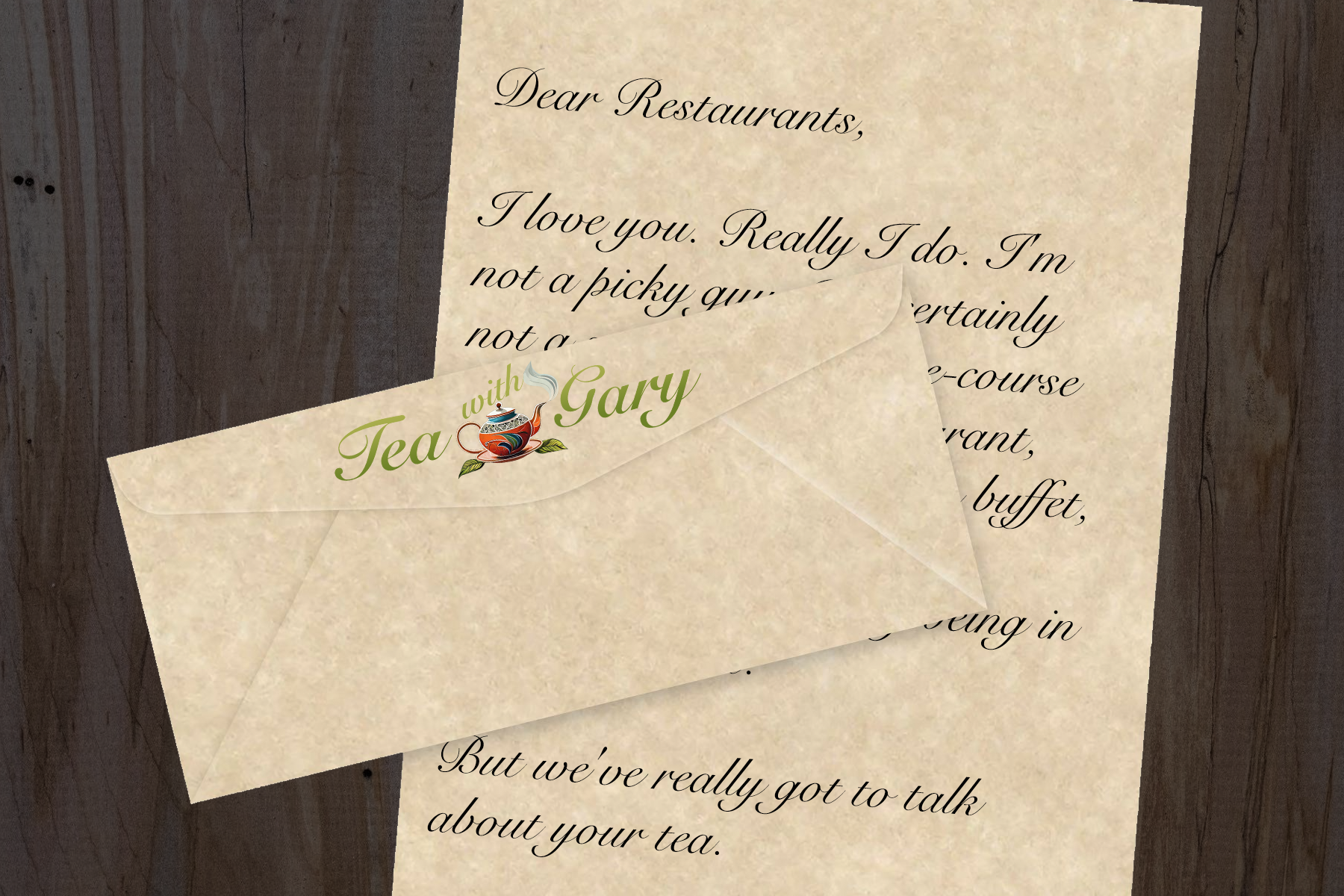
Dear Restaurants,
I love you. Really I do. I’m not a picky guy. I’m certainly not a snob. I love a five-course meal at a five-star restaurant, but I also must confess a fondness for a “Snag Burger” at the bar down the street from my shop. I love a good Indian buffet, a medium-rare steak, authentic London fish and chips, and an authentic Inverness haggis with neeps & tatties. Basically, if the chef cares about how the food tastes, I’m probably going to enjoy it. And if your servers care about serving the customers, I’m probably going to enjoy being in your restaurant. I love eating out.
But we’ve really got to talk about your tea.
To many people, having the right wine to go with their dinner transforms a good meal into a great one. Coffee drinkers will greatly appreciate fresh-brewed coffee, and beer aficionados will be greatly disappointed it you offer nothing but bland “megabrews” like Bud and Coors.
Those of us that love our tea feel exactly the same way. I’ve had some wonderful meals in restaurants and gone home disappointed because I got some bitter, oversteeped Lipton tea from a teabag instead of the restaurant putting in just a wee bit of effort and providing a good cup.
I’m not a tea Nazi, telling you and your other patrons the one and only way to make a proper cup of tea. Most of what I’m asking for is a proper selection and giving us the option to steep it as we wish.
#1: Tell us (or show us) the options!
First, if your restaurant is even half a notch above fast food, you have more than one type of tea, right? It may be powdered sweepings from the factory floor in a Lipton teabag, but you’ll have a black tea, a green tea, something without caffeine, and either Earl Grey or Moroccan Mint. If you don’t offer at least those four, you’d might as well hang a sign that says, “Tea Drinkers Not Welcome.”
So let’s start with that. When we order a cup of hot tea, either ask what kind we want, or present us with a basket or box containing a selection to choose from. Don’t just bring out a cup of black tea and then let us find out later that you had other options.
#2: Hot water. Really hot water.
Next, don’t grab the water until you’re on the way to the table. If we’re ordering black tea (and that includes Earl Grey), then we want that water boiling, or darned close to it
If we’re drinking tea that requires cooler water, such as a green or white tea, then we’d really prefer to get the boiling water and let it cool down ourselves. You can always cool water that’s too hot just by waiting, but you can’t heat water that’s too cold when you’re sitting at a table in a restaurant.
And now, a big no-no. Don’t ever ever put the tea leaves (or tea bag) in the water before you bring it to us (see below). The only exception to this rule is if you run a tea shop and your waitstaff plans to monitor the entire steeping process for us, in which case you’ll be controlling the steep time as well.
#3: The tea meets the water at the table.
There are several reasons for this.
First, most serious tea drinkers have their own opinions on how long their tea should be steeped. I typically short-steep my black teas and drink them straight. My friend Angela steeps hers long and strong and adds milk. There’s no way to prepare a cup of tea that will make both of us happy. You have to let us do it ourselves.
That said, if you start the tea steeping in the kitchen, we have no idea how long the leaves have been in the water when it gets to our table. A glass carafe helps that, but if we don’t know the particular brand and style of tea you’re serving, it’s really hard to judge by the color.
Additionally, not all tea takes the same water temperature. If I’m drinking black tea, I’ll pour in that boiling water the second it gets to me. If I’m drinking green or white tea, I’m going to let the water cool a bit first. Boiling water makes green tea bitter.
#4: Give us something to do with used leaves or teabags.
Once our tea is steeped to our liking, we’re going to want to remove the leaves from the water or pour the water off of the leaves.
I’ve been in many restaurants that give me a cup of water and a teabag, but no saucer to put the bag on when I’m done steeping it. I really don’t want a soggy teabag on my dinner plate, and you probably don’t want it on the tablecloth or place mat. Even the nice places that bring me a pot of water with a strainer full of leaves and a cozy to keep the pot warm sometimes don’t provide a place to put that strainer. Oh, and this reminds me of rule five:
#5: Don’t just dump leaves loose in a pot with a spout strainer unless it’s a single-serving pot.
It’s frustrating to pour off a cup of tea and know that by the time I’m ready for the second cup, it will be oversteeped and nasty and there’s not a thing I can do about it.
#6: Don’t add anything to the tea.
It’s fine to ask if we want sweetener or milk or lemon, but for goodness sake don’t add it without asking. We’re all different, but for me and a lot of other Americans, serving me a cup of good tea with milk in it is like serving me a good steak with ketchup on it. See the theme here? Give us options instead of deciding for us.
#7: If you serve iced tea, brew it.
Iced tea is incredibly easy to make fresh (sweet tea can be another issue), so please don’t use the powdered stuff! Just brew a pitcher of tea, pour it over ice, and voilà! Real iced tea. And please, oh please, don’t pre-sweeten it or throw a lemon slice in it. Give us some sweetener options and serve the lemon on the side.
Those seven rules will cover the basics. All but the real tea snobs can make something acceptable to drink if you have a few choices (which need to include unflavored options—don’t give us only Earl Grey, mint, fruity stuff, and herbal stuff) and serve it properly. But if you’d like to upgrade the experience and really make us tea drinkers feel welcome, here are a few bonus tips:
BONUS TIP #1: Loose-leaf tea makes a big difference to tea afficionados.
I know it’s a lot more work having to scoop a spoonful of leaves into an infuser than it is to toss a teabag in a cup. I get that. But to a tea drinker, it matters. It’s like getting fresh sliced peaches instead of peaches from a can, or fresh-baked bread instead of a slice from the grocery store.
BONUS TIP #2: Make sure all of your servers can answer rudimentary questions about your tea selection.
Everyone who works there should know which of your teas have caffeine and which don’t. They should know the difference between green and black tea (and know that Moroccan Mint is green and Earl Grey is black). They should know the teas from the tisanes (herbals), and they should know which ones are organic and/or fair trade.
If you serve loose-leaf tea, as opposed to bagged dust, give the staff a bit more information, like origin and style. You want your server to be able to tell a customer whether that red wine is a Merlot or Zinfandel and whether it’s from Bordeaux or Napa Valley. Why shouldn’t they be able to say whether the black tea is a Darjeeling, a Ceylon, or a Keemun?
BONUS TIP #3: Give us a couple of upgraded options.
Offering a oolong, a white tea, or a pu-erh makes me feel like you really want me to enjoy the experience. I don’t even mind paying more for a Bai Hao or a Silver Needle. It’s like offering some really nice wines in addition to the everyday wines; or offering craft beer in addition to Bud Light. That tea can make a good meal a really memorable one.
Attitude is everything in the service industry. If you and your staff are proud of the food you serve, it shows. Steak lovers look for restaurants that take pride in their steaks. Tea lovers look for restaurants that take pride in their tea. Most of the time, we’re lucky to find a restaurant that will even put a bit of effort into their tea, much less take pride in it.
If you aren’t a tea expert, find one and ask for advice. Show that you’re trying, and that you take as much pride in your drinks as you do in your food. We will notice. You will turn us into regular customers. We’ll be happy and you’ll be happy. We all win.
While writing this, I was drinking Jasmine King, a jasmine silver needle white tea. The touch of woodiness in the tea blended beautifully with the heavenly aroma of the jasmine. I don’t drink a lot of white tea, but I’m getting hooked on this one.

World Tea Expo 2024

When I was running my tea shop, Phoenix Pearl Tea, I looked forward to World Tea Expo (WTE) each year. It was a place to connect with vendors, network with my blogger buddies, learn about all that was new in the world of tea, and gather fresh material for Tea with Gary. I wrote about the Tea Bloggers Roundtable in 2013, and the expo in 2014 and 2015. Then I got lazy and haven’t updated you with much about the show recently.
As some of you may know, my wife Kathy and I turned the management of the tea shop over to our daughter Gwen when I took over the Yellowstone Wildlife Sanctuary about six years ago. That left me little time for Tea with Gary. Gwen moved Phoenix Pearl to Great Falls, Montana and switched to an online-only model. She’s now partnered with a local coffee shop and shares space with them in downtown Great Falls.
Now that I’m semi-retired and no longer running YWS, I’m getting back to my sorely-neglected tea writing, working on a new tea book (more on that soon), and preparing to launch a tea-related podcast. And I’m heading back to World Tea Expo this month in Las Vegas with Gwen and Kathy!
I’ve watched a lot of changes in WTE over the years, including the variety of logos in the banner above (the purple one at the top is this year’s). They’ve partnered with other conferences, and WTE passes have gotten us into healthy beverage expos, coffee shop exhibits, and this year, bar and restaurant stuff.
I’m excited about getting back into it and seeing what’s new, but even more excited to reconnect with old friends that I haven’t seen in a while. Are you going? Let me know in the comments below. Maybe we can meet at the tea bar on the show floor!

Phong Sali 2011 Pu-erh from Laos
I first wrote this post in October of 2013. As I wrote back then, this was a pretty good sheng pu-erh, but it needed to be aged more. With much going on in life, I ended up putting it away in the back of the tea cabinet and forgetting about it. I pulled it out in 2019 or so and it was much better. It’s now 2024. The tea is 13 years old, and it’s excellent. I’ve been drinking infusions of it all day—as one can do with pu-erhs—and thoroughly enjoying it.
At World Tea Expo this year, I picked up a Laotian pu-erh (well, technically a “dark tea,” since it doesn’t come from Yunnan) from Kevin Gascoyne at Camellia Sinensis Tea House. I mentioned this in a blog post back in June, and said I’d be tasting it and writing about it “soon.” Well, since it’s a very young sheng (a.k.a. “raw”) pu-erh, I figured it wasn’t a big hurry, and “soon” ended up being October. Oh, well. Had to get all that Oktoberfest stuff out of the way first, I suppose.

Let me begin by explaining the label and the style of this tea.
That big “2011” on the label is the year that it was produced. Most pu-erh drinkers will tell you that a sheng pu-erh should be aged a minimum of five years before you drink it. I certainly won’t argue that the flavors improve and ripen as the tea ages, but in my humble opinion there’s nothing at all wrong with drinking a young sheng. I enjoyed the bit that I took off of this 357-gram beeng cha (pressed cake), but I’ll be saving most of it to drink as it matures. Will I be able to hang on another three years or more to drink the majority of it? That remains to be seen.
The words “Phong Sali” do not refer to the style of the tea, but to its origin. Phong Sali (or, more commonly, Phongsali) is the capital of Phongsali province in Laos. Technically, as I mentioned above, this tea style should be called by its generic name (“dark tea”) rather than its regional name (“pu-erh”), because it doesn’t come from the Yunnan province of China. Since the little town of Phongsali (population about 6,000) is only about 50 miles from Yunnan (which borders Phongsali province on the west and north), I think we can let that bit of terminology slide.
“Old tree” refers to the tea plants themselves. In most modern plantations, the tea is pruned to about waist height to make it easy to pick. In many older plantations, the tea has been allowed to grow into trees, which can reach heights of thirty feet or more. The particular tea trees from which this tea comes are over 100 years old.
Tasting the tea
Unwrapping the beeng cha provided my first close look at the tea. The leaves are quite large, and the cake is threaded with golden leaves that didn’t oxidize fully.

There is still enough moisture in the cake to make it fairly easy to flake off some tea from one edge. Shu pu-erh is often dried very hard, as it is “force fermented” so that it will be ready to drink earlier. Sheng pu-erh, on the other hand, needs a bit of moisture in it to continue fermenting over time. I decided to try it in a gaiwan rather than making a large cup, so that it would be easier to experiment with multiple infusions and smell/taste the tea as I went.
I used water just a bit cooler than boiling (water boils at 202°F at this altitude, and I used 195°F water for this tea), and roughly 7 or 8 grams of tea. Unscientific, I know, but I didn’t measure it. I steeped the tea for just a minute the first time, and got a delicate but flavorful cup of tea. The flavor is similar to a characteristic Chinese green tea (think dragonwell), but more woody and with a bit of spice.
The picture on the right shows the leaves, uncurled after the first steeping. They are large, supple, and fragrant.
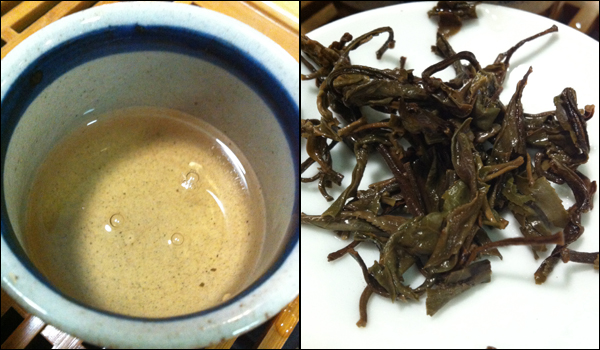
That one-minute steep wasn’t really enough to hydrate the leaves, so I went for a second steep at 1:30 (pictured at left above). Much more flavor, but still extremely delicate compared to a fully-aged sheng pu-erh. I enjoyed a third and fourth steep, which had only minor changes in flavor, but was interrupted before I had a chance to keep going and see how it stood up to eight or ten steeps. An experiment for a quieter day, I suppose.
This tea is definitely worth enjoying a bit early, and I will definitely be coming back to it. Again, we’ll see how much survives to full maturity. I’m not very good at waiting!

Quick and Easy Peppermint Matcha Fudge

When I had a tea shop, I used to do tea tasting/classes on Saturday afternoons. One was about mint. We examined peppermint, spearmint, and wintergreen, and then tasted a variety of teas and tisanes that we blend with the various mint leaves and extracts.
My wife, Kathy, decided that since it was a couple of days before Christmas, we should have a special treat. We’ve done a fair amount of cooking with tea, especially matcha (you can browse through some of the recipes here), and we have a brand-new peppermint matcha at the shop, so she decided to do a quick and easy matcha fudge.
It’s a white chocolate bakeless recipe; Kathy calls it “cheater” fudge.
Ingredients
- 16 oz white chocolate
- 1 ten-oz (300 ml) can of sweetened condensed milk
- A pinch of salt
- 2 tsp unsweetened matcha (we used the Maghreb Mint from Phoenix Pearl)
- 1/2 cup of chopped unsalted almonds
Process
- Combine the white chocolate and condensed milk in a double boiler over simmering water (a microwave works too). Stir regularly and make sure everything is completely melted.
- Stir in the matcha and pinch of salt. Blend it very thoroughly and make sure there are no little patches of dry matcha powder left.
- Once it’s completely smooth, pour into a greased 8×8 inch baking dish.
- Sprinkle the nuts over the top, and press them down gently to make sure they’re well attached.
- Chill overnight in the fridge, (at least three hours) and then cut into small pieces (about 1″ to 1-1/2″ square)
You can use this same process with other flavored matcha, although you probably won’t want to use sweet matchas designed for lattes.

Curing your mate gourd

If my article about yerba mate inspired you to try the traditional South American method of drinking yerba mate, you’ll need to get yourself a mate gourd.
As a reminder, it’s pronounced MAH-tay, it’s spelled “mate” in Spanish, and often spelled “maté” in English as a hypercorrection to differentiate it from the English word “mate.”
You can find mate gourds in many tea shops and just about any place that sells loose-leaf yerba mate. There are zillions of online sources as well, but if you like being able to see the actual gourd you’ll be buying, you’ll probably end up in a brick-and-mortar shop.

Once you get the gourd home, don’t just start drinking from it. Before using your new gourd for the first time, you’ll need to cure it to assure the best flavor and longest gourd life. Here’s the process:
- Put a couple of tablespoons of dry yerba mate leaf in your gourd.
- Fill it all the way to the top with hot water, but NOT boiling water! Boiling water can crack your gourd.
- Let it sit for 24 hours, and then dump out the liquid and the leaves. Don’t drink it. It will taste horrible.
- Thoroughly rinse the inside of the gourd with hot water.
- Gently scrape the inside of the gourd with a spoon. Don’t use a knife. Be careful scraping around the stem at the bottom; if you take out the stem, your gourd will leak.
- Dry the gourd completely. Set it upside down on a drying rack or prop it up where air can circulate and moisture can drip out.
Congratulations! Your gourd is now ready to use.
You only have to go through this curing process once, but you’ll want to make sure to rinse and dry completely after each use or you risk growing mold inside it. Don’t use soap! It can soak into the porous surfaces of the gourd and ruin the flavor of the mate next time you use it. A good rinse with warm water will do the trick.
Over time, the inside of your gourd will become stained, taking on the green color of the mate leaf. Don’t worry about it. That’s just a sign of a well-seasoned gourd.
 Tea With Gary