Blog Archives
Spicing up couscous
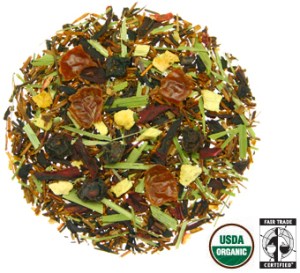
Jamaica Red Rooibos, courtesy of Rishi Tea
I have played around quite a bit with tea as a flavoring for vegetables, rice, fish, and other dishes. A few months ago, I was trying to decide on a good tea combo for adding some extra flavor to couscous. Most of the time, I use actual tea (made from the Camellia sinensis plant). Late one evening, however, when I was enjoying a cup of rooibos — a.k.a. African red bush — it occurred to me that it might make a great ingredient as well.
Straight rooibos wasn’t quite the flavor I was looking for, but one of the more popular blends at our tea bar seemed like just the ticket: Jamaica Red Rooibos from Rishi Tea.
The tea is named for the Jamaica flower, which is one of the nicknames for a variety of hibiscus (Hibiscus sabdariffa) commonly used in tea. Rishi’s blend is complex. In addition to the rooibos and hibiscus flowers, it also contains lemongrass, schizandra berries, rosehips, licorice root, orange peel, passion fruit flavor, essential oils of orange and tangerine, mango flavor, and essential clove oil.
After a bit of monkeying around, I settled on a very simple recipe:
- Following the instructions with your particular couscous, bring enough water for four servings to a boil, and remove from heat.
- Add 2-3 tablespoons of Jamaica Red Rooibos and steep for seven minutes.
- Remove the leaves. I used a disposable tea filter. You could just as easily dump the leaves in the water and pour through a strainer.
- Bring the water back to a boil and add the couscous.
- Continue as you would for unflavored couscous.
For a little bit of extra texture, try adding a few tablespoons of chopped walnuts.
You can buy this tea from a variety of sources, including (of course) our own tea bar.
UPDATE May 2012: The Tea Bar’s website is now up and running, and you can order Jamaica Red Rooibos here.
Copywriters and tea marketing experts

These days, you can’t be too careful what you say on a tea website. Last year, Unilever was warned by the FDA for claims they made about “Lipton Green Tea 100% Natural, Naturally Decaffeinated.” A week later, they warned Dr. Pepper Snapple Group about claims they made concerning “Canada Dry Sparkling Green Tea Ginger Ale.” Earlier this year, the FDA’s target was Diaspora Tea & Herb (d.b.a. Rishi Tea) for a wide variety of health claims on Rishi Tea’s website.
Given these warning shots fired across the bows of the big boys, the whole industry is being careful about making nutritional claims for tea. But we still need to say more about tea than just “this stuff tastes really, really good” — although that’s generally good enough for me.
For an example of how far companies are going these days, we got a promotional mailer today from Numi Tea. They are a fine company, and I’d be happy to resell some of their products in our tea bar. The mailer has some traditional marketing language (with appropriate footnotes, of course), just as I’d probably write myself:
“[Pu-erh]’s unique fermentation process results in more antioxidants than most green teas and is traditionally known to help weight management*, improve digestion and naturally boost energy.”
Well, I hope I wouldn’t write it exactly like that, but given a bit of tweaking to the grammar and punctuation, it’s a reasonable sentence.
The first claim is footnoted “*Along with a healthy diet and exercise.” Okay. I’ll buy that. Given enough healthy diet and exercise, lots of things help with weight management. The other two claims are very difficult to measure and/or prove. Vague claims typically don’t draw the ire of the FDA, so they’re probably safe.
But it was the next section that made me chuckle. It says, and I quote:
“Every blend is freshly brewed, made with full-leaf tea and uses 100% real ingredients for a pure Pu-erh tea taste.”
Wow! It uses 100% REAL INGREDIENTS! Is that the best they could do? Really? Can you imagine the certification process for that? “Is this an ingredient? Yep!” I carry 100 different teas in my tea bar, and I can guarantee you that every single one of them carries 100% real ingredients. Yep. Not an unreal ingredient in the bunch.
I did a bit of further looking, and found that the front cover of their mailer says, “Real ingredients. 100%. Nothing else.” There’s a whole section of their website called “100% real ingredients.” There’s a paragraph on that page of their site that says:
“For a pure, authentic taste, we blend premium organic teas and herbs with only real fruits, flowers and spices. We never use ‘natural’ flavorings or fragrances like other teas do.”
I’m pleased to hear that they only use “real” ingredients, and not “natural” ones like everyone else. Come on, Numi. You make some absolutely fantastic teas, and your organic and fair-trade programs are excellent. I’d like to see you spend more time talking about that — which really does differentiate your products — and less time talking about being “real,” which means absolutely nothing.
Twinings changes their Earl Grey. Stop the presses. Or don’t.
 The tea world is all a-twitter because British tea giant Twinings has changed the formulation of their Earl Grey tea after over a century and a half. This is being likened to the “New Coke” fiasco. It’s difficult to address a subject like this without puns, so let me get this out of the way and call it a tempest in a teapot.
When it comes to Earl Grey tea, we are swimming in a sea of alternatives. Every tea company has their own twist on the blend, and the only things they have in common are black tea and bergamot. In fact, even the black tea part is optional these days. You can get Earl Grey made from Chinese tea, Indian tea, Ceylon tea, or Kenya tea. You can even get white Earl Grey, green Earl Grey, red Earl Grey (which is made with rooibos rather than tea), or Mr. Excellent’s Post-Apocalyptic Earl Grey. The amount of bergamot can vary from just a hint to enough to knock your socks off. You can get your Earl Grey with lavender or dozens of other additives.
I am most amused by the Earl Grey variants that they call “citrus” Earl Grey. Hey, guys, all Earl Grey is citrus. That’s what bergamot is. It’s a variety of orange.

The bergamot orange.
We’ve done some experimentation in our tea bar. Since Earl Grey tea is hugely popular — one of my personal favorites, in fact — we started out with four Earl Greys: an Ancient Tree Earl Grey, Empire’s Earl Grey Supreme, a rooibos Earl Grey for the caffeine-free crowd, and our own lavender Earl Grey blend we call The Countess (here’s why we don’t call it Lady Grey). Yes, we know that’s not what’s in Twinings’ Lady Grey. We don’t care.
We knew those last two were going to be specialty drinks. The purists wouldn’t be interested in either one. The first two would be a horse race for popularity.
Rishi’s offering is my personal favorite. It’s a very straightforward Earl Grey made from organic fair-trade Yunnan Dian Hong. The Earl Grey Supreme from Empire Tea includes quite a bit more bergamot and some other citrus as well. The horse race became a runaway. Rishi’s Ancient Tree Earl Grey is the most popular tea at the tea bar (judging by ounces sold), outselling the high-bergamot Supreme by a four-to-one margin. If I were the type to draw conclusions based on a single data point, I’d say that adding more bergamot to Earl Grey isn’t a good thing.
That, however, is exactly what Twinings just did (and a touch of lemon, too).
This isn’t really going to affect me. They may have been first out of the gate with Earl Grey, but theirs has never been my favorite formulation. I think it will be a good thing for the tea business, though, as it will drive the old-line Twinings Earl Grey purists to get out and experiment a bit. We’ll see where it goes.
Update: 7 September 2011
That didn’t take long. Andrew Brown at the Telegraph blogged (actually before my post came out, so I suppose my research was inadequate) that Twinings has released “Earl Grey: The Classic Edition” to satisfy discontented fans. It’s an interesting post. The thing I find most interesting is the biography line at the top, which says, “Andrew M Brown is a writer with an interest in mental health and the influence of addiction on culture.” Good qualifications for someone writing about tea, eh?
How important is the word “organic”?

About 40% of the teas we offer at our tea bar are certified organic. Generally speaking, those teas run about 50% higher in price than the non-organic alternatives. In most cases, however, they outsell their non-organic counterparts by a fairly healthy margin. In tough economic times, that says something. But what does it say?
UPDATE 2017: The price difference between organic and non-organic teas is a lot smaller now. There are also a lot of alternatives to USDA organic programs, like the ones I wrote about in 2015.
Let’s say you were to prepare two cups of tea, processed identically, with tea grown in neighboring plantations. Identical weather and soil, but one organic and the other not. Would you be able to tell those two cups of tea apart? I doubt that I would. Yet as I write this I’m drinking a cup of USDA Organic Earl Grey tea, for which I paid quite a bit more than the “brand X” earl grey that I could have prepared instead. Why? Because I like it better. But the real question is why I started drinking that particular earl grey in the first place.
To me, the “organic” label doesn’t necessarily mean you have a better product. Conversely, lack of organic certification doesn’t mean there’s anything wrong with it. But when I’m looking at new tea for home or the tea bar, I look for the “USDA Organic” logo because it means somebody went to a lot of effort to get that certification. They cared enough to wade through the mounds of required paperwork and certify the origins of every ingredient. That’s a lot of work, and it means they take pride in their product.
On the front page of the current issue of our local paper, The Carbon County News, there’s an extensive interview with Bonnie Martinell, one of the owners of the On-Thyme Gourmet, the farm that grows the sage and apple mint tea we sell. They quoted her as saying:
“We were certified organic but the process became so burdensome. We tried to keep up with the forms but they are about five inches deep to start with and they keep coming back for changes with another five inches. You can’t function with all the paperwork.”
I’ve heard the same thing from other farmers and ranchers in this area. When I had my ranch, I couldn’t certify my cattle as organic because they had grazed for six months on BLM land, where I had no control over what they might have eaten.
If there’s an organic tea that I like, which sells well in my tea bar, I’m not going to stop selling it if it suddenly becomes non-certified. To me, it’s still the same product. I consider the “Certified Organic” label to be a shopping aid, not a label requirement. It guides me to producers who care enough to put extra effort into their product. I think it helps me to find good tea.
What about the price issue? Well, most tea is pretty inexpensive. The majority of our organic loose-leaf teas sell for $3.00/ounce or less. Even a big 16-ounce mug like the one I use at home only needs 7 grams of tea, which means about four cups per ounce. I generally use my leaves twice, which doubles the yield to eight cups per ounce. That’s 38 cents per cup for the organic tea, versus about 25 cents for a non-organic equivalent. About a dime a cup difference. I’d have to drink a lot of tea before a dime a cup would break my budget!
And in the tea bar, I charge the same price for a cup of just about every tea in the store (we do charge more for some specialties, like boba and chai), so as a consumer, you’d pay the same for the organic as you would for the non-organic.
My conclusion: argue all day long about what “organic” really means, but I don’t think it matters. When I’m buying unfamiliar tea, I’m going to look for that label!
 Tea With Gary