Category Archives: Thoughts

Tall Montanan is Tall?
I was perusing a post from a fellow tea blogger about World Tea Expo 2013 … well, perhaps I shouldn’t call it a “post.” It’s more of an essay. Or perhaps a minor tome. If you bound it in creepy leather and added a few paragraphs about demons, you could even call it a small grimoire. But I digress…
Ahem. Anyway. Geoffrey F. Norman (a.k.a. “the Lazy Literatus“) wrote about his experiences at the expo and featured a little snippet about me in which he mentioned one of my blends: Mr. Excellent’s Post-Apocalyptic Earl Grey tea. I mention this for four reasons:
1) He posted this picture of us with the caption, “Tall Montanan is Tall.”
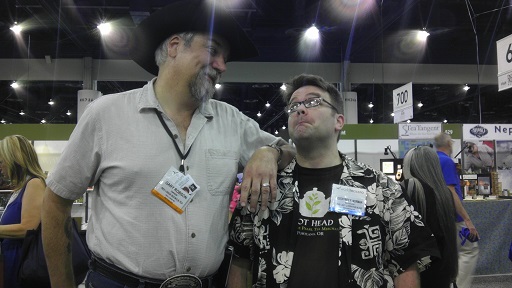
Photo courtesy of Geoffrey F. Norman.
Copyright Geoffrey F. Norman 2013.
2) It’s a good blog post. If you’re interested in tea and/or World Tea Expo, I recommend giving it a look.
3) It reminded me that I promised to send him a sample of Mr. Excellent’s Post-Apocalyptic Earl Grey and forgot in all the hubbub. Sorry, Geoffrey. I’ll get that on its way ASAP.
4) And, last but not least, he’s a perfect example of not blogging on a schedule!

If I learn just one new thing…

Back in my days in the software industry, I used to put on a lot of educational seminars. One day, I was teaching an all-day session and noticed one of my customers, a gentleman by the name of Ken Combs, sitting about fifteen rows back in the audience. At the first break, I went over to him and said, “What are you doing here, Ken? You could be teaching this seminar!” I absolutely loved his response: “I figure if I can learn one new thing, then the whole day is worth it.”
Before using this insightful little anecdote to segue into the subject of this blog, I have to tell a little tale of that seminar. It was, as I said, an all-day seminar. I’m pretty good at projecting my voice, and when I’m dealing with small groups, I usually eschew microphones. This particular day, however, I had an audience of about 120 people and we were in a hotel ballroom with dubious acoustics, so I had a sound system. Like most hotel ballrooms, this one had accordion-style dividers that could separate it into smaller rooms, and we were using about a third of the room.
The morning session went well, but the afternoon became Public Speaker Nightmare #23™: there was a wedding reception in the other part of the ballroom. They had a live DJ. He had a much more powerful sound system than I did. After about an hour with my sound system cranked up all the way, shouting into the microphone, I called a quick break and strolled over to the reception, where I asked the DJ if he’d mind taking the volume down a bit because he was making my job impossible. “Not my problem, dude,” he said as he cranked his volume up higher.
We tried everything. We appealed to the bride. We called the hotel’s booking desk. We tried to find the weekend manager. And throughout it all, I shouted my voice raw trying to be heard in the back of the room. I couldn’t talk for two days after that (I’m not sure whether my wife wrote a thank you note to the bride for that or not), and we did end up getting a portion of our rent for the room refunded, but it made for one miserable seminar.
Despite all of that, Ken learned his one new thing and I applied his philosophy from my side of the lectern and got much more careful about room bookings for future events. Remember I promised to bring this back to tea? Well, fast forward twenty years or so, and here I am at the World Tea Expo. I still try to follow Ken’s philosophy, and it serves me well.
I attended two good educational sessions yesterday, which I’ll probably be writing more about: “Le Nez du Thé” (the nose of tea) and a tea blending workshop. I certainly learned more than one thing in each. After the exhibit hall closed, I went to the Tea Bloggers Roundtable. Mostly, I went for networking purposes, to meet some of these people I know only through their blog posts and tweets. It was a wonderful networking event, but even without that I learned something.
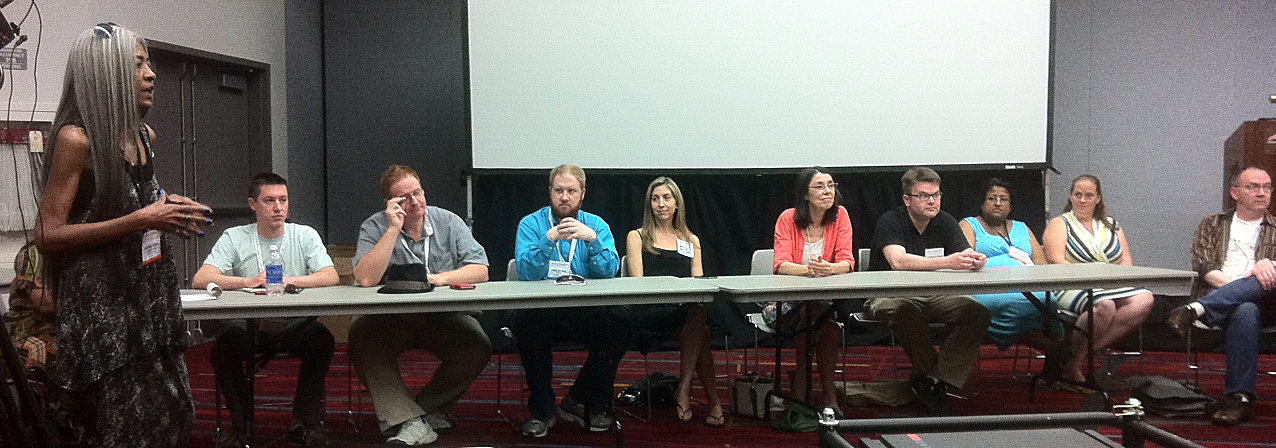
Yes, there was a bit of the mutual admiration society going on there, and the interplay was fun to watch (Godden and Coffey should take their show on the road), but it was also a very worthwhile session. There were more bloggers in the audience — including yours truly, of course — and the format was flexible enough that the distinction between panelist and audience member blurred. As everyone talked and questions were asked (and sometimes answered), it became clear that no two bloggers in the room really had the same objectives. For all of us, the blog is a representation of our personality enveloping the world of tea. Some of the blogs consist almost entirely of tasting notes (e.g., Nicole Schwartz’s “AmazonV” blog) and some have no tasting notes at all. We talked about tea, but mostly about the art of blogging, the expectations of our readers, and the trials and tribulations of trying to keep up any kind of a schedule for blog posts. I hope there’s another blogging event like this one again very soon!
Tasseomancy
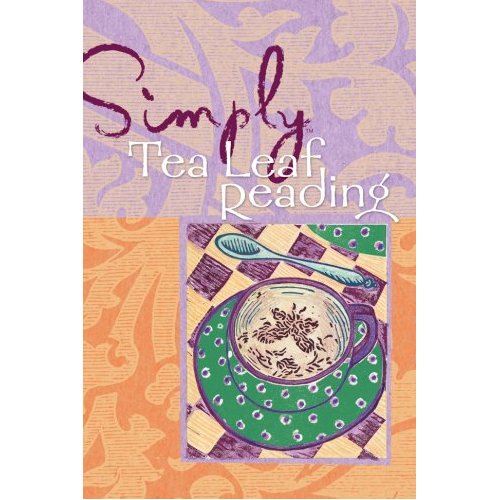
While perusing the Tea Guy Speaks blog, I came across an entry from last May about reading tea leaves (a.k.a. tasseomancy or tasseography). William does a great job of presenting a bunch of books about fortunetelling with tea leaves without really stating how he feels about tasseomancy. He doesn’t judge.
Well, I suppose somebody has to be the judgmental one, so I humbly volunteer my services.
For those unfamiliar with the practice, tasseomancy is the “art” of telling people’s fortunes by analyzing the positions of leftover leaves in a teacup. It is related to tea drinking in the same sense that astrology is related to astronomy. The former two involve Camellia sinensis leaves, and the latter two involve stars and planets. There, the resemblance ends.
Tea drinking certainly isn’t a hard science like astronomy is, but there’s a lot of science involved in proper analysis of the health benefits of tea, development and maintenance of new strains and varietals, developing repeatable and scalable production and farming techniques, and much more. Tea leaf reading, on the other hand, is an arbitrary assignment of meaning to the arbitrary positions of leaves in a cup, cultivated and developed into a complex fraud.
Yep, I used the word “fraud.” I went there. Performing tasseomancy can be a harmless party trick, or it can be a way of extracting cash from credulous people.
If someone accepts money for reading your fortune in tea leaves, they had might as well be stealing it. If five different fortunetellers read your leaves, they’ll get five different results. Heck, if the same one reads your leaves five times, they will get five different results. There’s no scientific basis for tasseomancy. I’ve never been able to find a study where a tasseomancer’s results were compiled and checked for accuracy.
I sell tea-related books in my bookstore/tea bar, but books on tea leaf reading are conspicuously absent. I’ll order one for anyone who asks, but I really don’t want to imply any kind of endorsement of the practice to my customers.
Please don’t misconstrue this as a complaint or condemnation of William’s blog post. I love his blog. Knowledge is power, and I believe in making information available to people. I also believe, however, in exposing scam artists, and that’s what people who perpetuate reading tea leaves for profit are.
Whole Leaf Tea
 I try not to be a tea snob (or a Tea Nazi). You drink what you like and I’ll drink what I like. But being a part of the tea industry means I hear from a lot of people with — shall we say — very strong opinions. One thing we all seem to agree on is that we really prefer loose leaf tea to teabags. But why is that?
There’s a quality difference, perceived if not always actual. Ask a tea snob about Lipton tea and they’ll tell you those teabags are filled with the floor sweepings left over after all of the good stuff was packed up. There’s a hint of truth to it: the tea isn’t swept up from the floor, but it’s often fannings or dust. There’s a good reason for that, too. By breaking those tea leaves into tiny pieces, the water has much more surface area to interact with. That’s why teabags often produce a heartier, stronger, and more “brisk” cup of tea.
You can get larger leaf teas in bags, though, and the “pyramid” or “sachet” bags allow much more flow of the water through the leaves. Still, argue many in the business, the highest grades of tea are typically reserved for sale as bulk loose leaf tea, and that gives us a better-tasting cup when we use loose leaf.
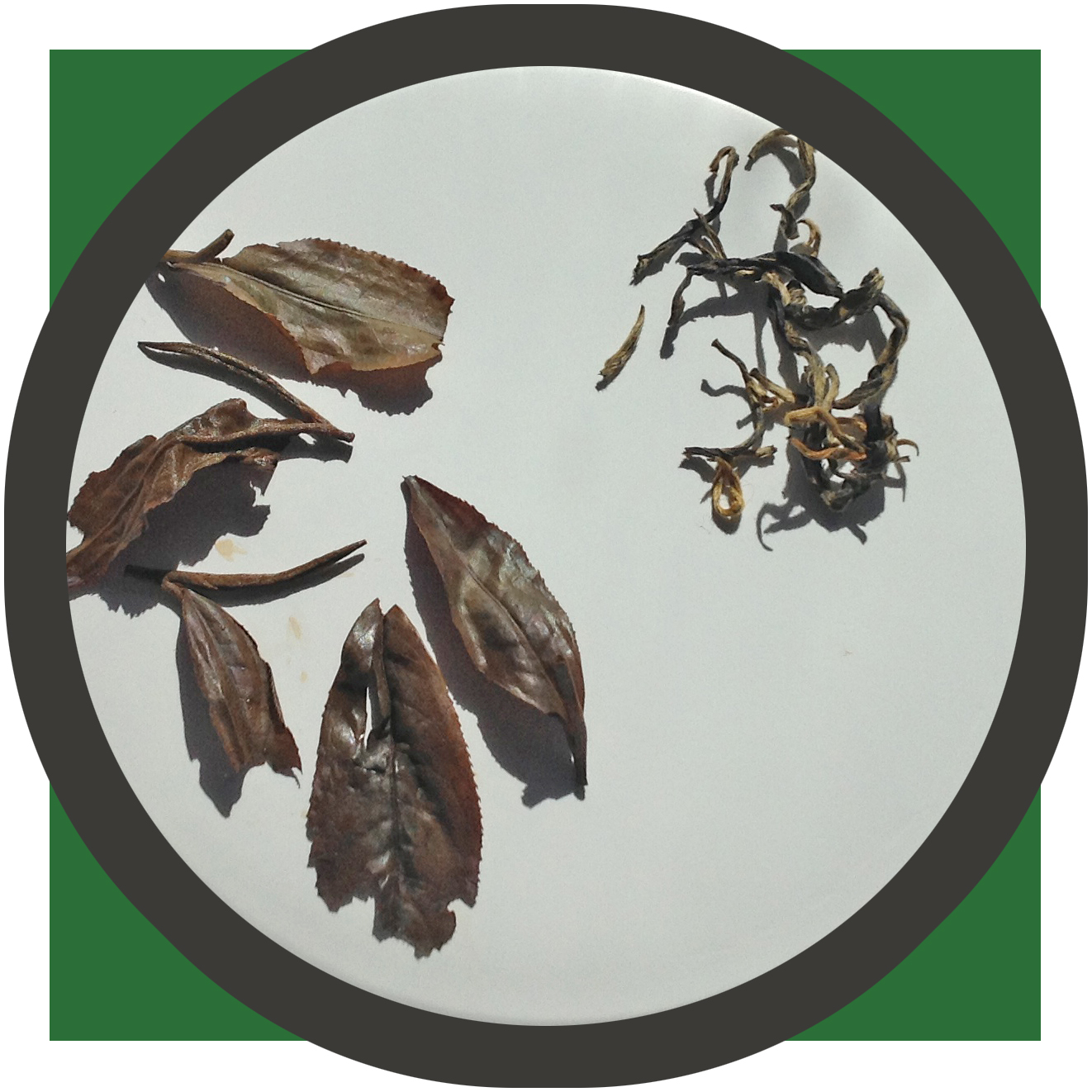
There’s another factor, though. One that’s as much based on aesthetics as taste. I like the whole leaf teas because I like the leaves themselves. The picture above shows dry and wet leaves from a whole leaf Royal Golden Safari, one of my favorite black teas. It’s a whole-leaf black tea from Kenya. After you’ve steeped it, you can see the leaves and buds fully unrolled. You can smell the leaf, feel the texture. You can see the size and shape of the leaf. Experiencing the leaves becomes a part of experiencing the cup of tea.
Wine drinkers enjoys more than just the taste of the wine. They’ll swirl the wine in the glass to bring out the nose, watch the legs as it runs down from the rim, examine the cork for hints of how the wine aged. The tea equivalent is watching the “agony of the leaf” as the tea leaves expand fully in the pot or infuser, holding the leaf and comparing its smell to the aroma of the brewed tea, and examining the leaves to glean what information you can about the origin and preparation of the tea.

What is “brisk”? The Lipton people say it means “astringent.” I might say it refers to a cool afternoon on the back deck watching tea leaves unfurl in hot water as I anticipate the luscious cup that I am soon to enjoy.
Book Review: 20,000 Secrets of Tea
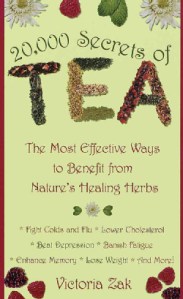
I read a lot about tea (what a surprise, eh?), and try to carry a decent selection of tea books in my bookstore. When somebody recommended the book 20,000 Secrets of Tea: The Most Effective Ways to Benefit from Nature’s Healing Herbs by Victoria Zak, I decided to give it a look. I confess I was put off by the subtitle, because it sounds more like a book of herbal medicine than a book about tea. Then I flipped the book over and took a look at the back cover. There I saw this:
“An Ancient Chinese Legend: Once there was a man who knew 100,000 healing properties of herbs. He taught his son 80,000 secrets. On his deathbed, he told his son to visit his grave in five years, and there he would find the other 20,000 secrets. When the son went to his father’s grave, he found, growing on the site, the tea shrub…”
Okay, that’s more promising. Especially this line in the next paragraph: “A simple cup of tea not only has the power to soothe and relax but to deliver healing herbal agents to the bloodstream more quickly than capsules, tinctures, or infusions.” That line indicates that they know the difference between tea and infusions/tisanes, and that this book is going to be about tea.
Oh, my, was I wrong.
Page one starts out with a description of the legend of the origin of tea. Chapter one continues on, repeating the story from the back cover and then providing some of the history of tea as a drink. Within five pages, it has transitioned to herbal infusions, and that’s pretty much the end of discussion of the tea plant (Camellia sinensis).
I flipped through the next 220 pages looking for more information about tea (after all, the next 20,000 secrets are all about the tea shrub, right?) and I all found was descriptions of various herbs along with multitudinous health claims about each (more on that in a moment).
I went to the index looking for tea. The index is 15 pages long, normally a good sign in a reference book. Under “tea” I found reference to pages 1-4, mentioned above. Under Camellia sinensis, nothing. Flipping through the alphabetical collection of herbs, tea isn’t even listed. I checked under “black tea” and found a two-page spread in the middle titled “Green, Oolong, Black: the legendary teas.”
Zak begins by repeating the origin legend from page 1, and then proceeds to talk about fermentation (none of those teas are fermented, although black and oolong are oxidized) and rates the three styles in order of “medicinal strength: (green, then oolong, then black). Nowhere does she mention white or pu-erh tea, and nowhere does she define what “medicinal strength” actually means. Obviously, when there’s so little information, it leads to gross overgeneralization. When you use up that little bit of space with statements like “Green tea’s polyphenols are powerful antioxidants are reputed to be two hundred times stronger than vitamin E. It has anticancer catekins (sic), which protect the cells from carcinogens, toxins, free radical damage, and help to keep radioactive strontium 90 out of the bones,” there’s no room left to describe the differences between tea styles, how to properly steep a cup, or any of the other subjects that I expected this whole book to be about.
Incidentally, none of those rather incredible health claims are footnoted, no studies are cited, and no backup data is provided.
All in all, this book is tailor-made for herbalists — especially those that don’t worry much about the scientific basis of their health claims — but pretty well useless for tea enthusiasts.
Traveling with tea
As we packed for the book signing tour and convention, my wife and I carefully plotted what to bring along. Obviously, some good loose-leaf tea was a part of the process. My choices were my own Scottish Breakfast blend for first thing in the morning, our house Earl Grey (one of the most popular selections at our tea bar) for the afternoon, and Rooibos for bedtime. We brought along an infuser to brew the tea.
At most of the motels and hotels, there was a microwave oven in the room where we could heat up our water. Some have the microwave in the lobby. Others provided only a coffeepot, which yields coffee-flavored hot water (I skipped having tea those days).
Then we got to Las Vegas, where we’re attending a convention at Bally’s. We got to the room, and there’s no way to heat water. No hotplate, no coffeepot, no microwave.
Note to self: Travel with a device that heats water.
Not a problem. I’ll just call housekeeping and have them bring something up. That’s where I hit the first snag. I was informed by housekeeping that only “Platinum Players” get coffeepots in their rooms. I explained that I’m here for book signings and a business conference (the NCRA annual convention), not to gamble, and she explained that “it’s the rules.”
I asked for a manager, and she transferred me. Someone at the front desk answered, I asked again for a manager, and I spent 25 minutes on hold listening to advertising for the hotel. Yes, twenty-five minutes! When I first asked for the manager, I was not upset. Amused, yes. Mildly annoyed, perhaps. But I figured this was a minor snag and I would be making tea in a few minutes. By the time I actually got the Bally’s manager on the phone, my patience was starting to wane.
I reasonably explained the situation to her, and she explained that there was 24-hour room service, so I have no need for a water-heating device. I explained that by the time hot water from the kitchen arrived in my room, it would be tepid water, which does not make good tea. She explained that only Platinum Players got coffee pots, and I’m not a Platinum Player.
I explained that I wasn’t there to gamble, and it was my understanding that Bally’s actually welcomed business conferences. She said, “oh, yes, we do welcome business conferences, and the members order from room service.”
I asked if I was the first person ever to request a way to make tea in my hotel room. She grudgingly acknowledged that others have asked as well. I asked if she had blown them off the same way she was blowing me off. She got a wee bit huffy.
Note to self: Avoid staying at Bally’s in the future.
In over 30 years of business travel, my experience has been that good hotels are eager to provide their guests with whatever they need. Did you forget a toothbrush? They’ll give you one. Does your shirt need ironed? They’ll bring you an iron. Did your shoes get scuffed? They will provide a shoe polishing kit. They want your experience to be positive.
Bally’s, on the other hand, wants you to get out of your room and blow money in their casino. If you insist on staying in the room, they want you to buy coffee from room service ($12 for a pot of French roast, delivered in 20-30 minutes). I’m not one of those Tea Absolutists who insists on only the finest first-flush Darjeeling steeped for precisely 90 seconds in 210-212 degree carbon-filtered water. But I don’t want a Lipton teabag from room service, and I don’t want tea made with tepid water that was boiling ten minutes ago.
At this point, it’s not so much about the tea — I am an adaptable kind of guy — but about the fact that the manager would not work with me when I asked nicely, or even when I pushed. She refused to acknowledge that every 2-bit motel in the country is willing to accommodate my request for a way to heat my water, but Bally’s is not.
She made it clear that keeping the guest happy is not a priority for this hotel. Hoovering money out of the guests’ pockets is. Welcome to Las Vegas.
 Tea With Gary