Category Archives: World Tea Expo

World Tea Expo 2024

When I was running my tea shop, Phoenix Pearl Tea, I looked forward to World Tea Expo (WTE) each year. It was a place to connect with vendors, network with my blogger buddies, learn about all that was new in the world of tea, and gather fresh material for Tea with Gary. I wrote about the Tea Bloggers Roundtable in 2013, and the expo in 2014 and 2015. Then I got lazy and haven’t updated you with much about the show recently.
As some of you may know, my wife Kathy and I turned the management of the tea shop over to our daughter Gwen when I took over the Yellowstone Wildlife Sanctuary about six years ago. That left me little time for Tea with Gary. Gwen moved Phoenix Pearl to Great Falls, Montana and switched to an online-only model. She’s now partnered with a local coffee shop and shares space with them in downtown Great Falls.
Now that I’m semi-retired and no longer running YWS, I’m getting back to my sorely-neglected tea writing, working on a new tea book (more on that soon), and preparing to launch a tea-related podcast. And I’m heading back to World Tea Expo this month in Las Vegas with Gwen and Kathy!
I’ve watched a lot of changes in WTE over the years, including the variety of logos in the banner above (the purple one at the top is this year’s). They’ve partnered with other conferences, and WTE passes have gotten us into healthy beverage expos, coffee shop exhibits, and this year, bar and restaurant stuff.
I’m excited about getting back into it and seeing what’s new, but even more excited to reconnect with old friends that I haven’t seen in a while. Are you going? Let me know in the comments below. Maybe we can meet at the tea bar on the show floor!

World Tea Expo 2015 – Day 1

Yesterday started out with the return of the bloggers to Tea Expo (it’s kind of like the return of the swallows to Capistrano, except noisier).

I was very pleased to find that The Tea Spot and Teas, Etc. were in the lobby to keep us all adequately caffeinated. I enjoyed cups of their tea before, during, and after the seminars. Interestingly, both companies had chocolate pu-erh blends, and both recommended steeping them for 4-5 minutes. That’s an awfully long time for a shu pu-erh. I went for 3 minutes, and quite liked both of them (sorry, purists).
My first seminar of the day was an absolutely fantastic start to Tea Expo: Jane Pettigrew and Bruce Richardson talked about “A Social History of Tea in the UK and USA.”

They walked us through the history of tea in the western hemisphere from the 1600s to modern times, covering everything from Catherine of Braganza to A&P (originally the Atlantic & Pacific Tea Company). A few of my favorite factoids from their seminar:
- “Monkey-picked oolong” isn’t picked by monkeys. That would be cost-prohibitive. It is just a term for the highest-grade oolong in the house.
- The “Queen’s closet” wasn’t a place to store clothes. It’s where she brewed tea and shared it with family & friends.
- “High Tea” isn’t the fancy thing many Americans think it is. It’s a casual family meal. The elegant tea you’re thinking of is “Afternoon Tea.”
- I’ve mentioned this one before, but there were no tea bricks dumped in Boston Harbor in in 1773. The Boston Tea Party tea was all loose-leaf — and quite a bit of it was green tea.

Every year I take another picture of this matcha stone at AOI. It just intrigues me. Last year I described it and even posted video of it, but I just can’t stay away from it.
One of the things I look for at Tea Expo every year is new and different tea. I do love the teas from the big tea-producing countries like China, India, and Kenya, but it’s fun to explore some of the varieties you don’t run into every day, from countries that aren’t represented in every single tea shop. We had a very pleasant tasting of Indonesian teas at three adjacent booths and found some great surprises.

The afternoon session “Amplifying Your Business Voice Through Tea Bloggers” was informative, even for tea bloggers. All of us look at things differently and run our blogs differently. I update this blog every Friday (most of the time, unless I’m late) with bursts of activity during events like World Tea Expo. Nicole Martin has been updating hers every weekday for the last six years. One of the blogs nominated for a World Tea Award this year hasn’t been updated since early 2014.
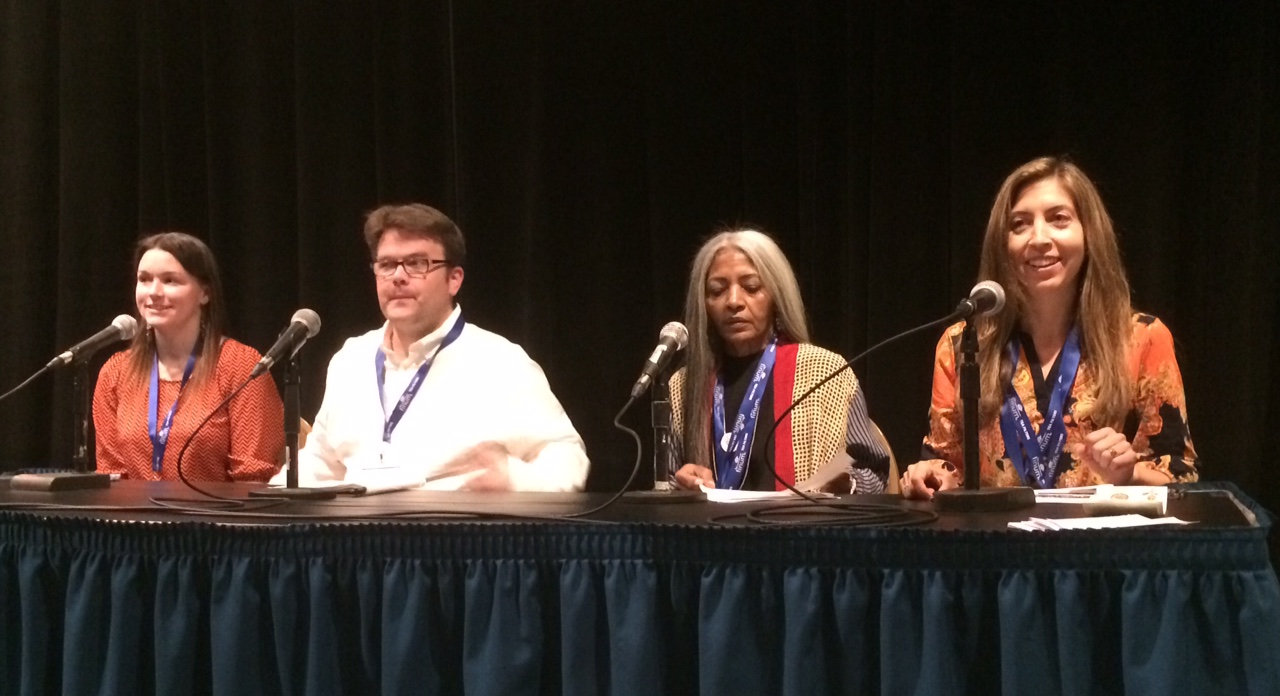
Some tea blogs are all about reviewing individual teas. Some are about teaware. Some are about stories. Mine is whatever happens to be either exciting me or annoying me at the moment. The big message from this session was, if you wish to work with tea bloggers, do your research first. Read the blogs. If you are selling flavored chamomile blends, don’t pick a tea blogger that’s a single-origin Camellia sinensis specialist. Geoff Norman told us that he didn’t know the difference between Yixing and Wedgewood, so don’t waste your time and money sending him a teapot to review!
Something else I’ll be writing about in more detail later is “Coffee leaf tea.”
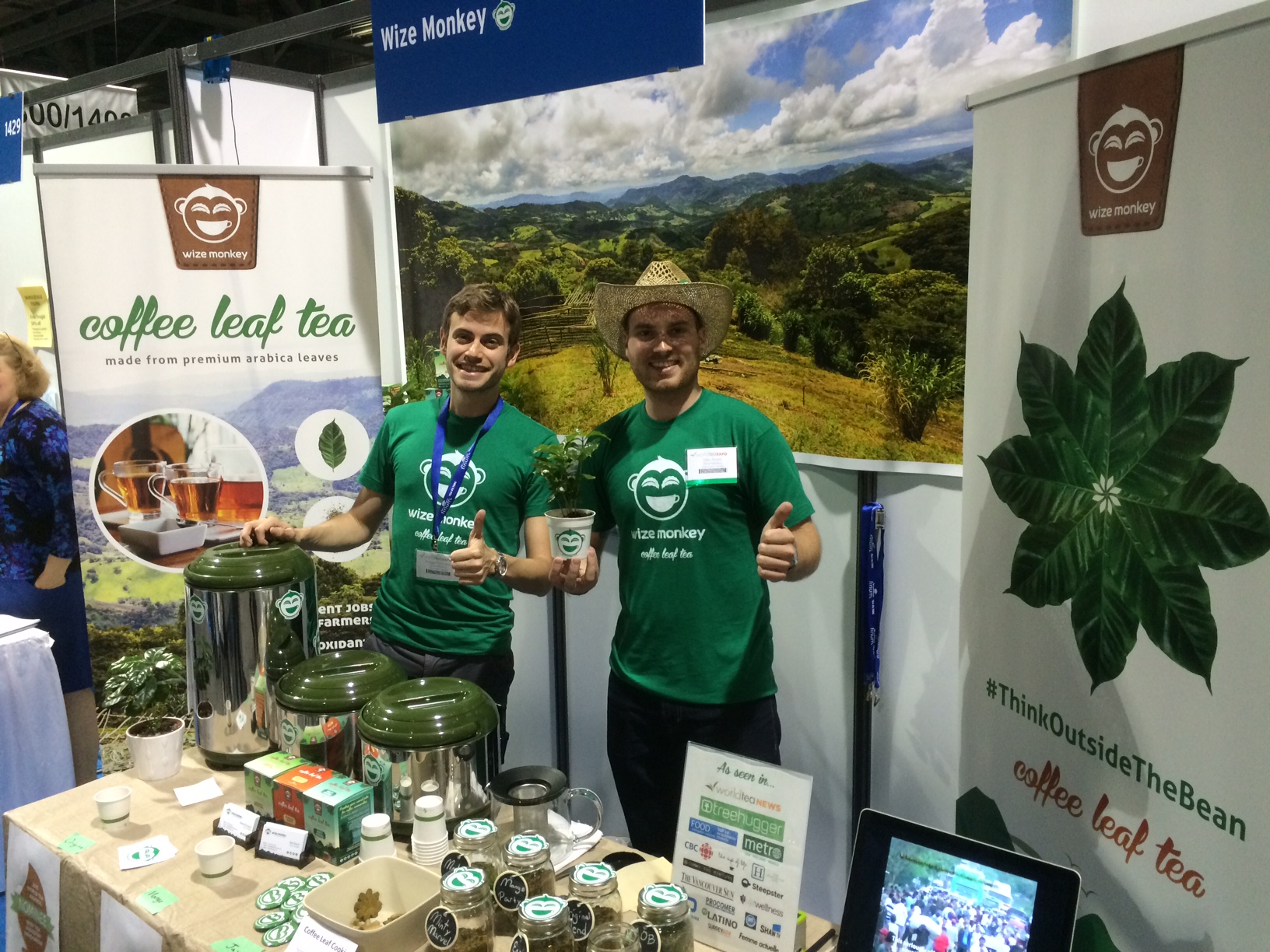
The name may be a bit confusing, as this product contains no coffee beans and no tea. It’s a tisane (“herbal tea”) made from the leaves of coffee plants. I can’t stand coffee, but I found the flavor of this drink quite pleasant. The company’s focus is on extending the season (picking leaves when you can’t pick beans) and creating more jobs, but there will be more on that in a future post.
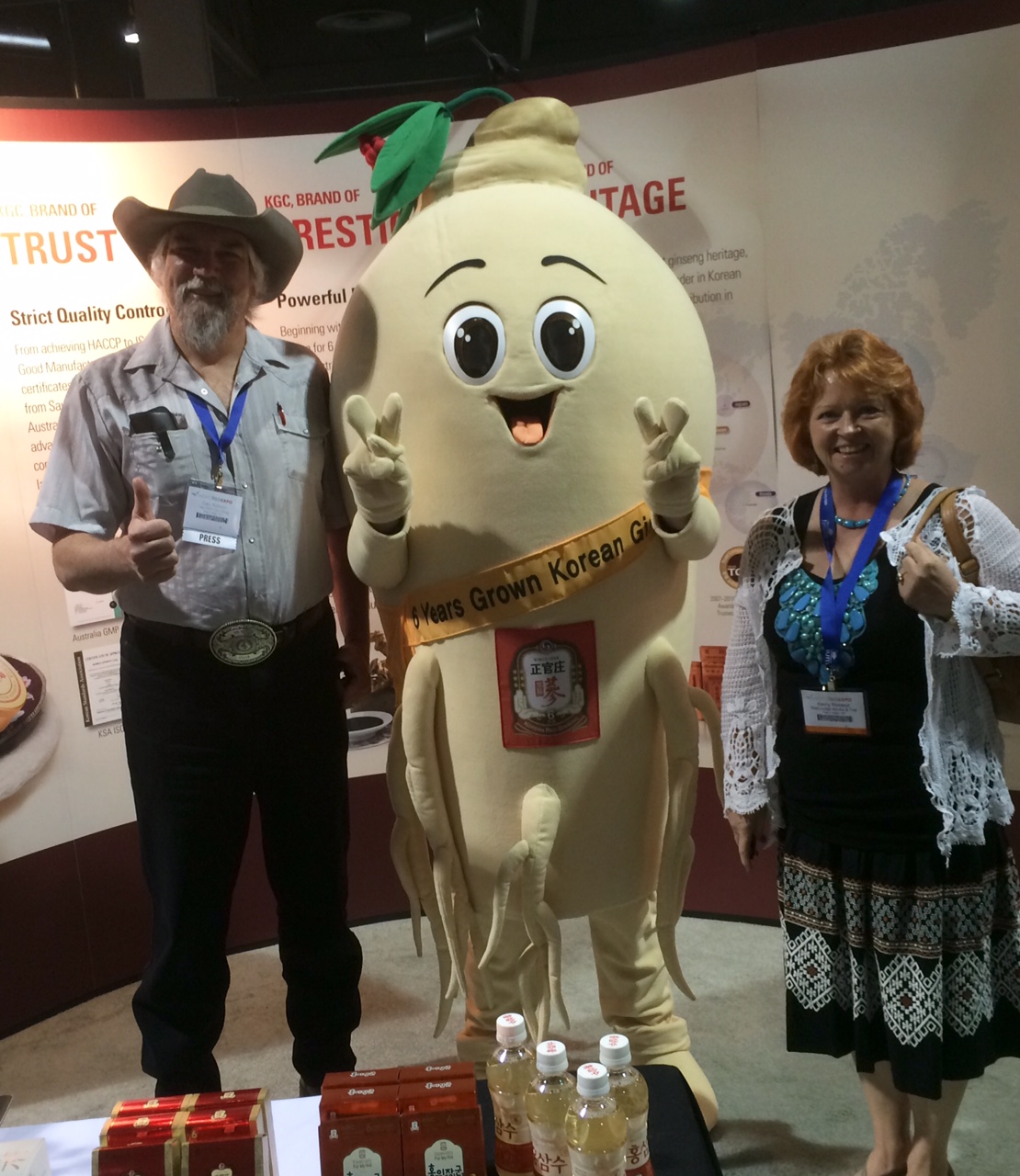
We all have our taste preferences, and mine tend to run towards pure (unflavored) tea. I’m not a big fan of ginger, either, but my wife, Kathy, and I couldn’t resist having our picture taken with this gigantic (and slightly creepy) Korean red ginseng root:
And, just as a close, my birthday is coming up and this automated pyramid satchel tea bagging machine is only $70,000. It would be an easy way to take some of my whole-leaf teas on the road with me. Hint, hint…

Tea Bloggers Roundtable 2015
Once again, World Tea Expo attendees will have an opportunity to share in the wacky (and occasionally educational) world of professional tea bloggers. You’re all invited to the Tea Bloggers Roundtable 2:30 to 3:30pm on Thursday, May 7. It will be a panel discussion featuring some of the names tea aficionados just might recognize.
The panel will consist of Rachel Carter (iHeart Teas), Chris Giddings (Tea Guy), Jo Johnson (A Gift of Tea), Nicole Martin (Tea for Me Please), Geoffrey Norman (Lazy Literatus), Jen Piccotti (An International Tea Moment), and Naomi Rosen (Joy’s Teaspoon). I’ll be moderating the panel, which has the theme this year of “Melding of Voices.” I know, all of those names are in that poster image right below this paragraph, but I wanted to include links to all of the blogs. Check us all out before the event!

One of the things I enjoy most about the world of tea blogging is the lack of competition. I don’t find myself thinking “oh, no, Geoff scooped me on that story,” or “how can I get more viewers than Robert (Lord Devotea’s Tea Spouts) this week?” Instead, we read each other’s posts; we talk about each other’s stories; we link to each other’s blogs; we gain inspiration from each other. We’re not in it to beat each other at the game. We’re in it to share our love of tea and each be the best we can be.
Our blogs all have different themes, too. Some of us just do tea reviews. Some talk about gadgets. Some are very professional in tone; and some are very personal. Some talk about the tea business, and some prefer to just focus on the tea itself. Some blogs, like mine, are all over the map. That’s what makes the tea blogging community such a great environment for newcomers.

It really gets to be fun when we open things up to questions from the audience, and that’s where we find out just how many people in the tea business are interested in blogging. In addition to the prepared questions, if past roundtables are any indication, we’ll also be dealing with questions like how to choose topics, how to get tea to review, the Association of Tea Bloggers, whether to schedule posts, what social media sites work best for promotion, the difference between a hobby tea blog and a professional tea blog, and much more.
If you have a conference badge, there’s no additional cost to attend the Tea Bloggers Roundtable, so take advantage of this opportunity to hobnob with experienced tea bloggers, writers, and social media marketers.
If you have questions, contact Jo Johnson at agiftoftea@gmail.com. She’ll take care of everything!
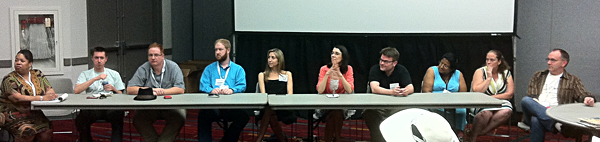
I wasn’t on it back then, so they had to add three extra people to compensate.
While writing this blog post, I was drinking a Vietnamese black tea called Good Morning Vietnam! I brewed this cup for 3:00 using boiling water. As usual, I did not add milk or sugar. Although this is a typical black tea in most ways, there is very little astringency. I don’t think your typical half-tea-half-milk breakfast tea drinker would find it overly satisfying, but it’s turning into my new favorite black tea.

A Matcha Mill at World Tea Expo 2014

Last week at World Tea Expo 2014, most of my time was focused on finding new things. I tasted new tea blends and fresh varietals, while browsing through billions of new gadgets, accessories, and tea-related products. I did try to make time to visit with our existing vendors and friends, and when we stopped at AOI, the company we buy our matcha from, I found something old rather than something new.
Have you ever looked at matcha powder and wondered how it’s made? Oh, it sounds very simple: take some high quality Japanese steamed green tea and powder it. But how do you powder it? Today, there are high-volume machines for absolutely everything, but matcha has been around for a very long time (see my posts about matcha and the Japanese tea ceremony for more information). How did they make matcha before the advent of machines?
AOI had the answer in their booth: a hand-carved millstone designed for tea leaves.

The upper stone has a hole in the top where dried tea leaves are inserted, and a vertical wooden shaft in the lower stone keeps it centered. There are grooves that move the ground-up leaves out to the lower stone’s dish. Of course, I had to try it, and then I made a short video of my daughter, Gwen using the mill:
I saw a lot of cool gadgets, but this is the one I’d like to have sitting next to my desk at home. Unfortunately, it wasn’t for sale…

World Tea Expo 2014, Day 3: Revenge of the Pu-erh

If you haven’t already read Day 1: The Saga Begins, Day 2: Attack of the Clonals, and Tea Bloggers Roundtable, you might want to read them first for context. If not, that’s fine. Read on. No biggie.
The third day of World Tea Expo 2014 started rather unexpectedly, as we pulled into the parking garage and encountered Harley Quinn. On roller skates. As we walked to the expo center, we met up with a variety of other comic characters, along with some characters from movie and TV shows. Yes, it was cosplay time at a comic book convention. Parked in front of the expo center, we saw a variety of vehicles: Kit from Knight Rider, three (Count em! Three!) Jurassic Park tour vehicles, the Back to the Future DeLorean, complete with a dead ringer for Doc Brown, and quite possibly the most awesome Batmobile I’ve ever seen.

Once we got past the Star Wars crowd, however, it was back to the business of tea. And most of that consists of placing orders on the last day of expo to catch all of the show specials. Most of what we purchased was pu-erh tea, which I drink a lot of these days. A good part of the reason we buy so much pu-erh at the World Tea Expo is that there’s a rich variety available, but it can be hard to find in the U.S.
Looking for a nice first-flush Darjeeling? Every major tea importer or distributor has one. Sencha? There’s hardly a catalog without at least one. Earl Grey? Even grocery stores in Montana are likely to carry more than one. But if you’re looking for unique and tasty pu-erh teas, you just might have a long (and pleasant) task ahead of you.
At World Tea Expo, there’s a broad variety of pu-erh laid out on tables all across the expansive show floor, almost all of it compressed into cakes of some form or another. One of the most intriguing we came across this year is a jasmine sheng pu-erh. It has the same jasmine aroma that any Chinese green jasmine tea has, but the underlying flavor is much more robust. A touch of the expected pu-erh earthiness comes through, along with more astringency than most. Part of the astringency is explained by the relatively long steeping time that LongRun used in their booth. They steeped for about four minutes. When I got it home, I played around and decided two minutes is more my speed on this one.

Yes, I can hear the faux gagging sounds coming from the purists, aghast at the idea of scenting a pu-erh tea. Pish tosh, I say to you. I’ll drink my straight pu-erh in the morning, but this lightly scented jasmine delight is just the thing for mid-afternoon. Also, being such a young fermented tea (2012), it will continue to get better and smoother for many years, aging like a fine wine. If you end up with enough self-control to put some away for five more years, it will be awesome!
Two other interesting things about that picture: the color of the tea in the glass in the background, and the pu-erh knife in the foreground. If you’re used to shu (“ripe”) pu-erh, which brews up very dark red, this pale green concoction will look mighty odd. I suppose if I wanted to really show the color, I wouldn’t have set it on a dark wood counter, but that’s beside the point. Sheng (“raw”) pu-erhs are much lighter and more delicate than the “in your face” shu pu-erhs.
For breaking apart pu-erh cakes, you don’t want a regular sharp knife. Cutting it will tear the leaves. What you want is a pointed knife that will slide between the layers of leaves and flake them apart. This pu-erh knife, which they call a “needle,” has a very sharp tip and basically no edges at all. I also like the ceramic handle.
In addition to the other pu-erh cakes we bought, my friend and fellow tea blogger Geoffrey Norman slipped me a little present: two “pu-erh” teas from different countries.

I’ve talked about spelling of Chinese teas here before, so don’t let Geoff’s “puer” and my “pu-erh” throw you off. The transliteration from Chinese into English will never be perfect, and often you’ll find different translators spelling the same words in different ways. The spelling Geoff uses is how the town of Puer appears on most maps, so it may end up winning out eventually if we ever come to consensus, but until then I’ll stick with my way.
Speaking of the town name, that’s why “puer” appears in quotes on the tube. Technically speaking, you’re not supposed to use the name pu-erh unless the tea comes from the Yunnan province of China, where the style originated. The tea is named for the town where it was processed and marketed. A fermented tea from anywhere else should be called a dark tea rather than a pu-erh. We’ll see if that works out as well as “masala chai.” Translated into English, that one should be “masala tea,” indicating a tea made with a masala spice blend. Instead, most Americans call it “chai tea,” which translates to “tea tea” and loses the whole meaning. *sigh*
There are fermented teas (pu-erh style dark teas) made in a number of places outside of Yunnan. In addition to the Taiwanese and Vietnamese I got from Geoff, I bought dark teas from Fujian and Anhui provinces, and I am carefully aging a Laotian beeng cha as well.
There is no other style of tea that has the variety pu-erh does. Some I steep for minutes, and some for mere seconds. Some brews so dark you can’t see through it, and some as light as a short-steeped dragonwell. The colors range from yellowish-green to orange to deep red. The flavors are all over the map. You can steep pu-erh leaves a dozen times, and each infusion will be different from the last. If you haven’t experienced pu-erh before, don’t blindly order some online. Go to a tea shop and talk to someone who really knows the style. Try several different ones to narrow it down. Only then, make the investment in a good pu-erh cake to take home and enjoy.

Tea Bloggers Roundtable 2014

Last night at World Tea Expo 2014, we had fun on the Tea Bloggers Roundtable.
The moderator, Naomi Rosen (Joy’s Teaspoon) asked us questions, guided the discussion, and took comments from the audience. The panel consisted of (left to right):
- Nicole Martin (Tea For Me Please)
- Linda Gaylard (the Tea Stylist)
- Jason Walker (Walker Tea Review)
- Chris Giddings (the Tea-Guy)
- Jen Piccotti (An International Tea Moment)
- Gary Robson (that would be me)
Nicole Schwartz (AmazonV) live tweeted questions and answers for those who couldn’t attend, and Geoffrey Norman (Lazy Literatus), who was on the panel last year, heckled us from the audience.
Our friend TeaPigeon from the exhibit floor (pictured below) was unable to attend the roundtable. Something about too much oolong.

We answered questions on a number of topics, and got some great audience participation, too. Among the topics were:
Q: What do you do if someone sends you a sub-par tea to review?
A: Most of us review only what we like, so if we get a bad product we don’t talk about it. If we do, we tend to lay it on the line.
Q: What’s the best time of day to update the blog and social media?
A: For the most part, we don’t post to the blogs on a schedule (except for Nicole, who posts at noon Eastern time), but we try to do the social media links early in the morning, as most folks check their Facebook and Twitter feeds first thing when they get up. Some of us repeat links in the afternoon, typically with different text.
Q: Do you blog about tea and health?
A: That’s a topic that’s in much demand, but there’s so little proper scientific research that we’re all hesitant to do it. Studies tend to be myopic (good word, Chris!), and media coverage of the studies often distorts the results. The dearth of data means everyone’s looking for solid information, but the research is time-consuming and can be expensive; not all of the studies are available for free on the Internet.
Q: How do you deal with word count?
A: Some tea bloggers (Geoffrey, for example) worry about whether their posts are too long and rambling. Others (like me) want to make sure there’s enough content to make them worth reading. The beauty of the Internet, though, as compared to print media, is that we don’t have hard limits. Gwen Gunn pointed out from the audience that for the first time in history, we have a medium with infinite scrolling. You can fit ten thousand words as easily as you can fit ten words. There’s no reason to trim it back.
Well, I need to get going and hit the last day of Expo, so I’ll cut this post short and talk more about tea blogging later. In case you’re interested, I started my day with a lovely golden tip Yunnan tea from TeaSource. That’s my kind of black tea!
World Tea Expo 2014, Day 2: Attack of the Clonals
There’s more than one way to skin a cat … er … build a tea plantation. The common theme through much of what we saw today was exactly that: how to make tea plants.
Traditionally, humans have allowed plants to go to seed, and then planted those seeds. That involves a male plant and a female plant, and the mixing of DNA, which can have unpredictable results. For many crop plants, farmers came to realize that taking cuttings meant the new plant was identical to the parent plant. If you have a perfect cultivar, don’t pollute the DNA with random Mendelian fluctuations; keep the strain pure.
This process, whether it entails planting cuttings or grafting varietals onto different rootstock, is known as cloning. Today at the World Tea Expo, clonals and interesting varietals of tea plants turned into a bit of a theme for the day.
The day began with fellow tea blogger Geoffrey Norman (the Lazy Literatus) rushing up to me after reading yesterday’s post. “Bacon tea?” he asked frantically, “Where did you find this bacon tea?” I took him down to the appropriate booth and as we waited for them to brew bacon tea, he said, “Did you hear about the smoked green Assam at Tealet?”
I’ve been looking for a good green Assam for quite a while. The overwhelming majority of the world’s green tea comes from Camellia sinensis var sinensis: the Chinese varietal of the tea plant. Camellia sinensis var assamica, the Indian varietal, is quite different.
We wandered over to Tealet’s booth and found that they were in the middle of a video recording. We met up with TJ Williamson, who said that they did, indeed have green Assam (both smoked and unsmoked), but we’d have to wait until they finished the video thing. After we chatted for a bit, he said that he’d like to interview us for the World Tea Podcast. We spent the next hour sipping tea and talking into TJ’s microphone.

The smoked green Assam was unique. The first hit on the tongue was very astringent, and very different from the aroma. It had a full mouthfeel, and it mellowed to a light smoky malty flavor that was very pleasant. They steeped the first infusion with 188-190 degree (F) water, and the second infusion with 175 degree water was much less astringent and much smoother.
Much of our afternoon consisted of placing orders and tasting tea — two of my favorite things to do. We found a lot of different cultivars (many of them clonals), and ordered some great new tea for the tea bar.
One particularly significant stop was at Ajiri Tea. I know I have said a few unflattering things about one particular Kenyan tea company, but I’d like to note for the record that I’ve never had a problem with Kenyan tea in general. Ajiri in particular is doing some wonderful things.
When Kenya gained independence from Great Britain in 1963, many of the huge tea conglomerates retained their land and operations. Many tracts of land, however, were broken up into family farms and cooperatives, which now represent almost 60% of Kenya’s huge tea industry. That’s who we prefer to buy from.
Ajiri was founded not just to export tea, but to create jobs (the word “ajiri” is Swahili for “employ”), especially for women. The boxes for their tea are hand-made, as are the beaded string ties for the bags. All of the labeling and decoration on the outside of the boxes is handmade from dried banana tree bark, and profits go back to Kenya for educating orphans. This is a tea operation we can get behind. Look for their products on our shelves next month.

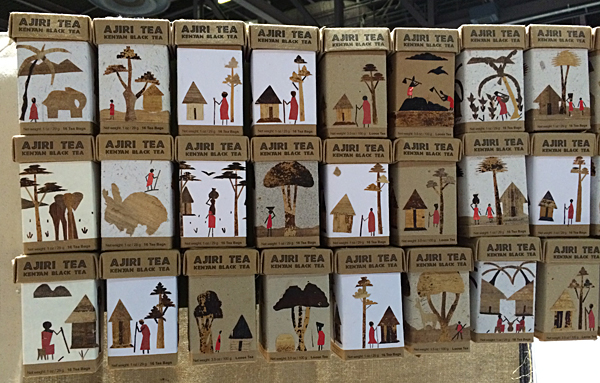
The day continued with a class in rolling oolong teas, and the tea bloggers roundtable you’ve all been waiting for, but it’s after midnight and I am growing weary. I shall sign off now, and continue tomorrow with the World Tea Expo saga…
World Tea Expo 2014, Day 1: The Saga Begins
So here I am at World Tea Expo 2014. The day didn’t start all that well. I’ve been attending expos and trade shows for decades, and this has to be the hardest one to find ever. Very little signage, and the parking area had no directions to the expo area. We got there late, there was an issue with my badge, and we didn’t get breakfast.
The day got better quickly, though. One of the first booths we visited had BACON TEA! That’s right. Tea with maple and BACON! Yeah, it sounds weird, but it was quite tasty. Also, my magic press pass has a sticker on it that allows me to take pictures on the show floor. I know, I took pictures last year, too, but a large security guard offered to escort me out of the building and take my badge away if I didn’t stop it. This year, it’s kosher.

I won’t even try to cover everything in this one post. Steampunk and vacuum tea infusion systems are going to get their own article. I’ll be writing book reviews separately. There will be an upcoming post comparing yaupan with the other caffeinated holly infusions (guayusa and yerba mate). And smokable mate? That’s definitely another subject all on its own!

The bacon tea is from the Tovah Group. Its ingredients, among other things, are maple black tea, lapsang souchong (for a smoky flavor), maple hickory smoked bacon jerky, and various masala chai spices. I think this will go really well with breakfast!
The next person to improve my day was Lillie at the Modern Tea Girl. She was showing off a line of tea-based frosting mixes (“just add two sticks of butter…”). To demonstrate, she had tasting cups with little tasting spoons, but that’s not all! She went above and beyond the call of duty by making little cupcakes. After Gwen and I sampled them — just a few, of course — we decided that the Lady Grey and the Chocolate Chai were definitely standout flavors!

With some cupcakes in my belly and tea samples from a half-dozen booths, I finally felt that I could settle into my rhythm for the day.
With hundreds of booths showing off approximately 4.3 zillion products, you can’t get overly caught up in one booth unless it’s (a) a good fit for the tea bar or (b) a great subject for a blog post. Oh, since I’m with my 21-year-old (single) son, there’s also a (c) that has to do with pretty girls in the booth, but we won’t get into that one.
As I said, there will be more posts, so I won’t describe the plethora of tea storage containers, yixing teapots, infusers, travel mugs, food products, RTD (ready-to-drink) beverages, tea blends, raw spices, electric kettles, and other wondrous things we looked at. We’ll be buying a lot of this stuff and taking it back to the shop. Some of what we looked at had me itching for a bigger budget (would you buy a $400 teacup with real gold in the ceramic glaze?), and some had me scratching my head.
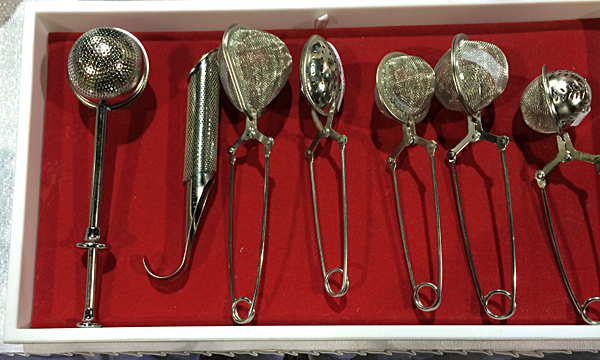
Two of the tea blends I encountered caught my eye, and the merchandizing part of my brain immediately jumped to the conclusion that they should be displayed side-by-side:
Elmwood Inn Fine Teas has a new small batch bourbon black tea. No, it doesn’t actually have bourbon in it, but they’ve put together a collection of teas and spices (including a smoky lapsang souchong) that really evoke the flavor of bourbon. It reminds me of what Vintage Tea Works did with their line of wine-inspired tea blends last year.
To go with it, we have Hancook Tea’s “Hang-Over (sic) No More” blend. This South Korean company has blended lotus leaf, persimmon leaf, hydrangea serrata leaf, and mulberry leaf to come up with a surprisingly sweet (but sugar-free) hangover remedy. It’s not something I’d drink just for the flavor, but it’s still rather pleasant — and who drinks hangover remedies for the flavor, anyway?

Have you ever seen a toy that you really wanted, but you just couldn’t have? AOI (our matcha supplier) had a matcha grinding stone device in their booth. It’s two pieces of hand-carved stone with some wooden parts. You place dried green tea leaves in the top, crank the handle, and it mills those leaves into matcha powder.
We tried it out, and it works wonderfully. The kind folks at AOI took it apart and showed us how it works. I’m not likely to ever start grinding my own matcha, and this device isn’t for sale anyway, but I’d sure love to have it in the tea bar, just to show off!
We finished out the day with the networking party, which featured the most 70s band ever, complete with bell-bottoms, afros, and Earth, Wind & Fire songs, and headed back to the hotel to wind down, blog a bit, and put together some orders for tomorrow.
And now, it is time to sleep. There will be more tomorrow. Lots more…
If you follow me on Twitter (@TeaWithGary), you can get updates all day long. Otherwise, check the blog at the end of the day.
And if you’re here in Long Beach, don’t miss the Tea Bloggers Roundtable, which will feature me along with a half-dozen or so of my fellow tea bloggers. They’re not all as strange as me (Robert Godden isn’t here, so I guess I have to be the weird one this year), but it should be a great panel discussion. It’s at 5:00 p.m. in room 104B.
Tea Blogger’s Roundtable in Long Beach
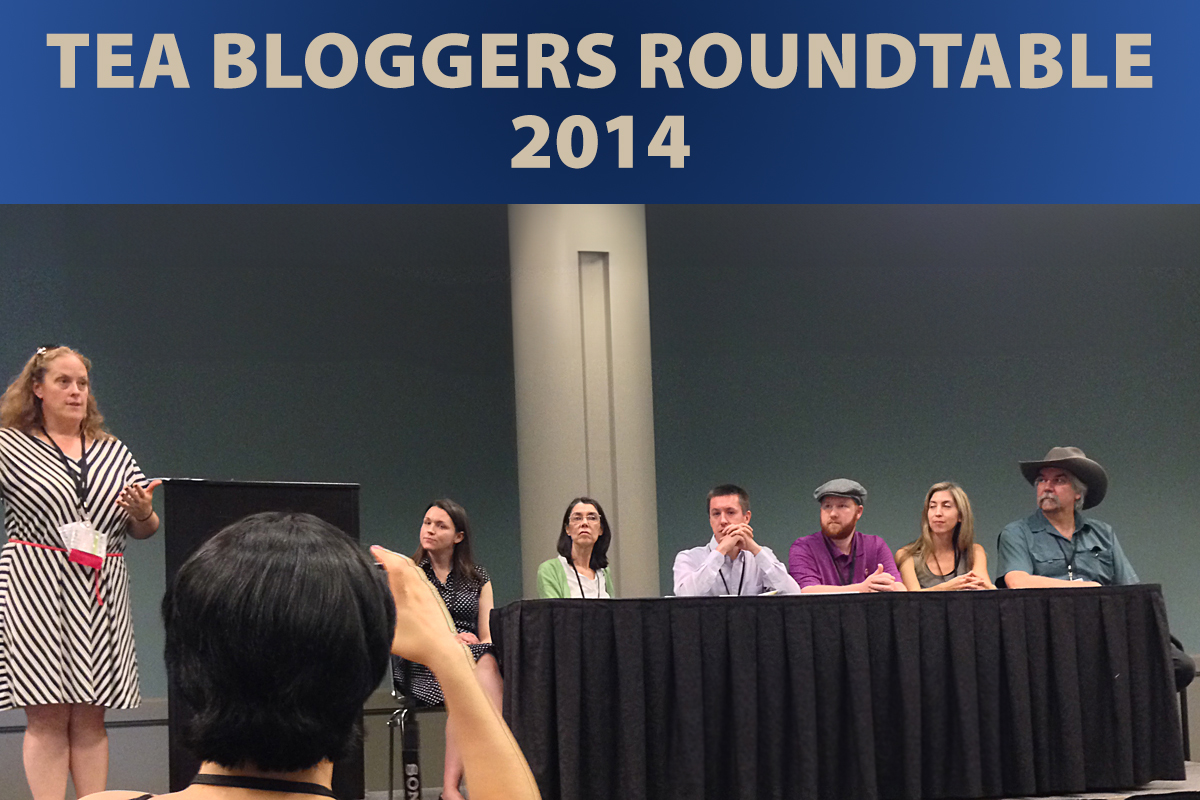
Last year at World Tea Expo in Las Vegas, I attended a Tea Blogger’s Roundtable. It was a great opportunity to talk with some of the big tea bloggers, share experiences, and discuss challenges. This year in Long Beach, California, I’m pleased to be one of the panelists.
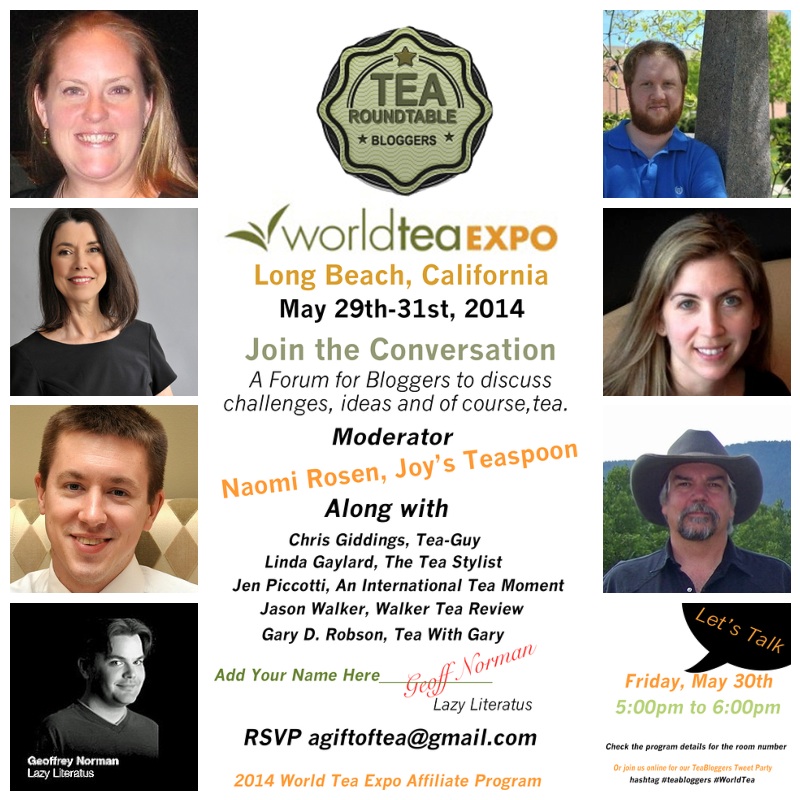
The panel will be on Friday, May 30th, starting at 5:00 p.m. Anyone registered for World Tea Expo or Healthy Beverage Expo is welcome to attend. If you can make it, please let us know using the email address in the poster above. Prepare questions for your favorite tea bloggers (and the ones you just tolerate, too). Take some time to check out the blogs before you attend, too. We all love getting new readers!
The event is being coordinated by A Gift of Tea (Twitter feed @AGiftOfTea). I will also be posting updates here and on my Twitter feed (@TeaWithGary). The bloggers on the panel (in alphabetical order) are:
- Linda Gaylard (the Tea Stylist)
- Chris Giddings (the Tea-Guy)
- Geoffrey Norman (Lazy Literatus)
- Jen Piccoti (An International Tea Moment)
- Gary Robson (Tea With Gary)
- Naomi Rosen (Joy’s Teaspoon)
- Jason Walker (Walker Tea Review)
I’m really not sure what they were thinking when they replaced Robert Godden (Lord Devotea’s Tea Spouts) with me. Maybe he’s too edgy and controversial. Or maybe he’s just getting old and everyone thought his 45-minute PowerPoint presentation on Australian eucalyptus tea was too darned boring. (I have a feeling I’m going to pay for that comment!)
See you there (except for Robert, unfortunately)!

If I learn just one new thing…

Back in my days in the software industry, I used to put on a lot of educational seminars. One day, I was teaching an all-day session and noticed one of my customers, a gentleman by the name of Ken Combs, sitting about fifteen rows back in the audience. At the first break, I went over to him and said, “What are you doing here, Ken? You could be teaching this seminar!” I absolutely loved his response: “I figure if I can learn one new thing, then the whole day is worth it.”
Before using this insightful little anecdote to segue into the subject of this blog, I have to tell a little tale of that seminar. It was, as I said, an all-day seminar. I’m pretty good at projecting my voice, and when I’m dealing with small groups, I usually eschew microphones. This particular day, however, I had an audience of about 120 people and we were in a hotel ballroom with dubious acoustics, so I had a sound system. Like most hotel ballrooms, this one had accordion-style dividers that could separate it into smaller rooms, and we were using about a third of the room.
The morning session went well, but the afternoon became Public Speaker Nightmare #23™: there was a wedding reception in the other part of the ballroom. They had a live DJ. He had a much more powerful sound system than I did. After about an hour with my sound system cranked up all the way, shouting into the microphone, I called a quick break and strolled over to the reception, where I asked the DJ if he’d mind taking the volume down a bit because he was making my job impossible. “Not my problem, dude,” he said as he cranked his volume up higher.
We tried everything. We appealed to the bride. We called the hotel’s booking desk. We tried to find the weekend manager. And throughout it all, I shouted my voice raw trying to be heard in the back of the room. I couldn’t talk for two days after that (I’m not sure whether my wife wrote a thank you note to the bride for that or not), and we did end up getting a portion of our rent for the room refunded, but it made for one miserable seminar.
Despite all of that, Ken learned his one new thing and I applied his philosophy from my side of the lectern and got much more careful about room bookings for future events. Remember I promised to bring this back to tea? Well, fast forward twenty years or so, and here I am at the World Tea Expo. I still try to follow Ken’s philosophy, and it serves me well.
I attended two good educational sessions yesterday, which I’ll probably be writing more about: “Le Nez du Thé” (the nose of tea) and a tea blending workshop. I certainly learned more than one thing in each. After the exhibit hall closed, I went to the Tea Bloggers Roundtable. Mostly, I went for networking purposes, to meet some of these people I know only through their blog posts and tweets. It was a wonderful networking event, but even without that I learned something.
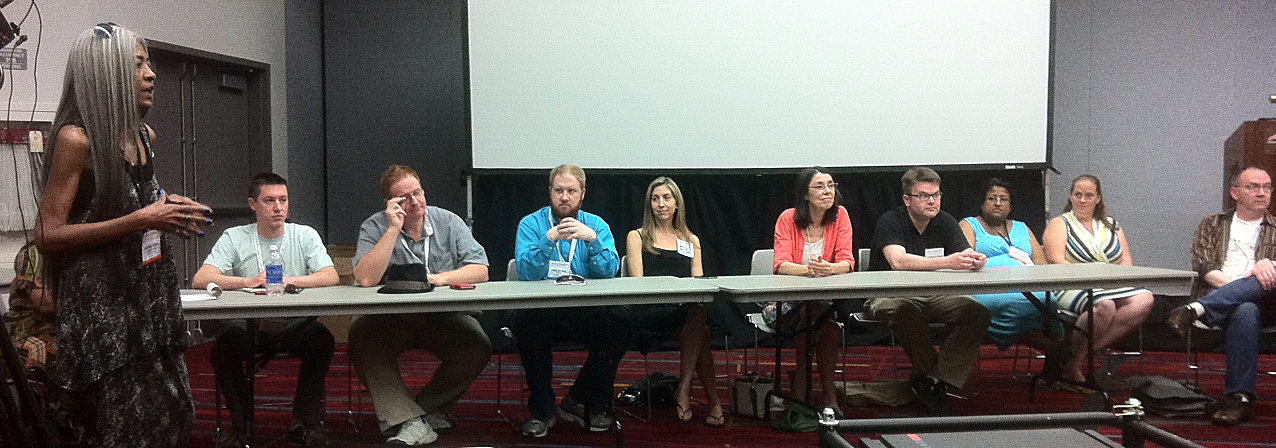
Yes, there was a bit of the mutual admiration society going on there, and the interplay was fun to watch (Godden and Coffey should take their show on the road), but it was also a very worthwhile session. There were more bloggers in the audience — including yours truly, of course — and the format was flexible enough that the distinction between panelist and audience member blurred. As everyone talked and questions were asked (and sometimes answered), it became clear that no two bloggers in the room really had the same objectives. For all of us, the blog is a representation of our personality enveloping the world of tea. Some of the blogs consist almost entirely of tasting notes (e.g., Nicole Schwartz’s “AmazonV” blog) and some have no tasting notes at all. We talked about tea, but mostly about the art of blogging, the expectations of our readers, and the trials and tribulations of trying to keep up any kind of a schedule for blog posts. I hope there’s another blogging event like this one again very soon!
 Tea With Gary