Category Archives: Tea Biz

An open letter to restaurants about tea
NOTE: I originally wrote this in 2014. Not much has changed since then, but since it’s been ten years, I decided it could use an update, so here’s the new & improved version.
Dear Restaurants,
I love you. Really I do. I’m not a picky guy. I’m certainly not a snob. I love a five-course meal at a five-star restaurant, but I also must confess a fondness for a “Snag Burger” at the bar down the street from my shop. I love a good Indian buffet, a medium-rare steak, authentic London fish and chips, and an authentic Inverness haggis with neeps & tatties. Basically, if the chef cares about how the food tastes, I’m probably going to enjoy it. And if your servers care about serving the customers, I’m probably going to enjoy being in your restaurant. I love eating out.
But we’ve really got to talk about your tea.
To many people, having the right wine to go with their dinner transforms a good meal into a great one. Coffee drinkers will greatly appreciate fresh-brewed coffee, and beer aficionados will be greatly disappointed it you offer nothing but bland “megabrews” like Bud and Coors.
Those of us that love our tea feel exactly the same way. I’ve had some wonderful meals in restaurants and gone home disappointed because I got some bitter, oversteeped Lipton tea from a teabag instead of the restaurant putting in just a wee bit of effort and providing a good cup.
I’m not a tea Nazi, telling you and your other patrons the one and only way to make a proper cup of tea. Most of what I’m asking for is a proper selection and giving us the option to steep it as we wish.
#1: Tell us (or show us) the options!
First, if your restaurant is even half a notch above fast food, you have more than one type of tea, right? It may be powdered sweepings from the factory floor in a Lipton teabag, but you’ll have a black tea, a green tea, something without caffeine, and either Earl Grey or Moroccan Mint. If you don’t offer at least those four, you’d might as well hang a sign that says, “Tea Drinkers Not Welcome.”
So let’s start with that. When we order a cup of hot tea, either ask what kind we want, or present us with a basket or box containing a selection to choose from. Don’t just bring out a cup of black tea and then let us find out later that you had other options.
#2: Hot water. Really hot water.
Next, don’t grab the water until you’re on the way to the table. If we’re ordering black tea (and that includes Earl Grey), then we want that water boiling, or darned close to it
If we’re drinking tea that requires cooler water, such as a green or white tea, then we’d really prefer to get the boiling water and let it cool down ourselves. You can always cool water that’s too hot just by waiting, but you can’t heat water that’s too cold when you’re sitting at a table in a restaurant.
And now, a big no-no. Don’t ever ever put the tea leaves (or tea bag) in the water before you bring it to us (see below). The only exception to this rule is if you run a tea shop and your waitstaff plans to monitor the entire steeping process for us, in which case you’ll be controlling the steep time as well.
#3: The tea meets the water at the table.
There are several reasons for this.
First, most serious tea drinkers have their own opinions on how long their tea should be steeped. I typically short-steep my black teas and drink them straight. My friend Angela steeps hers long and strong and adds milk. There’s no way to prepare a cup of tea that will make both of us happy. You have to let us do it ourselves.
That said, if you start the tea steeping in the kitchen, we have no idea how long the leaves have been in the water when it gets to our table. A glass carafe helps that, but if we don’t know the particular brand and style of tea you’re serving, it’s really hard to judge by the color.
Additionally, not all tea takes the same water temperature. If I’m drinking black tea, I’ll pour in that boiling water the second it gets to me. If I’m drinking green or white tea, I’m going to let the water cool a bit first. Boiling water makes green tea bitter.
#4: Give us something to do with used leaves or teabags.
Once our tea is steeped to our liking, we’re going to want to remove the leaves from the water or pour the water off of the leaves.
I’ve been in many restaurants that give me a cup of water and a teabag, but no saucer to put the bag on when I’m done steeping it. I really don’t want a soggy teabag on my dinner plate, and you probably don’t want it on the tablecloth or place mat. Even the nice places that bring me a pot of water with a strainer full of leaves and a cozy to keep the pot warm sometimes don’t provide a place to put that strainer. Oh, and this reminds me of rule five:
#5: Don’t just dump leaves loose in a pot with a spout strainer unless it’s a single-serving pot.
It’s frustrating to pour off a cup of tea and know that by the time I’m ready for the second cup, it will be oversteeped and nasty and there’s not a thing I can do about it.
#6: Don’t add anything to the tea.
It’s fine to ask if we want sweetener or milk or lemon, but for goodness sake don’t add it without asking. We’re all different, but for me and a lot of other Americans, serving me a cup of good tea with milk in it is like serving me a good steak with ketchup on it. See the theme here? Give us options instead of deciding for us.
#7: If you serve iced tea, brew it.
Iced tea is incredibly easy to make fresh (sweet tea can be another issue), so please don’t use the powdered stuff! Just brew a pitcher of tea, pour it over ice, and voilà! Real iced tea. And please, oh please, don’t pre-sweeten it or throw a lemon slice in it. Give us some sweetener options and serve the lemon on the side.
Those seven rules will cover the basics. All but the real tea snobs can make something acceptable to drink if you have a few choices (which need to include unflavored options—don’t give us only Earl Grey, mint, fruity stuff, and herbal stuff) and serve it properly. But if you’d like to upgrade the experience and really make us tea drinkers feel welcome, here are a few bonus tips:
BONUS TIP #1: Loose-leaf tea makes a big difference to tea afficionados.
I know it’s a lot more work having to scoop a spoonful of leaves into an infuser than it is to toss a teabag in a cup. I get that. But to a tea drinker, it matters. It’s like getting fresh sliced peaches instead of peaches from a can, or fresh-baked bread instead of a slice from the grocery store.
BONUS TIP #2: Make sure all of your servers can answer rudimentary questions about your tea selection.
Everyone who works there should know which of your teas have caffeine and which don’t. They should know the difference between green and black tea (and know that Moroccan Mint is green and Earl Grey is black). They should know the teas from the tisanes (herbals), and they should know which ones are organic and/or fair trade.
If you serve loose-leaf tea, as opposed to bagged dust, give the staff a bit more information, like origin and style. You want your server to be able to tell a customer whether that red wine is a Merlot or Zinfandel and whether it’s from Bordeaux or Napa Valley. Why shouldn’t they be able to say whether the black tea is a Darjeeling, a Ceylon, or a Keemun?
BONUS TIP #3: Give us a couple of upgraded options.
Offering a oolong, a white tea, or a pu-erh makes me feel like you really want me to enjoy the experience. I don’t even mind paying more for a Bai Hao or a Silver Needle. It’s like offering some really nice wines in addition to the everyday wines; or offering craft beer in addition to Bud Light. That tea can make a good meal a really memorable one.
Attitude is everything in the service industry. If you and your staff are proud of the food you serve, it shows. Steak lovers look for restaurants that take pride in their steaks. Tea lovers look for restaurants that take pride in their tea. Most of the time, we’re lucky to find a restaurant that will even put a bit of effort into their tea, much less take pride in it.
If you aren’t a tea expert, find one and ask for advice. Show that you’re trying, and that you take as much pride in your drinks as you do in your food. We will notice. You will turn us into regular customers. We’ll be happy and you’ll be happy. We all win.
While writing this, I was drinking Jasmine King, a jasmine silver needle white tea. The touch of woodiness in the tea blended beautifully with the heavenly aroma of the jasmine. I don’t drink a lot of white tea, but I’m getting hooked on this one.

World Tea Expo 2024

When I was running my tea shop, Phoenix Pearl Tea, I looked forward to World Tea Expo (WTE) each year. It was a place to connect with vendors, network with my blogger buddies, learn about all that was new in the world of tea, and gather fresh material for Tea with Gary. I wrote about the Tea Bloggers Roundtable in 2013, and the expo in 2014 and 2015. Then I got lazy and haven’t updated you with much about the show recently.
As some of you may know, my wife Kathy and I turned the management of the tea shop over to our daughter Gwen when I took over the Yellowstone Wildlife Sanctuary about six years ago. That left me little time for Tea with Gary. Gwen moved Phoenix Pearl to Great Falls, Montana and switched to an online-only model. She’s now partnered with a local coffee shop and shares space with them in downtown Great Falls.
Now that I’m semi-retired and no longer running YWS, I’m getting back to my sorely-neglected tea writing, working on a new tea book (more on that soon), and preparing to launch a tea-related podcast. And I’m heading back to World Tea Expo this month in Las Vegas with Gwen and Kathy!
I’ve watched a lot of changes in WTE over the years, including the variety of logos in the banner above (the purple one at the top is this year’s). They’ve partnered with other conferences, and WTE passes have gotten us into healthy beverage expos, coffee shop exhibits, and this year, bar and restaurant stuff.
I’m excited about getting back into it and seeing what’s new, but even more excited to reconnect with old friends that I haven’t seen in a while. Are you going? Let me know in the comments below. Maybe we can meet at the tea bar on the show floor!

Innovation in tea

Quora can be an interesting place. Questions tend to fall into a few broad categories:
- Thoughtful questions that inspire experts in the subject to post answers. These are educational and often fun (“Why do closed captions still look like they did in the 1990s?”).
- Questions that could have been answered by a quick Google search or a visit to Wikipedia. Often, the same question (or slight varieties) are posted over and over and over… (“Does green tea have caffeine?”).
- Questions that start with a bizarre or incorrect assumption (“Why does visiting a library or bookstore have an instant laxative effect?”).
This post is inspired by a question in that third category.
A Quora user posted the question, “Why don’t you get innovative tea shops like you do with coffee shops?” I wrote a short response to it, and then decided that it would make the basis for a good Tea with Gary article, so here we are!
I’m not a coffee fan, so I’ve spent very little time in coffee shops. On the other hand, I owned a tea bar bar for 15 years and I’ve written extensively about tea (including my book, Myths & Legends of Tea).
I challenge the assumption behind this question.
There are some incredibly inventive, innovative, and creative tea shops out there. In fact, because the overwhelming majority of tea shops are single-location “mom & pop” shops rather than corporate chains, they have a great deal more personality than the chain shops that represent the majority of coffee shops in the U.S.
Tea shops vary in quite a few ways, and each one leaves room for innovation.
Aesthetic/decor
Traditionally, tea shops either follow an Asian or Victorian aesthetic. It’s easy to find a tea shop serving Earl Grey in fine porcelain cups with scones and clotted cream, and every tea connoisseur knows at least one Chinese tea shop serving tea samples gongfu style or a Japanese tea shop where you can get a real authentic matcha whisked to perfection in a beautiful handmade chawan (matcha bowl) with some wagashi.
In visiting other tea shops and talking with tea shop owners & employees, I’ve found a whole lot of variety beyond those standards, though, including the “tea tavern” aesthetic of my shop, and tea shops that are steampunk, modern, art deco, fusion, and about any other style you can imagine.
Tea selection
Coffee shops tend to have a handful of basic varieties that they serve on a day-to-day basis, and a ton of additions you can make (steamed milk, sugar, sweet syrups, flavorings, whipped cream…). The one down the street from me has dozens of coffee varieties that they roast and blend on premises, but most of those aren’t available every day by the cup.
Tea shops, on the other hand, tend to have a lot more varieties, and all of them are available all the time. There’s no one single variety that you’re guaranteed to find in every tea shop, either (yes, there are a lot of tea shops that don’t have Earl Grey tea). Tea shops use a variety of criteria to choose their teas:
- Medicinal properties: There’s a tea shop in the big town down the street that’s run by an herbalist. She has a selection of good flavorful tea, but that’s not her focus. She has every variety of herb you’ve ever heard of (and many you haven’t), and an encyclopedic knowledge of their reputed effects on the human body.
- Flavor: A lot of shops focus exclusively on flavor, ignoring health benefits, sourcing, and quality of the underlying tea (which is overwhelmed by all of the added ingredients).

(I’m the one on the left)
- Quality pure tea: My friend Kevin Gascoyne owns the Camellia Sinensis Tea House in Canada (he’s the one I got the Laotian pu-erh from). They are deeply focused on super high-quality estate-grown teas. He can tell you exactly where every tea on his shelves came from—sometimes right down to which section of the estate the plants grew in, when it was picked, and sometimes even the name of the person who picked it or processed it. You can get some absolutely extraordinary tea from him!
- Creativity: I confess. We do this. One of us will wonder, “what if you made masala chai with pu-erh instead of black tea?” or “would a smoked Earl Grey work?” Next thing you know, we have another new & different blend on the shelf.
- The latest trends: Oh, yes. The tea biz is just like any other business. When boba tea became popular in the U.S., boba shops popped up everywhere (some don’t even put tea in their “boba tea”!). Ditto kombucha. When mainstream media started plugging the incredible benefits of matcha, tea shops dedicated exclusively to matcha appeared in the big cities.
Most shops are a fusion of these (we all touch on the trends from time to time), but one of these will be the focus.
Preparation style
Almost every shop can make you a cup of straight black tea. Some will make it with teabags (yuck), some with teapots, some with funky infusers. Some use monstrous electronically-controlled brewing systems.

Even the options for that hot cup of tea vary. I’ve been in two Teavana shops, and neither one offered milk or cream to pour in your English Breakfast tea (we offer 2%, whole, half & half, cashew, almond, and soy). Some shops will make a great tea latte, like a traditional masala chai or London Fog. Some pre-sweeten the teas, while others offer a dizzying array of sweetener options. Some offer syrup flavors, others focus on just straight tea.
Traditional serving methods from other countries show up, too. If you pick the right shop, you may be able to drink yerba mate from a gourd, matcha from a bowl, or strong black tea with salted yak butter from a samovar.
And there are always new methods cropping up. For example, we’re experimenting now with carbonated iced teas, fresh-brewed in front of the customer.
So I say to the original poster on Quora, if you haven’t seen an innovative tea shop, you’re looking in all the wrong places.
As I write this, I’m enjoying the third infusion of a well-aged single-serving “mini-brick” of shu pu-erh and paying the price for my inattention (see “Why I use a tea timer“). I usually give the first steeping an extra minute or so to let the leaves soak up water and separate, and then cut back on steep times for the next few infusions. Typically, I’d give the third infusion two minutes. My daughter would do one minute and my wife would do three. I wasn’t paying attention and steeped it four minutes. It’s quite a bit stronger than I’d prefer, but it’s certainly still drinkable.

How to be an awesome indie tea shop customer

As I was browsing the web looking for inspiration and education (a futile effort, much of the time), I came across an interesting blog post entitled, “How Not to Be a Bad Starbucks Customer: 10 Things You Should Do.” It’s an intriguing short post that — at least in my mind — goes a long way toward clarifying the difference between the coffee world and the tea world. We can start with the easy part: it doesn’t say “coffee” in the title; it says “Starbucks.” Granted, the blog is titled, StarbucksMelody: Unofficial Starbucks News & Culture, so I guess it’s only natural to have it Starbucks-centric.
But this is the point: the U.S. doesn’t have a “coffee culture” per se, but there is a “Starbucks culture,” which comes from their undeniable domination of all things coffee. In large part, Starbucks culture is our coffee culture. And people are nervous about it. So nervous that they read blog posts about how not to be a bad Starbucks customer. They don’t want to embarrass themselves.
We need to make sure this never happens in the tea world.
Our job, as tea shop owners, barTEAstas (if I may coin a particularly ugly word), tea writers, tea growers, tea importers, and general denizens of the tea world, is to welcome, encourage, and educate newcomers. It is not to shame them, make fun of their lack of knowledge, or cause them to worry because they don’t know where to stand or don’t know our terminology. Unfortunately, the terminology issue has already reared its ugly head, and a big chunk of the blame falls on … Starbucks. As an example, there’s a wonderful tea drink called “masala chai.” In Punjabi, “masala” refers to a spice blend, and “chai” means tea. An obvious English translation would have been “masala tea,” but Starbucks went for “chai tea” instead, a rather boneheaded phrase that basically means “tea tea.”
But I digress (as I am wont to do) …
“Our job … is to welcome, encourage, and educate newcomers. It is not to shame them, make fun of their lack of knowledge, or cause them to worry because they don’t know where to stand or don’t know our terminology.”
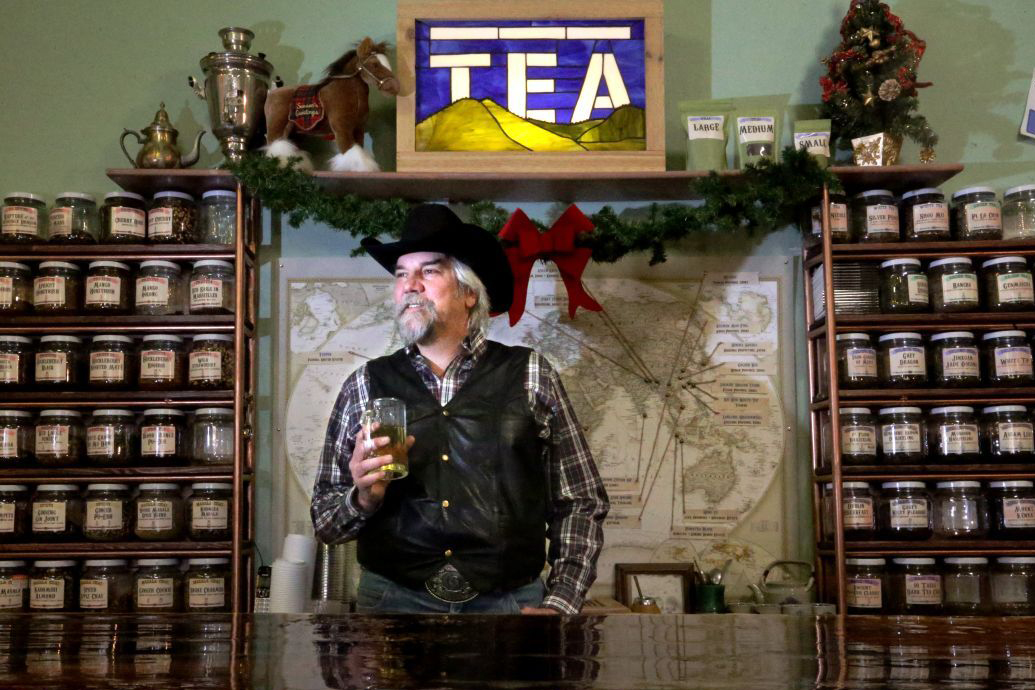
This is me behind the counter, sampling my own wares.
When you walk into an independently-owned tea shop, you are not expected to know that shop’s terminology, customs, or culture. You don’t need to feel anxious about whether you’re going to commit some horrific tea faux pas. You just need to do one thing to be the customer we all love.
What you have to do to be an awesome customer
- Enter the tea shop with an open mind and tell us what you do and don’t like.
We’ll take it from there!
Referring back to the blog post that inspired my blog post, let me re-frame what StarbucksMelody had to say from a tea perspective.
Things you don’t have to worry about
The tea experience is supposed to be calm and relaxing. You shouldn’t be stressed out about whether you’re properly prepared to walk in and order a cup of tea. And you really shouldn’t worry about these things:
- Knowing our sizes, or weird words for our sizes.
We don’t expect you to walk in the door knowing our sizes. We’ll tell you. Or maybe we’ll have cups on the counter labeled small, medium, and large — or 8oz, 12oz, 16oz. Don’t be afraid to ask. - Knowing what kind of tea we have
Coffee shops usually have a couple kinds of coffee out. They can do many things to it (add steamed milk, add flavor shots, pour it over ice, sweeten it…), but there’s generally just coffee and decaf coffee in that decanter behind the counter.
Tea shops usually have dozens (or even hundreds) of different types of tea. Even our regulars don’t know them all, as most tea shops regularly add or drop teas. If you tell us, “I’m looking for a strong hot black tea” or “I’m looking for a fruity green tea,” we can help you find one. That’s our job, and we love doing it. - Knowing how a particular tea is prepared
You don’t have to know the proper water temperature for white tea, the appropriate steeping time for Earl Grey, how to whisk a matcha, or how to rinse a pu-erh. That’s what you’re paying us for. We do know these things. - Using the right terminology
You don’t have to know a bunch of super-secret, just-for-the-cool-kids terminology to order tea. If you ask for that floral green tea that’s rolled into balls and left in your cup while you’re drinking, we know what you mean. Often, the terminology changes from shop to shop. The tea shop back home might call that style Jasmine Pearls, and my shop might call it Jasmine Dragon Tears, and they probably come from different producers. Either way, if you can describe it, we can probably figure it out. - Ordering something strange
It’s very common for people to come into my tea bar looking for something I don’t have. With any luck, I can do it anyway. You want a super-strong ginger Earl Grey latte with soy milk? I will pick the appropriate Earl Grey, add some ginger root, make it super strong for you, and froth up some soy milk. No problem. If you like it, I’ll make you a big bag of the blend and write instructions on the bag for how to prepare it. That’s what brings customers back for more. - How long your drink has been sitting out
This isn’t a coffee shop. Your tea hasn’t been sitting in a pot behind the counter for an hour. It’s being made fresh right there in front of you. - Asking questions
It’s okay to ask questions. We encourage you to ask questions. Most of the people working in indie tea shops absolutely love tea and love talking about it. If you want to know which of our teas are organic, how much caffeine they have, or what the Ethical Tea Partnership is, or where our milk oolong comes from, go ahead and ask.
The tea experience is supposed to be calm and relaxing.
It all boils down to this: Tea shops are not a place for stress. Don’t come in worrying about how to be a good customer (although we do appreciate it if you finish your phone call before you walk up to the counter), just come in looking for some good tea and let us help you get it.

World Tea Expo 2015 – Day 1

Yesterday started out with the return of the bloggers to Tea Expo (it’s kind of like the return of the swallows to Capistrano, except noisier).

I was very pleased to find that The Tea Spot and Teas, Etc. were in the lobby to keep us all adequately caffeinated. I enjoyed cups of their tea before, during, and after the seminars. Interestingly, both companies had chocolate pu-erh blends, and both recommended steeping them for 4-5 minutes. That’s an awfully long time for a shu pu-erh. I went for 3 minutes, and quite liked both of them (sorry, purists).
My first seminar of the day was an absolutely fantastic start to Tea Expo: Jane Pettigrew and Bruce Richardson talked about “A Social History of Tea in the UK and USA.”

They walked us through the history of tea in the western hemisphere from the 1600s to modern times, covering everything from Catherine of Braganza to A&P (originally the Atlantic & Pacific Tea Company). A few of my favorite factoids from their seminar:
- “Monkey-picked oolong” isn’t picked by monkeys. That would be cost-prohibitive. It is just a term for the highest-grade oolong in the house.
- The “Queen’s closet” wasn’t a place to store clothes. It’s where she brewed tea and shared it with family & friends.
- “High Tea” isn’t the fancy thing many Americans think it is. It’s a casual family meal. The elegant tea you’re thinking of is “Afternoon Tea.”
- I’ve mentioned this one before, but there were no tea bricks dumped in Boston Harbor in in 1773. The Boston Tea Party tea was all loose-leaf — and quite a bit of it was green tea.

Every year I take another picture of this matcha stone at AOI. It just intrigues me. Last year I described it and even posted video of it, but I just can’t stay away from it.
One of the things I look for at Tea Expo every year is new and different tea. I do love the teas from the big tea-producing countries like China, India, and Kenya, but it’s fun to explore some of the varieties you don’t run into every day, from countries that aren’t represented in every single tea shop. We had a very pleasant tasting of Indonesian teas at three adjacent booths and found some great surprises.

The afternoon session “Amplifying Your Business Voice Through Tea Bloggers” was informative, even for tea bloggers. All of us look at things differently and run our blogs differently. I update this blog every Friday (most of the time, unless I’m late) with bursts of activity during events like World Tea Expo. Nicole Martin has been updating hers every weekday for the last six years. One of the blogs nominated for a World Tea Award this year hasn’t been updated since early 2014.

Some tea blogs are all about reviewing individual teas. Some are about teaware. Some are about stories. Mine is whatever happens to be either exciting me or annoying me at the moment. The big message from this session was, if you wish to work with tea bloggers, do your research first. Read the blogs. If you are selling flavored chamomile blends, don’t pick a tea blogger that’s a single-origin Camellia sinensis specialist. Geoff Norman told us that he didn’t know the difference between Yixing and Wedgewood, so don’t waste your time and money sending him a teapot to review!
Something else I’ll be writing about in more detail later is “Coffee leaf tea.”
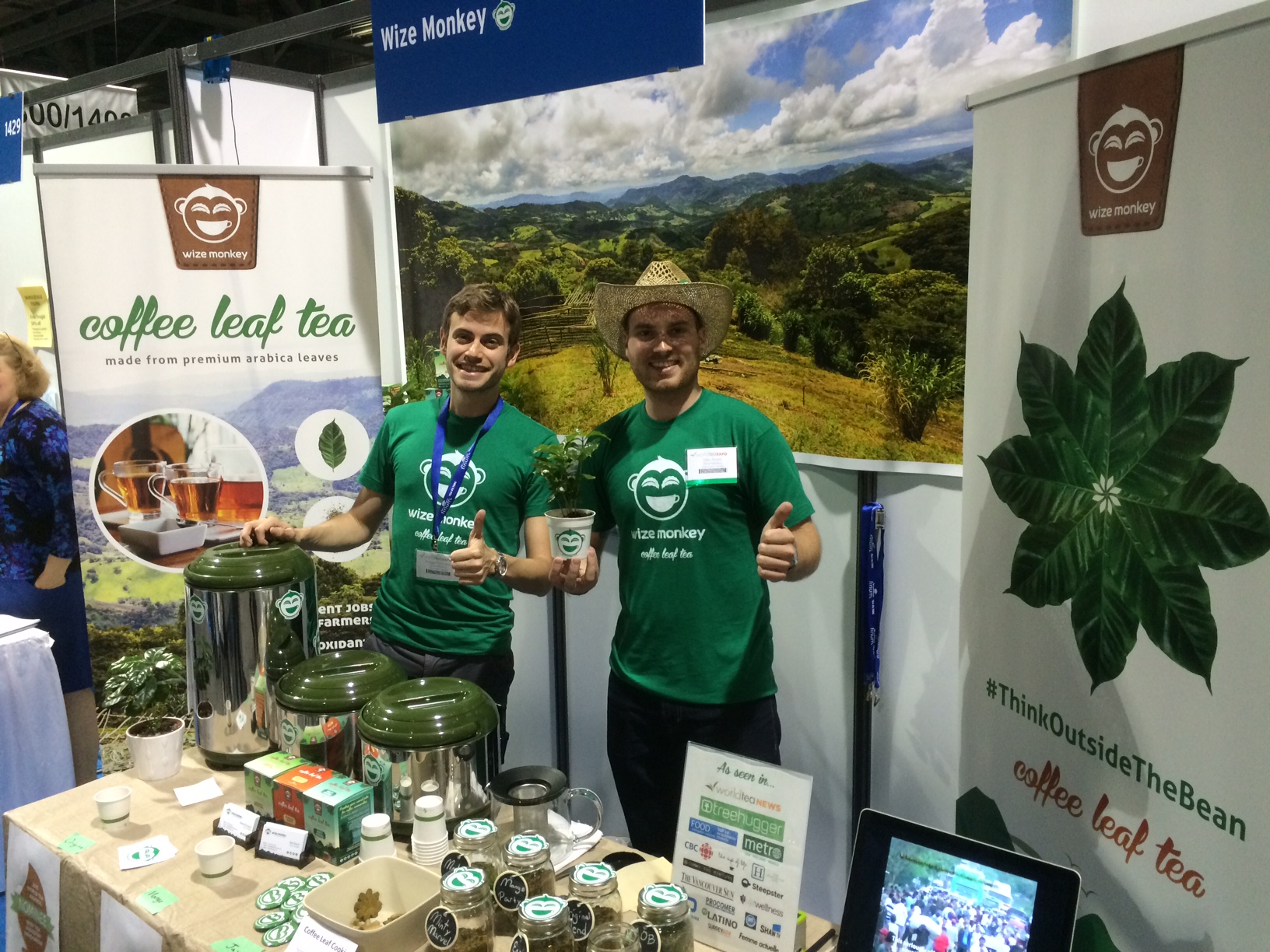
The name may be a bit confusing, as this product contains no coffee beans and no tea. It’s a tisane (“herbal tea”) made from the leaves of coffee plants. I can’t stand coffee, but I found the flavor of this drink quite pleasant. The company’s focus is on extending the season (picking leaves when you can’t pick beans) and creating more jobs, but there will be more on that in a future post.
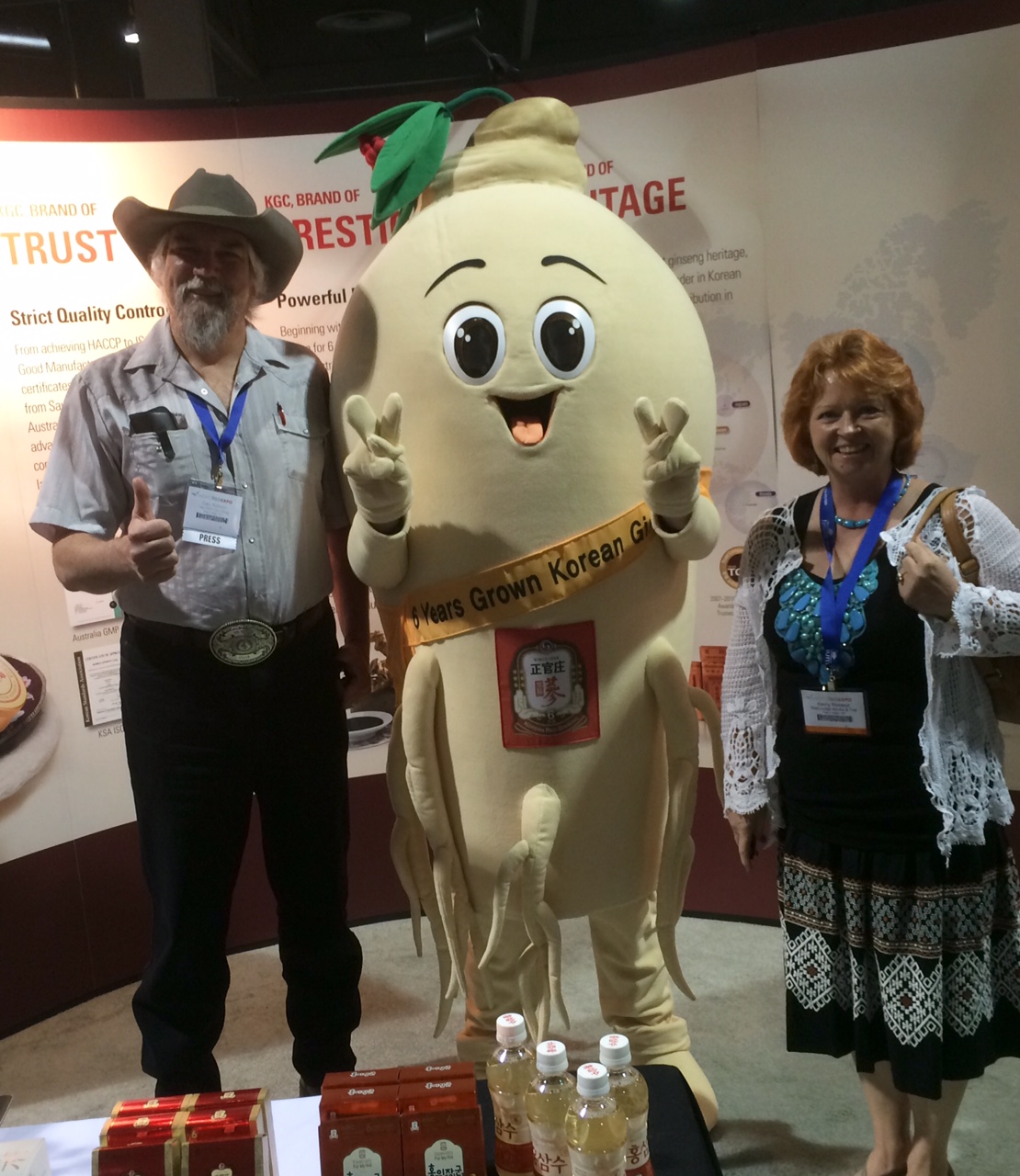
We all have our taste preferences, and mine tend to run towards pure (unflavored) tea. I’m not a big fan of ginger, either, but my wife, Kathy, and I couldn’t resist having our picture taken with this gigantic (and slightly creepy) Korean red ginseng root:
And, just as a close, my birthday is coming up and this automated pyramid satchel tea bagging machine is only $70,000. It would be an easy way to take some of my whole-leaf teas on the road with me. Hint, hint…


Tea Shops for the Younger Crowd

Recently, I came across a Quora question asking, “What advice is there for starting a tea shop … that is targeted to a younger crowd?” I’d been thinking a lot about that demographic since my Millennials & Tea article last month, so I decided to answer it. Looking over my answer, I realized that it was absolutely begging to be expanded and transformed into a Tea With Gary blog post.
If you are planning to open a tea shop and you want to target the young folks, here’s what I’d advise:
- Figure out where your target audience hangs out and put the shop close by. Don’t try to entice them to come all the way across town to get to your shop. They won’t.
- Keep it calm. If they want a frenetic environment with lots of energy and noise, they’ll go to a coffee shop (or a club, or a mall, or…). Tea shops are gaining in popularity because they are relaxing places to hang out.
- Hire people who are enthusiastic about tea and train the bejeebers out of them! In many ways, today’s tea shops are where coffee shops of the 1980s were. Our customers don’t just walk in and order a double-shot half-caf low-fat light-froth caramel mocha latte. Most of them walk in and look around, rather overwhelmed by the options. It’s our job to educate the customers. When they learn from us, they come back.
- Pick your niche and fill it. Are you going to be the healthy place that prescribes tea like medications? Are you going to be the socially-conscious place that has the organic, fair-trade, and ETP teas? Are you going to be the British tea house with Earl Grey and scones? Are you going to specialize in Chinese teas only? Will you be the über high-end place with the $500 pu-erh beengs and the $25/oz specialties, or the cheap place where tea is a buck a cup? You can’t be all of those things, so pick something that fits the youth in your area and do it well.
- If you want to sell loose tea, make sure to either sell by the cup or make samples. People are far more likely to buy it if they try it first.
- Prepare the tea for the customer and pour it yourself. Younger customers are less into product and more into experience. Control the amount of leaf, the water temperature, the steep time. Explain what you’re doing, and make it both educational (see #3) and fun.
- Don’t use solid colored dark mugs. Let the customers see the tea. I use glass mugs so that they can enjoy the beautiful colors of the various teas — engage the eyes, not just the taste buds and nose.
- Serve iced tea. No matter what the weather is outside, iced tea is massively popular in the United States. Make sure every single one of your teas is available iced, and teach your staff how to make a proper glass of iced tea. And brew each cup fresh!
- Serve boba tea, but keep it authentic. You’re a tea shop, not a snow-cone shop. Don’t use the sickly sweet syrups, make your boba from tea! Brew it up fresh and make it an experience (see #6). We do our boba in cocktail shakers.
- Most of the younger crowd is looking for a place to settle in and relax for a few minutes, not a place to dash in, grab a drink in 93 seconds, and dash out. Make your shop comfortable, brew everything fresh — even if it means your masala chai lattes take a while — and perhaps keep a hot pot of your tea of the day and a big jug of iced tea of the day for those customers who are in a hurry.
- If you’re pondering this right now, go to World Tea Expo and take their new business bootcamp. It’s coming up fast, and the bootcamp may be booked, but give it a try. The rest of the Expo is a great place to learn the industry and meet the people; and you do not want to miss that wonderful Tea Blogger Panel that I’m moderating. It’ll be a blast!

Millennials & Tea
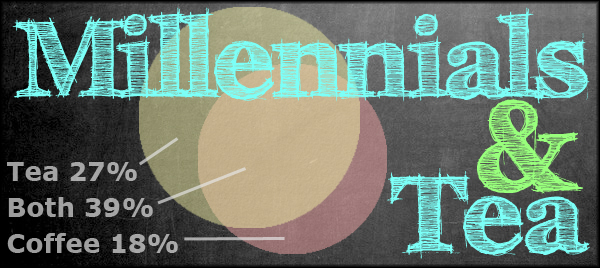
When a new study comes out, it’s interesting to see who spins it how. YouGov released a survey last month comparing American consumption of tea with coffee. Their headline was “Coffee’s millennial problem: tea increasingly popular among young Americans.” Oh, no! A coffee problem!
World Tea News, on the other hand, reported that same survey with the headline, “America’s Youth Embrace Tea.” Oh, boy! Kids are drinking tea.
Most of the articles I read about the survey included this handy-dandy chart:

It pretty clearly indicates that the younger you are, the more likely you are to prefer tea to coffee. The statistic I liked, on the other hand, I turned into the Venn diagram on my header for this article. Of Americans aged 18-29, 18% drink coffee, 27% drink tea, and 39% drink both (the remaining 17% don’t drink either one). In case you’re interested, 998 people were surveyed and 143 of them were in that “millennial” age range of 18-29.
I’m sure there are some people in the tea business that are saying, “This is marvelous! We just have to sit back and wait and we’re going to own this market!” Others are saying, “We really need to get people over 30 to drink more tea.” The coffee industry, of course, has known about this trend for years. That’s why Starbucks bought Tazo and Teavana.
Being a numbers geek, I decided to pull up the PDF of the full report and do a bit of digging. Here are some interesting points you might enjoy:
- The under-30 crowd is much more likely than the older crowd to drink neither coffee nor tea.
- Blacks are over twice as likely to drink tea only (no coffee) than whites or hispanics.
- 64% of Republicans prefer coffee, vs 55% of Democrats and 52% of independents.
- 33% of independents prefer tea, vs 32% of Democrats and 28% of Republicans.
- Middle-income Americans earning $40K-$80K/year are more likely to prefer tea than higher or lower-income Americans.
- 42% of people surveyed are trying to limit their coffee intake vs only 25% that are trying to limit tea.
- Women are much more likely to prefer tea than men
So let’s see here. A tea shop’s target audience is young women? This comes as a surprise to absolutely nobody in the tea business.

I confess that I didn’t expect some of these results. Since Montana is 89% white and 0.4% black, I don’t really have a statistically significant sampling to judge African-American preferences. I do see, however, quite a few Native Americans in the shop getting tea, although I haven’t tried doing any statistical analysis there.
To what do I attribute the tea-drinking millennial trend? The obvious factor is healthier lifestyles, but I would posit something else as well: younger folks are better informed about tea.
I am much more likely to hear an older person say, “I don’t like tea,” because back in their day, tea meant either a teabag full of basic Lipton black tea or the green tea at a Chinese restaurant. Millennials are more likely to have discovered tea in a tea shop that offers dozens — or hundreds — of options. That person who doesn’t like tea may never have tried masala chai, or oolong, or pu-erh, or white tea, or the huge variety of flavored, spiced, and scented options. They’ve probably never experienced the difference between that teabag full of dust and an FTGFOP-1 golden black whole-leaf tea. They may still be under the mistaken impression that latte means coffee, leaving them blissfully unaware of the wealth of tea lattes awaiting them in a good tea shop.
I’ve said many, many times that if you work in the tea business today, your primary job is education. I think this survey shows that tea education is working. Sure, we still sell your basic Earl Grey tea, but younger folks like the ladies in the picture above are well educated about their options. You’re as likely to see them sipping whole-leaf black Vietnamese tea or Indian oolong as you are a peach-flavored white tea or a sage Earl Grey (popular in our corner of Montana).
So let’s get out there and buy Grandma a great cup of tea!
While writing this post, I was drinking Jasmine King Silver Needle tea. It’s a delicate white tea perfectly scented with jasmine blossoms, so that you get the aroma of the jasmine and the flavor of the tea. Yes, jasmine isn’t just for green tea anymore. Hey, that’s a great tagline. Look for it as a blog post title one of these days!
Organic, Fair Trade, and the Ethical Tea Partnership

Ten years ago, I had a pretty simplistic view of the word “organic.” I figured there was some set of guidelines you had to follow, and *presto* — you could put the word organic on your product. As it turns out, things are much more complicated than that.
When my wife and I had our ranch, we had a neighbor that produced organic pork. One day, they were forced to make an unpleasant choice. A disease was circulating among the hogs in our area. They could inoculate their hogs, but it would cost them their USDA organic rating. Or they could keep the organic rating, and potentially lose the animals — possibly even the farm. In another post on this blog, I told a story of an herb farm near us that gave up their USDA organic rating simply because they couldn’t keep up with the paperwork. There is a daunting amount of documentation required for a small family business to be certified organic.
I learned even more about organic products when I got into the tea business.
I learned that if you take some organic tea leaves and mix them with organic peppermint leaves, you cannot call the resulting mint tea “organic” unless you go through the process of having your facility certified and document everything you do.
I learned that some of my customers will only buy tea that is certified organic — and others will only buy tea if it is not certified organic.
I also learned that there are countries that won’t produce USDA organic tea simply because they don’t want a U.S. government agency telling them what to do. That’s when I found out that not all organic tea is USDA organic. Japan has their JAS (Japanese Agricultural Standard) program, the logo in the center bottom of the header image for this blog post. The European Union countries have their EU organic program. All of these programs were designed to encourage natural and sustainable farming techniques, but they all do so in different ways.
There’s also Fair Trade. In their own words, “Products that bear our logo come from farmers and workers who are justly compensated. We help farmers in developing countries build sustainable businesses that positively influence their communities.”
In 1997, a group of tea companies grouped together to create a program that was more specific to tea. At first, it was about tea companies working to monitor and certify their supply chains. Eventually, it became the Ethical Tea Partnership. Many of the members are names you’d recognize, like Bigelow, Tazo, and Twinings. Others are boutique brands. All work with the entire chain of people involved in tea production, from the farmers all the way to the distributors.
The ETP certification process is unlike organic and fair trade certifications, but it has elements of both. Provisions of their global standard include:
- No bonded or forced labor. Employees can’t be forced to leave their identity papers with the employer, must be free to leave at any time, and may not be forced laborers from prisons
- Freedom of association. Employees must be allowed to join trade unions and bargain collectively if they so choose.
- A safe and healthy workplace. Tea businesses must provide clean, well-lit, and safe work areas. Workers in potentially hazardous areas must be provided with health and safety training and appropriate protective clothing.
- Safe and hygienic wash stations and restrooms.
- No child labor, and special treatment for workers under 18 years of age.
- Fair minimum wages and on-time payment of workers.
- Reasonable working hours, including a maximum of 48-hour regular weeks, paid overtime on a voluntary basis, maternity leave, and a minimum of one day off in every seven-day period.
- Equal opportunity employment, including equal pay for men and women and a written policy forbidding discrimination on the basis of race, caste, nationality, religion, age, gender, sexual orientation, and other factors.
- Environmental management systems, including policies for control and reduction of agrochemicals, and for prevention of soil erosion.
- Water and ecosystem conservation.
The entire global standard document is available online as a 30-page PDF file.
So the next time you’re looking for tea, don’t just look for that USDA logo. Keep an eye out for these other logos as well!

While writing this blog post, I was drinking Pi Lo Chun, a hand-processed Chinese green tea. I brewed this cup for 3:00 using 175 degree (F) water. If you’re squeamish, you may want to taste it before looking at the translation of its name (“green snail spring”) — but it contains no snails; it’s just straight green tea. It has a full body and an earthy flavor, but it’s not overpowering at all. In fact, I’d describe this tea as “soft.” It’s not like a hearty Japanese Sencha, which I almost feel I have to wrestle into submission.
I suppose I should be drinking something organic, or fairtrade, or at least ETP. Mea maxima culpa!
Tea Bloggers Roundtable 2015
Once again, World Tea Expo attendees will have an opportunity to share in the wacky (and occasionally educational) world of professional tea bloggers. You’re all invited to the Tea Bloggers Roundtable 2:30 to 3:30pm on Thursday, May 7. It will be a panel discussion featuring some of the names tea aficionados just might recognize.
The panel will consist of Rachel Carter (iHeart Teas), Chris Giddings (Tea Guy), Jo Johnson (A Gift of Tea), Nicole Martin (Tea for Me Please), Geoffrey Norman (Lazy Literatus), Jen Piccotti (An International Tea Moment), and Naomi Rosen (Joy’s Teaspoon). I’ll be moderating the panel, which has the theme this year of “Melding of Voices.” I know, all of those names are in that poster image right below this paragraph, but I wanted to include links to all of the blogs. Check us all out before the event!

One of the things I enjoy most about the world of tea blogging is the lack of competition. I don’t find myself thinking “oh, no, Geoff scooped me on that story,” or “how can I get more viewers than Robert (Lord Devotea’s Tea Spouts) this week?” Instead, we read each other’s posts; we talk about each other’s stories; we link to each other’s blogs; we gain inspiration from each other. We’re not in it to beat each other at the game. We’re in it to share our love of tea and each be the best we can be.
Our blogs all have different themes, too. Some of us just do tea reviews. Some talk about gadgets. Some are very professional in tone; and some are very personal. Some talk about the tea business, and some prefer to just focus on the tea itself. Some blogs, like mine, are all over the map. That’s what makes the tea blogging community such a great environment for newcomers.

It really gets to be fun when we open things up to questions from the audience, and that’s where we find out just how many people in the tea business are interested in blogging. In addition to the prepared questions, if past roundtables are any indication, we’ll also be dealing with questions like how to choose topics, how to get tea to review, the Association of Tea Bloggers, whether to schedule posts, what social media sites work best for promotion, the difference between a hobby tea blog and a professional tea blog, and much more.
If you have a conference badge, there’s no additional cost to attend the Tea Bloggers Roundtable, so take advantage of this opportunity to hobnob with experienced tea bloggers, writers, and social media marketers.
If you have questions, contact Jo Johnson at agiftoftea@gmail.com. She’ll take care of everything!
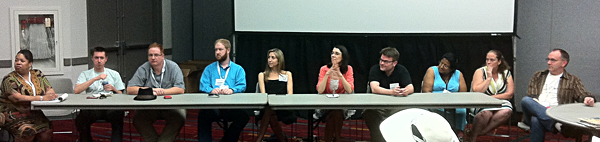
I wasn’t on it back then, so they had to add three extra people to compensate.
While writing this blog post, I was drinking a Vietnamese black tea called Good Morning Vietnam! I brewed this cup for 3:00 using boiling water. As usual, I did not add milk or sugar. Although this is a typical black tea in most ways, there is very little astringency. I don’t think your typical half-tea-half-milk breakfast tea drinker would find it overly satisfying, but it’s turning into my new favorite black tea.

The Logic of Tea Bar Redesign

It all started simply enough.
Gwen looked at the jars of tea behind the bar one day and said, “This cubbyhole-based system is too constricting. We have space for nine oolongs. If we want to add a new one, we have to drop one of the existing ones. What if we went to a more open system?”
Logical enough. If they are arranged in a linear system, we can drop a white tea and add a black one, and everything fits fine. But that led us to a much deeper discussion. Do our groupings make sense?
The old back bar had teas arranged by style. All of the green teas were together, including the dragonwell, sencha, raspberry hibiscus green, Moroccan mint, and jasmine green. But that’s not how people select a tea. That’s not how we select a tea. When a customer comes in that doesn’t know what he wants, we go through a decision tree.
We start with, “do you prefer straight tea, or something flavored?” If they choose straight tea, we ask if they like white, yellow, green, oolong, black, or pu-erh. If they choose flavored, we ask if they want something fruity, flowery, spicy, creamy, or minty.
So why not set up the shelves that way? Very few of the people asking for a berry tea care whether the base tea is green, black, or oolong. They just want a berry flavor. It makes more sense to put all of our huckleberry teas together instead of having one with the black teas, one with the rooibos, and one with the yerba maté.
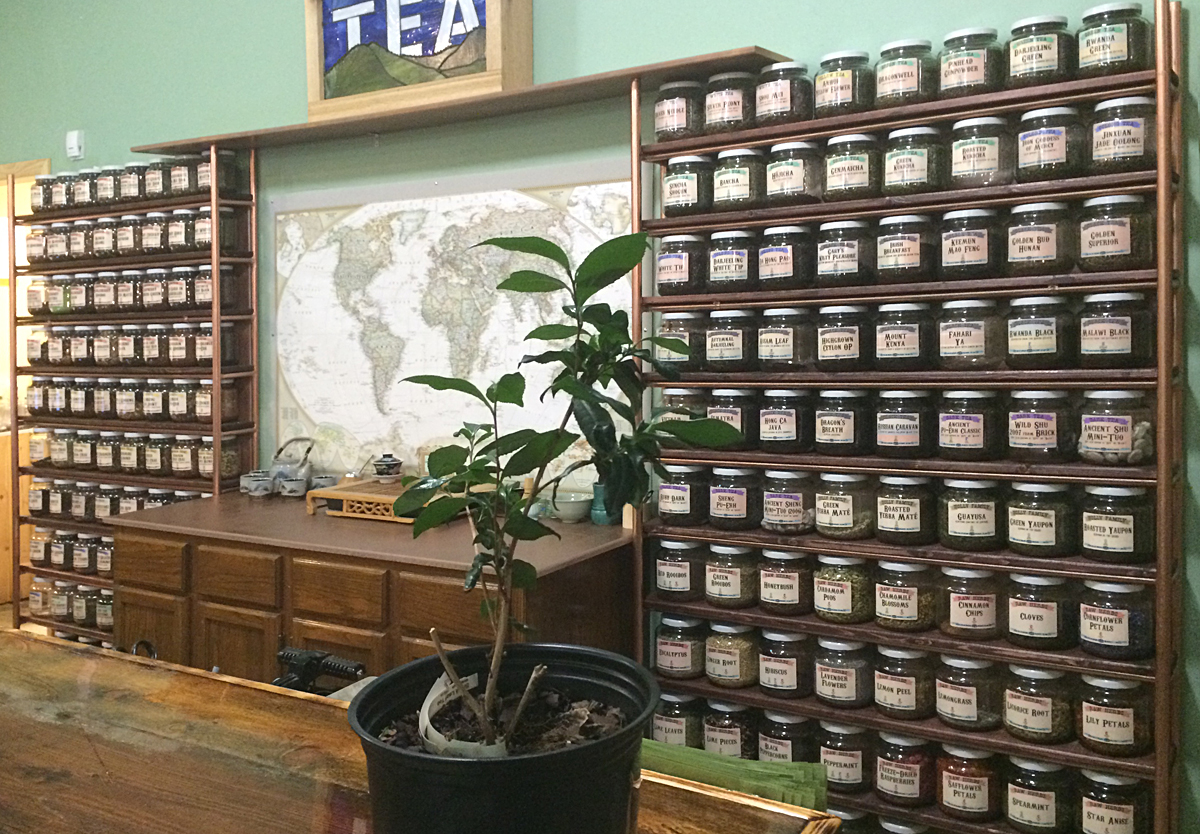
We went through our stock and found that if we grouped the herbs and tisanes (e.g., rooibos, yerba maté, guayusa…) with the straight tea, very close to half of our blends were flavored. So we arranged everything so that if someone says they’re looking for straight tea we take them to one side of the bar, and if they’re looking for something flavored, we go to the other.
Having an organization that customers can follow makes it less intimidating for people new to the tea world.
The straight teas are organized first by style, in order of oxidation (white, green, yellow, oolong, black, pu-erh). They are followed by the caffeinated herbs (maté, guayusa, yaupon) and then the caffeine-free herbs (rooibos, honeybush…). It’s nice to be able to point at the shelves and say, “everything from here up has caffeine, and from here down doesn’t.”

Within each style, the tea is arranged by origin, with blends coming first. In the picture above, you can see the black breakfast blends, and jars of black tea from China, Sri Lanka, Kenya, Rwanda, and Malawi. Most of our customers aren’t used to thinking about tea origins, and they’re intrigued by the diversity of sources.
“Where do you get your tea?” is one of the most common questions we get. It’s kind of difficult to answer. We deal with quite a few importers and distributors, but we also like to buy direct from estates and farms when we can; it helps us to be sure of what we’re getting. To answer the question, we included estate names on the labels where we can, and made a map to put between the two blocks of tea shelves.
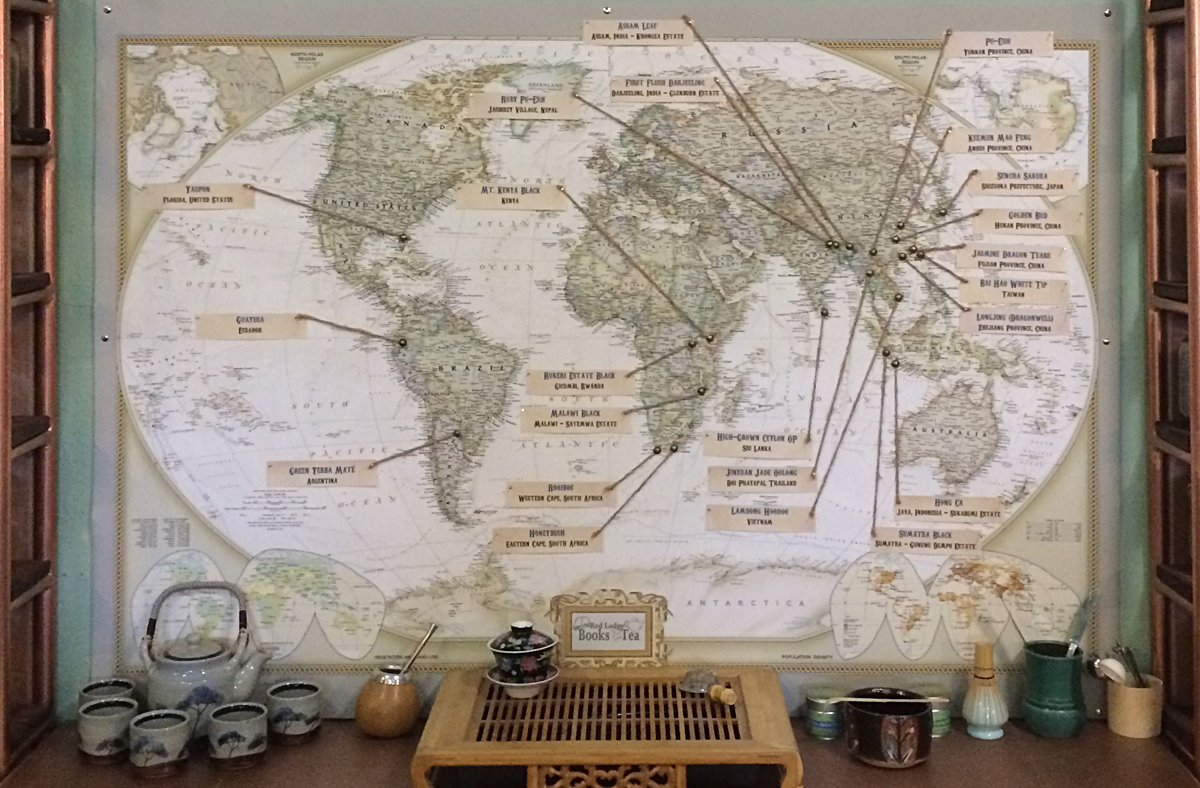
We’ve had very positive reactions to the map. People say, “I’ve never had a tea from Vietnam. I want to try that one!” Sales of some of more obscure tea are increasing, and people seem to be enjoying comparing tea from different parts of the world. It’s a great way to learn about terroir and regional differences in processing techniques.
When we move over to the flavored side, priorities are different. Few people care about the origins, and virtually all of them are blended from geographically-diverse ingredients. We couldn’t organize those by origin if we wanted to.
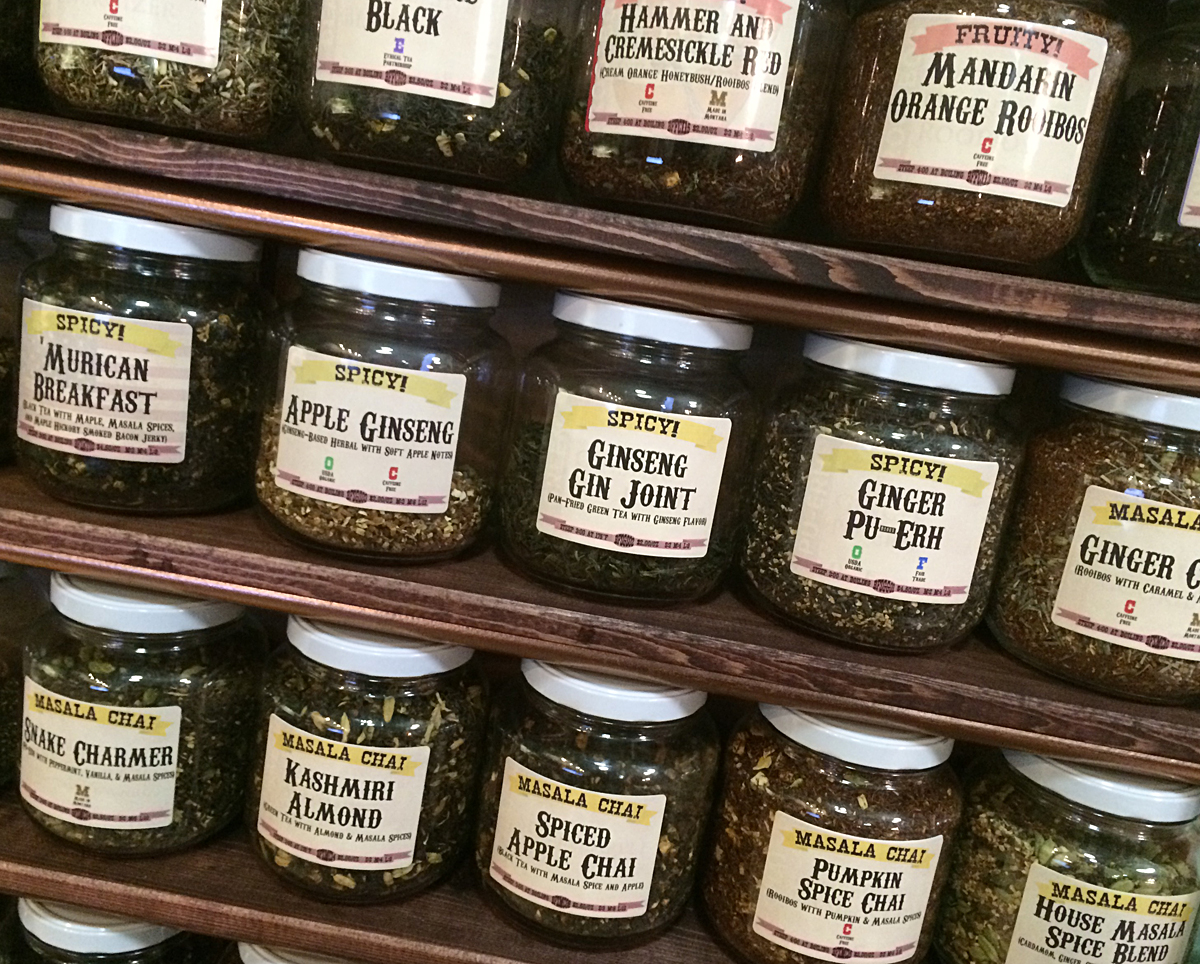
On that side, we start with fruity teas at the top, grouping all of the berry together, the citrus together, and so forth. We then proceed down through the spicy teas (with masala chai getting its own section), flowery teas, Earl Greys, mint teas, and on through the flavor profiles. Since caffeine isn’t taken into consideration in the sorting of the flavored teas, we put codes on the labels to help people find what they want: a green O for organic, blue F for fair trade, red C for caffeine-free, brown M for “made in Montana” (mostly our house blends), and purple E for Ethical Tea Partnership.
Is this the perfect organization for every tea shop? Of course not. An herbalist might want to group the teas and herbs by reputed health effects, or by Linnaean classification of the plants. A tea house focused on food might group them by the foods they pair well with. A café focused on tea by the cup rather than bulk sales might group their tea based on what’s best hot, what’s best iced, what works well in a latte, and so forth.
All indications at the moment, though, are that this is going to work well for us. I shall, of course, report back when we know more…
While writing this blog post, I was drinking Lamdong Hoodoo, a Vietnamese black tea. Since I don’t take milk or sugar in my tea, I prefer black teas with low astringency, but I still like plenty of flavor. This one definitely fits the bill. A nice spicy flavor and aroma, but no bitterness. I steep it for 2:30.
 Tea With Gary