Author Archives: Gary D. Robson

Tea + sweetener isn’t the same as sweet tea
Here’s a tip for my fellow Yankees: if a Southern friend asks for a cup of sweet tea, do not hand them a glass of iced tea and a couple of packets of sweetener. Sweet tea and sweetened tea are simply not the same thing.

They take their sweet tea quite seriously in Georgia. A decade ago, Georgia State Representative John Noel, along with four co-sponsors, introduced House Bill 819. The bill demanded that if a restaurant in Georgia served iced tea at all, it must serve sweet tea. The sponsors admitted that the bill was an April Fools Day joke, but that they were half-serious about it. The bill said:
(a) As used in this Code section, the term ‘sweet tea’ means iced tea which is sweetened with sugar at the time that it is brewed.
(b) Any food service establishment which served iced tea must serve sweet tea. Such an establishment may serve unsweetened tea but in such case must also serve sweet tea.
(c) Any person who violates this Code section shall be guilty of a misdemeanor of a high and aggravated nature.
There is no universal perfect glass of sweet tea any more than there’s a universal perfect cup of tea. There are, however, some simple rules you can follow to keep from embarrassing yourself in front of any guests you may have from Georgia.
Rule 1: Start with strong black tea. Even though sweet tea began as a green tea drink (more on that below), modern sweet tea is made with black tea steeped longer than most tea aficionados would approve.
Rule 2: Use plain white sugar, and lots of it. No artificial sweetener, no brown sugar, just good old-fashioned cane sugar.
Rule 3: The sugar goes in while the water is hot, preferably while the tea is brewing. Do not add the sugar after you chill the tea!
Rule 4: The tea needs to sit for a while in the fridge before serving. Overnight is good, but plan a few hours at least.
Rule 5: Additional ingredients like lemon and fresh mint leaves are a nice touch, but they are optional. Do not add mint or lemon without asking first. Serve it on the side.
So let’s back up a minute. Did I say above that sweet tea was originally made with green tea? Yes, indeed. The oldest know recipe for sweet tea comes from Housekeeping in Old Virginia by Marion Cabell Tyree, a cookbook first published in 1879, and it calls for green tea. In fact, the majority of sweet tea was made from green tea until World War II, when Americans disapproved of almost anything Japanese and switched to Indian (or Ceylon) black teas instead.
As any black tea drinker knows, the longer you let the tea steep, the stronger and more astringent it gets. For the most part, if you’re going to steep that tea longer than five minutes, you’ll be adding something to cut the bitterness. Personally, three minutes is plenty for me with most black teas. But with a Southern sweet tea, five minutes is a bare minimum. I’ve seen recipes calling for anything from seven minutes up to half an hour of steeping time.
Since the tea will be diluted with ice later, it’s traditional to use more tea leaf as well. Where I’d use a tablespoon of black tea leaves per pint of water for plain hot black tea, I use twice that much for sweet tea. An ounce of leaf per quart of water is not excessive. You can use teabags if you wish, but I think you get better results with loose whole leaf tea.
As per rule 2 above, don’t skimp on the sugar, either. About 3/8 of a cup of sugar per quart of water works well, but I know few Southern belles that would complain if you went up to 1/2 cup. For optimal results, dissolve the sugar completely in the water before steeping the tea in it, and make sure that water is boiling.
Once you’ve removed the tea leaves, put the pitcher in the fridge and let it chill down. For best results, it should be cold before you pour it over the ice to serve it.

The Perfect Cup of Tea part 2 (Royal Society of Chemistry)

Last week, we took a look at the International Organization for Standards (ISO) and their standard for the perfect cup of tea (ISO 3103:1980). They are by no means the only organization out there that believes it knows what constitutes “perfect” when tea is concerned!
Today, we’ll look at Britain’s Royal Society of Chemistry, and a 2003 press release they issued called How to make a Perfect Cup of Tea (their capitalization, not mine!). You can download this document in PDF format from their website if you’d like.
I’m sure the RSoC is a wonderful organization. Their self-description on the press release sounds downright wonderful.
“The Royal Society of Chemistry is the leading organisation in Europe for advancing the chemical sciences. Supported by a network of 45,000 members worldwide and an internationally acclaimed publishing business, our activities span education and training, conferences and science policy, and the promotion of the chemical sciences to the public.”
Were I a chemist in Great Britain (or possibly even here in the U.S.), I would definitely want to join this society. But a quick perusal of that paragraph above fails to reveal anything about their expertise in tea. Perhaps it’s just that they are British. That must be it.
The document begins, logically enough, with a list of ingredients and a list of implements. This raised my eyebrows immediately.
“Ingredients: Loose-leaf Assam tea; soft water; fresh, chilled milk; white sugar.”
I love Assam tea as much as the next guy, but is using Assam really a prerequisite for preparing the perfect cup of tea? Can a white-tip Bai Hao oolong not be perfect?
And I’m going to let a bit of my prejudice show here: I’m no tea Nazi, and I’m happy to let you prepare your tea your own way. I do, however, think that if a cup of tea is perfect there is no need to adulterate it with milk and sugar.
“Implements: Kettle; ceramic tea-pot; large ceramic mug; fine mesh tea strainer; tea spoon, microwave oven.”
Oh, my! One of the implements required for preparing the perfect cup of tea is a microwave oven? Please tell me that my friend Angela from London isn’t reading this. It would set her poor heart aflutter. They’re only using the microwave to warm up the cup, but still!
The instructions follow all of the standard British rules for making a cup of black tea (I’m sure George Orwell would approve): pre-warm the cup, take the pot to the kettle, pour the milk in the cup before the tea, and so forth. I will give them kudos for this little gem:
“Drink at between 60-65 degrees Centigrade to avoid vulgar slurping which results from trying to drink tea at too high a temperature.”
It’s the next paragraph, though, that stopped me in my tracks.
“Personal chemistry: to gain optimum ambience for enjoyment of tea aim to achieve a seated drinking position in a favoured home spot where quietness and calm will elevate the moment to a special dimension. For best results carry a heavy bag of shopping – or walk the dog – in cold, driving rain for at least half an hour beforehand. This will make the tea taste out of this world.”
I simply don’t know what else to say. I’m going to go prepare myself an imperfect cup of tea and ponder this for a while.

Making the perfect cup better?
What timely news! Last week, I wrote about standards for preparing the perfect cup of tea, including ISO 3103:1980 and the British standard BS-6008. A couple of days ago, Marc Abrahams wrote an article for the Guardian entitled “The correct way to make a cuppa is being reviewed,” which says that the British Standards Institution is reviewing BS-6008 and several related standards, including the ones for black tea (BS-3720), green tea (BS-11287), and instant tea (BS-7390). Is there actually such a thing as a perfect cup of instant tea? I suppose that’s a question for another blog post, but I suspect the answer will be a resounding no.

I believe that standards organizations perform an important service. We may laugh about silly standards from time to time — Marc Abrahams does quite a bit of that as editor of the Annals of Improbable Research and organizer of the Ig Nobel prize — but where would we be if people couldn’t agree on standard measurements or file formats? I served on the CEA (Consumer Electronics Association) committee that defined the standards for television closed captioning and saw how important it is for broadcasters and TV manufacturers to agree on how things work.
Sometimes, however, you just have to laugh. BS-6008 is being reviewed in time for World Standards Day on Monday, October 14, 2013. With a name like “World Standards Day,” you’d assume that we’ll all be celebrating it on a, well, “standard” day, right? As my father taught me, never assume. In 2013, the US will hold World Standards Day on Thursday, October 3, and Canada will wait for Wednesday, October 16.
And people wonder why we can’t agree on how to make a cup of tea.
UPDATE!
BS 6008:1980, “Method for preparation of a liquor of tea for use in sensory tests,” was officially withdrawn on 18 Sep 2023. I guess they listened!

The Perfect Cup of Tea part 1 (ISO 3103:1980)

Everybody wants to brew the perfect cup of tea. Well, except those silly coffee drinkers, but we usually ignore them on our tea blogs, don’t we?
I’ve made it clear on this blog before that I’m not a big fan of tea Nazis, nor do I necessarily agree with folks like George Orwell about what constitutes a “nice cup of tea.” There are many, however, that believe the perfect cup is not subjective and is not open to debate.
Some organizations that feel they have the secret well in hand have released official documents describing the process, although I suppose that means it’s not a secret anymore. I’ve recently looked over a couple of those documents that I’d like to share. Today, we’ll look at a lovely document called ISO 3103:1980.
ISO 3103: Tea — Preparation of liquor for use in sensory tests
The International Organization for Standardization (ISO) has developed standards for everything from electronics to language and currency codes to quality control management. They also have a food safety management group that has taken it upon themselves to set the standard for preparing a cup of tea.
The standard itself (ISO 3103:1980) is available in the U.S. for the low, low price of $45.00 (less for members) from ANSI, the American ISO member (buy it here). The official description is
“The method consists in extracting of soluble substances in dried tea leaf, containing in a porcelain or earthenware pot, by means of freshly boiling water, pouring of the liquor into a white porcelain or earthenware bowl, examination of the organoleptic properties of the infused leaf, and of the liquor with or without milk or both.”
(I have to confess, word geek that I am, that I had to look up the word “organoleptic.” I will definitely be using this word in the future!)
For those who don’t wish to pony up forty-five bucks for the official standards document, there is a summary on Wikipedia. In keeping with their Creative Commons Attribution-ShareAlike License, I shall copy the details here and save you the trouble of clicking on the link. I’m changing their bullet points to a numbered list for easy reference. These numbers don’t appear in their document.
- The pot should be white porcelain or glazed earthenware and have a partly serrated edge. It should have a lid that fits loosely inside the pot.
- If a large pot is used, it should hold a maximum of 310 ml (±8 ml) and must weigh 200 g (±10 g).
- If a small pot is used, it should hold a maximum of 150 ml (±4 ml) and must weigh 118 g (±10 g).
- 2 grams of tea (measured to ±2% accuracy) per 100 ml boiling water is placed into the pot.
- Freshly boiling water is poured into the pot to within 4–6 mm of the brim. Allow 20 seconds for water to cool.
- The water should be similar to the drinking water where the tea will be consumed
- Brewing time is six minutes.
- The brewed tea is then poured into a white porcelain or glazed earthenware bowl.
- If a large bowl is used, it must have a capacity of 380 ml and weigh 200 g (±20 g)
- If a small bowl is used, it must have a capacity of 200 ml and weigh 105 g (±20 g)
- If the test involves milk, then it is added before pouring the infused tea.
- Milk added after the pouring of tea is best tasted when the liquid is between 65 – 80 °C.
- 5 ml of milk for the large bowl, or 2.5 ml for the small bowl, is used.
Clearly, this standard is designed for comparative testing of tea, not for consumption. In my humble opinion, this standard would ruin the majority of the teas that I drink. The water temperature (paragraph 5) would make a bitter mess out of most white and green teas, and the steep time (paragraph 7) would destroy most of the black and pu-erh teas I drink (and the oolongs and greens, for that matter).
It surprises me not in the slightest that British version of this work (called, appropriately enough, BS-6008) received the Ig Nobel Prize in 1999.
In part 2 of this series, we’ll take a peek at what the Royal Society of Chemistry has to say.
Argentina and Yerba Maté: Stop 8 on the World Tea Tasting Tour
While Europe was getting hooked on coffee and Asia was drinking tea, the people of Argentina and Paraguay were enjoying their own indigenous source of caffeine: yerba maté.

Yerba maté comes from a plant called Ilex paraguariensis, a species of holly which contains caffeine and other xanthines. Maté is a traditional beverage throughout South America, typically served hot (well, “warm” by American standards) and shared among friends from a gourd and bombilla (metal or cane straw).
The matés we tasted were:
- Traditional green yerba maté (organic)
- Roasted yerba maté
- Montana huckleberry maté
- Carnival maté
- Eye of the Storm (our house blend minty maté)
Although when it comes to caffeinated drinks, Argentina is mostly known for its yerba maté, the country is the world’s 9th largest producer of tea, with an annual production of about 60,000 tons. Most of that tea is used in blends and iced teas, and it’s pretty rare to find an Argentinian tea on the menu at a tea bar.
In land area, Argentina is the world’s 8th largest country, covering over a million square miles. Their population is just over 40 million, and the main language is Spanish.
Yerba Maté
The word maté actually means “gourd,” a reference to the vessel traditionally used when drinking yerba maté in most of South America. In Paraguay, on the other hand, they often drink their maté cold (they call it tereré) from a guampa, a drinking vessel made from an ox horn.
The total world production of yerba maté is about 500,000 tons, of which about 290,000 tons comes from Argentina: almost five times their annual tea production. The rest is almost all grown in Brazil and Paraguay. This makes it about a $1.4 billion market (in U.S. dollars) — much bigger than the rooibos market we talked about last week. The majority of the maté is consumed in South America, with the largest outside buyer being Syria.
Maté is usually produced like a green tea, with minimal oxidation. The gourd is packed about half full with leaves in an elaborate ritual, and then filled the rest of the way with water at about 150 degrees F. Argentinian children enjoy maté, too, usually prepared with milk.
In the U.S., maté is more often prepared like tea, by steeping in hot or boiling water. A bit of sugar can help to cut the bitterness caused by the hotter water.
We tasted both a plain maté and one of our house blends with peppermint and spearmint added (that one is yummy iced!).
Roasted Maté
It is becoming increasingly popular to roast the maté, producing a drink that is darker and richer. The taste of roasted maté is often compared to coffee or chicory. We tasted a plain roasted maté plus two flavored ones: a “carnival” maté with caramel and Spanish safflower, and a Montana huckleberry maté.
Caffeine and Maté
It was long thought that maté contained a chemical called mateine, similar to caffeine and a member of the xanthine family. Recent research has shown that mateine actually is caffeine, and it just showed up differently in lab tests because of other compounds present in the maté.
Yerba maté contains three different xanthines: caffeine, theobromine, and theophylline. The total caffeine content is higher than a typical cup of tea, but less than a strong coffee. The way the maté is prepared has a great effect on the caffeine content: the temperature of the water, the steep time, and the amount of leaf used all interact to influence how much caffeine is extracted from the leaves into the drink.
When I have some more time, I’ll write a post detailing and illustrating the maté ceremony.
This was the eighth stop on our World Tea Tasting Tour, in which we explore the tea of China, India, Japan, Taiwan, England, South Africa, Kenya, and Argentina. Each class costs $5.00, which includes the tea tasting itself and a $5.00 off coupon that can be used that night for any tea, teaware, or tea-related books that we sell.
For a full schedule of the tea tour, see my introductory post from February.
The Rooibos of South Africa: Stop 7 on the World Tea Tasting Tour
If you’re looking for a drink with all the health benefits of tea, a similarly great taste, but no caffeine, look to South Africa! Rooibos is made from the South African red bush (Aspalathus linearis). Using rooibos instead of tea is a great way to enjoy a caffeine-free hot (or iced) drink without using any chemical decaffeination process. Rooibos is full of antioxidants, Vitamins C and E, iron, zinc, potassium, and calcium. It is naturally sweet without adding sugar.

Rooibos grows only in the Western Cape of South Africa, and a similar plant called honeybush (the Cyclopia plant) grows in the Eastern Cape. Its flowers smell of honey, hence the name. The taste of honeybush is similar to rooibos, though perhaps a bit sweeter. Like rooibos, honeybush is naturally free of caffeine and tannins; perfect for a late-evening drink.
The teas we tasted were:
- Red rooibos (organic)
- Green rooibos (organic)
- Honeybush (organic)
- Jamaica red rooibos (organic, fair trade)
- Bluebeary relaxation (organic, fair trade)
- Iced rooibos
- Cape Town Fog (a vanilla rooibos latte!)
South Africa, as the name implies, sits at the very southern tip of the African continent. It completely surrounds a small country called Lesotho. South Africa covers 471,443 square miles (about three times the size of Montana) and has a population of 51,770,000 (a bit more than Spain). Despite wide open spaces in the middle of the country, the large cities make it overall densely populated.
The country has the largest economy in Africa, yet about 1/4 of the population is unemployed and living on the equivalent of US $1.25 per day.
Red rooibos
Rooibos isn’t a huge part of the South African economy. It does, however, employ about 5,000 people and generates a total annual revenue of around US $70 million, which is nothing to sneeze at. The plant is native to South Africa’s Western Cape, and the country produces about 24,000,000 pounds of rooibos per year.
The name “rooibos” is from the Dutch word “rooibosch” meaning “red bush.” The spelling was altered to “rooibos” when it was adopted into Afrikaans. In the U.S., it’s pronounced many different ways but most often some variant of ROY-boss or ROO-ee-bose.
I’ve written quite a bit about red rooibos in several posts — and about the copyright issues — so I won’t repeat it all here. Rooibos is also great as an ingredient in cooking: see my African Rooibos Hummus recipe for an example.
Green rooibos
Green rooibos isn’t oxidized, so it has a flavor profile closer to a green tea than a black tea. Again, I’ve written a lot about it, so I’ll just link to the old post.
Honeybush
Honeybush isn’t one single species of plant like rooibos. The name applies to a couple of dozen species of plants in the Cyclopia genus, of which four or five are used widely to make herbal teas. Honeybush grows primarily in Africa’s Eastern Cape, and isn’t nearly as well-known as rooibos.
It got its name from its honey-like aroma, but it also has a sweeter flavor than rooibos. It can be steeped a long time without bitterness, but I generally prefer about three minutes of steep time in boiling water.
Jamaica Red Rooibos
I decided to bring out a couple of flavored rooibos blends for the tasting as well. The first is Jamaica Red Rooibos, a Rishi blend. It has an extremely complex melange of flavors and aromas, and is not only a good drink, but fun to cook with as well (see my “Spicing up couscous” post).
Jamaica Red Rooibos is named for the Jamaica flower, a variety of hibiscus. The extensive ingredient list includes rooibos, hibiscus, schizandra berries, lemongrass, rosehips, licorice root, orange peel, passion fruit & mango flavor, essential orange, tangerine & clove oils
BlueBeary Relaxation
BlueBeary Relaxation one of the blends in our Yellowstone Wildlife Sanctuary fundraiser series (the spelling “BlueBeary” comes from the name of one of the bears at the Sanctuary). It’s an intensely blueberry experience that’s become a bedtime favorite of mine. It’s like drinking a blueberry muffin!
Iced rooibos
To make a really good cup of iced rooibos, prepare the hot infusion with about double the leaf you’d use normally, because pouring it over the ice will dilute it. Both green and red rooibos make great iced tea. I prefer both styles unadulterated, but many people drink iced red rooibos with sugar or honey.
Cape Town Fog
This South African take on the “London Fog” is a great caffeine-free latte. To prepare it, you’ll want to preheat the milk almost to boiling. If you have a frother of some kind, use it — aerating the milk improves the taste. Steep the red rooibos good and strong, and add a bit of vanilla syrup or extract. We use an aged vanilla extract for ours. Mix it all up, put a dab of foam on top if you frothed the milk, and optionally top with a light shake of cinnamon.
This was the seventh stop on our World Tea Tasting Tour, in which we explore the tea of China, India, Japan, Taiwan, England, South Africa, Kenya, and Argentina. Each class costs $5.00, which includes the tea tasting itself and a $5.00 off coupon that can be used that night for any tea, teaware, or tea-related books that we sell.
For a full schedule of the tea tour, see my introductory post from February.
The Oolongs of Taiwan: Stop 6 on the World Tea Tasting Tour
Taiwan may not have originated oolong tea, but it is definitely at the forefront of oolongs today. At this stop on the tea tour, attendees learned about what oolong tea actually is, and tasted a variety of Taiwanese oolongs, including Bao Zhong, White Tip Bai Hao, and of course Tieguanyin, better known as “Iron Goddess of Mercy.” We’ll also talk a bit about the history of Formosa tea (Taiwan was called Formosa until the 1940s).

For comparison, we also tasted a couple of Chinese oolongs.
The teas we tasted were:
- Bao Zhong (Pouchong) – Taiwan
- White Tip Bai Hao – Taiwan
- Tieguanyin (Iron Goddess of Mercy) – Taiwan
- Wuyi (Shui Xian) – China
- Qilan (Dark) – China
- Boba (“bubble”) Tea – Taiwan

Officially, Taiwan is known as the Republic of China (ROC). It is an island off the coast of mainland China, which is officially known as the People’s Republic of China (PRC). The PRC lays claim to Taiwan, but the ROC has declared its independence and established its own government, currency, and economy. The island, formerly known as Formosa, is 13,978 square miles — only about a tenth the size of the state of Montana. It’s population, however, is about 23,315,000, which is significantly more than the state of Texas.
A variety of tea styles is produced in Taiwan, but their specialty is oolong. About 20% of the world’s oolong tea comes from this small island.
There have been wild tea plants on Taiwan for a long time. They were first reported to the Western world in a report in 1685. Chinese tea plants were brought out to Taiwan by Ke Chao in the late 18th century, and a Scotsman named John Dodd established a tea export business in 1869. Tea soon became Taiwan’s major export, and the Tea Research Institute of Taiwan was formed in 1926.
Oolong, which means “black dragon” in Chinese, is the most complex of tea styles to produce. Oolongs are generally not crushed or torn, and are only partially oxidized (not fermented), unlike green tea, which isn’t oxidized at all, and black tea, which is fully or almost-fully oxidized.
Generally, we tailor the steep time and water temperature to each individual tea in our tastings, but tonight we wanted to give everyone a solid basis for comparison, so we prepared all of the oolongs in 195-200 degree (F) water and steeped them for two minutes.
Pouchong

Pouchong is often spelled as “Bao Zhong” to more accurately reflect the way it is pronounced. It’s a very lightly oxidized oolong tea that appeals well to green tea lovers. Because of its mild taste and aroma, many flavored oolongs use pouchong as their base.
White Tip Bai Hao
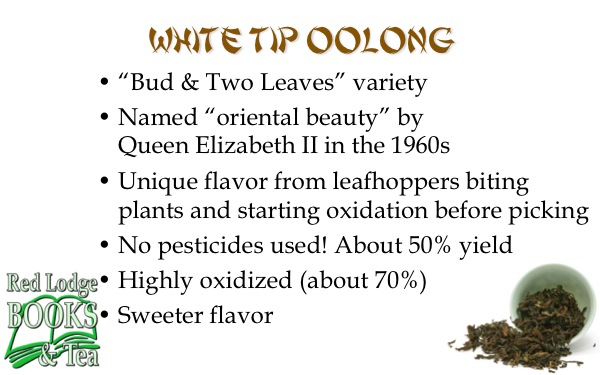
Here’s a tea with many names, including Bai Hao in the east and Oriental Beauty in the west. In the beginning, it was known as “bragger’s tea” because of the origin story (one of the stories that will appear in my new book, by the way), where a farmer went ahead and used leaves that had been chewed up by insects and discovered that the flavor was so wonderfully enhanced that he got twice his normal price at market.
Tieguanyin (Iron Goddess of Mercy)
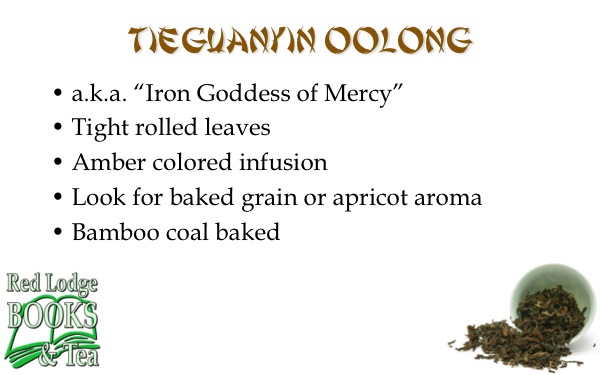
This style originated in China, but has become a staple of Taiwanese oolong as well. I’ve written about it before. Even with 120 different teas to choose from in my tea bar, it’s rare for me to go more than a couple of days without drinking a few cups of Tieguanyin. It’s generally good for at least 5-7 infusions, and it’s a great everyday tea.
Wuyi Oolong
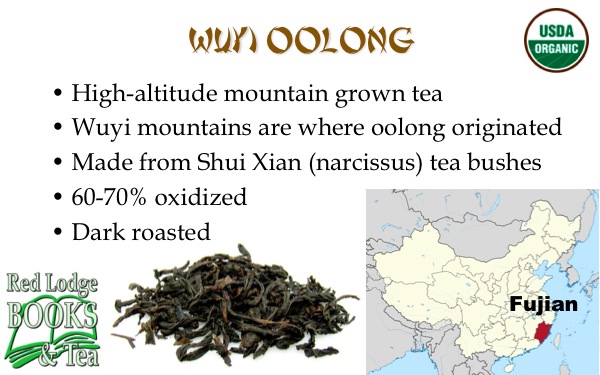
We then moved to the birthplace of oolong tea: the Wuyi mountains in the Fujian province of China. This tea is highly oxidized and then roasted to give a very full-flavored cup. We tasted it on the first stop (China) of our World Tea Tasting Tour, making this the first tea that’s been in two different tastings.
Qilan Oolong

Staying in that same area, we moved on to an even more oxidized and roasted dark oolong. Qilan (“profound orchid”) is actually a darker and more flavorful tea than many of my favorite black teas, like Golden Yunnan, Royal Golden Safari, and first-flush Darjeeling (all described in previous tasting notes).
Boba Tea

The most recent export from Taiwan is an iced drink they call “boba milk tea,” usually served as “bubble tea” in the United States. It has taken many urban areas here by storm, especially in the Pacific Northwest. Unfortunately, the way most of the mainstream purveyors prepare it, there’s no tea in bubble tea — they use snowcone syrups or similar super-sweet flavorings.
We prepare ours by steeping a strong cup of tea (tonight’s tasting used a mango-flavored tieguanyin as the base). In a cocktail shaker we add ice, simple syrup (sugar water), and a bit of milk. After shaking that into a froth, we pour it over fresh-made tapioca pearls.
This was the sixth stop on our World Tea Tasting Tour, in which we explore the tea of China, India, Japan, Taiwan, England, South Africa, Kenya, and Argentina. Each class costs $5.00, which includes the tea tasting itself and a $5.00 off coupon that can be used that night for any tea, teaware, or tea-related books that we sell.
For a full schedule of the tea tour, see my introductory post from February.
Oolong-related articles on Tea With Gary
-

The Iron Goddess of Mercy – Part 1
The Iron Goddess of Mercy Part 1 — China, 1761 — It was the reign of the Qianlong Emperor, the sixth emperor of the Qing Dynasty in China, but our story concerns no emperors, warlords, or nobles. It is just a tale of a humble farmer by the name of…
-

The Iron Goddess of Mercy – Part 2
The Iron Goddess of Mercy Part 2 — China, 1761 — It was the reign of the Qianlong Emperor, the sixth emperor of the Qing Dynasty in China, but our story concerns no emperors, warlords, or nobles. It is just a tale of a humble farmer by the name of…
-

Canon cameras and oolong tea
Why should you drink oolong tea when you’re taking pictures with a Canon camera? Let me explain…
-
The Oolongs of Taiwan: Stop 6 on the World Tea Tasting Tour
Taiwan may not have originated oolong tea, but it is definitely at the forefront of oolongs today. At this stop on the tea tour, attendees learned about what oolong tea actually is, and tasted a variety of Taiwanese oolongs, including Bao Zhong, White Tip Bai Hao, and of course Tieguanyin,…
-
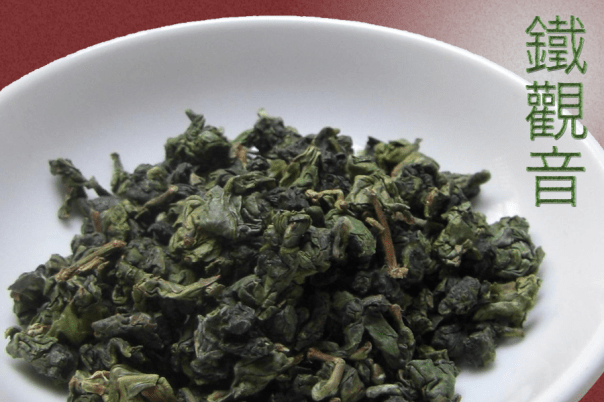
Free mystery tea (Tieguanyin)!
A friend stopped by the tea bar the other day and brought a bag of tea from China that a friend had given her. She didn’t know what it was, and she’d had it for five years, so she asked if I’d like to have it.
Deepest Africa – The Tea of Kenya: Stop 5 on the World Tea Tasting Tour
When you think of tea, Africa probably isn’t the first place to pop into your mind, but Kenya is the largest exporter of tea in the world. Tea has revitalized their economy, and tea lovers everywhere became winners. Red Lodge Books & Tea works with family owned plantations in Kenya, and was the first tea bar in the United States to serve Kenya’s unique purple tea.

Kenya is known for its black tea, but with their expanding tea economy, the country has expanded into other styles. We tasted some green and white tea from Kenya, along with traditional estate-grown Kenyan black teas and with some fun and different tea you just can’t get anywhere else.
The teas we tasted were:
- White Whisper
- Rift Valley Green Tea
- Golden Safari (black)
- Lelsa Estate FBOP (black)
- Royal Tajiri (black)
- Purple Tea
A quick bit of background on Kenyan tea before we go any farther. As I mentioned earlier, Kenya is the largest exporter of tea in the world, and the third largest producer (after China and India). Largely because of the population difference, Kenya doesn’t consume as much of its product as China and India do. Kenya produces about 345,000 tons of tea per year, but consumes only about 32,000 tons of that. About 9.6% of the world’s total tea production comes from Kenya.
Those are fascinating statistics, but let’s put some human faces on them. When I wrote my first blog post about purple tea in 2011, I was contacted shortly afterwards by a Kenyan woman by the name of Joy W’Njuguna. I had the pleasure of meeting her in 2012 at the World Tea Expo, as you can see in the picture below. She’s not actually that short — it’s just that I’m six-foot-five and I’m wearing a cowboy hat, so she does look like a tiny little thing.
CAUTION: Before doing business with Royal Tea of Kenya or Joy W’Njuguna, please read my post from May 2014. There are at least a dozen companies (mine included) that report paying for tea and never receiving it!

I’ve learned a lot from Joy about Kenya and its tea industry. One telling tidbit is that about half of Kenya’s tea is produced by corporate farms, and the other half by independent growers. I have a soft spot in my heart for the independents, since I own a (very) independent bookstore and tea bar. Joy, in addition to representing her own family business, is involved in a collaborative export business that represents a coalition of independent family farms in Kenya. The big producers there are focused on producing very high volumes of CTC (Crush, Tear, and Curl) tea that ends up in grocery store teabags. The independent growers are focused instead on producing high-quality handmade tea that will catch the attention of the rest of the world.
I like being able to put a face to the products I buy. I like being able to show my customers a picture and say, “See these people? These people hand-picked the tea you’re drinking. Not machines. We know where the tea came from and we know what we’re buying.”
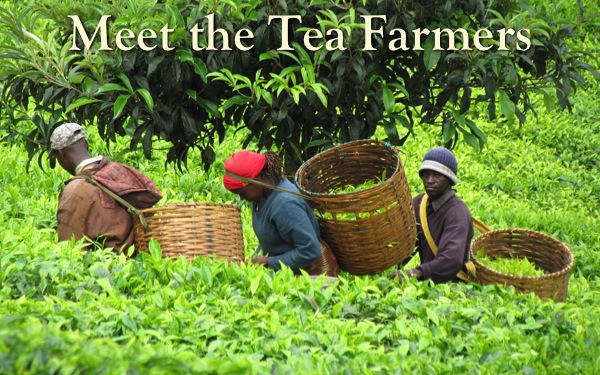
Some of the people who picked the tea we tasted at this class.
Well, that’s probably enough of a soapbox for the day — or maybe even the month. Let’s move on to the teas that we tasted. If you’re like most of my customers, you didn’t even know Kenya produced a white tea. Heck, until about a year and a half ago, I didn’t know either. So let’s start there:
White Whisper

Silver Needle is one of the flagship teas of China. White Whisper is not a clone, but a Kenyan tea made with the same process. The vast differences in terroir make show from the first sniff. It’s richer and earthier than Silver Needle. Even at the 5:00 steep time we used, it’s less delicate. Personally, though, I love the complexity of this tea. Just pay close attention to that water temperature. You pour boiling water over these leaves and you’re going to ruin it.
Rift Valley Green Tea

The first time I tried this green tea, I wasn’t really impressed. Since it’s a pan-fired tea, I followed the general guidelines for Chinese greens and steeped it for three minutes. Next pass, I read the tasting notes from Royal Tea of Kenya, which recommend a thirty-second steep. Really? Thirty seconds? Yep. That’s all this tea needs.
I love the fact that this tea comes from the slopes of Mount Kenya. Some of my best memories of my trip to Kenya when I was in high school center around that area and the day and night we spent at the Mount Kenya Safari Club. What a wonderful place!
Royal Golden Safari

I’ve written about this tea before. It’s one of my favorite black teas. In this session, as in most of my tastings, I got raised eyebrows from people when I poured this and told them it was a black tea. It brews up pale red with just a touch of astringency and appeals to many oolong drinkers. Unlike most black teas, I regularly get four or five infusions out of Golden Safari.
Lelsa Estate FBOP

Next, we moved on to a much more traditional Kenyan black. This FBOP is one of the ingredients I use in Gary’s Kilty Pleasure (my Scottish breakfast blend). The estate in Kericho participates in the Ethical Tea Partnership program, which I appreciate, and the tea has a deep red color and characteristic Kenyan “jammy” notes. The maltiness blends well with Assam tea, and those who take their tea English-style will appreciate how well it takes milk.
Royal Tajiri

“Tajiri” is the Swahili word for “rich,” and this tea lives up to its name. The finely broken leaves mean an intense extraction. If you’re a black tea lover, this one will give you everything you’re looking for — assertive astringency, deep red (almost black) color, and a very complex flavor profile.
Royal Purple Tea

I’ve written so much about purple tea on this blog (here, here, and here) that I’ll skip the background data — although the picture on that slide is new: the tea on the left is a traditional Camellia sinensis, and the one on the right is the purple tea varietal TRFK306/1. The molecular structure in the background of the slide is the anthocyanin. I didn’t have my shipment of handcrafted purple tea yet (and the sample didn’t last long!), so we were unable to compare the orthodox to the handcrafted. I will put up separate tasting notes on that when my main shipment arrives.
I will note that we brewed the orthodox purple tea for this tasting with 170 degree (F) water instead of boiling, as I’ve done in the past. The cooler water brought out more of the complex undertones of the tea and backed the astringency down, making it more to my liking. We tasted this side by side with and without milk. If you haven’t had this tea with milk before, add a bit just to see the fascinating lavender color that the tea turns!
Nandi Chai

I confess. I was bummed that we didn’t get our handcrafted purple tea in time for this event. I kind of unloaded on Joy about it, and she was good enough to find me something else fascinating and unique for this event: an African chai. The tea (a blend of purple and traditional black) is from Kenya and the spices are all from Ethiopia.
We closed the tasting with this unique chai, and it went over very well. Instead of taking up half of this post talking about it, I’m going to dedicate a whole blog post to Nandi chai in the near future.
This was the fifth stop on our World Tea Tasting Tour, in which we explore the tea of China, India, Japan, Taiwan, England, South Africa, Kenya, and Argentina. Each class costs $5.00, which includes the tea tasting itself and a $5.00 off coupon that can be used that night for any tea, teaware, or tea-related books that we sell.
For a full schedule of the tea tour, see my introductory post from last month.
Kenyan Tea in the News

For some reason, there seems to be a lot going in in the world of Kenyan tea this month!
Kenya is the world’s largest exporter of tea. Not the largest producer, for they consume less than a tenth of the 345,000 tons of tea they produce each year — as opposed to China, which produces about 1.25 million tons, but consumes a staggering 1.06 million tons of it.
The fifth stop on our World Tea Tasting Tour was the Tea of Kenya, which we held last week. I’ll be posting notes from the class and tasting shortly.
One of the things I’m most excited about is a new development in purple tea. The orthodox purple tea that I first wrote about in 2011 has a great story and many benefits. Tastewise, though, it is more astringent than I usually prefer, since I typically don’t take milk in my straight black tea. In other words, it’s just not my cup of tea (I’m allowed to make that pun once a year — it’s in my contract). This year, however, I got a sample of a new handcrafted purple tea from Kenya in February. Ambrosia. Absolutely wonderful stuff. I have a kilo on the way, and I’ll write up some decent tasting notes once it arrives.
For our tea tasting, they sent us a marvelous new chai (An African chai. Who’d have thunk it?) called Nandi Chai, after the Nandi peoples of Kenya. The tea is a blend of Kenyan black and purple varieties, and all of the spices are Ethiopian. I’ll be writing more on that later.

In other news, the Kenyan tea industry is trying to lower its costs and carbon footprint. An article in Tea News Direct says that four factories managed by the Kenya Tea Development Agency (KTDA) are going green through the “Gura project,” which will build a hydroelectric plant on the nearby Gura river. The factories will receive carbon credits from the Clean Development Mechanism, which is part of the United Nations Framework Convention on Climate Change (UNFCCC).
To end on a lighter note, there’s a post on the English Tea Store blog today that included a picture of what they called the ugliest teapot in the world (picture below). I honestly can’t decide whether it’s the ugliest or the most awesome. Had I spotted one when I visited Kenya decades ago, I would have almost certainly purchased it.

Chanoyu: The Way of Tea
This is part two of my article on the Japanese stop of our World Tea Tasting Tour. Part one was posted a few days ago.

The Japanese tea ceremony has been around for a very long time, but it was solidified into its current form in the 1500s by a man named Sen no Rikyū. He was an adherent of a philosophy called wabi-sabi, which honors and treasures simplicity, transience, asymmetry, and finding the beauty in imperfection. Rikyū applied this to the tea ceremony, developing what became known as chanoyu: the Way of Tea.
He removed unnecessary ornamentation from tearooms, typically reducing the decor to a single scroll on the wall and a flower arrangement designed to harmonize with the garden outside. Everything else in the room was functional. Chanoyu teaches four fundamental principles known as wa kei sei jaku, intended to be not only the core of the tea ceremony, but a representation of the principles to incorporate into daily life.

Wa (harmony) was his ultimate ideal. From harmony comes peace. Guest and host should be in harmony and man should strive for harmony with nature, rather than attempting to dominate nature.
Kei (respect) allows people to accept and understand others even when you do not agree with them. In a tea ceremony the guest must respect the host and the host must respect the guest, making them equals. The simplest vase should be treated as well as the most expensive, and the same politeness and purity of heart should be extended to your servant as to your master.
Sei (purity) is a part of the ritual of the tea ceremony, cleaning everything beforehand and wiping each vessel with a special cloth before using it. But that is only an outward reflection of the purity of the heart and soul that brings the harmony and respect. In accordance with wabi-cha, imperfection was to be prized here as well. To Rikyū, the ultimate expression of purity was the garden after he spent hours grooming it and several leaves settled randomly on the assiduously manicured walkway.
Finally, Jaku (tranquility) is the ultimate goal of enlightenment and selflessness. It is also the fresh beginning as you go back with fresh perspective to examine the way you have chosen to implement harmony, respect, and purity into your life.

There is a long list of implements that are used in the preparation of matcha, which is the powdered tea used in the tea ceremony. The four that I concentrated on in this class were the bowl, scoop, whisk, and caddy. It could be argued that others are as important, or even more important, but I chose to focus on the ones that are used at home when you make matcha, even if you are not participating in a tea ceremony. The link in the slide above is a great place to learn all about the ceremony itself, and the site contains a detailed list of chanoyu utensils.
In preparing matcha, the bamboo scoop is used to take tea powder and place it in the bowl. After adding water, the whisk is used not only to mix the powder, but to aerate the mixture, leaving it slightly frothy.
Of all of the tools of chanoyu, the bowl is probably the most personal.

We were lucky enough to have Karin Solberg, who created the matcha bowls we sell at our store, talk about the process of creating and decorating the bowls. Karin has done some lovely work, and we enjoyed learning from her. There is a picture showing some of her bowls in part 1 of this article.
I have said many times before that tea is a very personal thing. Nobody can tell you what tastes good to you. The “right” way for me to enjoy a particular tea could be quite different than the “right” way for you to enjoy that same tea. To Rikyū, however, the tea ceremony was not about what made your matcha taste the best. It was all about using the ritual to clear your mind and help you to see things more clearly. It was about achieving harmony, respect, purity, and tranquility.
Outside of the ceremony, however, I would argue that your way of relaxing is the right way of relaxing, whether it means sitting on your front porch with a steaming hot cup of Earl Grey, preparing a delicate silver needle tea to enjoy with a friend, or laying back in the bathtub with a fragrant jasmine green tea. Tea should be a pleasure, not a chore, and the ceremony is about sharing that pleasure with your friends and guests.

If you live in the area and were unable to attend this session, I sure hope to see you at one of our future stops on our World Tea Tasting Tour. Follow the link for the full schedule, and follow us on Facebook or Twitter for regular updates (the event invitations on Facebook have the most information).
 Tea With Gary