Monthly Archives: August 2011
How important is the word “organic”?

About 40% of the teas we offer at our tea bar are certified organic. Generally speaking, those teas run about 50% higher in price than the non-organic alternatives. In most cases, however, they outsell their non-organic counterparts by a fairly healthy margin. In tough economic times, that says something. But what does it say?
UPDATE 2017: The price difference between organic and non-organic teas is a lot smaller now. There are also a lot of alternatives to USDA organic programs, like the ones I wrote about in 2015.
Let’s say you were to prepare two cups of tea, processed identically, with tea grown in neighboring plantations. Identical weather and soil, but one organic and the other not. Would you be able to tell those two cups of tea apart? I doubt that I would. Yet as I write this I’m drinking a cup of USDA Organic Earl Grey tea, for which I paid quite a bit more than the “brand X” earl grey that I could have prepared instead. Why? Because I like it better. But the real question is why I started drinking that particular earl grey in the first place.
To me, the “organic” label doesn’t necessarily mean you have a better product. Conversely, lack of organic certification doesn’t mean there’s anything wrong with it. But when I’m looking at new tea for home or the tea bar, I look for the “USDA Organic” logo because it means somebody went to a lot of effort to get that certification. They cared enough to wade through the mounds of required paperwork and certify the origins of every ingredient. That’s a lot of work, and it means they take pride in their product.
On the front page of the current issue of our local paper, The Carbon County News, there’s an extensive interview with Bonnie Martinell, one of the owners of the On-Thyme Gourmet, the farm that grows the sage and apple mint tea we sell. They quoted her as saying:
“We were certified organic but the process became so burdensome. We tried to keep up with the forms but they are about five inches deep to start with and they keep coming back for changes with another five inches. You can’t function with all the paperwork.”
I’ve heard the same thing from other farmers and ranchers in this area. When I had my ranch, I couldn’t certify my cattle as organic because they had grazed for six months on BLM land, where I had no control over what they might have eaten.
If there’s an organic tea that I like, which sells well in my tea bar, I’m not going to stop selling it if it suddenly becomes non-certified. To me, it’s still the same product. I consider the “Certified Organic” label to be a shopping aid, not a label requirement. It guides me to producers who care enough to put extra effort into their product. I think it helps me to find good tea.
What about the price issue? Well, most tea is pretty inexpensive. The majority of our organic loose-leaf teas sell for $3.00/ounce or less. Even a big 16-ounce mug like the one I use at home only needs 7 grams of tea, which means about four cups per ounce. I generally use my leaves twice, which doubles the yield to eight cups per ounce. That’s 38 cents per cup for the organic tea, versus about 25 cents for a non-organic equivalent. About a dime a cup difference. I’d have to drink a lot of tea before a dime a cup would break my budget!
And in the tea bar, I charge the same price for a cup of just about every tea in the store (we do charge more for some specialties, like boba and chai), so as a consumer, you’d pay the same for the organic as you would for the non-organic.
My conclusion: argue all day long about what “organic” really means, but I don’t think it matters. When I’m buying unfamiliar tea, I’m going to look for that label!
Kenya will be growing Purple Tea

According to Business Daily in Africa, farmers in Kenya have been given permission to start growing purple tea, a varietal they’ve been developing for the last 25 years. The new varietal, called TRFK306/1, was developed by the Tea Research Foundation of Kenya (TRFK), and is expected to provide dramatically higher profits for farmers than existing tea plants.
Unlike white, green, and black tea — which all refer to different ways of processing tea leaves — purple tea is actually a variant of the plant. It can be processed in different ways to yield “black purple tea” or “green purple tea,” as confusing as that terminology might be (kind of like the “green red rooibos” I wrote about recently.

All “true” tea is produced from the same plant: Camellia sinensis. There are two main variants of the plant, known as var. sinensis (Chinese) and var. assamica (Assam), and hundreds of sub-varieties. The new purple tea cultivar is what’s known as a “clonal” cultivar, meaning it is propagated by cutting and grafting rather than seed.
It is called “purple” because of high amounts of anthocyanin. The anthocyanin gives the leaves a purplish color in the fall, and contributes more astringency (what Lipton calls “briskness”) to the taste than standard varieties. People who drink tea for its healthy properties will be more interested, however, in the powerful antioxidant properties of anthocyanin.
According to New Agriculturalist, the strain is also higher yielding than existing Kenya teas, and is drought-resistant and frost-resistant. (Hmmm. Drought and frost resistant tea plants. I wonder how they would do here in Montana?) The TRFK told Reuters that the seeds “produce oil suitable for cooking, cosmetics and the pharmaceutical industries.” Kenya is the world’s third-largest producer of tea, after China and India, but it is the largest exporter of tea, according to FAO statistics.
How will this affect us in the U.S.?
Fans of black teas typically prize astringency (the “puckeriness” provided by the tannins in the tea, also found in wines like merlot), which purple tea processed like oolong will provide more of. People looking for a healthier beverage often seek out the teas with the highest antioxidant content, which lead them to white and green teas. Green purple tea should provide more of the antioxidants (although the jury is still out on the affect of anthocyanin on free radicals) while filling a new taste niche. I’ve only found one review of the flavor (apparently it’s “earthy and rustic”), so I’m holding off on expressing an opinion there until I get some myself.
It will probably be next year or the following before any significant quantity of purple tea shows up in the United States. I’m not going to jump on the health bandwagon, but I’ll certainly be one of the first to give it a taste and bring some in for the tea bar when the price becomes a bit more reasonable.

Cooking with Lapsang Souchong
Lapsang souchong is a fascinating tea. People either love it or hate it. I’ve been winning some converts for it, though, by recommending a use other than drinking it: cooking with it.

Photo courtesy of Phoenix Pearl Tea.
For those unfamiliar with it, lapsang souchong is a black tea that’s smoked instead of using typical tea drying techniques. Traditionally, it is dried in bamboo baskets over a wet pine fire, which gives it an aroma much like sitting near a campfire. A couple of my pipe smoking friends have compared it to a Latakia tobacco. It’s also one of the primary types of tea used in the Russian Caravan blend. I know. Lapsang souchong sounds like a very strange tea—and I’ll confess it’s not your run-of-the-mill Lipton.
I was visiting another tea shop and chatting with the owner earlier this year. As I was buying some lapsang souchong to drink, she asked if I’d tried using it as a rub. That, by golly, got my mind spinning. Since then, my wife and I have tried variations on several different kinds of meats and fish—and on meatballs, too!
Give this recipe a try, and let me know what you think. If you tweak it for your taste, please share that, too. I used a rich, strong lapsang souchong from our tea bar for this.
Salmon Souchong
Ingredients
- Four salmon fillets (the ones we use are about 1/2″ thick — thick fillets require longer cooking times)
- 1 ounce lapsang souchong leaves
- 1 tbsp fresh ground black peppercorns
- 2 tsp sweet Hungarian paprika
- 4 tbsp butter
- 4 cloves fresh garlic
- 1 small lime
Procedure
- Cut lime in quarters.
- Crush garlic in press and put in a skillet with butter over low heat.
- Moisten salmon filets.
- Grind tea into powder using mortar & pestle.
- Add pepper and paprika to tea powder and mix well.
- Remove excess moisture from fish and place skin side down on plate or cutting board.
- Apply tea powder mixture liberally to top side of fillets.
- Once butter is melted, turn heat up to medium-high and place salmon in pan, skin-side down.
- Cook for about 5 minutes, then flip salmon. If you wish to remove the skin, now is the time to do it. It should lift right off with a spatula.
- Cook about another 5 minutes, until salmon is flaky.
- Remove from skillet and serve with lime wedges.
Give it a try. It’s also great on the barbecue (my wife prefers that to the pan-fried version). And for goodness’ sake, drink some of that lapsang souchong along with your dinner!
Ice, Ice, Baby!

An iced cup of our
Valerian Steel tea.
When starting up a new venture, it’s a good idea to minimize the amount of cash you put in until you’re sure it’s going to work. In keeping with that philosophy, when we started our tea bar at the bookstore, we bought what the health inspector said we had to buy (e.g., a triple-basin sink and a sanitizing hand soap dispenser) and what the state said we had to buy (a Federally-certified and State-inspected scale that cost ten times what a standard kitchen food scale costs), but we were careful beyond that.
Oh, we bought a Zojirushi machine to keep our tea water at exactly the right temperature and some IngenuiTEA brew pots to prepare the tea for our customers. We did not, however, buy any other fancy equipment. We decided to spend the money on tea instead. One of the things in the “fancy equipment” category was an ice machine.
We figured we would sell some iced tea in the warm days of summer, but our bookstore had a waitress station in the back corner from the old days when the building housed a restaurant. That waitress station had an ice bin. We decided to just buy bags of ice at the grocery store and put them in the ice bin. Our old freezer in the back could hold an extra bag or two, so we’d be all set, right?
We soon discovered the error of our ways. The not-too-well-insulated ice bin allowed the ice to melt all too fast, and we served a lot more iced tea than we had anticipated. The grocery store is just far enough that you can’t really make an ice run when there are customers waiting, so we often bought more ice than we really needed. Bags of ice are pretty pricey at the grocery store, too: about $1.70 for a 7-pound bag. When you’re going through two or three bags a day, it really adds up.
Then we realized that the liquor store right next to us had an ice machine. Perfect! I negotiated a price so we could just run over there with a bucket, fill it with ice, and have them put it on our tab. More convenient for us, a better price for us, no work at all for the liquor store. There were a few minor inconveniences, like the fact that they opened later in the morning than we did and they are closed Sundays, but we could easily deal with that.
Then things began to get surreal. We’d run over and the scoop would be hidden away somewhere. We’d have to wait while someone found it. They shut the ice machine down for a week (without telling us), so there was no ice available. We found ourselves having to run over to the grocery store anyway. And still, we were spending $4 or $5 per day for ice.
I decided to start shopping for ice machines. I got an email from Sysco that they were having an ice machine sale. What perfect timing! Until I found that the sale price on their cheapest unit was close to $2,000. I searched high and low, and then my friend Martha, who runs the Café Regis, suggested a fellow named Mike who deals in used kitchen equipment.
 After a whole bunch more research and several discussions with Mike, we finally settled on a Hoshizaki counter-top ice making machine. It was still pricey, although the $875 we spent is a lot less than the $2,800 list price, but it makes us independent. I know we’ll spend less on ice in the winter than we do in the summer, but I still figure that machine will pay for itself in less than a year, and it’s far more convenient. Not only that, we can put a filter on the line and gain control over the quality of the water used to produce the ice.
Unfortunately, I don’t deal well with plumbing. After three hours of fiddling around and running back and forth to the hardware store, we still didn’t have a functional water line and filter. I ended up having to get a plumber just because none of the connectors would mate without leaking (I still can’t believe you have to fabricate custom hoses and connectors to hook up a water filter to this line — it boggles the mind).
So, at last, we produce our own ice. Nice little pellets of ice — not the big cubes we were using before — which cool the hot tea down swiftly.
Postscript: Just as I finished typing this, I got a call from the bookstore (it’s my day off). The machine is leaking all over the floor. *sigh* I hate plumbing with the burning passion of 1,000 leaky hot-water lines. I really, really do.
I’ll have a green red tea, please
I’ve been drinking rooibos (a.k.a. “African redbush,” a.k.a. “red tea”) for years, and stocked our tea bar liberally with varieties of it. All of them use the same base plant — Aspalathus linearis — prepared with an oxidation process similar to what’s used for black tea. The plant is naturally caffeine-free, which is a great boon for those of us who aren’t fans of chemical or pressure decaffeination techniques.
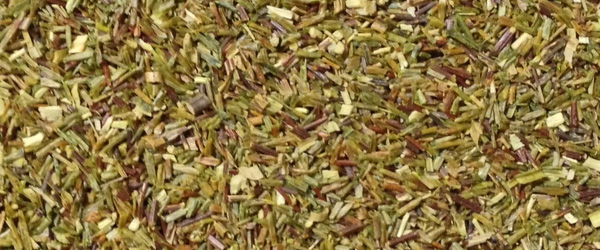
In green rooibos, the leaves (shaped like needles) are heated after picking to stop the oxidation process and keep the green color and mild flavor.
Rooibos has developed quite a following, especially with all of the press it’s been getting for being high in antioxidants. Only recently, however, have requests started coming in at the tea bar for “green” rooibos.
I am in the tea business because I love the flavors of tea. I’m not an herbalist, so everything I do with tea starts with the taste. I ordered in some green rooibos for the tea bar, and gave it a try. Green rooibos has minimal tannin content, so bitterness isn’t a danger. For my first try, I made a cup using 195-degree water (I’m at 5,500 feet altitude, so that’s about 7 degrees below boiling), and steeped it for 5 minutes. I used one tablespoon for a 13-ounce cup, and did not add anything (no lemon, sugar, milk…).
The first thing I noticed was the color. The liquid is a beautiful golden honey color, quite different both from most green teas and from the traditional red rooibos. The tea is smooth and woody, with just a hint of grassiness and nut flavor. True to promise, there’s no bitterness at all, and no need for additives. Just to push the limits, I re-used the leaves, steeping them for 10 minutes this time. The flavor and aroma were almost identical to the first cup.
There are a lot of claims out there about green rooibos being significantly higher in antioxidants than traditional red rooibos. A quick perusal of the research still shows mixed results on that, so I’m not going to take a position on the health effects. As I’ve mentioned before, I’m in it for the taste!
While writing this, I realized that I had tried it hot, but not iced. The folks over at Suffuse Rooibos say green rooibos makes a fantastic iced tea, so I took a break to make a cup of iced green rooibos (the research is the best part of this job!). I brewed it the same way (5-minute steep time), and poured it directly over a cup of ice cubes — again, I didn’t add anything to it. I found it refreshing and tasty; excellent for a hot day when I don’t want to overload with caffeine. I will definitely be drinking more of this!
 Tea With Gary