Blog Archives

Random observations from the tea bar

Looking for something pithy and educational about tea today? Well, you picked the wrong blog post. Today I am just posting a free association of recent observations and happenings at the my tea bar.
Never give up. Never surrender.

I love pu-erh tea. I have far more of it in the tea bar than our local population can justify, especially if you include the “dark tea,” which is tea fermented like a pu-erh but not produced in Yunnan. I have grown used to having to explain pu-erh to every person I mention it to. It’s part of the education mission of the tea world.
Then, one of my regulars brought in a friend from out of town. He bought a quarter-pound each of Irish Breakfast and my own Scottish Breakfast blend (which I call “Gary’s Kilty Pleasure”). He asked for something different, and I asked if he’d tried pu-erh. He knew what it was! He liked it! We probably spent 15 minutes talking about pu-erh and he bought a tuo-cha (bird’s nest shaped pu-erh cake) and some loose pu-erh. The education efforts of tea shops around the country are paying off!
I hate cheap equipment.
Some of the equipment in the tea bar has worked beautifully since the day we bought it. Some has been a source of endless frustration.
The milk heater/frother units we got from Keurig? One broke in just over 3 months, the other in just under a year. Fragile parts, hard to clean, cheap construction. The ones we got from a company I’d never heard of, on the other hand, are both working beautifully.
Tea timers? I suppose it’s not the manufacturer’s fault that we drop them from time to time. But some timers survive multiple drops and some die after the first.
Frothing wands? I just had to deal with our third dead wand in a year. They really should last more than six months. This just isn’t acceptable.
Never put out pressed tea samples
Found this out the hard way. One of our distributors carries these wonderful little pressed hearts of tea they call Antony & Cleopatra. I thought it was a cool novelty idea and ordered a pound of them. They’re black tea, not a pu-erh like most pressed teas. They are actually halfway decent black tea, which makes them better than just a novelty item. Just drop it in the teapot, pour in boiling water, and in a few minutes you have a cup of tea.
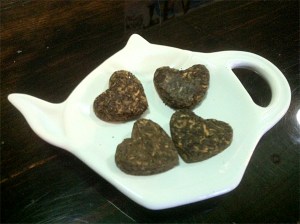
I put a big jar of them (sealed, of course) on the tea bar and a little plate (actually a cute little teapot-shaped teabag holder) in front of the jar with some of the tea hearts on it. Can anyone guess what happened? Anyone? Bueller? Yeah, that’s right. People ate them. Apparently compressed tea leaves make pretty yucky-tasting cookies. Who’d have guessed?
Bleach is your friend
Ever hear commercials for cleaning products that say “even gets out tough tea stains?” There’s a reason for that. Tea stains everything, especially infusers, filters, and teapots. Luckily, a tablespoon of bleach in a pint of water will get rid of all those tea stains in no time flat. Of course, you’ll be rinsing the bleach smell out for a little while, but it’s worth it. Sparkly clean!
Everybody thinks lattes have to have coffee in them
“Latte” is used in English as a short form of the Italian “caffè latte,” which simply means “coffee with milk.” Other drinks can have milk in them, too. Tea lattes are absolutely wonderful drinks. Generally speaking, they have two ingredients: tea and heated/frothed milk. Sometimes a sweetener. So why is it that people keep asking what kind of coffee we add to our tea lattes? They aren’t tea caffè lattes. They are tea lattes.
There. I feel better now.

Keurig K-Cups and Tea
We checked into the Lake Hotel in Yellowstone last week for the latest stop on my book signing tour. As usual, I schlepped in all of my tea stuff so I could have a decent cup in the morning: electric kettle, teapot, a selection of loose-leaf tea.
Frequently, hotels have coffee makers in the room (unless you’re in Las Vegas), but I don’t like having my tea water taste like coffee, so I don’t use them.
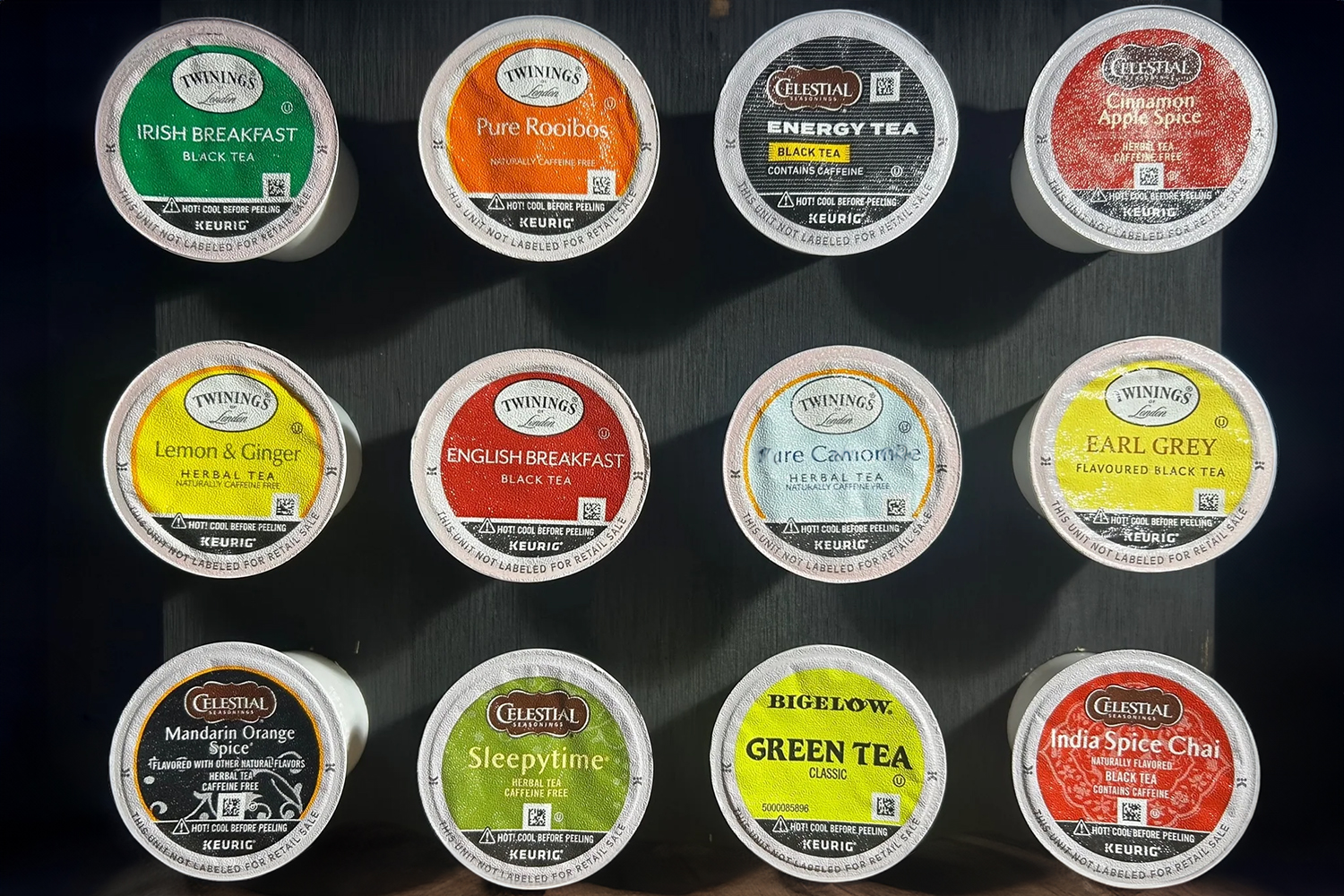
In this room, however, was a Keurig® B130 In-Room Brewing System, the kind that uses the single-serving K-Cups. The sampling of K-Cups in the room included two regular coffees, two decaf coffees, one tea, and one herbal blend. I decided to give their Celestial Seasonings English breakfast tea a try. For some reason, Celestial Seasonings decided not to capitalize “English.” Because of my Scottish heritage, that makes me smile, but that’s irrelevant to the subject at hand.

Following their instructions, I took the sealed cup, which had its lid puffed out from the altitude, and inserted it in the machine. When I closed it (puncturing the top & bottom of the cup), the top of the coffee maker popped open. I added a cup of water, set the mug in its place, and looked for adjustments. Finding none, I just pressed “brew.”
The cup was ready surprisingly fast (one point for the machine), with much hissing and burbling. And it tasted like … your basic cup of breakfast tea in a restaurant. I don’t take milk or sugar in my tea, so I use shorter steeping times than the British generally do. Unfortunately, there are no adjustments on this machine, so I got a stronger, more astringent brew than I wanted. Minus one point.
I couldn’t taste any coffee at all in my tea — and I am pretty sensitive to that flavor — so that’s plus one point.
After my wife removed the tea K-Cup and made herself some coffee, I decided to see if I could get a second infusion out of the tea. I carefully lined up the puncture hole on the bottom of the cup and reinserted it. I followed the rest of the process as before, and got a pretty decent second cup. It was weaker than the first, of course, and similar to what you’d get if you reused a tea bag.

Opening the used cup gave some insight into the workings. As you’d expect with a mass-market breakfast tea, they used CTC (crush, tear, curl) processed leaves, broken into quite small pieces. This provides the large surface area needed for the accelerated brewing process Keurig uses.
I understand you can purchase special empty K-Cups to fill yourself. It would be interesting to play around with whole-leaf teas and tweak the amount of leaf. Unfortunately, since you can’t adjust water temperature, the Keurig would destroy delicate white or green teas, and since you can’t adjust steep times, it would produce bitter oversteeped pu-erh or Darjeeling.
Interestingly, I took a look at the list of tea K-Cups on Keurig’s website, and it does include green and white tea. I’m guessing that their target audience probably uses boiling water in green tea anyway, and doesn’t realize it’s not supposed to taste like that. Most of their 50 selections are black tea, of course, and many are herbal tisanes rather than tea. There are a couple of chai selections there, and I’m guessing those would work.
In conclusion, if you’re looking for a fast, easy way to replicate your basic restaurant-style black tea, the Keurig will work admirably. If you want more than that, it’s a lot cheaper to buy an electric kettle and an IngenuiTEA, and you’ll get much better tea, too. The Keurig Brewer is at heart a coffee maker, and using it for making tea is like driving nails with a wrench: you can do it, but it’s a sub-optimal solution.
 Tea With Gary