Blog Archives
The Oolongs of Taiwan: Stop 6 on the World Tea Tasting Tour
Taiwan may not have originated oolong tea, but it is definitely at the forefront of oolongs today. At this stop on the tea tour, attendees learned about what oolong tea actually is, and tasted a variety of Taiwanese oolongs, including Bao Zhong, White Tip Bai Hao, and of course Tieguanyin, better known as “Iron Goddess of Mercy.” We’ll also talk a bit about the history of Formosa tea (Taiwan was called Formosa until the 1940s).

For comparison, we also tasted a couple of Chinese oolongs.
The teas we tasted were:
- Bao Zhong (Pouchong) – Taiwan
- White Tip Bai Hao – Taiwan
- Tieguanyin (Iron Goddess of Mercy) – Taiwan
- Wuyi (Shui Xian) – China
- Qilan (Dark) – China
- Boba (“bubble”) Tea – Taiwan

Officially, Taiwan is known as the Republic of China (ROC). It is an island off the coast of mainland China, which is officially known as the People’s Republic of China (PRC). The PRC lays claim to Taiwan, but the ROC has declared its independence and established its own government, currency, and economy. The island, formerly known as Formosa, is 13,978 square miles — only about a tenth the size of the state of Montana. It’s population, however, is about 23,315,000, which is significantly more than the state of Texas.
A variety of tea styles is produced in Taiwan, but their specialty is oolong. About 20% of the world’s oolong tea comes from this small island.
There have been wild tea plants on Taiwan for a long time. They were first reported to the Western world in a report in 1685. Chinese tea plants were brought out to Taiwan by Ke Chao in the late 18th century, and a Scotsman named John Dodd established a tea export business in 1869. Tea soon became Taiwan’s major export, and the Tea Research Institute of Taiwan was formed in 1926.
Oolong, which means “black dragon” in Chinese, is the most complex of tea styles to produce. Oolongs are generally not crushed or torn, and are only partially oxidized (not fermented), unlike green tea, which isn’t oxidized at all, and black tea, which is fully or almost-fully oxidized.
Generally, we tailor the steep time and water temperature to each individual tea in our tastings, but tonight we wanted to give everyone a solid basis for comparison, so we prepared all of the oolongs in 195-200 degree (F) water and steeped them for two minutes.
Pouchong

Pouchong is often spelled as “Bao Zhong” to more accurately reflect the way it is pronounced. It’s a very lightly oxidized oolong tea that appeals well to green tea lovers. Because of its mild taste and aroma, many flavored oolongs use pouchong as their base.
White Tip Bai Hao
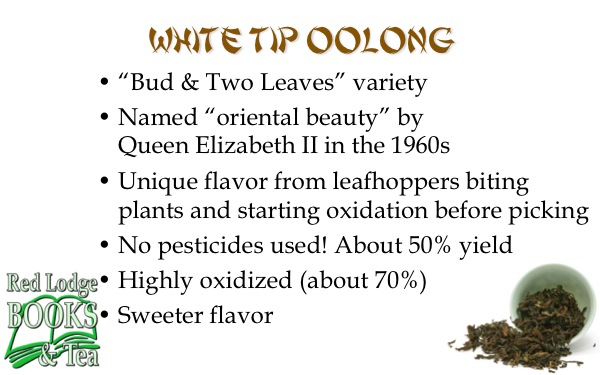
Here’s a tea with many names, including Bai Hao in the east and Oriental Beauty in the west. In the beginning, it was known as “bragger’s tea” because of the origin story (one of the stories that will appear in my new book, by the way), where a farmer went ahead and used leaves that had been chewed up by insects and discovered that the flavor was so wonderfully enhanced that he got twice his normal price at market.
Tieguanyin (Iron Goddess of Mercy)
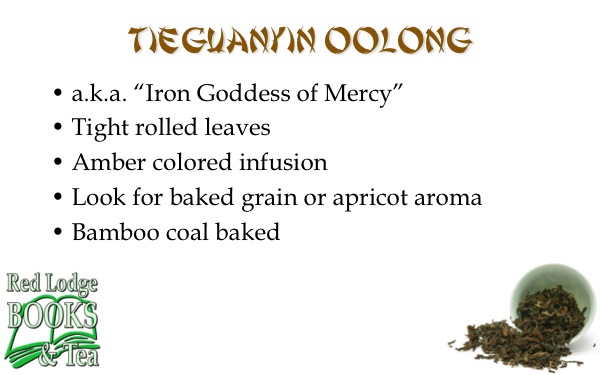
This style originated in China, but has become a staple of Taiwanese oolong as well. I’ve written about it before. Even with 120 different teas to choose from in my tea bar, it’s rare for me to go more than a couple of days without drinking a few cups of Tieguanyin. It’s generally good for at least 5-7 infusions, and it’s a great everyday tea.
Wuyi Oolong
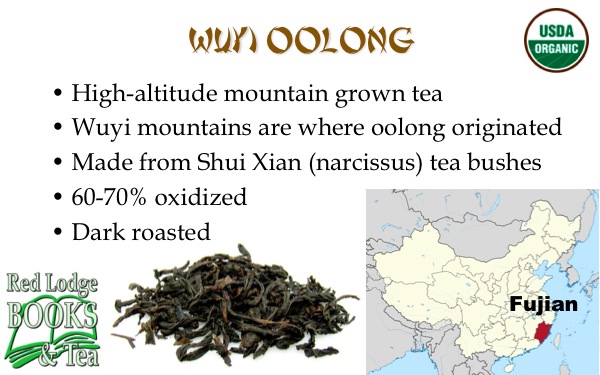
We then moved to the birthplace of oolong tea: the Wuyi mountains in the Fujian province of China. This tea is highly oxidized and then roasted to give a very full-flavored cup. We tasted it on the first stop (China) of our World Tea Tasting Tour, making this the first tea that’s been in two different tastings.
Qilan Oolong

Staying in that same area, we moved on to an even more oxidized and roasted dark oolong. Qilan (“profound orchid”) is actually a darker and more flavorful tea than many of my favorite black teas, like Golden Yunnan, Royal Golden Safari, and first-flush Darjeeling (all described in previous tasting notes).
Boba Tea

The most recent export from Taiwan is an iced drink they call “boba milk tea,” usually served as “bubble tea” in the United States. It has taken many urban areas here by storm, especially in the Pacific Northwest. Unfortunately, the way most of the mainstream purveyors prepare it, there’s no tea in bubble tea — they use snowcone syrups or similar super-sweet flavorings.
We prepare ours by steeping a strong cup of tea (tonight’s tasting used a mango-flavored tieguanyin as the base). In a cocktail shaker we add ice, simple syrup (sugar water), and a bit of milk. After shaking that into a froth, we pour it over fresh-made tapioca pearls.
This was the sixth stop on our World Tea Tasting Tour, in which we explore the tea of China, India, Japan, Taiwan, England, South Africa, Kenya, and Argentina. Each class costs $5.00, which includes the tea tasting itself and a $5.00 off coupon that can be used that night for any tea, teaware, or tea-related books that we sell.
For a full schedule of the tea tour, see my introductory post from February.
Oolong-related articles on Tea With Gary
-

The Iron Goddess of Mercy – Part 1
The Iron Goddess of Mercy Part 1 — China, 1761 — It was the reign of the Qianlong Emperor, the sixth emperor of the Qing Dynasty in China, but our story concerns no emperors, warlords, or nobles. It is just a tale of a humble farmer by the name of…
-

The Iron Goddess of Mercy – Part 2
The Iron Goddess of Mercy Part 2 — China, 1761 — It was the reign of the Qianlong Emperor, the sixth emperor of the Qing Dynasty in China, but our story concerns no emperors, warlords, or nobles. It is just a tale of a humble farmer by the name of…
-

Canon cameras and oolong tea
Why should you drink oolong tea when you’re taking pictures with a Canon camera? Let me explain…
-
The Oolongs of Taiwan: Stop 6 on the World Tea Tasting Tour
Taiwan may not have originated oolong tea, but it is definitely at the forefront of oolongs today. At this stop on the tea tour, attendees learned about what oolong tea actually is, and tasted a variety of Taiwanese oolongs, including Bao Zhong, White Tip Bai Hao, and of course Tieguanyin,…
-
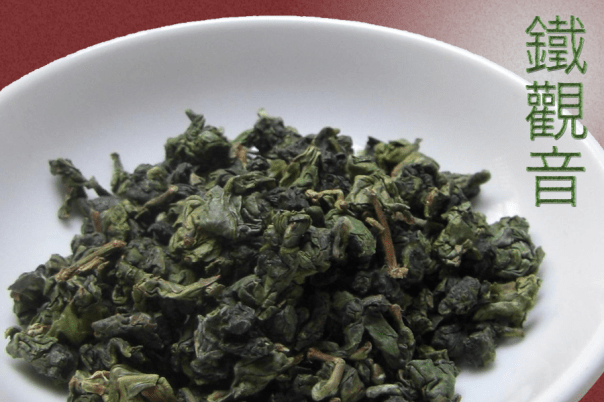
Free mystery tea (Tieguanyin)!
A friend stopped by the tea bar the other day and brought a bag of tea from China that a friend had given her. She didn’t know what it was, and she’d had it for five years, so she asked if I’d like to have it.
Our boba tea (“bubble tea”) experience
As my friends discovered that we were opening a tea bar at the bookstore, special requests began to pour in: Can you get me a first-flush Darjeeling? Will you have lapsang souchong? You’ll have gunpowder tea, right? Will you be stocking silver needle white tea? Are you going to have herbals? Can you bring in something good with ginger?
We selected our teas with a focus on “real” tea (Camellia sinensis) and related drinks like rooibos, honeybush, and maté. A few carefully-chosen herbals rounded out the mix. Then a friend asked if we were going to carry boba tea. Little did I know what that request would lead us to.

Stories vary, but the consensus seems to be that boba tea originated in Taiwan in the 1980s and took its sweet time (no pun intended) finding its way to the United States and picked up the nickname “bubble tea” because of the way it’s prepared. In Taiwan, it was called boba milk tea (波霸奶茶 or bōbà nǎichá), but it has many other names around the world. I have no idea whether there’s any truth to Boba Loca‘s story that “boba” is a children’s slang word for “nipple” in Mandarin.
Like chili or meatloaf, it seems that no two shops make boba tea the same way. What they all have in common is tapioca balls (“pearls”) sitting in the bottom of a chilled drink, and a fat straw big enough — just barely — to suck the pearls through. The “hip” places often use very sweet flavorings, similar to the ones used in sno-cones, and many of the boba “tea” drinks have no tea in them at all.
Typically, boba tea uses a base drink — typically a green or black tea — with milk and sweet syrup. This is placed in a shaker with ice and shaken into a bubbly froth (hence the appellation “bubble tea). The frothy mix is poured over tapioca pearls in a clear glass or plastic cup and served. As you drink the tea, the pearls randomly ride up the straw, and you find yourself with something chewy in your tea. It’s a joy watching people’s faces as they experience this for the first time!
I started asking people from the coasts, where boba is most popular, whether they thought it would make a good addition to our tea bar. The three most common answers were, “what the heck is boba tea?”, “yes, because then you’d be a real tea bar,” and “no, real tea bars don’t serve that stuff.” Given this massive lack of consensus, my wife and I flipped a coin and said, “What the heck? Let’s give it a shot.”
First decision: Since we are a tea bar, all of our boba would use real tea. After a bit of experimentation, I picked a nice black tea (organic English breakfast) and a jasmine green tea to use as a base. Two options should be adequate, right? How naïve I was!
Second decision: We’d keep the sweet syrup as basic as possible, and prepare it in advance. Since boba tea isn’t exactly a diet drink, we’d make it with real brown and white sugar, but we wouldn’t make it overly sweet.
The day after we launched our test in the store, a friend from the west coast told me that boba with chai tea is quite popular in Seattle. Coincidentally, we had recently brought in a new organic fair-trade chocolate chai for the tea bar, made with pu-erh tea and yerba maté. We gave it a shot, and it was an immediate hit. My attempt to simplify choices by only offering two base teas went right out the window. By the end of the day, we were making boba with any of the 80 teas we have at the bar.
We also found that special requests didn’t stop at the base tea. Miss Amber, a good customer of ours from another shop down the street, is from the South, and she likes her tea very sweet! We now have a “Miss Amber Boba,” made from cinnamon orange spice tea and about three times the normal amount of syrup.
Boba tea has turned out not to be the novelty drink we expected it to be, but a mainstay of the menu, especially on hot days. Some experiments in our store turn out to be wild successes and some turn out to be dismal flops. I’m going to give boba tea a “success” rating, and start looking for the next experiment. Thai red tea, perhaps?
 Tea With Gary
Complicated drinks, education, and consistency
Jul 7
Posted by Gary D. Robson
Is there some particular tea concoction that’s “your” tea drink? Is it something complicated? You’ll hear people every day in Starbucks ordering coffees that take twenty words to describe, but we don’t run in to that much in the tea bar … yet.
Why is it that more coffee drinkers than tea drinkers tend to be like the guys in this PVP Online comic? I think it’s a matter of education and consistency.
Most of our regulars at the tea bar are like me: they order something different each time they come in. I may go through phases where I drink nothing but malty Assam for a few days, but then I’m back to switching it up. I also drink different tea in the morning than I do in the afternoon or evening. Of course, I’m also that annoying guy that will go into a bar four times, order something completely different each time, and then ask for my “regular” on the fifth visit.
We do have some regulars that are consistent, but their drinks tend to be simple: a cup of sencha, Scottish breakfast with a touch of milk, or iced mango oolong. As people learn the menu and zero in on what they like, that is beginning to change a bit, though.
Amber is from the South. She likes her tea sweet, and she loves boba tea (a.k.a. “bubble tea”). I finally put the “Amber special” on the menu so she didn’t have to describe her boba tea made with Cinnamon Orange Spice tea, vanilla soy milk, and triple the usual sweet syrup.
Phyllis isn’t much of a tea fan, but she found herself drawn to Hammer & Cremesickle Red, which is a rooibos/honeybush blend. She likes it prepared as a latte with frothed 2% milk and a bit of honey.
Starbucks has dramatically changed coffee culture, much as McDonald’s has changed restaurants (I’m going to catch grief for that one, I know, but keep reading). You can go into a McDonald’s in an unfamiliar city, and you know that Big Mac and fries will be just like the ones back home. Similarly, you can go into any one of 19,555 Starbucks franchises and be comfortable that your half-caf double-shot venti skinny hazelnut macchiato will taste just like it would from the franchise back home. They have taught the world their own terminology (education) and made sure that the drinks are prepared exactly the same at each franchise (consistency).
Let’s look at those two factors as they apply to tea:
Consistency
The world of tea is generally not a good place for consistency. Even for fans of a single type of tea, the options are legion. There are dozens of matchas, hundreds of oolongs, and each has its own unique flavor. My tea bar offers six types of milk (nonfat, 2%, whole, half-and-half, vanilla soy, and almond), where another may offer 1%, light soy, and whole. When I went into the tea business’ closest thing to a national chain (Teavana – you can read about my visit here), they didn’t offer milk at all. You may go into one tea shop that has a hundred Chinese green and white teas and an English tea shop that has only black teas.
There’s a strong parallel to be drawn here with independent bookstores and big chains. You can find exactly the same books at a Barnes & Noble in Austin, Texas as you’d find in San Francisco, Denver, or New York. On the other hand, two indie bookstores a block apart can offer completely different experiences.
Tea aficionados revel in this. I enjoy wandering into a tea shop that has dozens of different pu-erhs available and tasting something I’ve never had before, even though I know the odds of finding that 1935 Double Lions Tongqing Hao anywhere else are close to zero (and the odds of being able to afford it are similar).
Tea shops can help a lot with this problem by proper labeling and by knowing the products well enough to compare our wares with popular brands from elsewhere. If someone walks into my shop that likes Constant Comment, I can guide them to my closest loose-leaf blend (that would be the aforementioned Cinnamon Orange Spice). If someone buys a mountain-grown Wuyi oolong in my shop, the next tea shop they visit should be able to give them something with a similar flavor profile.
Consumers can help by asking questions. If I have a breakfast tea I enjoy, I’ll ask the shopkeeper what’s in the blend. Then I’ll know to ask for an Assam/Tanzanian black breakfast tea blend next time I want something similar. I watch (or ask) how much leaf they use and what temperature the water is. Again, if I don’t know how they brewed it, I can’t ask for it to be prepared that way next time.
Education
The tea industry is where coffee and wine were a few decades ago. The average person has no idea what the difference is between a green tea and a white tea, but they know the difference between Merlot and Chardonnay. Tea people need to focus on education the same way wine and coffee people have done.
Educating customers is a bad thing for the mediocre shops. The more people learn about tea, the less likely they are to buy lower-grade products, and the less likely they are to buy from people who don’t know what they’re talking about. Once the person who’s been buying pre-sweetened chai from a box tastes fresh-brewed chai, they won’t be switching back.
On the other hand, education is a great thing for consumers and for good tea shops.
The more you know as a consumer, the better you’re able to find what you like and recognize the good products (and good prices). Educated consumers will frequent the better shops, and spend more money there, benefiting both the shop and the customer.
Share this:
Posted in Brewing
2 Comments
Tags: boba tea, chai, coffee, consistency, Constant Comment, education, McDonald's, PVP Online, Scott Kurtz, Starbucks, tea, wine