Category Archives: Tea Science

Temperature, Time, and Lying Kettles

So this guy walks into a tea shop… A joke? No, a story with a lesson in it.
This fellow clearly knew what he wanted when he walked into my shop. A traditional Earl Grey. I pulled out a couple of options and let him give them a sniff. He chose one, and then specified exactly how he wanted it brewed.
“Three minutes.” Easy. Check.
“Two tablespoons of milk.” No problem.
“212 degree water.” Well, now we have an issue.
What he really wanted was boiling water. This fellow lived quite close to sea level, and to him, boiling meant 212°F (100°C). What he didn’t know was that the boiling point of water changes with your altitude. At sea level, it is indeed 212°F, but the boiling point drops by about a degree for every 500 foot gain in altitude. Take a look at the graph above. The blue dot represents where my tea shop was, at an altitude of very close to 5,500 feet (1,680 meters). That makes the boiling point of water in the shop 202°F (94.4°C).
I explained to him that water simply can’t reach 212 at this altitude. It turns to steam at 202. I told him I would be happy to make his tea using boiling water, however, which is what everyone recommends for black teas like Earl Grey.
He wasn’t buying it. To him, tea must be made with 212° water. Period. End of sentence. I tried to explain that would mean he couldn’t have tea unless he was sitting on the beach. He said I was making excuses because I couldn’t boil water properly.
Luckily for me, my electric kettle lies
In the tea shop, I used Zojirushi electric kettles that keep water at a precisely specified temperature. I had one for black tea and one for green tea (I mixed it with cold water to get lower temperatures), so the right temperature water was always available at a moment’s notice.
I noticed something interesting soon after I bought my first Zoji: If you press the “quick temp” button, it will heat the water until it reaches your specified temperature. If you don’t, it will bring it all the way to a boil and then let it cool to your specified temperature. The interesting part is what happens when the water comes to a boil. It displays a temperature of 212°F (see the photo above). This, of course, made me mistrust their temperature readings, but more on that in a moment.
I added some water, told the fellow in the tea shop to wait a moment, and let the water come to a boil. I showed him the (completely wrong) temperature readout on the Zoji, made his tea, and let him leave my shop thinking he won. *sigh* The customer isn’t always right, but sometimes it’s not worth the trouble of introducing facts, no matter how solid the facts are and how easy they are to verify.
Postscript
As I said, the inaccurate temperature shown at boiling point is indisputably, inarguably, wrong. And I can’t see any way it was an accident. Zojirushi must have done it on purpose, as their temperature sensor in the water can’t possibly register 212°F at an altitude this high. Perhaps they did it to cut down on tech support calls, rather than trying to explain the bad reading.
I used a thermometer that I trusted to check the “hold” temperatures of 208, 195, 175, and 160. All of them were accurate to within a degree or two. That means that for everyday usage, it’s okay. It just means the marketing folks at Zoji must have overridden the engineers, who certainly know better.
As I write this, I’m drinking an excellent Tanzanian green tea. The fluffy twisted leaves provide a great “agony of the leaf” display as it steeps and the tea tastes excellent. I steeped it at 175°C for two minutes, and got three infusions from the leaves.

Is Your Tea Gluten Free?

The answer to this question should be easy. All tea comes from the Camellia sinensis plant. It is not grain. It contains no gluten.
For those casually following the gluten-free lifestyle, that answer should be enough. But for those with celiac disease, a bit more detail may be required:
A lot of things are called tea that aren’t tea
As the first paragraph said, real tea comes from Camellia sinensis. But many (most?) people refer to anything that involves steeping leaves or flowers in hot water as tea: yerba mate, rooibos, chamomile, honeybush, and so forth. Technically, they are tisanes or infusions, but they are often sold as tea.
So if you’re buying actual black tea, green tea, oolong, pu-erh, or white tea, all is well. If you’re buying “herbal tea,” you’d better take a closer look at that label.
But wait…
Flavored teas have all kinds of additives
You may be getting a nice black tea that’s totally 100% gluten-free, but many flavored blends are sweetened. One of the things they may be sweetened with is malted barley, which does contain gluten. There’s not going to be very much of it, but it may be enough to cause problems for celiac patients.
So if you’re buying unflavored straight black tea, green tea, oolong, pu-erh, or white tea, all is well. If you’re buying flavored teas, you’d better take a closer look at that label.
But wait…
Gluten in teabags? Really?
A number of tea companies use sealants for their teabags that contain gluten. There’s no gluten in the tea itself, but once you dip that bag in boiling water and the glue starts to melt, you’re picking up a tiny bit of gluten. By “tiny bit,” we’re talking a few parts per million in the brewed tea here, which is a tiny fraction of what it takes to cause reactions in someone with celiac disease. But if you’re actually looking for ZERO gluten content, we’re not quite there yet.
So if you’re buying loose-leaf unflavored straight black tea, green tea, oolong, pu-erh, or white tea, all is well. If you’re buying teabags, you’d better take a closer look at that label.
But wait…
Cross-contamination
Now we’re getting into incredibly small amounts, but some tea companies use the same facility for manufacturing tea as they use for manufacturing products that contain gluten. There is a possibility of airborne cross-contamination from those products.
At this point, we might as well be talking about any other food product on the planet. Can we guarantee that there wasn’t a wheat field next to the farm where your tomatoes were grown? A big mug of tea might use 7 grams of tea leaf. Cross-contamination at 1 ppm means 7 micrograms of gluten. That’s about one millionth of the gluten you’d get from a couple of slices of bread or a pint of beer.
According to this article, “research has suggested that a daily gluten intake of less than 10 milligrams (mg) is unlikely to cause significant damage to the intestines in most people with celiac disease.” The gluten you’d pick up from teabag glue or cross-contamination is less than a thousandth of that amount.
That same article says that, “In most parts of the world, regulations say that to be labeled gluten-free, a product can contain up to 20 parts per million (ppm) of gluten.” That means a slice of gluten free bread could still contain 100 times the gluten of a cross-contaminated cup of tea!
I am not a nutritionist, medical practitioner, or scientist, but I think those numbers make it pretty clear that if someone with celiac disease wants to drink a few cups of tea every day, it’s going to be just fine.
As I write this, I’m sipping on a cup of Jinxuan Jade Oolong, a rich buttery semi-oxidized tea that has replaced Iron Goddess of Mercy as my regular morning cup. I steep it 3:00 in boiling water, and then get three more cups out of it, adding a half-minute of steep time to each successive infusion. Although it is of the “milk oolong” style, it contains neither milk nor gluten.

What’s the Healthiest Tea?

Unlike some of the other questions I address here, this one has a very straightforward answer. The healthiest tea is the one you’ll actually drink.
Figuring out which specific tea has the most health benefits is a complex task. Most styles and brands don’t have lab analysis of their antioxidant content, caffeine levels, and other details. Many scientific reports and studies are being misinterpreted, and others are being oversimplified.
Here’s the bottom line, though: if you don’t like the taste of a tea, you won’t want to drink it. You’ll have fewer cups per day. You’ll use smaller cups. You’ll use less leaf.
But if there’s a variety that has a bit less benefit — perhaps half of those healthy amino acids you’re after — and you love the flavor, you’ll drink more. You’ll use one of those big American mugs instead of a dainty British teacup. You’ll make it stronger. You’ll sneak in extra cups because you enjoy it. And even though each cup has less of what you’re trying to get, you’ll get a lot more.
So if your goal is to drink more white tea, don’t just buy a pound of the first (or cheapest) white tea you find and choke it down. Experiment! Try a variety of white teas and buy the one you really enjoy drinking. If you want green tea and you don’t like the Chinese variety you tried, try a few Japanese green teas.
Whether you’re in this for the health benefits or for because you enjoy tea, it’s fundamentally all about the taste!


How much caffeine is in my tea?
I wish there was a simple answer to this question. It would be ever so cool if I could just say, “black tea has 45 mg of caffeine per 8-ounce cup.” In fact, a number of people say it actually is that simple. Unfortunately, they’re wrong.
This graph came from the front page of the eZenTea website:

And this one is from a tweet from SanctuaryT (it said, “Finally, the truth about #tea and #caffeine!”):

They make it pretty simple, right? But that’s not very useful when they disagree with each other! The first chart shows the caffeine in green tea at 20 mg/cup and white tea at 10 mg/cup, showing that white tea has half as much caffeine as green tea. The second chart shows green tea at 25 mg/cup and white tea at 28 mg/cup, indicating that white tea has 12% more caffeine.
Then we get confusing (and frankly pretty silly) charts like this one from HellaWella:

All three charts have green tea in the same basic range (20-25 mg/cup), but the HellaWella chart breaks out black tea (which is 40-42 mg/cup in the other two charts) into “brewed tea” at 47 mg/cup and “brewed imported tea” at 60 mg/cup. Huh? “Imported”? HellaWella’s “about” page doesn’t say what country they’re from, but I’m going to guess from the spellings that they’re from the U.S. Sure, there are few small tea plantations in the U.S., but I would venture to guess that approximately zero percent of casual tea drinkers have ever had a domestically grown tea. In America, pretty much all tea is “imported.”
So why the discrepancies?
Because the people making these charts (a) don’t explain their methodology and/or (b) don’t understand tea.
As I explained in my three-part caffeine series (here’s part 1), green, white, oolong, black, and pu-erh tea all come from the same species of plant (Camellia sinensis), and in some cases, the same actual plant. We carry a black and a green Darjeeling tea that are picked from the same plants, but processed differently. No part of that process creates or destroys caffeine.
Let me make that clear: let’s say you pick a bunch of tea leaves on your tea farm. You divide them up into four equal piles. You turn one pile into green tea, one into white tea, one into black tea, and one into oolong tea. When you’re done, you make a cup of tea from each. Assuming you use the same water at the same temperature, use the same amount of leaf per cup, and steep them for the same time, they will all have the exact same amount of caffeine.
If that processing doesn’t change the caffeine content, what does?
- The part of the plant that’s used. Caffeine tends to be concentrated in the buds and leaf tips. A high-quality golden or white tea made from only buds will have more caffeine than a cheap tea made with the big leaves farther down the stem.
- The growing conditions. Soil, rainfall, altitude, and many other factors (collectively known as terroir) all affect how much caffeine will be in the tea leaves.
- The time of year the leaves were harvested. Tea picked from the same plants several months apart may have dramatically different amounts of caffeine.
- How long you steep the tea. The longer those leaves sit in the water, the more caffeine will be extracted into your drink.
- How much leaf you use in the cup. Use more leaves, get more caffeine.
- How big the cup is. This seems ridiculously obvious, but it’s something a lot of people miss. Anyone who went to elementary school in the United States knows that one cup = eight ounces. However, a four-cup coffee maker doesn’t make 32 ounces (8 x 4); it makes 24 ounces. They decided their coffee makers sound bigger if they use six-ounce cups.
Even if you and I measure the same amount of leaf out of the same tin of tea, your cup might have twice the caffeine of my cup, depending on how we like to fix it. Unless we both precisely followed the ISO 3103 standard for brewing the perfect cup of tea.
Unfortunately, the lab tests to assess caffeine content are expensive, so most tea shops never test their teas. On top of that, people can’t seem to agree on how to brew the tea they are testing. I read one study where every tea was brewed for five minutes in boiling water. That’s consistent, but it’s not realistic. You don’t brew a Japanese green tea that way, or you’ll have a bitter, undrinkable mess. Another, by Kevin Gascoyne, tested tea as most people drink it (e.g., black tea in boiling water, white tea in cooler water). That’s better but even still, Kevin’s way of brewing a particular tea may not be the way I do it.
The bottom line is that every tea is different. Very different. In fact, Kevin tested two different sencha teas and one had four times the caffeine of the other. If someone shows you a handy-dandy chart that indicates exactly how much caffeine a cup of tea has (as opposed to showing a range), it’s wrong.
While writing this blog post, I was drinking green rooibos from South Africa, which has no caffeine at all. It is a non-oxidized “redbush” tea has a much softer flavor than red rooibos. I brewed this cup for 4:00 using boiling water. It’s a remarkably forgiving drink, and I’ve steeped it for as long as 10 minutes without ruining it. It’s usually good for at least two infusions.

Tips for reading news about tea studies
As I write this in 2014, Dr. Oz is being thoroughly (and rightfully) shredded by the Senate Commerce, Science, and Transportation Committee for pimping weight-loss scams, we shouldn’t lose sight of the fact that (a) there are a lot of valid health benefits to tea, and (b) virtually every news story about tea and health manages to misrepresent or misinterpret the scientific study they’re describing.
As you read articles about tea and health, it’s important to keep in mind that the person writing the article is usually not the person (or people) who actually performed the study it references, and that the reporter/blogger may have read only the summary, not the whole study. Also, in larger news operations, the person writing the headline isn’t the same person who wrote the article, and if they’re operating on a deadline, the headline may not accurately sum up the story.
Tip 1: Beware of extreme claims
There’s an article on Authority Nutrition entitled,”How Green Tea Can Help You Lose Weight Naturally.” It’s worth reading. There are good explanations of the benefits of tea, and it cites dozens of actual scientific studies. But any article that begins with a statement like “green tea is the healthiest beverage on the planet” should set off alarm bells. No, there’s never been a study that tested every single beverage on the planet (there’s never been a study of every style of tea on the planet, for goodness’ sake). No, we don’t have a generally-accepted definition of “healthiest beverage.” An opening sentence like that one tells you you’re about to read something sensationalistic, and you should view everything they say with skepticism.
Any article that begins with a statement like “green tea is the healthiest beverage on the planet” should set off alarm bells.
Tip 2: They only studied what they studied
There’s an article on Byron J. Richards Wellness Resources entitled, “The Effects of Green Tea on Weight Management.” The author is a Board Certified Clinical Nutritionist, the studies cited all appear to be properly-conducted randomized controlled trials, and the conclusions all appear to be realistic. So what’s the problem? Reading this may make you want to rush to your tea cabinet and throw away all of those white teas, oolong teas, yellow teas, and pu-erh teas. You need to replace those all with green tea, right. Wrong!
The studies looked at green tea. Specifically, they measured catechins and caffeine in green tea. They never compared green tea with white tea—or any other kind of tea. White tea may be even better for weight loss. So might oolong, pu-erh, or yellow. If green tea is measured against anything else in a study, it’s almost always black tea. What’s the difference between green and black tea? Black tea is oxidized, and that process converts a lot of the antioxidants into other compounds (catechins are a type of antioxidant). But white and yellow tea isn’t oxidized, and oolong is only partially oxidized. Shu pu-erh is oxidized and fermented, and sheng pu-erh is fermented without being oxidized first. Don’t draw conclusions about your oolong from a study that never even looked at oolong!
Tip 3: There’s more to tea than antioxidants
I think it’s pretty universally agreed that antioxidants are a good thing, but they aren’t the only source of health benefits in tea. When I got in a tiff with Fox News’ Chris Kilham about misrepresenting studies, it related to a study that showed coffee had some great health benefits. Reading the study showed that it looked at one thing: caffeine. All of the health benefits it listed for coffee would apply just as much to tea, guayusa, yerba maté, or Mountain Dew. If you like black tea, don’t let yourself get talked out of drinking it just because it doesn’t have the same antioxidant content as green tea.
Tip 4: All green tea is not created equal
It’s wonderful to see an article like the one titled, “Green Tea,” on the University of Maryland Medical Center page. It has tons of information, cites numerous studies, and explains potential drug interactions and side effects. But, like all of the other articles, it just references “green tea.” Did they test Japanese steamed green tea like sencha? Pan-fired Chinese green tea like longjing? Or was it roasted (hōjicha), powdered (matcha), shade-grown (gyokuro), scented (jasmine), or rolled (gunpowder)? The Kevin Gascoyne study I referenced in my 3-part series on caffeine found tea caffeine content ranging from 12mg to 126mg per cup. Yes, the most caffeinated tea had ten times as much caffeine as the least. He found a similar range of antioxidant contents. If you want to replicate the results of the study, you have to know what kind of tea they used.
Tip 5: Pay attention to who funded the study
If they had done a study that found that green tea gives people smelly feet, how much publicity do you think that would have gotten?
You can’t automatically discount a study because the funding group had something to gain from it. Tea companies are the ones most likely to fund tea studies, after all. But take a look at “Green Tea Promotes Weight Loss, New Research Finds,” an article on Medical News Today (well, actually, it’s a press release, but they don’t make that obvious until the end). It’s very clear in reading the article that Lipton did the research, and that Lipton is very excited about having done the research. It’s a big company, and their PR department did a good job of really spreading the news about that study.
If they had done a study that found that green tea gives people smelly feet, how much publicity do you think that would have gotten? I always tend to pay a little more attention to research coming from neutral parties, or research that’s been duplicated by neutral parties.
Tip 6: Check to see if the methodology was realistic
WebMD has an article entitled, “Green Tea Fights Fat,” which does appear to actually compare weight loss effects of green tea with oolong tea. But read this sentence from the article carefully: “For three months, the first group drank a bottle of oolong tea fortified with green tea extract containing 690 milligrams of catechins, and the other group drank a bottle of oolong tea with 22 milligrams of catechins.”
First, they aren’t comparing green tea with oolong. Both groups drank oolong tea. In one group, they added green tea extract, and in the other, they didn’t. So this study actually compares drinking oolong with drinking oolong plus green.
Second, the average cup of green tea has 50-100mg of catechins. That means the “extract” they fortified the bottle of oolong with made it equivalent to 7-14 cups of green tea. That’s a lot of tea!
If you have specific reasons for controlling your intake of caffeine, L-theanine, catechins, and other components, then there’s plenty of research to plunge into. Focus on people who actually study tea rather than folks like Dr. Oz or Oprah. Look at the paper and see what they actually studied. If it doesn’t apply to you, move on to the next one. If it does, take it at face value without trying to overgeneralize.
But if you’re just looking for a healthy drink that tastes good, stop worrying and buy more of what you like the most. You’re likely to drink a lot more of a beverage you love than one you don’t. If you like to experiment, all the better! If you drink a wide variety of tea, you’ll get a wide variety of nutritional benefits, and you can enjoy yourself as you do it.

Caffeine Math: How much caffeine is in a tea blend?
For some reason, it seems like I write a lot about caffeine on this blog. My three-part series on the subject is the most popular thing I’ve ever posted. My recent post about theanine talked about caffeine as well. One thing I haven’t addressed in detail is what happens to caffeine content when you blend tea with something else.
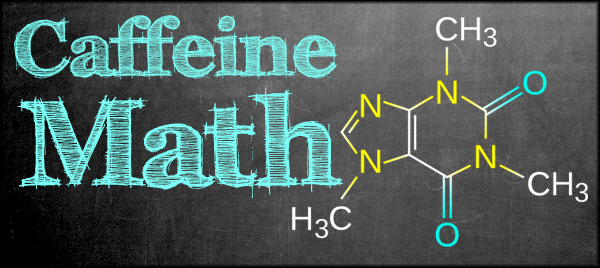
The first thing we have to do is clear our minds of preconceptions. Remember that there’s no simple formula saying that one kind of tea has more caffeine than another (see my caffeine myths article for details). And resign yourself to the fact that there’s no way short of spending a couple of thousand dollars on lab tests to determine how much tea is in a commercial blend, for reasons I’ll explain in a moment.
Let’s start with an example. Assume you have a tea you enjoy. You use two teaspoons of tea leaf to make a cup, and we’ll say this tea gives you 20mg of caffeine. You decide to use this tea in a blend. What happens to the caffeine level?
Ingredient blends
If you blend with other bulk ingredients, the caffeine calculations are simple ratios. If you blend the tea 50/50 with peppermint, then instead of two teaspoons of tea (20mg of caffeine), you’re using one teaspoon of tea (10mg of caffeine) plus one tablespoon of mint (no caffeine). You’ve cut the amount of caffeine in half. If your blend is 1/3 ginger and 2/3 tea, it will have 2/3 as much caffeine as the straight tea.
If you’re blending tea with other tea, the ratios work the same way. Blend together two tea styles with equivalent caffeine levels and the result will have the same amount of caffeine as the original tea blends.
All of this is contingent upon your measuring techniques. It becomes more complicated if you blend by weight instead of volume. Put together a cup of green tea and a cup of peppermint, and two teaspoons of the blend will contain (about) one teaspoon of tea and one teaspoon of mint. If you put together an ounce of gunpowder green tea and an ounce of peppermint leaves, the result is very different. Gunpowder tea is very dense, and peppermint leaves are light and fluffy. Two teaspoons of that mixture might only have a half teaspoon of tea, which means a quarter of the caffeine.
Extracts and oils
In many commercial tea blends whole ingredients like chunks of berry, flakes of cinnamon, and bits of leaf are more for looks than flavor. Soak a strawberry in hot water for three minutes and you’ll see what I mean. The real flavoring in those blends comes from extracts and essential oils that are sprayed on the tea leaves. In that case, the caffeine content is pretty much unaffected. A teaspoon of flavored tea leaves has the same caffeine as a teaspoon of unflavored tea leaves.
A little tea blending secret: sometimes the chunks of fruit in the tea really are chunks of fruit, but they’re not what you think they are. Tea blenders can purchase small chunks of dried apple that are sprayed with (or even soaked in) flavorings or extracts. Your piña colada blend might just be apple bits flavored with coconut and pineapple extracts. There’s very little flavor in the dried apple, so all you’re getting is the flavoring that was added. Why use them at all? Because it’s easy to experiment with, it doesn’t require the tea company to invest in leaf-spraying equipment, and it adds some visual variety to the blend. The chunks can even be colored.
A couple of real-world examples
Let’s start with genmaicha. This is a classic Japanese blend of green tea and roasted rice. I started with a tablespoon of my favorite genmaicha:

The base tea in this blend is sencha, which is fairly easy to recognize from the color and needle shape of the leaves. I don’t know the exact caffeine content of the sencha, but I can do a bit of Googling and come up with an estimate. Let’s go with 30mg per cup. Now, we’ll separate the tea leaves from the rice:

The main thing I learned from this exercise is that I don’t have the patience to pick all of the rice out of a tablespoon of genmaicha! The separation I did showed that a tablespoon of this particular genmaicha contained about 1/3 tablespoon of rice and 2/3 tablespoon of sencha. Since rice has no caffeine, that means a cup of this genmaicha probably has about 20mg of caffeine in it.
I was going to try the same experiment with a Moroccan mint tea, but found that the one I have on hand has no peppermint leaves. It appears to contain only tea leaves and mint extract. That means it has the same caffeine level as the tea used to make it — in this case a gunpowder green tea.
Doing the math
I don’t think you actually have to do much math to estimate caffeine levels. It’s imprecise at best because tea leaves don’t come labeled with their caffeine content. But if you look at a tea blend and it appears to be about half tea leaves and half something else, it’ll have about half the caffeine of the tea alone. Some blends I’ve looked at lately appear to have very little tea leaf — those might as well be decaffeinated tea! Others, like the Moroccan mint I mentioned a moment ago, are almost entirely tea, so treat them just as you would unflavored tea.

Tea and theanine
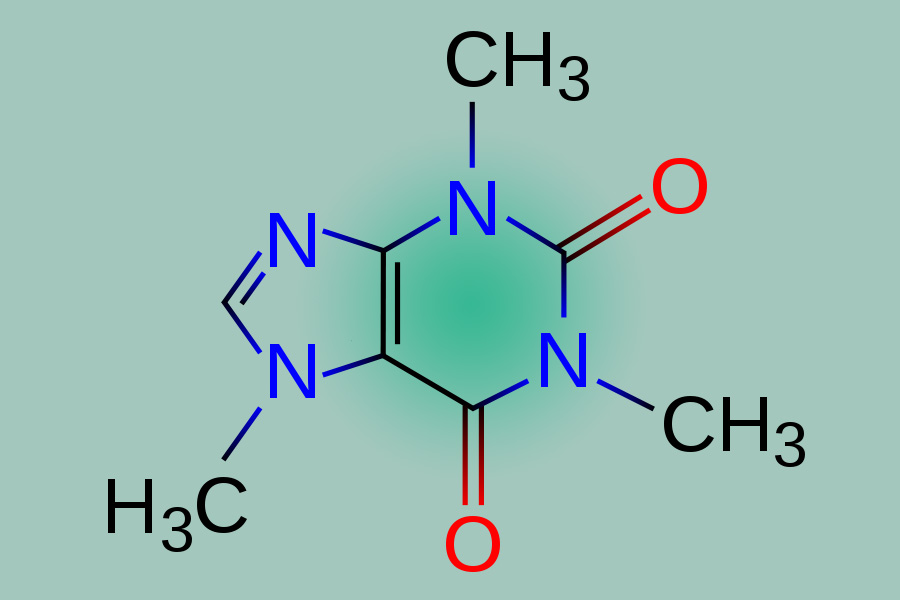
I mentioned theanine (C7H14N2O3) in the first post of my caffeine trilogy, but I haven’t really gone into any detail about it. I suppose now is as good a time as any.

L-theanine (commonly just called theanine) is an amino acid found in tea, guayusa, and certain mushrooms. It acts as a relaxant, helps to improve concentration, and adds a savory (umami) flavor to whatever it’s added to. Most important—at least when we’re talking about tea—is what it does when combined with caffeine.
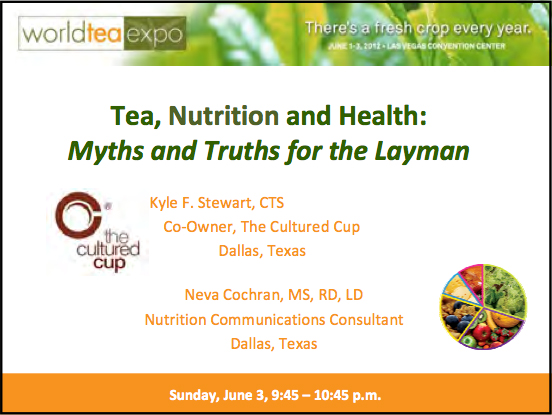
At the 2012 World Tea Expo, I attended a session entitled “Tea, Nutrition and Health: Myths and Truths for the Layman,” presented by Kyle Stewart and Neva Cochrane. They discussed the relaxation and alertness affect of tea, and also noted that a “2012 study found tea was associated with increased work performance and reduced tiredness, especially when consumed without milk or sugar.”
This caught my attention not only because of the increased work performance, but because it validated my personal preference for tea without sweetener or milk.
Stewart and Cochrane attributed the increased work performance to the combination of caffeine, theanine, theophylline, and theobromine. There have been some excellent articles on theanine, including Tony Gebely’s “Theanine: a 4000 Year Old Mind-Hack” and RateTea’s “L-Theanine and Tea.”
Both of them agree with the conclusion that theanine coupled with caffeine produces a seemingly-contradictory combination of relaxation and alertness. This isn’t news to tea aficionados, of course. People have been relaxing and focusing themselves with tea for millennia. Many of the health benefits of tea come from the caffeine, and those obviously apply to theanine-free drinks like coffee, cola, and cocoa.
Caffeine by itself doesn’t work quite the same way, however.
The “spike & crash” affect of caffeine is well known to any coffee drinker. You’re droopy and tired, you have your morning cup, and you swiftly find yourself wide awake and full of energy. A while later, bam! You’re back where you started, and possibly in a pissier mood than when you started. Yes, I said “pissier.” It’s a technical term. When drinking tea, thanks in large part to the theanine content, the effects take longer to kick in, and also take longer to wear off. Mixing a relaxant (theanine) with a stimulant (caffeine) works quite well in this case.
Wikipedia summarizes a half-dozen studies with this statement:
“Theanine has been studied for its potential ability to reduce mental and physical stress, improve cognition, and boost mood and cognitive performance in a synergistic manner with caffeine.”
“Boost mood,” eh? As I wrote last week, there has been at least one study that indicates tea improves mood. That study, however, defined a good mood as decreased fatigue. It appears that there may be more to the mood-enhancing effects of tea than my previous post indicated!
Tea, Hydration, Elevation, and Good Moods
I have heard it since I was a kid: Drink plenty of fluids means water. It doesn’t include caffeinated beverages like tea. That statement didn’t come with much explanation when I was little. Later, Mom explained that only clear liquids count. I couldn’t figure out why 7-Up was okay when I was sick, but iced tea wasn’t. When I got married, my wife explained to me that it was the caffeine that caused the problem. Caffeine, you see, is a diuretic. That means it makes you pee. The more you drink, the less hydrated you are. This explanation has always bothered me, but I never went to the trouble to research it for myself.
Until now.

I came across a paper entitled Caffeine ingestion and fluid balance: a review, by R.J. Maughan and J. Griffin. They reached the conclusion that large amounts of caffeine consumed by people unused to caffeine can, indeed, cause dehydration. On the other hand, people who regularly drink caffeine can consume quite a bit of it without a problem. To quote their results directly:
“The available literature suggests that acute ingestion of caffeine in large doses (at least 250-300 mg, equivalent to the amount found in 2-3 cups of coffee or 5-8 cups of tea) results in a short-term stimulation of urine output in individuals who have been deprived of caffeine for a period of days or weeks. A profound tolerance to the diuretic and other effects of caffeine develops, however, and the actions are much diminished in individuals who regularly consume tea or coffee. Doses of caffeine equivalent to the amount normally found in standard servings of tea, coffee and carbonated soft drinks appear to have no diuretic action.”
In conclusion, when I am sick and/or dehydrated, I may feel free to drink my tea.
But wait! It gets better! I came across another paper entitled The effect of drinking tea at high altitude on hydration status and mood by D. Scott, J.A. Rycroft, J. Aspen, C. Chapman, and B. Brown. This is an absolutely awesome study, simply because they performed it at Mt. Everest base camp. It’s not a statistically valid sampling (only 13 people participated), and I’m not sure how valid a study performed at 17,500 feet altitude is for us lowlanders at 5,500 feet. But, hey, it was done at Mt. Everest base camp, and the procedure they used in the study does seem reasonably rigorous.
To put the results in their own words:
“The study shows therefore that even when drunk at high altitude where fluid balance is stressed, there is no evidence that tea acts as a diuretic when consumed through natural routes of ingestion by regular tea drinkers, but that it does have a positive effect on mood.”
Immediately upon reading this, I began putting together a list of people that might benefit from a few cups of tea. There are even those rare occasions when my own mood is not particularly sunny and bright. Not many, of course, but I must be prepared and have some good tea set aside for those moments.
Alas, upon closer reading I discovered that the “positive effect on mood” is actually “subjects reporting reduced fatigue when tea was included in the diet.” Oh, well. If you think about it, tea has long been touted as a good relaxant, so this particular finding makes sense.
With my hopes for a worldwide cure for bad moods rudely dashed, I shall have to fall back on tea as a way to hydrate and reduce fatigue. Sounds like the perfect thing to have along on a hike or at the gym. Surely that’s no surprise to my tea-loving readers!
Kombucha: A Tea Guy’s Perspective

Several times in the last couple of years, people have come in to the tea bar and asked if we have kombucha. The first time, I did a quick Google search, looked at the process required to brew it, and said no. After the third time, I figured I should look a bit deeper into this phenomenon. Conveniently enough, the Healthy Beverage Expo was held in Las Vegas alongside the World Tea Expo (the largest trade conference in the tea business), so I was able to sign up for a kombucha seminar to go along with all of the tea seminars I was taking.
I learned quite a bit in the seminar, although virtually none of what the instructor covered was applicable to a tea shop serving freshly-brewed drinks. Almost everything she talked about applied to RTD (ready-to-drink) bottled beverages, which really doesn’t interest me. We don’t serve bottled tea or soda — or even bottled water — so RTDs didn’t really interest me much. I was there to learn about fresh beverages.
Following the seminar, I did some further research and made an informed decision about selling kombucha in my tea shop. Here is my thought process:
What is kombucha?
Kombucha is a fermented drink made from a fairly heavily sweetened black tea (about 1 cup of sugar per gallon of tea), although other types of tea can be used as well. A symbiotic culture of bacteria and yeast known by the acronym “SCOBY” (it stands for “Symbiotic culture of bacteria and yeast”) is placed on top of the tea blend. It grows into a gelatinous mass on top of the tea as it ferments the sugars in the tea mixture. After a week or so, the freshly grown bacteria/yeast mat can be separated out into a new SCOBY for the next batch, and the liquid can be drawn off to drink.
It’s really good for you, right?
First of all, I don’t select teas based on health claims. I select teas that taste good. At times, those goals align, but I’m frankly underwhelmed at the amount of hard data backing most herbal health claims, and I’m not going to pass on health claims to my customers unless they are backed up by honest-to-goodness, peer-reviewed, reproducible studies — preferably with double-blind clinical studies.
Sitting in the kombucha seminar, I was struck by the PowerPoint slide titled “Health Benefits.” It listed every imaginable ailment from cancer to Alzheimer’s, heart disease to diabetes. The list was absolutely stunning. Before I had a chance to react, someone else in the audience asked what the basis was for this list. The instructor informed us that she had recorded everything her friends, family, and customers had told her. If someone told her they drank kombucha and their gout got better, she’d put gout on the list.
In other words, all of these health benefits were unconfirmed hearsay with no scientific basis whatsoever. A short amount of digging brought me to an article on kombucha by the American Cancer Society. I think one quote from that article sums it up really well:
Available scientific evidence does not support claims that Kombucha tea promotes good health, prevents any ailments, or is works to treat cancer or any other disease. Serious side effects and occasional deaths have been linked with drinking Kombucha tea.
Not exactly a ringing endorsement.
Logistics of kombucha
In a tea bar environment, I have dried leaves with a shelf life measured in months. The few fresh items I need, such as milk, boba pearls, and lemon slices, can either be purchased on a moment’s notice at the grocery store, or made in a matter of minutes. Kombucha requires at least a week to brew, which means if you want to serve it fresh, you need to be very good at predicting demand a week in advance.
If you wish to store and keep it, you have to bottle or keg it, and that takes me back to the RTD issue I opened this article with. If I’m going to serve a bottled beverage, I’d might as well buy it from someone else instead of trying to ferment it myself.
Fermentation leads to another issue as well. The yeast in the SCOBY does exactly what yeast does in beer or wine: it consumes sugars and excretes alcohol and carbon dioxide (CO2). The CO2 provides carbonation, most of which is allowed to escape. The alcohol is another issue. The Federal government puts strict controls over alcohol content in beverages. If you wish to sell fresh-brewed kombucha, you must carefully control and measure the amount of alcohol.
Not only can we not sell beverages to children if they contain more than a fraction of a percent alcohol, but without the proper licenses, we can’t produce alcoholic beverages in the tea bar anyway.
My conclusion
I used to do a lot of homebrewing. I really enjoyed making and drinking my own beer. If I still had all of my equipment set up for the beer, I’d probably brew up a batch of kombucha just for fun, although I’ve yet to try a kombucha that didn’t taste like old gym socks. I’m not, however, going to make it in the tea bar because the logistics are complex, it doesn’t fit the business model of freshly-brewed tea, and the health benefits are unsubstantiated.
Tea and caffeine part III: Decaf and low-caf alternatives

This article is the second of a three-part series.
Part I: What is caffeine?
Part II: Exploding the myths
Part III: Decaf and low-caf alternatives
So you’ve decided you like tea, but you really don’t want (or can’t have) the caffeine. What are your alternatives?
Well, first there’s decaf tea. As Part I of this series explained, decaffeination processes don’t remove 100% of the caffeine, so this is a reasonable alternative if you want less caffeine, but not if you want none at all. There’s another problem with switching to decaf: the selection of high-quality decaffeinated tea is — let’s just say, limited.
It’s easy to find a decaf Earl Grey or a decaf version of your basic Lipton-in-a-bag. But if your tastes run more to sheng pu-erh, sencha, dragonwell, lapsang souchong, silver needle, Iron Goddess of Mercy, or organic first-flush Darjeeling, you have a problem.
You can try the “wash” home-decaffeination method, but I explained a couple of days ago why that process is overrated. You’re likely to be able to remove 20% or so of the caffeine that way, but that’s about it.
Another alternative is simply to brew weaker tea and/or use more infusions. Let’s do the math for an example. Assume you’re a big fan of an oolong that contains 80 mg of caffeine in a tablespoon of leaves, and you drink four cups of tea per day.
If you use a fresh tablespoon of leaves for each cup, and you steep it for three minutes, you will be extracting about 42% of the caffeine in each cup, which equals 34 mg per cup, or a total of 136 mg of caffeine for the day. If you shorten your steep time to two minutes, the extraction level drops to about 33% (total of 106 mg). Alternatively, you could use the leaves twice each time, so you’re extracting about 63% of the caffeine, but using a total of half as many leaves (total of 101 mg). Or, if you don’t mind significantly weaker tea, just use 1-1/2 teaspoons of leaves instead of a full tablespoon. Half the leaves means half the caffeine (total of 68 mg).
No caffeine at all
If you look through the selection of teas in a health-food store, you’ll notice that most of them have no tea at all, and the vast majority of those non-tea drinks have no caffeine. The problem is that chamomile for a tea drinker is like Scotch to a wine drinker; it’s just not the same.
There are a couple of beverages, however, that are somewhat similar to tea. Both come from South Africa and both are naturally caffeine-free.
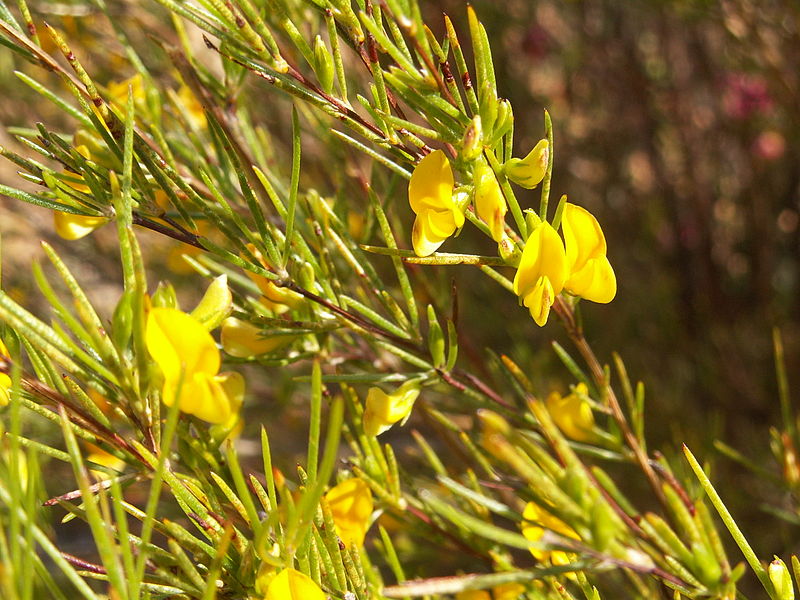
Rooibos is often called “red bush” in the United States because the way it’s usually prepared leaves a deep red infusion. Typically, rooibos is oxidized (not fermented) like a black tea. It can also be prepared more like a green tea. I blogged about green rooibos last August if you’d like to know more about it.
North American news shows, along with people like Oprah and Dr. Oz, have been singing the praises of rooibos lately, bringing it more into the mainstream awareness. It is very high in antioxidants and much lower in tannins than a black tea. Unfortunately, there isn’t a lot of independent research published about it yet, so many of the claims can’t really be backed up. The one that can be backed is that it has no caffeine and it tastes kind of like black tea (green rooibos is a bit grassy with malty undertones, more like a Japanese steamed green tea with a touch of black Assam).

Honeybush, like rooibos, grows only in South Africa. Also like rooibos, it is naturally caffeine-free and can be prepared either as a red or a green “tea.” When blooming, the flowers smell like honey, and honeybush tends to be somewhat sweeter than rooibos. Honeybush isn’t nearly as well-known as rooibos in the U.S., and the green version is very hard to find. I’ve found that if you want a flavored honeybush, citrus complements it very well. My “Hammer & Cremesickle Red” is the most popular honeybush blend in our tea bar (here is a blog post about it, and you can find it on the store website here).
A blended approach
If you like the idea of reducing your caffeine intake, but you don’t like the idea of a weaker tea (as I described above) or switching to rooibos or honeybush, you might want to consider blending. If you mix your tea half-and-half with something containing no caffeine, then you can still brew a strong drink, but get only half the caffeine from it. Combine that with the other tricks, like taking two infusions, and you can cut it even farther.
 Tea With Gary