Category Archives: Tea Biz

If I learn just one new thing…

Back in my days in the software industry, I used to put on a lot of educational seminars. One day, I was teaching an all-day session and noticed one of my customers, a gentleman by the name of Ken Combs, sitting about fifteen rows back in the audience. At the first break, I went over to him and said, “What are you doing here, Ken? You could be teaching this seminar!” I absolutely loved his response: “I figure if I can learn one new thing, then the whole day is worth it.”
Before using this insightful little anecdote to segue into the subject of this blog, I have to tell a little tale of that seminar. It was, as I said, an all-day seminar. I’m pretty good at projecting my voice, and when I’m dealing with small groups, I usually eschew microphones. This particular day, however, I had an audience of about 120 people and we were in a hotel ballroom with dubious acoustics, so I had a sound system. Like most hotel ballrooms, this one had accordion-style dividers that could separate it into smaller rooms, and we were using about a third of the room.
The morning session went well, but the afternoon became Public Speaker Nightmare #23™: there was a wedding reception in the other part of the ballroom. They had a live DJ. He had a much more powerful sound system than I did. After about an hour with my sound system cranked up all the way, shouting into the microphone, I called a quick break and strolled over to the reception, where I asked the DJ if he’d mind taking the volume down a bit because he was making my job impossible. “Not my problem, dude,” he said as he cranked his volume up higher.
We tried everything. We appealed to the bride. We called the hotel’s booking desk. We tried to find the weekend manager. And throughout it all, I shouted my voice raw trying to be heard in the back of the room. I couldn’t talk for two days after that (I’m not sure whether my wife wrote a thank you note to the bride for that or not), and we did end up getting a portion of our rent for the room refunded, but it made for one miserable seminar.
Despite all of that, Ken learned his one new thing and I applied his philosophy from my side of the lectern and got much more careful about room bookings for future events. Remember I promised to bring this back to tea? Well, fast forward twenty years or so, and here I am at the World Tea Expo. I still try to follow Ken’s philosophy, and it serves me well.
I attended two good educational sessions yesterday, which I’ll probably be writing more about: “Le Nez du Thé” (the nose of tea) and a tea blending workshop. I certainly learned more than one thing in each. After the exhibit hall closed, I went to the Tea Bloggers Roundtable. Mostly, I went for networking purposes, to meet some of these people I know only through their blog posts and tweets. It was a wonderful networking event, but even without that I learned something.

Yes, there was a bit of the mutual admiration society going on there, and the interplay was fun to watch (Godden and Coffey should take their show on the road), but it was also a very worthwhile session. There were more bloggers in the audience — including yours truly, of course — and the format was flexible enough that the distinction between panelist and audience member blurred. As everyone talked and questions were asked (and sometimes answered), it became clear that no two bloggers in the room really had the same objectives. For all of us, the blog is a representation of our personality enveloping the world of tea. Some of the blogs consist almost entirely of tasting notes (e.g., Nicole Schwartz’s “AmazonV” blog) and some have no tasting notes at all. We talked about tea, but mostly about the art of blogging, the expectations of our readers, and the trials and tribulations of trying to keep up any kind of a schedule for blog posts. I hope there’s another blogging event like this one again very soon!
Joining the Association of Tea Bloggers
 I (well, technically this blog) have been accepted for membership in the Association of Tea Bloggers. If you don’t work in the tea business, this probably doesn’t mean much to you, but I am very excited about it.
The association has been around for four years this month. It is comprised of people who blog primarily about tea, and there is a list of criteria for membership. What I really like about it is the connection with like-minded people. Some blog far more frequently than I do (you must write at least three posts a month to be accepted as a member) and some less. Some do straight text and some mix in video and audio. Some blogs are run by a single individual, and some by a group.
One of the benefits of membership is access to members-only discussion forums. I’ve used such forums in other businesses and found them invaluable when you’re looking for advice.
I’m hoping that some of the other members of the association will be attending World Tea Expo next week in Las Vegas. It would be nice to meet them face to face. If you’re a tea blogger and you’ll be there, let me know. We can get together for a cup and a chat. Or maybe even — dare I say it? — a beer.
Members of the general public who are interested in tea will find a different benefit from the association: the feed aggregator. This aggregator collects all of the posts from all of the member blogs and shows them all in one place. If you want to get a feeling for what’s going on in the world of tea, just browse through this feed and click on any post that looks interesting.
If you are a Facebook user, you can also pick up an aggregated feed of many of the blogs by visiting the Association of Tea Bloggers Facebook page.
As I get more involved with the Association of Tea Bloggers, I’ll make sure to write more about it.
Britain growing and exporting tea?
For hundreds of years, tea has flowed from the east (originally China) to the west, and has been a huge part of British culture. Just as in the U.S. and Canada, Britain’s favorite drinks aren’t grown in Britain. Until recently, that is.
The Tregothnan Estate in Cornwall, owned by Evelyn and Katharine Boscawen, is growing Camellia sinensis (tea bushes) for production, and is now starting to reverse the flow of tea by exporting their products to countries like China. Their production is small — projected to be about $3.14 million this year — but having even a small portion of that sold on the export market means the flow now goes both ways.

Although the estate has only been growing for production since 2005, rumor has it that Tregothnan was growing ornamental tea bushes in the early 1800s. They are now producing both black and green tea, using the Japanese (steamed) method for the green. They also grow a variety of flowers and herbs.
In addition to production facilities, Tregothnan also has a tea bar. As I perused their website, I came across a quote that reflects the philosophy of my own tea bar perfectly:
“Unlike the ubiquitous and characterless High Street coffee shop, the Tea Bar is all about taking time.”
This is a point that we heard over and over at the World Tea Expo last year. Coffee shops are all about energy. They are designed for a frenetic feel, for higher sound levels, for ramping up for the day. Tea shops fill a different niche. Although we serve a caffeinated beverage, we’re about relaxing, slowing down, and shedding the stress that we wear like a overly-bulky jacket during the workday.
For more information about the estate, visit their website (linked above).
Teavana: That was a disappointment
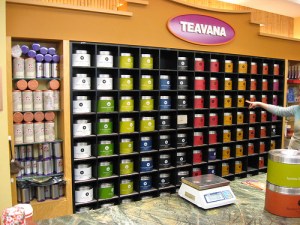
I love visiting other tea shops and other bookstores, especially shops that carve out their own niche. When visiting other people’s shops, I get great ideas for our own tea bar, learn new things, taste new teas, and get an opportunity to chat with other people who share my obsessions. I’ve heard a lot about Teavana, and I was quite looking forward to visiting one on our trip to California last weekend.
I found their selection of teaware impressive. The overwhelming majority of it was oriental, but they had some nice new avante-garde items and a few English teapots. At first glance, their selection of tea is impressive, too. They had 117 varieties of loose-leaf tea in big tins behind the counter. First impression: positive. Then it began falling apart.
I knew what I wanted. I was in the mood for a cup of pu-erh while I browsed. Unfortunately, there were two employees there — one behind the bar and one roaming the shop — and the roamer really wanted me to try all the free samples and look at all the pots. I didn’t want to try the samples. It really took some effort to get past him and order a cup of tea.
Next problem: They don’t have any unflavored pu-erh. Every single blend they had contained fruits or flowers or something. No vintage aged pu-erh bricks. Not even a generic blend. Ditto on rooibos. No unflavored red or green. Every single one was blended with other stuff.
Okay, clearly this place isn’t for purists. Let’s switch to masala chai. The fellow behind the counter found me an oolong-based chai, which (aside from too much cinnamon, in my humble opinion) was pretty tasty. Generally, I don’t put milk in my tea, but chai is an exception. I don’t like it as sweet as most Indians do, but I like some milk and a touch of honey.
The Teavana shop had no milk. None. Only some non-dairy creamers. As I said, I don’t put milk in my own tea, but our tea bar has nonfat, 2%, whole milk, half-and-half, and soy milk. I want to make sure I have whatever the customers want. Teavana doesn’t appear to think that way.
Then my wife came up and pointed out another problem. They had six different teas available for tasting that day. Every single one was pre-sweetened — and not one was pure tea (they were all fruity or herbal blends). If you want to sell me your product, let me taste the tea, not the sugar. And what would a diabetic have done in there?
Overall, I found myself thoroughly unimpressed. When I want a really nice cast-iron teapot, I may check out a Teavana. For the tea itself, I’m going back to looking for independent tea rooms and shops when I’m on the road.
The absolute best tea shop ever
 I just finished reading a fascinating Harvard Business Review blog post entitled “Stop Competing to Be the Best.” Whether your business is computers, airport terminals, or tea shops, Joan Magretta has a pertinent message for you: being “the best” is a bad thing.
I remember when I bought my iPad, and I listened to people telling me why I had made a horrible mistake. “It doesn’t show Flash websites.” I don’t use any Flash-based websites. “It doesn’t have a real word processor.” I don’t use it for word processing. “It has no camera.” I use my phone as a camera. “It doesn’t run Windows.” Well, thank God for that! The point is that everyone uses their tablets differently. While the iPad is perfect for me, it may be a horrible choice for you.
The same is true of tea shops.
When we opened our tea bar, we asked ourselves a lot of hard questions. One of them was what to call the business. The term “tea room” conjures up images of fine china, Earl Grey tea, crumpets with clotted cream, and lace doilies. Definitely not our market. A “tea shop” is frequently either focused on Chinese or Japanese tea, with beautiful oriental teacups and a great selection of green and white teas. The nearest tea house to us is run by an herbalist, who has a deep selection of herbs; she must have 200 drinks that don’t contain Camellia sinensis (the tea plant) at all.
Do we want to compete with them to be the best tea shoppe/tea bar/tea room in the area? Not at all.
Success in the tea business, like success in any other business, depends upon defining the word “best” so that it applies to you. We serve our tea in glass mugs so you can see the tea. If you want a “to go” cup, we use compostable cups for both hot and iced tea. No fine china. No fancy teapots. We don’t consider Earl Grey to be any better or any worse than lapsang souchong (or Earl Grey lapsang souchong for that matter), white tea, green rooibos, or purple tea. They’re just different. We’re not tea Nazis.
We’re also not herbalists. I don’t select our teas based on whether they’re supposedly good for menstrual cramps or helping you go to sleep — most of that is pseudoscience and marketing hype anyway. I choose them based on how they taste. People don’t walk into our tea bar looking for a couple ounces of something to help with their digestion; they walk in looking for a tasty genmaicha or pu-erh. That, we can help with.
I remember taking a marketing class that used Sun Tzu’s Art of War as its text. It’s amazing how much an ancient Chinese treatise on war applies to modern-day marketing and business strategy. One of the clear lessons is that you should never meet the enemy on its own turf unless you have an overwhelming advantage. If you wish to succeed in the tea business, then create your own business model. Don’t pick someone else’s and try to beat them at it. If you define the word “best” so that it applies to you, then you win the game from the day you open your doors. I don’t know if Joan Magretta studied Sun Tzu, but they’re preaching the same message. Learn from it.
Copywriters and tea marketing experts

These days, you can’t be too careful what you say on a tea website. Last year, Unilever was warned by the FDA for claims they made about “Lipton Green Tea 100% Natural, Naturally Decaffeinated.” A week later, they warned Dr. Pepper Snapple Group about claims they made concerning “Canada Dry Sparkling Green Tea Ginger Ale.” Earlier this year, the FDA’s target was Diaspora Tea & Herb (d.b.a. Rishi Tea) for a wide variety of health claims on Rishi Tea’s website.
Given these warning shots fired across the bows of the big boys, the whole industry is being careful about making nutritional claims for tea. But we still need to say more about tea than just “this stuff tastes really, really good” — although that’s generally good enough for me.
For an example of how far companies are going these days, we got a promotional mailer today from Numi Tea. They are a fine company, and I’d be happy to resell some of their products in our tea bar. The mailer has some traditional marketing language (with appropriate footnotes, of course), just as I’d probably write myself:
“[Pu-erh]’s unique fermentation process results in more antioxidants than most green teas and is traditionally known to help weight management*, improve digestion and naturally boost energy.”
Well, I hope I wouldn’t write it exactly like that, but given a bit of tweaking to the grammar and punctuation, it’s a reasonable sentence.
The first claim is footnoted “*Along with a healthy diet and exercise.” Okay. I’ll buy that. Given enough healthy diet and exercise, lots of things help with weight management. The other two claims are very difficult to measure and/or prove. Vague claims typically don’t draw the ire of the FDA, so they’re probably safe.
But it was the next section that made me chuckle. It says, and I quote:
“Every blend is freshly brewed, made with full-leaf tea and uses 100% real ingredients for a pure Pu-erh tea taste.”
Wow! It uses 100% REAL INGREDIENTS! Is that the best they could do? Really? Can you imagine the certification process for that? “Is this an ingredient? Yep!” I carry 100 different teas in my tea bar, and I can guarantee you that every single one of them carries 100% real ingredients. Yep. Not an unreal ingredient in the bunch.
I did a bit of further looking, and found that the front cover of their mailer says, “Real ingredients. 100%. Nothing else.” There’s a whole section of their website called “100% real ingredients.” There’s a paragraph on that page of their site that says:
“For a pure, authentic taste, we blend premium organic teas and herbs with only real fruits, flowers and spices. We never use ‘natural’ flavorings or fragrances like other teas do.”
I’m pleased to hear that they only use “real” ingredients, and not “natural” ones like everyone else. Come on, Numi. You make some absolutely fantastic teas, and your organic and fair-trade programs are excellent. I’d like to see you spend more time talking about that — which really does differentiate your products — and less time talking about being “real,” which means absolutely nothing.
Ice, Ice, Baby!

An iced cup of our
Valerian Steel tea.
When starting up a new venture, it’s a good idea to minimize the amount of cash you put in until you’re sure it’s going to work. In keeping with that philosophy, when we started our tea bar at the bookstore, we bought what the health inspector said we had to buy (e.g., a triple-basin sink and a sanitizing hand soap dispenser) and what the state said we had to buy (a Federally-certified and State-inspected scale that cost ten times what a standard kitchen food scale costs), but we were careful beyond that.
Oh, we bought a Zojirushi machine to keep our tea water at exactly the right temperature and some IngenuiTEA brew pots to prepare the tea for our customers. We did not, however, buy any other fancy equipment. We decided to spend the money on tea instead. One of the things in the “fancy equipment” category was an ice machine.
We figured we would sell some iced tea in the warm days of summer, but our bookstore had a waitress station in the back corner from the old days when the building housed a restaurant. That waitress station had an ice bin. We decided to just buy bags of ice at the grocery store and put them in the ice bin. Our old freezer in the back could hold an extra bag or two, so we’d be all set, right?
We soon discovered the error of our ways. The not-too-well-insulated ice bin allowed the ice to melt all too fast, and we served a lot more iced tea than we had anticipated. The grocery store is just far enough that you can’t really make an ice run when there are customers waiting, so we often bought more ice than we really needed. Bags of ice are pretty pricey at the grocery store, too: about $1.70 for a 7-pound bag. When you’re going through two or three bags a day, it really adds up.
Then we realized that the liquor store right next to us had an ice machine. Perfect! I negotiated a price so we could just run over there with a bucket, fill it with ice, and have them put it on our tab. More convenient for us, a better price for us, no work at all for the liquor store. There were a few minor inconveniences, like the fact that they opened later in the morning than we did and they are closed Sundays, but we could easily deal with that.
Then things began to get surreal. We’d run over and the scoop would be hidden away somewhere. We’d have to wait while someone found it. They shut the ice machine down for a week (without telling us), so there was no ice available. We found ourselves having to run over to the grocery store anyway. And still, we were spending $4 or $5 per day for ice.
I decided to start shopping for ice machines. I got an email from Sysco that they were having an ice machine sale. What perfect timing! Until I found that the sale price on their cheapest unit was close to $2,000. I searched high and low, and then my friend Martha, who runs the Café Regis, suggested a fellow named Mike who deals in used kitchen equipment.
 After a whole bunch more research and several discussions with Mike, we finally settled on a Hoshizaki counter-top ice making machine. It was still pricey, although the $875 we spent is a lot less than the $2,800 list price, but it makes us independent. I know we’ll spend less on ice in the winter than we do in the summer, but I still figure that machine will pay for itself in less than a year, and it’s far more convenient. Not only that, we can put a filter on the line and gain control over the quality of the water used to produce the ice.
Unfortunately, I don’t deal well with plumbing. After three hours of fiddling around and running back and forth to the hardware store, we still didn’t have a functional water line and filter. I ended up having to get a plumber just because none of the connectors would mate without leaking (I still can’t believe you have to fabricate custom hoses and connectors to hook up a water filter to this line — it boggles the mind).
So, at last, we produce our own ice. Nice little pellets of ice — not the big cubes we were using before — which cool the hot tea down swiftly.
Postscript: Just as I finished typing this, I got a call from the bookstore (it’s my day off). The machine is leaking all over the floor. *sigh* I hate plumbing with the burning passion of 1,000 leaky hot-water lines. I really, really do.
Our boba tea (“bubble tea”) experience
As my friends discovered that we were opening a tea bar at the bookstore, special requests began to pour in: Can you get me a first-flush Darjeeling? Will you have lapsang souchong? You’ll have gunpowder tea, right? Will you be stocking silver needle white tea? Are you going to have herbals? Can you bring in something good with ginger?
We selected our teas with a focus on “real” tea (Camellia sinensis) and related drinks like rooibos, honeybush, and maté. A few carefully-chosen herbals rounded out the mix. Then a friend asked if we were going to carry boba tea. Little did I know what that request would lead us to.

Stories vary, but the consensus seems to be that boba tea originated in Taiwan in the 1980s and took its sweet time (no pun intended) finding its way to the United States and picked up the nickname “bubble tea” because of the way it’s prepared. In Taiwan, it was called boba milk tea (波霸奶茶 or bōbà nǎichá), but it has many other names around the world. I have no idea whether there’s any truth to Boba Loca‘s story that “boba” is a children’s slang word for “nipple” in Mandarin.
Like chili or meatloaf, it seems that no two shops make boba tea the same way. What they all have in common is tapioca balls (“pearls”) sitting in the bottom of a chilled drink, and a fat straw big enough — just barely — to suck the pearls through. The “hip” places often use very sweet flavorings, similar to the ones used in sno-cones, and many of the boba “tea” drinks have no tea in them at all.
Typically, boba tea uses a base drink — typically a green or black tea — with milk and sweet syrup. This is placed in a shaker with ice and shaken into a bubbly froth (hence the appellation “bubble tea). The frothy mix is poured over tapioca pearls in a clear glass or plastic cup and served. As you drink the tea, the pearls randomly ride up the straw, and you find yourself with something chewy in your tea. It’s a joy watching people’s faces as they experience this for the first time!
I started asking people from the coasts, where boba is most popular, whether they thought it would make a good addition to our tea bar. The three most common answers were, “what the heck is boba tea?”, “yes, because then you’d be a real tea bar,” and “no, real tea bars don’t serve that stuff.” Given this massive lack of consensus, my wife and I flipped a coin and said, “What the heck? Let’s give it a shot.”
First decision: Since we are a tea bar, all of our boba would use real tea. After a bit of experimentation, I picked a nice black tea (organic English breakfast) and a jasmine green tea to use as a base. Two options should be adequate, right? How naïve I was!
Second decision: We’d keep the sweet syrup as basic as possible, and prepare it in advance. Since boba tea isn’t exactly a diet drink, we’d make it with real brown and white sugar, but we wouldn’t make it overly sweet.
The day after we launched our test in the store, a friend from the west coast told me that boba with chai tea is quite popular in Seattle. Coincidentally, we had recently brought in a new organic fair-trade chocolate chai for the tea bar, made with pu-erh tea and yerba maté. We gave it a shot, and it was an immediate hit. My attempt to simplify choices by only offering two base teas went right out the window. By the end of the day, we were making boba with any of the 80 teas we have at the bar.
We also found that special requests didn’t stop at the base tea. Miss Amber, a good customer of ours from another shop down the street, is from the South, and she likes her tea very sweet! We now have a “Miss Amber Boba,” made from cinnamon orange spice tea and about three times the normal amount of syrup.
Boba tea has turned out not to be the novelty drink we expected it to be, but a mainstay of the menu, especially on hot days. Some experiments in our store turn out to be wild successes and some turn out to be dismal flops. I’m going to give boba tea a “success” rating, and start looking for the next experiment. Thai red tea, perhaps?
 Tea With Gary