Category Archives: Cooking with Tea

Quick and Easy Peppermint Matcha Fudge

When I had a tea shop, I used to do tea tasting/classes on Saturday afternoons. One was about mint. We examined peppermint, spearmint, and wintergreen, and then tasted a variety of teas and tisanes that we blend with the various mint leaves and extracts.
My wife, Kathy, decided that since it was a couple of days before Christmas, we should have a special treat. We’ve done a fair amount of cooking with tea, especially matcha (you can browse through some of the recipes here), and we have a brand-new peppermint matcha at the shop, so she decided to do a quick and easy matcha fudge.
It’s a white chocolate bakeless recipe; Kathy calls it “cheater” fudge.
Ingredients
- 16 oz white chocolate
- 1 ten-oz (300 ml) can of sweetened condensed milk
- A pinch of salt
- 2 tsp unsweetened matcha (we used the Maghreb Mint from Phoenix Pearl)
- 1/2 cup of chopped unsalted almonds
Process
- Combine the white chocolate and condensed milk in a double boiler over simmering water (a microwave works too). Stir regularly and make sure everything is completely melted.
- Stir in the matcha and pinch of salt. Blend it very thoroughly and make sure there are no little patches of dry matcha powder left.
- Once it’s completely smooth, pour into a greased 8×8 inch baking dish.
- Sprinkle the nuts over the top, and press them down gently to make sure they’re well attached.
- Chill overnight in the fridge, (at least three hours) and then cut into small pieces (about 1″ to 1-1/2″ square)
You can use this same process with other flavored matcha, although you probably won’t want to use sweet matchas designed for lattes.

Masala Chai Molasses Cookies

I’m just getting around to posting the recipe for the cookies that my wife, Kathy, made for the Red Lodge Christmas Stroll, but here you go, just in time for Christmas!
Sometimes when you’re cooking with tea, the objective is to be subtle. In this case, it’s not. Kathy wanted to add ginger to her molasses cookie recipe, and it takes something strong to stand up to all of the flavor in these cookies. She selected the Ginger Cookie Chai from our shop, which is a caffeine-free, rooibos- and caramel-based blend with lots of ginger. You could use pretty much any masala chai blend for this, but if you want to duplicate these delicious results, pick one with caramel that’s heavy on the ginger!
Ingredients
- 4 tbsp ginger cookie chai (use loose tea, not syrup, powder, or tea bags!)
- 3/4 cup + 2 tbsp margarine
- 1 cup white sugar (to mix with other ingredients)
- 1/2 cup white sugar (to roll cookies in)
- 1 egg
- 1/4 cup molasses
- 2 cups all-purpose flour
- 2 tsp baking soda
- 1/2 tsp salt
- 2 tsp ground cinnamon
- 1 tsp ground cloves
- 1 tsp ground ginger
Process
- Melt the margarine, stir in the loose tea, and simmer on low heat for 20 minutes. Water is good for extracting flavor from tea leaves, but the masala spices need the fats in the margarine (or butter, if you’re a purist) to pull all of the flavor out.
- Pour the margarine through a strainer or cheesecloth, and squeeze out everything you can. You’ll lose a bit of margarine, but don’t worry about it – that’s what the two extra tablespoons in the ingredient list is for!
- Mix the margarine infusion with 1 cup of the sugar and the egg. Mix until it’s smooth, and then stir in the molasses.
- Combine the flour, baking soda, salt, cinnamon, cloves, and ginger, and then blend them into the molasses/margarine mixture. Cover and chill for at least an hour.
- Preheat the oven to 375°F (190°C).
- Roll dough into walnut-sized balls, and roll them in the remaining 1/2 cup of white sugar. Place them on ungreased baking sheets about 2 inches apart.
- Bake for about 10 minutes, until the tops are cracked.
- Cool on a wire rack.
This recipe makes about 3 dozen cookies.

Tea and Beer

I’m a big fan of beer. In fact, I used to write a beer column for a local newspaper a few years back. I’ll often have a beer when I start dinner, and switch to tea at the end. I even took a seminar at World Tea Expo about pairing tea and beer, looking for common flavor characteristics in different styles of the two beverages. A conversation with fellow tea blogger Robert Godden (Lord Devotea’s Tea Spouts), however, got me thinking about the possibility of actually combining the two. You know, putting beer and tea in the same glass. Yeah, Robert’s a strange one.
But why not?
There are beer styles exemplified by certain flavors, which you might get from additives like fruit or other grains, or you might get from doing strange things to the barley, like smoking it. Why not get those flavors from tea? Especially that smoky one…
A buddy of mine, Doug “Beerbarian” Bailey, works at our local brewery, Red Lodge Ales. Doug is a sales guy, but he still understands beer pretty well. He and I both go for smoky flavors. We drink lapsang souchong and Russian caravan tea. We drink smoky rauschbier. We drink Islay Scotches like Laphroaig, which just ooze peat and smoke. We even enjoy the same pipe tobaccos.
So Doug and I had a long discussion about flavoring beer with tea, especially about making our own variety of rauschbier by adding smoked tea to a nice robust beer. It was a wonderful discussion, but we didn’t follow through on it. And then, months later, I get a private message from him on Facebook:

Initially, we’d been talking about actually adding the tea leaves to the kettle while brewing the beer, but Doug was in a hurry. He proposed adding the tea to beer that was already brewed and sitting in the keg. This brings up a few complications, like how to avoid watering down the beer and how to pour tea into a full keg of carbonated beer.
The solution to the first problem was simple: just make the tea really strong so we don’t have to use much of it. In fact, to avoid diluting the flavor of the beer, we went right past “really strong” to “stupid strong.” And as for the second problem, Doug came up with a set of fittings that allowed us to put the tea into an empty keg, pressurize it, and then add the contents of a full keg of beer to it.
The more we talked about the solutions to the problems, the more we realized making just one beer wasn’t going to cut it, so when experiment day arrived, Doug grabbed the kegs of beer and I brewed three stupid strong batches of tea from the tea shop to match them.
We started by adding carefully measured amounts of the übertea to glasses of beer. Instead of wrecking our palates with the smoked tea, we started with a lighter one. The beer is Helio Hefeweizen, a light and citrusy unfiltered wheat beer. I paired that with a cinnamon orange spice rooibos tea. I had brewed the tea with 1 ounce of leaf to 8 ounces of boiling water and steeped it for six minutes. It didn’t take a whole lot of tea to give the beer a wondrous spicy flavor with an orangy nose. We settled on 940 ml of strong tea in the 5-gallon keg of beer. It was a rousing triumph. We made a bit extra so I could take a growler home with me.

Our second experiment was completely off the wall. Doug did say he wanted something “wacky,” so I paired their Beartooth Pale Ale with an infusion of one of my own special tea blends, which I call “Coyotes of the Purple Sage.” It’s an Earl Grey made with black tea, sage, and a hint of mint. I didn’t brew it quite as strong (same amount of leaf as the first one, but with a 5 minute infusion). Our first experiment was rather overwhelming, so we backed down the ratio, using 750 ml of tea in the 5-gallon keg.
I’m not going to call this one an overwhelming success. The sage and bergamot was just a little strange in the pale ale.

The final beer was the one that started all this. We used a Russian Caravan tea, 1 ounce of leaf per 8 ounces of water, brewed for 4 minutes. The base beer is Jack’s Scottish Ale. We played around with the proportions for a bit, and ended up using 900 ml of tea per five gallon keg. We made two kegs: one for Doug’s special event, and one to put on tap in the tasting room that night. Doug named it “Smokin’ Jack.” It was exactly what we were trying to accomplish!
This will not be the last time I bring together my loves of beer and tea. Maybe it’s getting to be time to dust off all of my old homebrewing equipment and get to work.

Cooking With Rooibos: African Rooibos Hummus

Last weekend, we hosted an “African Tea Experience” at the tea bar. Unlike our World Tea Tasting Tour sessions, this one was a private party that we donated to a local nonprofit organization for a silent auction fundraiser. Instead of just tasting some tea we made this a more immersive experience, including—among other things—food.
My first thought was to use the Hipster Hummus that we’ve prepared here before, but it’s really more of a Middle Eastern hummus than an African one. What’s the difference? I’m glad you asked.
Hummus is currently thought of as a Middle Eastern dish. Lebanon is pushing the European Commission to declare hummus a uniquely Lebanese food. In Israel, hummus is a staple. You can find it anywhere in Turkey or Palestine. But that’s not where the dish originated.
According to Gil Marks’ Encyclopedia of Jewish Food, the earliest known recipes for hummus date back to 13th century cookbooks from Cairo. It’s still a popular dish throughout northern Africa, and there are few differences between the African version and the Middle Eastern version. For this event, I decided to make a more Africanized version of our regular hummus.
All hummus is based on chickpeas (or garbanzo beans) and tahini (sesame paste). The primary ingredient difference in the African version is cumin. I decided to add red rooibos, which is a uniquely South African tisane (it’s often called “tea,” but since it isn’t made from Camellia sinensis, it isn’t technically tea). What we ended up with isn’t traditional, but it did get rave reviews. Despite the hot sauce, it isn’t overly spicy. Personally, I’d consider it almost mild. You could substitute a hot paprika for the milder roasted one that I used to give it more kick, or increase the Sriracha sauce.
Ingredients
- One 15-oz can garbanzo beans/chickpeas
- 1-1/2 tbsp sesame tahini paste
- 1 tsp cumin
- 1/2 ounce red rooibos leaves
- 1-1/2 tsp minced garlic
- 4 tbsp fresh-squeezed orange juice
- 1/2 tsp sea salt
- 1/2 tbps Sriracha
- 1/4 tsp roasted Israeli paprika
- 1 tsp olive oil
- sprig of fresh parsley
Process
- Drain the garbanzo beans/chickpeas and set aside the juice
- Heat the juice almost to boiling and add the rooibos — steep for five minutes
- Put beans, tahini, garlic, cumin, orange juice, salt, and Sriracha in a food processor
- Add 1/4 cup of the tea infusion to the food processor
- Blend everything to a smooth consistency
- Chill overnight in the fridge
- Spread hummus on plate with a dip in the center
- Drizzle olive oil through the center dip (not shown in the picture above, where I put pita chips in the middle instead)
- Sprinkle the paprika over the hummus, and garnish with parsley
- Serve with pita chips or fresh pita bread
The flavor of the rooibos definitely comes through, although it’s a bit subtle. Feel free to increase both the amount of leaf and the steeping time if you want more rooibos character.
Enjoy!

Quick and Easy Masala Chai Rice

Sometimes you want to add flavor to a dish without doing something complicated. A perfect example is plain white or brown rice. Here’s a nice trick, especially if you’re cooking Indian food.
All you have to do is follow the recipe for your rice, but substitute masala chai tea for the water. I recommend brewing the tea strong, using twice as much leaf as you’d normally use in that quantity of water. Add boiling water to the leaves and give it five to seven minutes to steep. Then strain off the leaves and spices, add the tea infusion to your rice, and follow the rest of the directions as normal.
This even works with instant rice, which can otherwise be pretty bland.
Meatballs in Lapsang Souchong Cream Sauce
I’ve written about cooking with lapsang souchong here before, but we decided to try something new for the Chamber of Commerce party at the bookstore/tea bar last month (the same one where we served the Hipster Hummus and the Orange Spice Carrot Cake Muffins).
If you’re not familiar with lapsang souchong tea, it’s a Chinese black tea that’s dried in bamboo baskets over a fire made with wet pine wood. The smoke from the fire dries and cures the tea, giving it a wonderful campfire smell. I think it’s a great wake-up tea in the morning, and it adds a great flavor to meats and fish. The lapsang souchong I used in this recipe is Cascade Smokehouse, from our tea bar.
The meatballs for this recipe aren’t really as important as the sauce, because the flavors in the sauce mask the meatballs themselves. Any old meatball recipe will do. Here’s how to do the rest:
Ingredients
- 1/4 cup butter (you can use margarine if you’d like)
- 1/4 cup flour
- 2 cups chicken broth
- 1 ounce lapsang souchong loose-leaf tea
- 1/4 tsp salt
- 1 cup sour cream
Process
- Grind up the tea leaves, using a mortar & pestle or small food processor. They don’t need to be completely powdered, just broken into small pieces.
- Heat the chicken broth to boiling and add the tea leaves. Set aside for five minutes.
- In a small saucepan, melt the butter and slowly stir in the flour.
- Add the salt and broth (do not filter out the tea leaves).
- Stir over medium heat until it thickens.
- Remove from stove, and stir in the sour cream.
- Put the meatballs in a crock pot over low heat, and pour the sauce over it.
We left the meatballs and sauce in the crock pot for several hours on low heat before serving them. They went over very well!
Orange Spice Carrot Cake Muffins
 As promised, here’s the second recipe from our recent Chamber of Commerce party. Our food theme was cooking with tea, and this was a variant of a recipe that Bigelow Tea originally published. Obviously, we substituted teas that we sell at our Tea Bar for what they originally suggested.
In the muffins themselves, Kathy used our Cinnamon Orange Spice Ceylon tea, which adds some nice black tea flavor to the pure herbal blend in the original recipe.
For the frosting, she used one of my house blends: Hammer & Cremesickle Red Tea (you can order it here). The honeybush, rooibos, orange, and vanilla give it a sweet, rich, creamy flavor.
We made mini muffins, since they were being served hors d’oeuvre style. Feel free to try this as full-sized muffins or even a cake tin. Just adjust the baking time a bit.
Muffin Ingredients
- 1/2 ounce of Cinnamon Orange Spice Ceylon Tea
- 1/2 cup water
- 1-3/4 cup sugar
- 3/4 cup vegetable oil
- 3 large eggs
- 1 can of mandarin oranges
- 2 tsp vanilla extract
- 2 tsp fresh-grated orange zest
- 2-1/2 cups all-purpose flour
- 2-1/2 tsp baking soda
- 2 tsp ground cinnamon
- 1/2 tsp salt
- 2 cups shredded carrots
Muffin Process
- Boil water and add to tea. Steep for 6 minutes and strain out leaves.
- Heat oven to 350 F.
- In a large mixing bowl, combine sugar, eggs, and vegetable oil. Mix thoroughly at high speed for 1 to 2 minutes, or until thick and creamy.
- Drain the can of mandarin oranges (discard the liquid), and add it to the mixing bowl, along with the tea, vanilla, and orange zest. Continue mixing until well blended.
- In a separate bowl, stir together the flour, baking soda, salt, and cinnamon. Add this blend to the mixing bowl and mix at low speed for another 1-2 minutes.
- Add the shredded carrots and continue mixing until well blended.
- Scoop the batter into muffin tins, either using paper muffin cups or spraying the tins with non-stick spray. Fill a bit over 1/2 full.
- Bake for 18 to 20 minutes or until a wooden toothpick inserted in the center of a muffin comes out clean.
Frosting Ingredients
- 1/4 ounce Hammer & Cremesickle Red Tea
- 1/4 cup water
- 1 eight-ounce package of cream cheese
- 1 tbsp butter (softened)
- 3-1/2 cups confectioner’s sugar
Frosting Process
- Boil water and add to tea. Steep for 6 minutes and strain out leaves.
- Combine butter and cream cheese in a mixing bowl. Mix at high speed for one minute or until light and creamy.
- Add 2 tbsp of tea from step 1 and mix well.
- Add confectioner’s sugar and mix thoroughly for 1 to 2 minutes or until smooth and creamy.
- After the muffins have cooled, frost the top of each one with frosting.
These were a smash hit at the party, along with the Hipster Hummus recipe that I posted last week, and a couple more that I’ll be posting soon (next in the series: Meatballs in Lapsang Souchong Cream Sauce).
Hipster Hummus
Tonight, my store (Red Lodge Books & Tea Bar) hosted a Red Lodge Chamber of Commerce mixer event. My wife, Kathy, and I decided that we’d make all of the appetizers with tea. I cook with tea quite a bit, but most of the time I use tea in entrees and side dishes, not appetizers and desserts. So we’ve spent the last couple of weeks experimenting. Over the next week or so, I’ll share the recipes we prepared for tonight’s event, starting with Hipster Hummus.
I got the idea for this from — of all places — MIT. The winners of the 2012 Hummus@MIT competition used black tea in their recipe, but it just wasn’t what I was looking for. I did some experimenting with the ingredients, and came up with something that got rave reviews from the crowd. It’s simple as can be, and very tasty!
Ingredients
- One 15-oz can garbanzo beans/chickpeas
- 1-1/2 tbsp sesame tahini paste
- 1-1/2 tsp minced garlic
- 1/2 ounce Scottish breakfast tea leaves (about 2-1/2 tbsp)
- 4 tbsp fresh-squeezed grapefruit juice (the juice from 1/2 of a typical grapefruit)
- 1/2 tsp sea salt
- 1/2 tbps Sriracha
Process
- Drain the garbanzo beans/chickpeas and set aside the juice
- Heat the juice almost to boiling and add the tea leaves — steep for five minutes
- Put beans, tahini, garlic, grapefruit juice, salt, and Sriracha in a food processor
- Add 1/4 cup of the tea infusion to the food processor
- Add about 1 tbsp of tea leaves from the infusion to the food processor
- Blend everything to a smooth consistency
- Chill in the fridge for an hour before serving
I tried this with green tea initially, and it just didn’t provide enough flavor to show through the grapefruit and Sriracha. The Scottish breakfast blend I used is a nice strong blend of Assam and Kenya tea that adds both taste and texture to the dish (it’s the most popular breakfast tea at my tea bar). I used significantly less Sriracha than the MIT crowd used, which produced a mild but tasty hummus that the whole crowd could enjoy. If you like something hotter and spicier, feel free to add double or triple what I used. My next experiment will be some green Tabasco sauce. I think that would add a nice flavor and just the right touch of spice.
Next up: some orange & spice tea-based carrot cake muffins that will blow your socks off!
Spicing up couscous
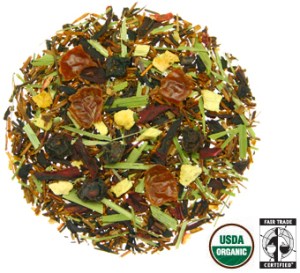
Jamaica Red Rooibos, courtesy of Rishi Tea
I have played around quite a bit with tea as a flavoring for vegetables, rice, fish, and other dishes. A few months ago, I was trying to decide on a good tea combo for adding some extra flavor to couscous. Most of the time, I use actual tea (made from the Camellia sinensis plant). Late one evening, however, when I was enjoying a cup of rooibos — a.k.a. African red bush — it occurred to me that it might make a great ingredient as well.
Straight rooibos wasn’t quite the flavor I was looking for, but one of the more popular blends at our tea bar seemed like just the ticket: Jamaica Red Rooibos from Rishi Tea.
The tea is named for the Jamaica flower, which is one of the nicknames for a variety of hibiscus (Hibiscus sabdariffa) commonly used in tea. Rishi’s blend is complex. In addition to the rooibos and hibiscus flowers, it also contains lemongrass, schizandra berries, rosehips, licorice root, orange peel, passion fruit flavor, essential oils of orange and tangerine, mango flavor, and essential clove oil.
After a bit of monkeying around, I settled on a very simple recipe:
- Following the instructions with your particular couscous, bring enough water for four servings to a boil, and remove from heat.
- Add 2-3 tablespoons of Jamaica Red Rooibos and steep for seven minutes.
- Remove the leaves. I used a disposable tea filter. You could just as easily dump the leaves in the water and pour through a strainer.
- Bring the water back to a boil and add the couscous.
- Continue as you would for unflavored couscous.
For a little bit of extra texture, try adding a few tablespoons of chopped walnuts.
You can buy this tea from a variety of sources, including (of course) our own tea bar.
UPDATE May 2012: The Tea Bar’s website is now up and running, and you can order Jamaica Red Rooibos here.

Cooking with Lapsang Souchong
Lapsang souchong is a fascinating tea. People either love it or hate it. I’ve been winning some converts for it, though, by recommending a use other than drinking it: cooking with it.

Photo courtesy of Phoenix Pearl Tea.
For those unfamiliar with it, lapsang souchong is a black tea that’s smoked instead of using typical tea drying techniques. Traditionally, it is dried in bamboo baskets over a wet pine fire, which gives it an aroma much like sitting near a campfire. A couple of my pipe smoking friends have compared it to a Latakia tobacco. It’s also one of the primary types of tea used in the Russian Caravan blend. I know. Lapsang souchong sounds like a very strange tea—and I’ll confess it’s not your run-of-the-mill Lipton.
I was visiting another tea shop and chatting with the owner earlier this year. As I was buying some lapsang souchong to drink, she asked if I’d tried using it as a rub. That, by golly, got my mind spinning. Since then, my wife and I have tried variations on several different kinds of meats and fish—and on meatballs, too!
Give this recipe a try, and let me know what you think. If you tweak it for your taste, please share that, too. I used a rich, strong lapsang souchong from our tea bar for this.
Salmon Souchong
Ingredients
- Four salmon fillets (the ones we use are about 1/2″ thick — thick fillets require longer cooking times)
- 1 ounce lapsang souchong leaves
- 1 tbsp fresh ground black peppercorns
- 2 tsp sweet Hungarian paprika
- 4 tbsp butter
- 4 cloves fresh garlic
- 1 small lime
Procedure
- Cut lime in quarters.
- Crush garlic in press and put in a skillet with butter over low heat.
- Moisten salmon filets.
- Grind tea into powder using mortar & pestle.
- Add pepper and paprika to tea powder and mix well.
- Remove excess moisture from fish and place skin side down on plate or cutting board.
- Apply tea powder mixture liberally to top side of fillets.
- Once butter is melted, turn heat up to medium-high and place salmon in pan, skin-side down.
- Cook for about 5 minutes, then flip salmon. If you wish to remove the skin, now is the time to do it. It should lift right off with a spatula.
- Cook about another 5 minutes, until salmon is flaky.
- Remove from skillet and serve with lime wedges.
Give it a try. It’s also great on the barbecue (my wife prefers that to the pan-fried version). And for goodness’ sake, drink some of that lapsang souchong along with your dinner!
 Tea With Gary