Author Archives: Gary D. Robson
Meatballs in Lapsang Souchong Cream Sauce
I’ve written about cooking with lapsang souchong here before, but we decided to try something new for the Chamber of Commerce party at the bookstore/tea bar last month (the same one where we served the Hipster Hummus and the Orange Spice Carrot Cake Muffins).
If you’re not familiar with lapsang souchong tea, it’s a Chinese black tea that’s dried in bamboo baskets over a fire made with wet pine wood. The smoke from the fire dries and cures the tea, giving it a wonderful campfire smell. I think it’s a great wake-up tea in the morning, and it adds a great flavor to meats and fish. The lapsang souchong I used in this recipe is Cascade Smokehouse, from our tea bar.
The meatballs for this recipe aren’t really as important as the sauce, because the flavors in the sauce mask the meatballs themselves. Any old meatball recipe will do. Here’s how to do the rest:
Ingredients
- 1/4 cup butter (you can use margarine if you’d like)
- 1/4 cup flour
- 2 cups chicken broth
- 1 ounce lapsang souchong loose-leaf tea
- 1/4 tsp salt
- 1 cup sour cream
Process
- Grind up the tea leaves, using a mortar & pestle or small food processor. They don’t need to be completely powdered, just broken into small pieces.
- Heat the chicken broth to boiling and add the tea leaves. Set aside for five minutes.
- In a small saucepan, melt the butter and slowly stir in the flour.
- Add the salt and broth (do not filter out the tea leaves).
- Stir over medium heat until it thickens.
- Remove from stove, and stir in the sour cream.
- Put the meatballs in a crock pot over low heat, and pour the sauce over it.
We left the meatballs and sauce in the crock pot for several hours on low heat before serving them. They went over very well!
Teavana: That was a disappointment
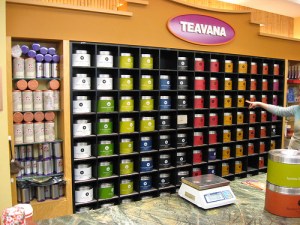
I love visiting other tea shops and other bookstores, especially shops that carve out their own niche. When visiting other people’s shops, I get great ideas for our own tea bar, learn new things, taste new teas, and get an opportunity to chat with other people who share my obsessions. I’ve heard a lot about Teavana, and I was quite looking forward to visiting one on our trip to California last weekend.
I found their selection of teaware impressive. The overwhelming majority of it was oriental, but they had some nice new avante-garde items and a few English teapots. At first glance, their selection of tea is impressive, too. They had 117 varieties of loose-leaf tea in big tins behind the counter. First impression: positive. Then it began falling apart.
I knew what I wanted. I was in the mood for a cup of pu-erh while I browsed. Unfortunately, there were two employees there — one behind the bar and one roaming the shop — and the roamer really wanted me to try all the free samples and look at all the pots. I didn’t want to try the samples. It really took some effort to get past him and order a cup of tea.
Next problem: They don’t have any unflavored pu-erh. Every single blend they had contained fruits or flowers or something. No vintage aged pu-erh bricks. Not even a generic blend. Ditto on rooibos. No unflavored red or green. Every single one was blended with other stuff.
Okay, clearly this place isn’t for purists. Let’s switch to masala chai. The fellow behind the counter found me an oolong-based chai, which (aside from too much cinnamon, in my humble opinion) was pretty tasty. Generally, I don’t put milk in my tea, but chai is an exception. I don’t like it as sweet as most Indians do, but I like some milk and a touch of honey.
The Teavana shop had no milk. None. Only some non-dairy creamers. As I said, I don’t put milk in my own tea, but our tea bar has nonfat, 2%, whole milk, half-and-half, and soy milk. I want to make sure I have whatever the customers want. Teavana doesn’t appear to think that way.
Then my wife came up and pointed out another problem. They had six different teas available for tasting that day. Every single one was pre-sweetened — and not one was pure tea (they were all fruity or herbal blends). If you want to sell me your product, let me taste the tea, not the sugar. And what would a diabetic have done in there?
Overall, I found myself thoroughly unimpressed. When I want a really nice cast-iron teapot, I may check out a Teavana. For the tea itself, I’m going back to looking for independent tea rooms and shops when I’m on the road.
Orange Spice Carrot Cake Muffins
 As promised, here’s the second recipe from our recent Chamber of Commerce party. Our food theme was cooking with tea, and this was a variant of a recipe that Bigelow Tea originally published. Obviously, we substituted teas that we sell at our Tea Bar for what they originally suggested.
In the muffins themselves, Kathy used our Cinnamon Orange Spice Ceylon tea, which adds some nice black tea flavor to the pure herbal blend in the original recipe.
For the frosting, she used one of my house blends: Hammer & Cremesickle Red Tea (you can order it here). The honeybush, rooibos, orange, and vanilla give it a sweet, rich, creamy flavor.
We made mini muffins, since they were being served hors d’oeuvre style. Feel free to try this as full-sized muffins or even a cake tin. Just adjust the baking time a bit.
Muffin Ingredients
- 1/2 ounce of Cinnamon Orange Spice Ceylon Tea
- 1/2 cup water
- 1-3/4 cup sugar
- 3/4 cup vegetable oil
- 3 large eggs
- 1 can of mandarin oranges
- 2 tsp vanilla extract
- 2 tsp fresh-grated orange zest
- 2-1/2 cups all-purpose flour
- 2-1/2 tsp baking soda
- 2 tsp ground cinnamon
- 1/2 tsp salt
- 2 cups shredded carrots
Muffin Process
- Boil water and add to tea. Steep for 6 minutes and strain out leaves.
- Heat oven to 350 F.
- In a large mixing bowl, combine sugar, eggs, and vegetable oil. Mix thoroughly at high speed for 1 to 2 minutes, or until thick and creamy.
- Drain the can of mandarin oranges (discard the liquid), and add it to the mixing bowl, along with the tea, vanilla, and orange zest. Continue mixing until well blended.
- In a separate bowl, stir together the flour, baking soda, salt, and cinnamon. Add this blend to the mixing bowl and mix at low speed for another 1-2 minutes.
- Add the shredded carrots and continue mixing until well blended.
- Scoop the batter into muffin tins, either using paper muffin cups or spraying the tins with non-stick spray. Fill a bit over 1/2 full.
- Bake for 18 to 20 minutes or until a wooden toothpick inserted in the center of a muffin comes out clean.
Frosting Ingredients
- 1/4 ounce Hammer & Cremesickle Red Tea
- 1/4 cup water
- 1 eight-ounce package of cream cheese
- 1 tbsp butter (softened)
- 3-1/2 cups confectioner’s sugar
Frosting Process
- Boil water and add to tea. Steep for 6 minutes and strain out leaves.
- Combine butter and cream cheese in a mixing bowl. Mix at high speed for one minute or until light and creamy.
- Add 2 tbsp of tea from step 1 and mix well.
- Add confectioner’s sugar and mix thoroughly for 1 to 2 minutes or until smooth and creamy.
- After the muffins have cooled, frost the top of each one with frosting.
These were a smash hit at the party, along with the Hipster Hummus recipe that I posted last week, and a couple more that I’ll be posting soon (next in the series: Meatballs in Lapsang Souchong Cream Sauce).
Hipster Hummus
Tonight, my store (Red Lodge Books & Tea Bar) hosted a Red Lodge Chamber of Commerce mixer event. My wife, Kathy, and I decided that we’d make all of the appetizers with tea. I cook with tea quite a bit, but most of the time I use tea in entrees and side dishes, not appetizers and desserts. So we’ve spent the last couple of weeks experimenting. Over the next week or so, I’ll share the recipes we prepared for tonight’s event, starting with Hipster Hummus.
I got the idea for this from — of all places — MIT. The winners of the 2012 Hummus@MIT competition used black tea in their recipe, but it just wasn’t what I was looking for. I did some experimenting with the ingredients, and came up with something that got rave reviews from the crowd. It’s simple as can be, and very tasty!
Ingredients
- One 15-oz can garbanzo beans/chickpeas
- 1-1/2 tbsp sesame tahini paste
- 1-1/2 tsp minced garlic
- 1/2 ounce Scottish breakfast tea leaves (about 2-1/2 tbsp)
- 4 tbsp fresh-squeezed grapefruit juice (the juice from 1/2 of a typical grapefruit)
- 1/2 tsp sea salt
- 1/2 tbps Sriracha
Process
- Drain the garbanzo beans/chickpeas and set aside the juice
- Heat the juice almost to boiling and add the tea leaves — steep for five minutes
- Put beans, tahini, garlic, grapefruit juice, salt, and Sriracha in a food processor
- Add 1/4 cup of the tea infusion to the food processor
- Add about 1 tbsp of tea leaves from the infusion to the food processor
- Blend everything to a smooth consistency
- Chill in the fridge for an hour before serving
I tried this with green tea initially, and it just didn’t provide enough flavor to show through the grapefruit and Sriracha. The Scottish breakfast blend I used is a nice strong blend of Assam and Kenya tea that adds both taste and texture to the dish (it’s the most popular breakfast tea at my tea bar). I used significantly less Sriracha than the MIT crowd used, which produced a mild but tasty hummus that the whole crowd could enjoy. If you like something hotter and spicier, feel free to add double or triple what I used. My next experiment will be some green Tabasco sauce. I think that would add a nice flavor and just the right touch of spice.
Next up: some orange & spice tea-based carrot cake muffins that will blow your socks off!

New toy! A Russian samovar
We have mostly modern equipment in the tea bar and at home. The Zojirushi water heater does a fabulous job of bringing water up to temperature and holding it there, with multiple selectable temperature ranges and thermostat. But I’ve always loved traditional equipment, and I’m fascinated by the ways different parts of the world prepare their tea.
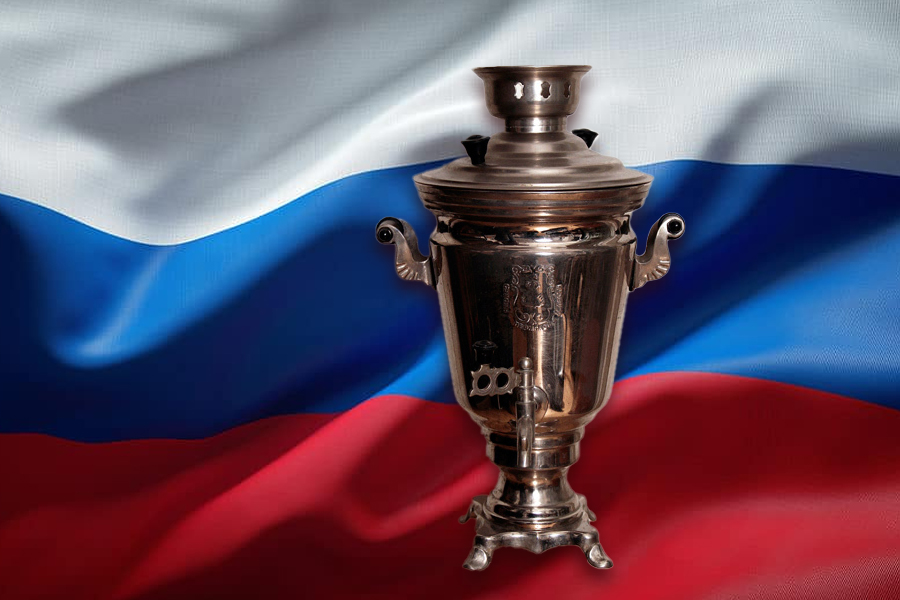
I just purchased a Russian samovar (literally translated: self-boiler) made in 1980. Traditional metal samovars in Russia date back to the early 1700s, when they used charcoal or other fuels to heat the water. A “chimney” ran vertically through the middle of the samovar, where the fuel generated the heat. The vessel was filled with water that would be drawn from a tap on the bottom. Often, a teapot was placed directly on top, so there would be concentrated prepared tea in addition to the heated water surrounding the chimney.
One of the things I’ve always loved about samovars is their steampunk look. The metal is often beautifully worked and etched or engraved. My new one is made of brass plated with silver/nickel. The samovar is designed for a communal tea setting, where it is kept going all day long, and the condensed tea in the pot is diluted by the boiling water in the main chamber every time someone wants a cup.
My new samovar is about 18 inches tall, and powered by good old-fashioned electricity. Since Russian AC power is 220 volt, I’m going to need to make or buy an adapter to let me run it on 110 volt U.S. power, but that’s pretty easy. Given its size and weight, I think I’ll find it a spot to live at the tea bar instead of trying to take it with me wherever I go.
I think this will be a great way to enjoy some of the Russian Caravan tea that I like to drink in the afternoons. Or maybe I’ll get cross-cultural and use it for some Mr. Excellent’s Post-Apocalyptic Earl Grey. No need to be a tea Nazi, right?
Spicing up couscous
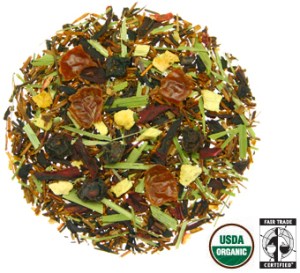
Jamaica Red Rooibos, courtesy of Rishi Tea
I have played around quite a bit with tea as a flavoring for vegetables, rice, fish, and other dishes. A few months ago, I was trying to decide on a good tea combo for adding some extra flavor to couscous. Most of the time, I use actual tea (made from the Camellia sinensis plant). Late one evening, however, when I was enjoying a cup of rooibos — a.k.a. African red bush — it occurred to me that it might make a great ingredient as well.
Straight rooibos wasn’t quite the flavor I was looking for, but one of the more popular blends at our tea bar seemed like just the ticket: Jamaica Red Rooibos from Rishi Tea.
The tea is named for the Jamaica flower, which is one of the nicknames for a variety of hibiscus (Hibiscus sabdariffa) commonly used in tea. Rishi’s blend is complex. In addition to the rooibos and hibiscus flowers, it also contains lemongrass, schizandra berries, rosehips, licorice root, orange peel, passion fruit flavor, essential oils of orange and tangerine, mango flavor, and essential clove oil.
After a bit of monkeying around, I settled on a very simple recipe:
- Following the instructions with your particular couscous, bring enough water for four servings to a boil, and remove from heat.
- Add 2-3 tablespoons of Jamaica Red Rooibos and steep for seven minutes.
- Remove the leaves. I used a disposable tea filter. You could just as easily dump the leaves in the water and pour through a strainer.
- Bring the water back to a boil and add the couscous.
- Continue as you would for unflavored couscous.
For a little bit of extra texture, try adding a few tablespoons of chopped walnuts.
You can buy this tea from a variety of sources, including (of course) our own tea bar.
UPDATE May 2012: The Tea Bar’s website is now up and running, and you can order Jamaica Red Rooibos here.
The absolute best tea shop ever
 I just finished reading a fascinating Harvard Business Review blog post entitled “Stop Competing to Be the Best.” Whether your business is computers, airport terminals, or tea shops, Joan Magretta has a pertinent message for you: being “the best” is a bad thing.
I remember when I bought my iPad, and I listened to people telling me why I had made a horrible mistake. “It doesn’t show Flash websites.” I don’t use any Flash-based websites. “It doesn’t have a real word processor.” I don’t use it for word processing. “It has no camera.” I use my phone as a camera. “It doesn’t run Windows.” Well, thank God for that! The point is that everyone uses their tablets differently. While the iPad is perfect for me, it may be a horrible choice for you.
The same is true of tea shops.
When we opened our tea bar, we asked ourselves a lot of hard questions. One of them was what to call the business. The term “tea room” conjures up images of fine china, Earl Grey tea, crumpets with clotted cream, and lace doilies. Definitely not our market. A “tea shop” is frequently either focused on Chinese or Japanese tea, with beautiful oriental teacups and a great selection of green and white teas. The nearest tea house to us is run by an herbalist, who has a deep selection of herbs; she must have 200 drinks that don’t contain Camellia sinensis (the tea plant) at all.
Do we want to compete with them to be the best tea shoppe/tea bar/tea room in the area? Not at all.
Success in the tea business, like success in any other business, depends upon defining the word “best” so that it applies to you. We serve our tea in glass mugs so you can see the tea. If you want a “to go” cup, we use compostable cups for both hot and iced tea. No fine china. No fancy teapots. We don’t consider Earl Grey to be any better or any worse than lapsang souchong (or Earl Grey lapsang souchong for that matter), white tea, green rooibos, or purple tea. They’re just different. We’re not tea Nazis.
We’re also not herbalists. I don’t select our teas based on whether they’re supposedly good for menstrual cramps or helping you go to sleep — most of that is pseudoscience and marketing hype anyway. I choose them based on how they taste. People don’t walk into our tea bar looking for a couple ounces of something to help with their digestion; they walk in looking for a tasty genmaicha or pu-erh. That, we can help with.
I remember taking a marketing class that used Sun Tzu’s Art of War as its text. It’s amazing how much an ancient Chinese treatise on war applies to modern-day marketing and business strategy. One of the clear lessons is that you should never meet the enemy on its own turf unless you have an overwhelming advantage. If you wish to succeed in the tea business, then create your own business model. Don’t pick someone else’s and try to beat them at it. If you define the word “best” so that it applies to you, then you win the game from the day you open your doors. I don’t know if Joan Magretta studied Sun Tzu, but they’re preaching the same message. Learn from it.
Tea Styles
This article first appeared in the May 2010 issue of the Local Rag newspaper, describing a tea tasting and class I held at our bookstore before we added the tea bar.
When I was a kid, tea was something that came in bags with a little tag that said “Lipton.” Visits to a Chinese or Japanese restaurant introduced me to the “other” kind of tea: green tea. The first time I ordered tea in a nice restaurant, I encountered the fancy presentation box, containing exotic varieties of tea like chamomile, Earl Grey, English breakfast tea, and Constant Comment. In high school, I drove a delivery truck for an office supply store in Boulder, Colorado, and one of my stops was Celestial Seasonings.
By that time, I was probably a typical American tea consumer. I classified teas into herbal, green, medicinal, and “ordinary.” Not until quite some time later did I discover just how much I was missing, and in an April tea tasting at Red Lodge Books, I tried to pass on a bit of what I’ve learned. This article is a distillation of the talk I gave that day.
All “true” tea comes from the same plant: Camellia sinensis. There are three major variants. The China bush (var. sinensis), the Assam bush (var. assamica) from India, and the Java bush (var. cambodi). Within those broad categories are over 1,000 individual subvarieties. Just as red climbing roses and yellow tree roses are both roses, all of these subvarieties are still Camellia sinensis, the tea plant.
There are six generally-accepted ways to process Camellia sinensis leaves, which produce white, yellow, green, oolong, black, and pu-erh. Yellow tea is so rare that I decided not to cover it. All “true” teas have caffeine, including the delicate whites and greens. Red tea (a.k.a. African rooibos), which I’ll discuss next month, is made from a different plant that does not have caffeine.
White Tea
White tea is the least-processed, and generally lightest and sweetest-flavored tea. It is typically more expensive than black or green teas, and is recognized as having significant health benefits. It is brewed at a lower temperature, and steeped for a short time. The leaves can be re-used, to make 2-3 cups of tea from one teabag or container.
The white tea we tasted at the bookstore was Rishi’s organic Silver Needle (Bai Hao Yin Zhen), from the Fujian province of China. This tea was voted the best tea in the world at the 2008 World Tea Championships, and the best white tea in 2009. The taste is very light and subtle, and there is a wonderful jasmine-infused version available as well.
White teas start out as young budsets (an early bud with or two leaves). After picking, they are “wilted” indoors to get some of the moisture out, and then baked or panned. After a light rolling of the leaves, they are dried and packaged for shipment.
Green Tea
Green tea is the traditional tea of China and Japan. It has long been lauded for its healthiness, and intricate ceremonies have been developed around its preparation. People study the Japanese Tea Ceremony for years before performing it publicly. Like white tea, it is brewed at lower temperatures, and can yield 2-3 infusions.
The green tea we tasted was an organic Sencha from the Kagoshima Prefecture of Japan; voted the best green tea in the 2008 championships. It is a very traditional green tea, grown in volcanic soil, yielding a deep almost grassy flavor.
After picking, the leaves are steamed or panned, rolled, and then dried. Sometimes, they’ll be formed into balls or other shapes before drying.
Oolong Tea
Oolong is a very highly-processed tea; one of the most complex to produce. It is generally flavorful and rich without the bitterness often associated with black teas. Unlike green and white teas, the leaves are partially oxidized, which darkens the color and intensifies the flavor.
We tasted an organic Wuyi Oolong. The Wuyi Mountains in Northern Fujian are where oolong tea was first produced, and this variety has a roasted aroma, complex flavor, and sweet finish.
To make oolong tea, the freshly-picked leaves are first wilted (partially dried) in the sun, and then again indoors. They are tossed in a basket to bruise them, and then partially oxidized (typically anywhere from 30-70%). After oxidation, the leaves are baked or panned, and then rolled. The final steps are drying and firing, which produces the smoky aroma.
Black Tea
By far the most common type of tea in Europe and India, black tea is usually brewed hot and strong. Many cultures serve it with milk, sugar, or both to mitigate its inherent bitterness, and it is often flavored with lemon, orange, or other spices (Red Lodge Books has a fascinating vanilla black tea). Black tea flavored with bergamot is known as “Earl Grey.” Black teas are also the basis of English and Irish breakfast tea. Unlike white, green, and oolong teas, black teas are generally only infused once: use the leaves and discard them.
At the tasting, we had Rishi’s organic fair-trade China Breakfast, which won “best breakfast blend” at the 2009 World Tea Championships. It’s rich, malty, and robust; great for the first cup of the morning.
Black teas are usually made with an indoor wilting, followed by a cutting or crushing step. This can range from a light crush to a full “CTC” (crush-tear-curl). This exposes more of the leaf’s insides to assist in oxidation. Black teas are 100% oxidized, yielding higher caffeine content and stronger flavor. Following oxidation, leaves are rolled and dried.
Pu-Erh
This is probably the least familiar process to Americans, but it has been around in China for centuries. What differentiates it from black or oolong tea is a fermentation step at the end of processing. Although the term “fermented” is often incorrectly used instead of “oxidizing” for black teas, pu-erh is the only variety that is actually fermented.

If you’ve ever had a mulch pile, you’re familiar with the process: plant matter is piled up wet, and left alone. The inside of the pile grows hotter as it ferments. Unlike most teas, which are served as fresh as possible, pu-erh is often compressed into cakes (sometimes immense bricks) that can be stored for years. Century-old pu-erh cakes are sold at auctions for thousands of dollars.
Pu-erh is brewed in boiling hot water, and can be re-infused at least 6-8 times. I’ve used leaves ten times and still gotten good flavor from the tenth infusion.
At the tasting, we had a classic loose-leaf organic fair-trade pu-erh from Yunnan, China. The flavor was earthy and rich. The description may seem off-putting to some, but it’s definitely worth trying a good pu-erh.
Tasting purple tea

Today, I received my first shipment of the purple tea that I blogged about back in August. I opened the bag with no preconceptions, as I haven’t read anyone else’s tasting notes.
The leaves look like pretty much any black tea. Not surprising, as the purple tea plant (TRFK306/1) can be prepared using any tea process, and this was oxidized like a traditional (orthodox) black tea. This is a very dense tea. The kilogram bag I purchased was the same size as the half-kilo (500g) bag of Golden Safari (a Kenya black I’ll be writing about soon).
I took a deep whiff, and picked up a slight earthiness to it that isn’t present in the other Kenya black teas I’ve tried. Not as extreme as a shu pu-erh, of course, as there was no fermentation in the process, but enough to distinguish the aroma from a traditional black tea.
Actually, despite my previous comment, I did come in to this with one preconception. Since this is a high-tannin tea, I expected a fair amount of astringency (“briskness,” as Lipton calls it), so I decided to take it easy on the first cup and make it like I make my 2nd-flush Darjeelings: 5 grams of leaves, 16 ounces of water at full boil, and a scant two-minute steep time.
“I did not expect purple, as the anthocyanin that gives purple tea its name doesn’t affect the color of black tea.”
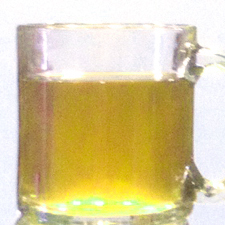
The leaves settled immediately to the bottom of the pot, and I was taken by surprise by the color. I did not expect purple, as the anthocyanin that gives purple tea its name doesn’t affect the color of black tea. But I also didn’t expect the pale greenish tan color that immediately appeared (it later mellowed to a deep black with — you guessed it, a purplish tinge). We don’t have any analyses yet of total antioxidant content, but we know that the anthocyanin does contribute quite a bit.
My first taste of the purple tea was impressive. Rich, complex, and a bit more astringent than you’d expect with only a two-minute brewing time. The earthiness in the aroma comes through subtly in the taste, and there’s a silky mouthfeel that lingers on the back of the tongue.
I figured that there was enough going on in that tea that it could hold up to a second infusion, so I brewed a second cup off of the same leaves. This time I gave it a three-minute steep, and it came out tasting very similar to the first brew, although a bit more pale in color.
“Purple tea is certainly not cheap.”
All in all, I’m pleased and excited to have this new varietal available at the tea bar. Purple tea is certainly not cheap. At $16.00 per ounce, it’s one of the priciest teas on our menu, but I expect it to build a fan base quickly. Our new tea website isn’t quite ready to launch yet (I’ll make a big announcement here when it is), but if you’d like to order some Royal Purple tea, just call the store (406-446-2742) or send an email to gary (at) redlodgebooks (dot) com. We’re ready to ship right away.
UPDATE MAY 2012: Our tea website is up and running, and Royal Purple tea is now available for purchase.
More more information about purple tea, please see my earlier blog post announcing and describing the varietal.

Chris Kilham responds

A few days ago, I posted an admittedly rather snarky article on this blog entitled “Coffee vs. Tea: Do your homework, Fox News.” The main subject of the article was Chris Kilham, the “Medicine Hunter” from Fox News. Chris has responded to the article in email, expressing an interest in carrying on a dialog. Here is what he sent me (verbatim, and in its entirety):
Hi Gary- I saw your mistaken response to my segment on FOX, and thought I’d take time out to reply. Having studied coffee and tea deeply for decades, and having read thousands of pages of science on both, I stand by the claim that coffee is more potently antioxidant ounce per ounce. More Americans do drink black tea rather than green, the fermenting of tea does degrade the antioxidants, and no, the benefits of coffee are not limited to caffeine. I referred to the work of Astrid Nellig, who compiled over 300 human studies on coffee, not the others you noted. And yes, oxidation is in fact “rusting.” The exact same process occurs to cells that occurs to metal, though metal is not living tissue. I see you leave no place on your blog for intelligent feedback. Good idea. Before you rant off on a tangent, you really should get your science together. I have. Point by point I will be happy to go toe to toe. Enjoy.
First, Chris, I hope it was okay to use the thumbnail picture from your Medicine Hunter website. If you would prefer that I didn’t have it on my blog, let me know and I’ll remove it post haste.
Thank you for responding to my post. I appreciate getting feedback direct from the source, and I know you’re busy. Before going through your email point by point, I’d like to start by addressing the very last issue you raise: that there’s “no place on [my] blog for intelligent feedback.” As I said, I actively encourage intelligent feedback. There’s a place on every single blog post for people to leave their comments. If you’re looking at the front page of the site, it’s a link at the end of the post. If you’re looking at an individual article, it’s a section at the end with two tabs: one to see existing comments and one to leave your own. Please feel free to leave your comments on this or any other post on my blog, whether you agree with me or not.
Now, let’s—as you said—go point-by-point, toe-to-toe. I will quote your email, and then respond.
“Having studied coffee and tea deeply for decades, and having read thousands of pages of science on both, I stand by the claim that coffee is more potently antioxidant ounce per ounce.”
I did not dispute this. I said that I was unable to find meaningful studies regarding flavonoid content that covered multiple types of tea and coffee and various ways of preparing them, so I have no way of disproving your claim. What I did say is, “Flavonols aren’t the only basis for measuring the healthiness of a drink.” I will expand that to say that antioxidants in general aren’t the only things that make a drink healthy.
But if you can show me a study comparing antioxidants in coffee with antioxidants in black, green, white, oolong, purple, and pu-erh tea, I would love to see it. Really. I get that question a lot and I don’t have an answer for it.
“More Americans do drink black tea rather than green…”
I agree with you. In fact, I said “One accuracy point for Kilham” after I verified the claim with FAO’s statistics.
“…the fermenting of tea does degrade the antioxidants…”
Black tea is not fermented. This little piece of misinformation is a pet peeve of mine, and it’s one of the things that prompted me to write the original article. Black tea is oxidized. Fermentation is an anaerobic process. There are fermented teas (a favorite style of mine called shu pu-erh is both oxidized and fermented), but they represent such a miniscule percentage of the tea consumed in the United States that they don’t factor into this discussion. I will continue the discussion assuming you meant to say “oxidized” rather than “fermented.”
I am neither a chemist nor a nutritionist, so you’re going to have to tell me what “degrade” means in this context. You had originally said that they were “lost,” and I responded that “Flavonols aren’t ‘lost’ during oxidation; most (but not all) are converted into different antioxidants called theaflavins, and some convert to thearubigins (which produce the reddish hue of black tea).” Am I wrong?
“…and no, the benefits of coffee are not limited to caffeine.”
Did I say they are? No. I said, “But yes, coffee does contain antioxidants. So, in fact, does tea.” My reference to caffeine was specifically related to your claim that coffee can improve a bad mood. Every study that I found showed that you are absolutely correct. Coffee can improve a bad mood because of the caffeine, which means that tea and Mountain Dew can improve bad moods as well.
“I referred to the work of Astrid Nellig, who compiled over 300 human studies on coffee, not the others you noted.”
I am unfamiliar with Nellig’s work, but if the studies are specifically on coffee, they wouldn’t have pinged my radar (I am uninterested in coffee). If any of Nellig’s studies compare coffee with various types of tea, I’d like to read them, though.
“And yes, oxidation is in fact ‘rusting.'”
This could be an interesting discussion. When I was taking chemistry in school, I would have been smacked for saying that, for example, copper had rusted. Oxidizing was presented as the more general term. All rusting is oxidation, but not all oxidation is rusting. Perusing Merriam-Webster’s dictionary, however, I see that one of the definitions of rust as a verb is “to form rust: to oxidize.” And since the primary definition of oxidize is “to combine with oxygen,” I suppose the first part of your statement is true, based on current dictionary definitions. But do you really want to use “rust” as a synonym for “oxidize” in discussing living organisms? Try this:
Substituting “rust” for “oxidize,” a simplified description of the cardiovascular system would say that you inhale air into your lungs, where oxygen in the air is used to rust your red blood cells. Your arteries and capillaries carry those rusted blood cells to the rest of your body, where the red blood cells “un-rust” as they cause other cells in your body to rust. The de-rusted blood cells then return, via veins, to be rusted once again in the lungs.
Accurate, using those current Merriam-Webster definitions, but it sure sounds strange.
“The exact same process occurs to cells that occurs to metal, though metal is not living tissue.”
Really? To the best of my knowledge, metal is unable to use up oxygen and become un-rusted. Living cells can. It’s not the same process.
The “oxidation vs. rusting” discussion is largely semantic, though, and I don’t want this to turn into a massive debate about free radicals and properties of antioxidants. That wasn’t the point. The point was that your “Q&A With Dr. Manny” article went on a great length about health benefits of coffee without acknowledging that many (all?) of those benefits are shared with various types of tea. The only health benefits of tea that you brought up were antioxidants, and that’s only a single piece of the puzzle.
“Before you rant off on a tangent, you really should get your science together. I have.”
Okay, if you want to call my post a “rant,” I’ll have to agree. It was. But it was by no means “off on a tangent.” It directly addressed your Fox News story, directly on-point. It wasn’t off-topic. And I haven’t seen you call out one single scientific error in what I said (unless you want to call my bullheaded prescriptivism on the definition of “rust” a scientific error).
 Tea With Gary